How Long Does Sarcopenia Take to Recover in Dogs?
Sarcopenia is not an injury that heals on a fixed timeline — it is age-related muscle loss, and rebuilding takes months of consistent resistance loading, adequate protein and veterinary oversight rather than weeks. Owners typically watch for gradual gains in gait, stamina and topline over a full training season, not a fixed recovery date.
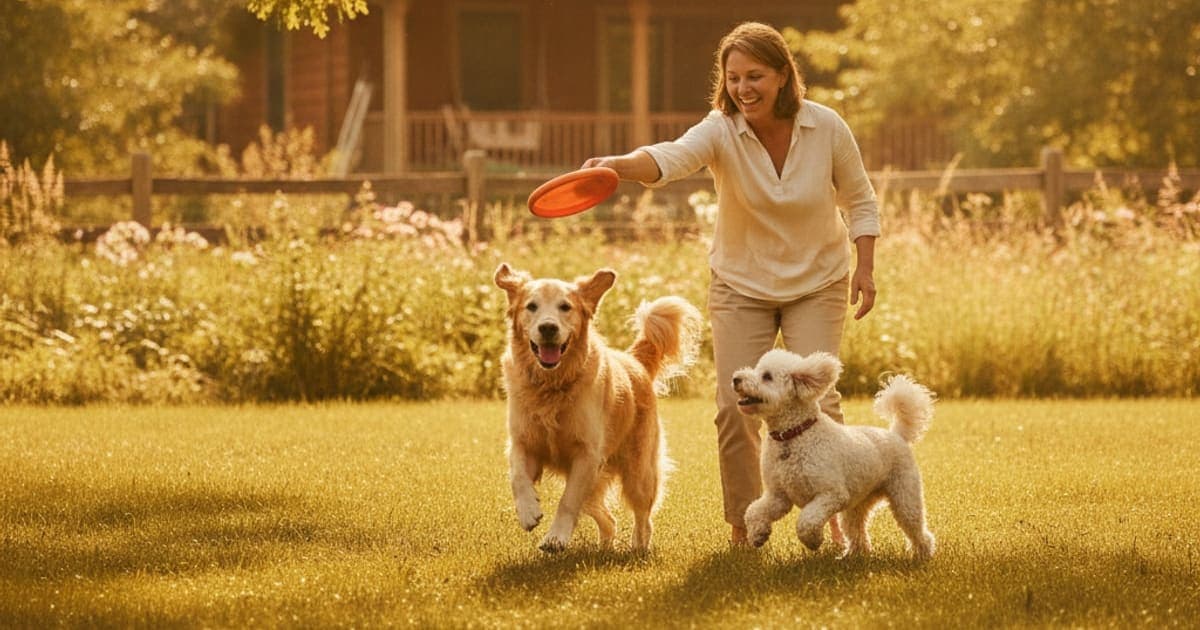
How long does sarcopenia take to heal in dogs?
Sarcopenia doesn't heal on a schedule. It is age-related loss of muscle mass and strength, not an injury closing over, so progress is measured in months of consistent loading, adequate protein and veterinary follow-up — not weeks. Most owners watch for gradual gains in stance, stamina and muscle fullness across a season.
Veterinary nutrition literature draws a sharp line here. Lisa Freeman's review of cachexia and sarcopenia in the Journal of Veterinary Internal Medicine describes sarcopenia as age-associated loss of lean body mass that occurs in the absence of underlying disease, distinct from cachexia, where muscle is stripped away by a chronic illness such as heart disease, kidney disease or cancer. The WSAVA Global Nutrition Committee's Muscle Condition Score chart gives your veterinarian a hands-on way to grade muscle over the skull, shoulder blades, spine and pelvis — which matters, because a dog can lose meaningful muscle while the scale barely moves.
Why muscle loss behaves like a trajectory, not a wound
Healing is a sequence. A torn tendon or a surgical incision moves through inflammation, proliferation and remodelling. The tissue keeps maturing for a long time afterwards, but there is a recognisable beginning, middle and end, and a rehabilitation plan can be mapped onto it.
Sarcopenia has none of that shape. It is the slow tipping of a balance. Muscle protein breakdown quietly outpaces muscle protein synthesis. Motor units — a nerve and the fibres it commands — are gradually lost and remodelled, so the remaining nerves take over orphaned fibres and coordination coarsens. Fast-twitch fibres, the ones responsible for pushing off a curb or catching a stumble, shrink faster than slow-twitch endurance fibres. And the satellite cells that repair fibres and donate nuclei to growing muscle become less responsive to the same signals that used to activate them readily. Physiologists describe this last piece as anabolic resistance: the same meal and the same amount of work produce a smaller building signal than they did in a younger animal.
That is why the honest version of the question is not how long until it heals but how long until the direction changes, and how do we hold the new direction. Rehabilitation veterinarians tend to answer in training blocks and reassessments — a plan, a period of consistent work, a re-measure, an adjustment — rather than in a countdown. Muscle circumference measurements, muscle condition scoring and simple functional tests such as timed sit-to-stand repetitions give you objective markers to compare against, and those comparisons are far more useful than watching your dog every day and wondering.
Sorting sarcopenia from the muscle loss it gets confused with
Before any timeline means anything, the cause has to be named. Several very different processes look identical from across the room.
| Pattern of muscle loss | What's driving it | How it usually behaves |
|---|---|---|
| Sarcopenia (age-related) | Gradual, whole-body decline in lean mass; anabolic resistance; reduced activity | Slow and symmetrical; responds to loading and nutrition over months, and needs maintaining afterwards |
| Cachexia (disease-related) | Inflammatory and metabolic drive of a chronic illness such as heart, kidney or neoplastic disease | Tracks the underlying disease; managing that disease with your veterinarian comes first |
| Disuse atrophy | Offloading a painful limb, crate rest, post-operative restriction | Appears fastest, often one-sided, and commonly the quickest to respond once safe loading returns |
| Neurogenic atrophy | Nerve root compression or injury, including lumbosacral disease | Follows the affected nerve's distribution; requires a neurological work-up, not a strength plan alone |
Most older dogs are not a clean single column. A twelve-year-old with hip arthritis has genuine age-related loss layered on top of months of quietly offloading one side. The rebuild schedule is set by how consistently your dog can load muscle without pain — which means the pain has to be diagnosed and managed by a veterinarian before the clock starts at all. Ask for that assessment specifically; a limp that is dismissed as "just age" is often an arthritic joint that is entirely manageable, and managing it is what makes exercise possible.
What actually rebuilds muscle in an older dog
Four levers do most of the work, and none of them are fast.
Mechanical load. Muscle grows in response to tension. Walking on flat ground maintains; it does not build. Progressive resistance — controlled hill work, sit-to-stand repetitions, cavaletti poles, sand or long-grass walking, and underwater treadmill work under a rehabilitation veterinarian's supervision — creates the mechanical signal that fibres respond to. The signal itself is quick; muscle protein synthesis rises within hours of a loading session. Visible mass lags far behind, because turning repeated signals into measurable cross-sectional area takes many cycles of stimulus and recovery.
Protein and calories. Building tissue requires substrate. Reflexively restricting protein in an older dog is a common and counterproductive habit; unless your veterinarian has a specific clinical reason to restrict it, senior dogs generally need adequate high-quality protein to defend lean mass, and the amount and source should be set by whoever knows your dog's kidney values, body condition and diet history. This is a conversation for your veterinarian or a board-certified veterinary nutritionist, not a forum.
Pain control and sleep. A dog in pain will not load the limb, and a dog that cannot settle at night does not consolidate recovery. Prescribed analgesia, joint-directed medication and a comfortable resting surface are not obstacles to a muscle plan — they are what makes it possible. Never stop or reduce anything your veterinarian has prescribed in order to "see how the supplement does on its own."
Consistency over intensity. Short, frequent, well-tolerated sessions beat weekend heroics that leave your dog sore for three days and unwilling on the fourth. The dogs that make the most ground are the ones whose owners do a modest amount almost every day, for months.
What tends to change first, and what changes last
The order of improvement is fairly predictable, even though the pace is not.
| Stage | What is happening | What owners commonly report noticing |
|---|---|---|
| Earliest | Neural adaptation — better recruitment of the fibres that remain | Steadier rising from the floor, fewer slips, more willingness to move |
| Middle | Fibre-level remodelling under repeated load | Longer stamina on walks, less hesitation at stairs or the car |
| Longest | Measurable gain in muscle cross-section | Fuller thighs and topline, better muscle condition score at re-check |
That first stage is why some owners feel encouraged before anything looks different, and why others get discouraged: the mirror lies before the stopwatch does. Measure, don't eyeball.
Where BPC-157 and TB-500 fit into a rebuilding window
BPC-157 is a synthetic peptide based on a sequence identified in gastric juice protein. Preclinical research, largely in rodent models, suggests it may support angiogenesis — the formation of new small blood vessels — and influence the migration and survival of the fibroblasts involved in tendon and ligament repair. TB-500 is a synthetic fragment related to thymosin beta-4, a naturally occurring actin-binding protein; research suggests it plays a role in cell migration and in modulating the local inflammatory environment during tissue remodelling.
The reason owners pair them through a recovery or reconditioning block is straightforward: connective tissue is the rate limiter. In an older dog, tendons and their attachments adapt more slowly than muscle bellies do, and the tendon–bone interface remodels over a long horizon. Supporting the environment in which that remodelling happens is where the mechanism sits.
This is emerging and promising science that a growing number of owners are adopting, and the honest framing matters: BPC-157 and TB-500 are not FDA-approved veterinary drugs, nothing here is a treatment claim, and no compound substitutes for load. pawgen's K9-REPAIR is a BPC-157 and TB-500 formulation made for dogs — third-party tested with certificates of analysis available, dosed by body weight in guidance you should confirm with your veterinarian, shipped direct to your door, and backed by a 60-day money-back guarantee. Bring the bottle and the COA to your next appointment and have the conversation openly; a veterinarian who knows what your dog is receiving can interpret changes properly.
What quietly stalls a rebuild
The usual culprits are unglamorous. Undiagnosed pain that keeps a limb offloaded. Excess body weight, which raises the load on every joint while contributing nothing useful. Restricted protein without a clinical reason. Long gaps between sessions that reset the adaptation each time. And a cabinet full of kitchen-sink chews — proprietary blends that list twenty ingredients, disclose the amount of none of them, and publish no third-party testing. A label crowded with names is a marketing decision, not a formulation decision. Ask any brand what is in the bottle, at what concentration, and who tested it. If the answer is vague, that tells you what you need to know.
Key takeaways
- Sarcopenia is age-related loss of muscle mass and strength, not an injury with a healing endpoint — think in months and reassessments rather than weeks.
- The first job is diagnosis: age-related loss, disease-related cachexia, disuse atrophy and nerve-driven atrophy look alike and are managed very differently.
- Progressive loading, adequate protein, effective pain control and daily consistency are the four levers that actually move muscle mass.
- Improvements in willingness and steadiness usually appear before any visible change in muscle bulk, so track objective measures with your veterinary team.
- Peptide support such as K9-REPAIR is what many owners use alongside a structured rehabilitation plan — as support for the recovery environment, never as a replacement for loading, prescribed medication or surgery.
Your veterinarian owns the diagnosis and the treatment plan. They decide what is causing the muscle loss, what medication is appropriate, whether a rehabilitation referral is warranted and how hard your dog can safely work. Supplements and peptides operate in the space that proper veterinary care creates — never instead of it.
For deeper reading, see the complete guide to sarcopenia, along with what are the first signs of sarcopenia in dogs, can sarcopenia in dogs be reversed, how much does it cost to treat sarcopenia in dogs, where do i buy bac water for my dog and can bac water replace my dogs pain medication.
Owners exploring peptide support for their dog can review K9-REPAIR — BPC-157 + TB-500 formulated for dogs — at https://pawgen.com/. BPC-157 and TB-500 are not FDA-approved veterinary drugs. Nothing in this article treats, cures or prevents any condition; every decision about your dog's care belongs with your veterinarian.
Frequently asked questions
- What are the first signs of sarcopenia in dogs?
- The earliest signs are functional rather than visual: hesitating at stairs, struggling to rise from a slippery floor, shorter walks, or a hind end that sways slightly. Muscle over the thighs, topline and skull may feel less full under your hands. Because these creep in gradually, they are often mistaken for ordinary ageing.
- How is sarcopenia diagnosed in dogs?
- Your veterinarian diagnoses it clinically, by hands-on muscle condition scoring over the skull, shoulder blades, spine and pelvis, combined with history, gait assessment and limb measurements. Bloodwork and imaging are typically used to rule out disease-driven muscle loss, orthopaedic pain and nerve-related atrophy, which look similar but are managed very differently.
- What helps a dog with sarcopenia?
- Progressive resistance work such as controlled hill walking, sit-to-stand repetitions and rehabilitation-supervised underwater treadmill sessions, paired with adequate high-quality protein and effective veterinary pain control. Many owners also add peptide support such as K9-REPAIR alongside that plan. Ask your veterinarian to set the exercise prescription rather than guessing at intensity.
- Is sarcopenia in dogs painful?
- Age-related muscle loss itself is not usually described as painful. The problem is what travels with it: arthritic joints, compensatory strain and reduced stability all cause discomfort, and pain then discourages movement, which accelerates further loss. A veterinary pain assessment is essential before starting any strengthening work.
- What makes sarcopenia worse in dogs?
- Inactivity is the biggest accelerator, followed by unmanaged pain that causes a dog to offload limbs, unnecessary protein restriction, excess body weight and long periods of crate rest. Chronic illness drives a separate process called cachexia. Inconsistent exercise — intense one week, nothing the next — also blunts the adaptation muscle needs.
- Can sarcopenia in dogs be reversed?
- Age-related muscle loss is not usually described as fully reversible, but the trajectory can often be changed. Research and rehabilitation practice indicate older muscle still responds to progressive loading and adequate protein, so meaningful strength and function can be regained. Gains are maintained only while the work continues, so the plan is ongoing.
- How is sarcopenia different from muscle loss after surgery?
- Post-operative loss is disuse atrophy — rapid, usually one-sided, caused by restricted movement and offloading. It typically responds more quickly once safe loading resumes. Sarcopenia is gradual, symmetrical and whole-body, driven by ageing physiology rather than a single event, so rebuilding it takes a longer and more sustained effort.
- Do BPC-157 and TB-500 build muscle in dogs?
- No product should be framed that way. BPC-157 and TB-500 are not FDA-approved veterinary drugs, and research into them is mechanistic: it suggests roles in angiogenesis, cell migration and connective-tissue remodelling. Owners use formulations such as K9-REPAIR to support recovery alongside a loading plan. Discuss any addition with your veterinarian first.
Educational content. BPC-157 and TB-500 are not FDA-approved veterinary drugs. Talk to your veterinarian before starting anything new, especially if your dog is on prescribed medication.