Sheepadoodle Health Problems: What Owners Should Watch
Yes. Sheepadoodles can inherit health risks from both parent breeds, including hip and elbow dysplasia, inherited eye conditions, bloat, skin and ear infections, and thyroid disease. None of these is certain in any individual dog, but knowing the early signs helps you get veterinary attention before a small problem grows.
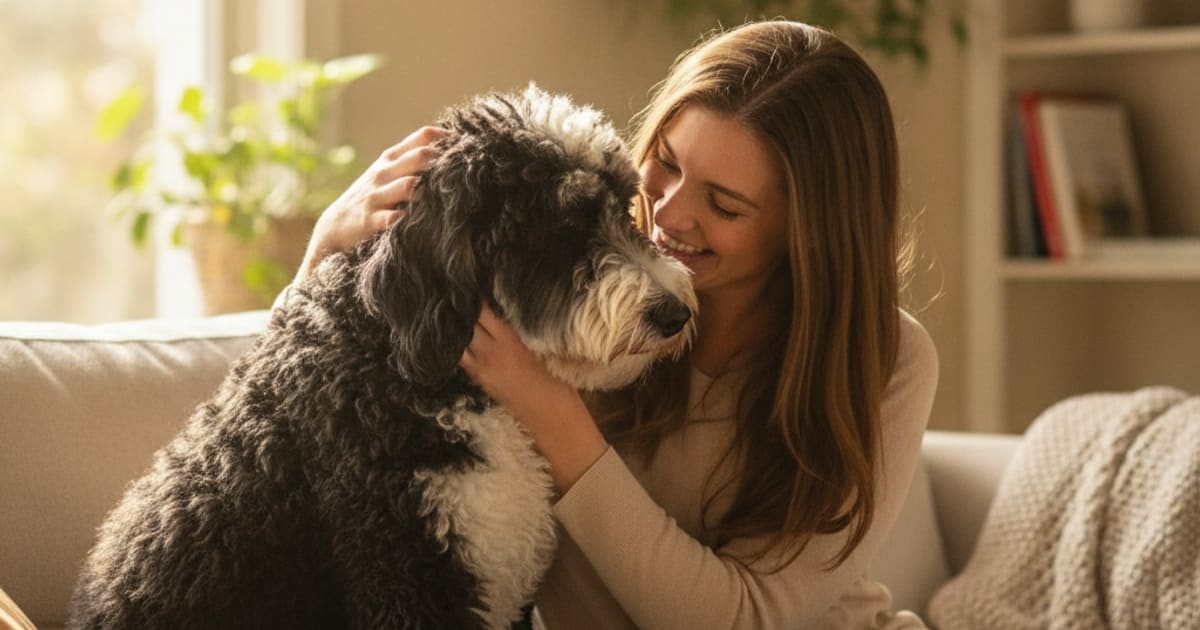
Yes, Sheepadoodles do have health problems, and the ones worth knowing about come from both sides of the cross between the Old English Sheepdog and the Poodle. If your dog is limping, retching without bringing anything up, has a swollen or tight belly, is squinting or rubbing an eye, or has a new lump anywhere on the body, book a veterinary appointment rather than waiting to see whether it settles on its own.
A hybrid is not a blank slate. A Sheepadoodle can inherit the orthopaedic and eye problems that run in either parent line, the skin and ear issues that come with a dense coat and drop ears, the hormone conditions seen in both breeds, and the risk of bloat that goes with a deep chest. What a Sheepadoodle cannot inherit is certainty. Plenty of these dogs go through life without a single item on this list, and breed averages describe populations, not your dog, so what actually protects a Sheepadoodle is a veterinarian who knows them and an owner who notices change early. Any new lump or swelling needs to be examined, and only a needle sample taken by a vet can tell you what kind of cells are inside it.
Where a Sheepadoodle's risk profile comes from
To understand Sheepadoodle health risks, look at the two parent breeds separately and then overlap them.
The Old English Sheepdog contributes size, a deep chest, a heavy double coat, and a family history that includes hip dysplasia, inherited eye disease, autoimmune and hormone conditions, and ear problems that follow from drop ears buried in hair.
The Poodle side contributes its own set. Standard Poodles are associated with hip dysplasia, kneecap instability in smaller lines, inherited retinal disease, and skin conditions linked to the hair-type coat. The curly, continuously growing coat that makes Sheepadoodles appealing to allergy-conscious households is also the coat that traps moisture, mats against the skin, and plugs the ear canal.
Where those lists overlap, the risk is worth taking seriously. Hips, eyes and thyroid appear on both sides. Where they do not overlap, a Sheepadoodle can still inherit from either parent, which is why a vague answer like "mixed breeds are healthier" is not a plan. The practical version is simpler: know the handful of systems that deserve attention in this cross, learn what early trouble looks like in each, and talk to your vet when something shifts.
It also helps to understand that size varies enormously in this cross. A Sheepadoodle built like a Standard Poodle crossed with an Old English Sheepdog is a large, deep-chested dog, and large deep-chested dogs carry both the joint loading and the bloat risk that come with that frame.
Joint problems: hips, elbows and early mobility changes
Orthopaedic problems are the area where Sheepadoodle owners tend to see trouble first, because the signs are visible long before anything hurts enough to make a dog cry out.
Hip dysplasia is a malformation of the ball-and-socket joint. The joint sits loosely, the surfaces grind rather than glide, and arthritis develops in response. In a young dog it can look like a bunny-hopping gait, reluctance to use stairs, a swaying back end, or difficulty rising after sleep. In an older dog it looks like a narrower stance, loss of muscle over the hips, and a dog who shortens their own walk.
Elbow dysplasia describes several developmental problems in the front leg joint. It shows up as front-end lameness that is worse after rest, a shortened stride, or a dog who stands with the elbows turned out.
Cruciate ligament injury is a tear in a stabilising ligament in the knee, and in dogs it is usually the result of gradual degeneration rather than one unlucky step. The classic presentation is a sudden non-weight-bearing hind leg lameness that partially improves and then returns.
Patellar luxation, a kneecap that slips out of its groove, is more associated with the Poodle side, especially in smaller Sheepadoodles. It often presents as a skipping step where the dog carries one hind leg for a few strides and then carries on normally.
What matters here is sequence. Lameness in a large dog is a veterinary question, not a wait-and-see question, because the examination and imaging that identify which joint is involved also determine whether the answer is weight management, physical rehabilitation, pain management prescribed by your vet, or surgery. Keeping a Sheepadoodle lean is one of the few things entirely within your control, and it reduces the load on every joint. Results vary from dog to dog, and your vet is the one who should set the plan.
Eyes, skin and ears: the issues owners usually notice first
Eyes
Both parent breeds carry inherited eye disease, so eyes deserve attention throughout a Sheepadoodle's life.
Progressive retinal atrophy is a gradual degeneration of the retina. Early signs are subtle: hesitation in dim light, bumping into furniture after dark, reluctance on unfamiliar stairs, or eyes that seem unusually reflective.
Cataracts cloud the lens and can be inherited or secondary to other disease. A bluish or white haze in the pupil warrants an examination, partly because cataracts can cause inflammation inside the eye if left unassessed.
Glaucoma, a rise in pressure inside the eye, is painful and urgent. A red eye, a cloudy cornea, a dilated pupil that does not respond, obvious squinting, or a dog pawing at one eye should be treated as a same-day emergency.
Dry eye and eyelid conformation problems such as rolled-in or rolled-out lids also appear in these lines, producing chronic discharge, redness and squinting.
Hair falling over the eyes is a specific Sheepadoodle issue. Keeping the face trimmed so you can actually see both eyes is not cosmetic, it is how you spot a change.
Skin
The coat is dense, grows continuously and mats close to the skin. Underneath a mat, moisture and bacteria sit against warm skin, and hot spots develop quickly. Allergic skin disease is also seen in both parent breeds and tends to show as itching around the paws, face, armpits and belly, with recurrent secondary infections and a persistent odour. A dog who licks one paw raw or who scoots and chews at the base of the tail is telling you something that a vet can usually identify on examination.
Ears
Drop ears, hair inside the canal and a coat that holds water after swimming or bathing add up to repeated ear infections in many Sheepadoodles. Head shaking, a tilted head, redness, odour, dark discharge, or pain when you touch the ear base all mean a vet visit. Repeated ear infections are also a common outward sign of underlying allergic skin disease, so treating the ear alone sometimes misses the actual problem.
Bloat and thyroid: the internal problems that are easier to miss
Bloat, and in particular gastric dilatation and volvulus, is the emergency every owner of a deep-chested dog should be able to recognise. The stomach fills with gas and can twist on itself. The signs are a distended or drum-tight abdomen, unproductive retching, excessive drooling, restlessness and pacing, an arched or hunched posture, and rapid collapse. This is an immediate emergency. Go to an emergency veterinary hospital straight away rather than calling in the morning. Ask your vet whether a preventive surgical procedure to tack the stomach is appropriate for your dog, and whether it can be considered at the time of another planned procedure.
Thyroid disease, specifically hypothyroidism, appears in both parent lines. The thyroid gland produces less hormone than the body needs and the changes creep in slowly, which is exactly why owners miss them. Weight gain without a change in diet, lethargy, cold-seeking behaviour, hair thinning along the flanks or tail, a dull coat, recurrent skin and ear infections, and a flat mood are all worth mentioning to your vet. Diagnosis is made with blood work, and it is one of the conditions where a blood panel at a wellness visit earns its keep. You can read more about how individual canine conditions are assessed in the conditions library.
Lumps, swellings and when to book the appointment
Any new lump, bump or swelling on a Sheepadoodle should be examined by a veterinarian. Size, shape, firmness and how fast it grew are all useful information, but none of them identifies a lump. Only a sample of the cells, usually collected with a fine needle, can tell you what the lump actually is. Do not squeeze, drain or treat a lump at home, and do not assume a soft, mobile lump is harmless.
The same applies to swellings that are not obviously lumps: a swollen joint, a puffy face, an enlarged area under the jaw, or a limb that is thicker on one side.
| Sign you notice | What it can point to | How urgently to act |
|---|---|---|
| Unproductive retching, swollen tight belly, pacing | Bloat or gastric torsion | Emergency vet now |
| Red, cloudy or painful eye, hard squinting | Glaucoma or other acute eye disease | Emergency or same-day vet |
| Sudden non-weight-bearing hind leg lameness | Cruciate injury or acute joint problem | Same-day or next-day vet |
| Head shaking, ear odour, dark discharge | Ear infection, possible allergic skin disease | Appointment this week |
| Any new lump or swelling | Needs a needle sample to identify | Appointment this week |
| Weight gain, lethargy, coat thinning | Possible thyroid or hormone change | Scheduled visit with blood work |
| Stiffness rising, bunny-hopping, shortened stride | Hip or elbow problem, arthritis | Scheduled visit for examination |
Key Takeaways
- Sheepadoodles can inherit health risks from both parent breeds, mainly affecting joints, eyes, skin, ears, the thyroid gland and, in deep-chested dogs, the stomach.
- Hip and elbow dysplasia, cruciate injury and kneecap instability are the orthopaedic issues to watch, and early signs are changes in gait and stamina, not yelping.
- Inherited retinal disease, cataracts and glaucoma all appear in these lines, so keep the face trimmed and have any eye change assessed.
- A dense coat plus drop ears makes skin infections, hot spots and ear infections frequent reasons for a vet visit, and repeat ear infections often point to allergic skin disease underneath.
- Hypothyroidism develops slowly and is identified with blood work, so mention weight, energy and coat changes at wellness visits.
- Bloat is a true emergency with recognisable signs, and recognising it quickly is the single most useful thing an owner of a deep-chested dog can learn.
- Any new lump or swelling needs veterinary examination, and only a needle sample can identify it.
Your veterinarian owns the diagnosis and the plan. They are the one who examines the joint, images the hip, measures the thyroid hormone, looks inside the ear with a scope, samples the lump and decides whether something is urgent. Nothing in this article replaces that, and nothing you read online should delay it. Keep a note of what you notice and when, bring it to the appointment, and talk to your vet before changing anything about how your dog is managed.
For a quick reference on the symptoms that mean you should not wait until morning, see Dog Emergency Signs.
Frequently asked questions
- Do sheepadoodles have health problems?
- Yes. Sheepadoodles can inherit problems from both parent breeds, including hip and elbow dysplasia, inherited eye disease, hypothyroidism, allergic skin disease, recurrent ear infections and, in deep-chested dogs, bloat. No individual dog is guaranteed to develop any of these, but owners should learn the early signs and talk to your vet.
- What are the sheepadoodle common health problems owners should watch for?
- Watch the joints, eyes, skin, ears, thyroid and stomach. That means limping or stiffness, squinting or cloudiness in an eye, itching and hot spots under the coat, head shaking and ear odour, unexplained weight gain with coat thinning, and any sign of a swollen, tight abdomen.
- Are sheepadoodle health risks lower than in purebred dogs?
- Not automatically. Crossbreeding widens the gene pool, but a Sheepadoodle can still inherit conditions found in either the Old English Sheepdog or the Poodle. Hips, eyes and thyroid appear on both sides, so those risks carry across. Treat the cross as carrying both parent breeds' concerns, not neither.
- How do I know if my Sheepadoodle has hip dysplasia?
- You cannot confirm it at home. Suggestive signs include a bunny-hopping gait, reluctance to use stairs or jump, difficulty rising after rest, a swaying back end and loss of muscle over the hips. Diagnosis requires a veterinary orthopaedic examination and imaging, so book an appointment if you notice these changes.
- Can Sheepadoodles get bloat?
- Yes, especially larger, deep-chested Sheepadoodles. Signs include a distended or drum-tight belly, retching without producing anything, heavy drooling, restless pacing, a hunched posture and collapse. This is an immediate emergency requiring a veterinary hospital straight away. Ask your vet whether a preventive stomach-tacking procedure suits your dog.
- Why does my Sheepadoodle keep getting ear infections?
- Drop ears, hair growing inside the canal and a coat that holds moisture create warm, damp conditions in the ear. Repeated infections also frequently signal underlying allergic skin disease, which means treating the ear alone will not solve it. Your vet can examine the canal and look for the root cause.
- What eye problems affect Sheepadoodles?
- Progressive retinal atrophy, inherited cataracts, glaucoma, dry eye and eyelid conformation problems all appear in the parent breeds. Early signs include hesitation in dim light, bumping into things, cloudiness in the pupil, discharge, redness or squinting. A red, painful eye needs same-day veterinary attention because pressure changes are painful.
- When should a lump on my Sheepadoodle be checked by a vet?
- Any new lump, bump or swelling should be examined, and sooner is better than later. Size, texture and mobility do not identify a lump, and only a sample of cells taken by a veterinarian, usually with a fine needle, can tell you what it is. Never squeeze or treat it at home.
- Can Sheepadoodles develop thyroid problems?
- Yes. Hypothyroidism is seen in both parent breeds and develops gradually, which makes it easy to miss. Mention unexplained weight gain, low energy, cold-seeking behaviour, hair thinning along the flanks or tail, a dull coat and recurrent skin or ear infections to your vet, who can check thyroid levels with blood work.
Educational content, not veterinary advice. Ask your vet about your dog.