Should I Worry If My Dog Is Bunny Hopping? (Gait Signs)
Bunny hopping — both hind legs pushing off together — is worth taking seriously in an adult dog, because it is a recognized compensation pattern for hip, stifle or lower back discomfort. In young puppies at full speed it can be normal. Persistent hopping warrants a veterinary orthopedic exam.
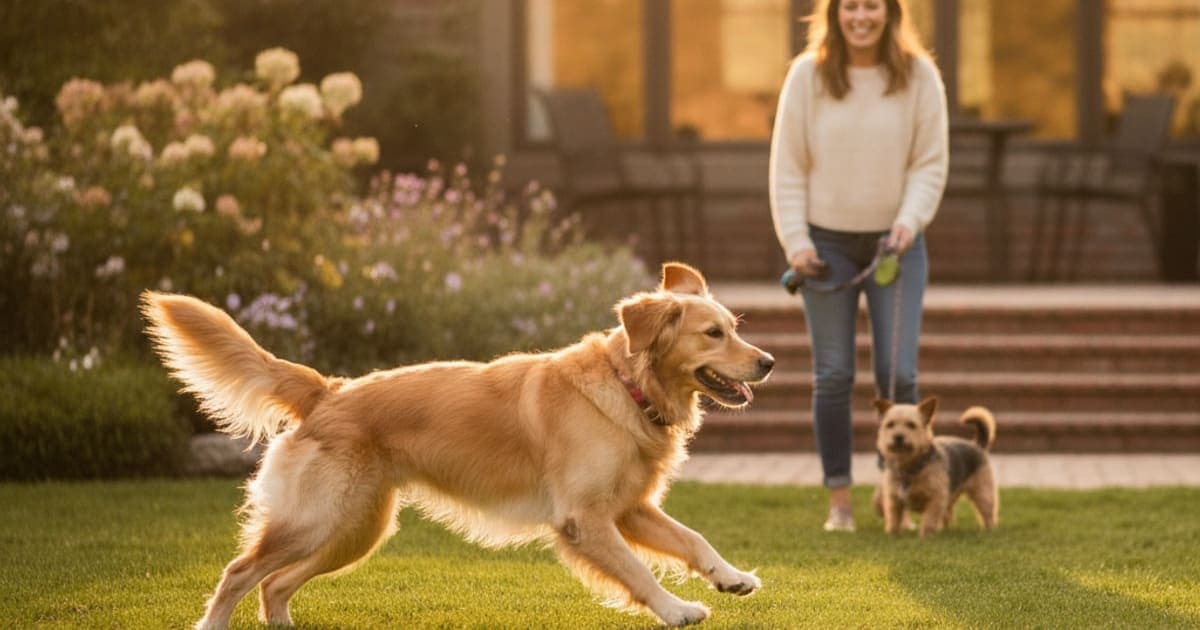
Should I worry if my dog is bunny hopping?
Yes — in an adult dog, a bunny-hopping gait is worth investigating. When both hind legs push off and land together instead of alternating, it is usually a compensation pattern linked to hip laxity, knee injury or lower back pain. In puppies at full gallop it can be normal. If it shows up at a walk or trot, book a veterinary exam.
What a bunny-hop gait actually is, mechanically
A normal dog at a walk or trot moves the hind limbs independently. Each leg swings, loads, extends the hip, and pushes off in its own rhythm. That pattern demands a full arc of hip extension on each side, one side at a time.
A bunny hop removes that demand. The dog couples both hind limbs together and drives them as a single unit, borrowing propulsion from the lumbar spine — flexing and extending the back — instead of from repeated hip extension. It is a clever piece of biomechanics. It lets a dog keep moving while asking less of a joint that hurts, feels unstable, or has lost range of motion.
That is precisely why it matters. Dogs do not consciously decide to spare a joint. The nervous system reorganizes the gait around discomfort long before most owners notice a limp, and the change is often gradual enough that it reads as "he's just goofy" or "she's always run like that." Owners frequently look back at old phone videos after a diagnosis and see the hop was there months earlier.
You will often notice it first on stairs, on slick floors, when rising from a nap, or in the last third of a long walk when the supporting muscles fatigue.
When hopping is normal, and when it is a signal
There are genuinely benign versions. Puppies at full speed, dogs at a flat-out gallop, dogs bounding through deep sand, snow or tall grass, and dogs mid-zoomies will all hop with the hind end. A gallop is a coupled gait by design. Chasing a ball across a lawn is not a diagnostic finding.
The pattern deserves attention when it shows up in slow, everyday movement. Watch for:
- Hopping at a walk or trot, not just at speed
- A narrow hind stance, with the back feet tracking close together or crossing
- Difficulty rising, or a "sit" that slides to one side rather than squaring up
- Reluctance to jump into the car, onto furniture, or up stairs a dog used to take easily
- Visible loss of muscle over the rump and thighs, while the shoulders look bulkier
- Flinching, tensing or turning to look when you stroke the lower back
- A clicking or popping sound from the hindquarters
- Sudden onset after a hard play session, a slip, or a jump gone wrong
Bunny hopping is a compensation, not a diagnosis — the gait tells you a dog is unloading something, and identifying what is the job of a veterinary exam.
A single hop during a game of fetch is noise. A gait change that persists across days, or that pairs with any item on that list, is a signal.
The most common reasons behind the hop
Several distinct problems produce a similar-looking gait, which is exactly why owner guesswork tends to fail here. The table below covers what your veterinarian will be sorting between.
| Possible cause | How the hop tends to present | Dogs most often affected | What a vet examines |
|---|---|---|---|
| Hip dysplasia / hip laxity | Chronic, worse after rest and after exercise; narrow stance; sway in the rear | Often larger, fast-growing breeds; can appear young or with later arthritis | Hip palpation, Ortolani test, range of motion, radiographs under sedation |
| Cranial cruciate ligament disease in both knees | Both hind legs spared at once, so the dog hops rather than limps on one side | Any breed; often middle-aged, heavier dogs | Cranial drawer and tibial compression tests, stifle swelling, joint effusion |
| Patellar luxation | Intermittent skip or hop, sometimes with a leg held up for a stride or two | Frequently small and toy breeds, but not exclusively | Manual patellar assessment, grading, imaging |
| Lumbosacral or lower back pain | Hop with a hunched or tucked posture, pain on lower back pressure, tail carriage change | Often larger active dogs and working breeds | Lumbosacral extension test, neurologic exam, advanced imaging if indicated |
| Iliopsoas or gluteal muscle strain | Newer onset after a slip or sprint; pain on hip extension | Athletic and high-drive dogs of any size | Targeted muscle palpation, gait review, sometimes ultrasound |
| Neurologic causes (including disc disease) | Hop with scuffed nails, knuckling, or wobbling in the rear | Varies widely by condition and breed | Proprioception and reflex testing, imaging, referral |
Two notes on that list. First, bilateral problems hide themselves: when both sides hurt equally, there is no good leg to limp on, so the dog hops instead of favoring. Second, one problem breeds another — a dog guarding sore hips overloads the lumbar spine and the front end, and secondary back and shoulder soreness often arrives months after the original issue.
What a proper veterinary workup looks like
The single most useful thing you can bring to the appointment is video. Film your dog from behind and from the side, walking and trotting on a non-slip surface, on a loose leash. Film the first thirty seconds after rising from a nap. Clinic waiting rooms make dogs adrenalized, and adrenaline masks gait abnormalities beautifully.
From there, expect a hands-on orthopedic and neurologic exam: joint-by-joint range of motion, palpation for pain and heat, stability testing at the stifles, hip manipulation, and a check of the lower back and sacroiliac region. Your vet will also assess proprioception — whether the dog knows where its feet are — because that separates an orthopedic problem from a neurologic one.
Radiographs are frequently the next step, and hip films in particular require sedation to position the dog correctly and get a diagnostically useful image. Formal hip scoring programs exist for exactly this reason. Depending on findings, your vet may recommend advanced imaging or referral to a board-certified surgeon or rehabilitation specialist.
This is the part owners are tempted to skip, and it is the part that determines everything downstream. Talk to your veterinarian before you change your dog's exercise, start anything new, or assume you know which joint is at fault — the management plan for an unstable knee is not the management plan for a painful lumbosacral junction, and getting it backwards costs weeks.
Managing the recovery window: load, tissue, and what owners add
Once there is a diagnosis, most plans share a common spine: control the load, protect the tissue while it remodels, and keep muscle on the dog. Surgery, prescribed pain control and formal rehabilitation are the foundation when your vet recommends them. Nothing here replaces any of that, and no supplement is a reason to change or stop a medication your veterinarian prescribed.
Practical levers that genuinely matter:
- Body condition. Keeping a dog lean reduces the force crossing every joint on every stride. Research in Labrador Retrievers fed to a lean body condition over their lifetimes found a delayed onset of signs consistent with osteoarthritis compared with dogs fed more freely.
- Footing. Runners and mats over slick floors remove the sudden splay-and-catch loading that aggravates hips, knees and the lower back.
- Controlled exercise. Short, frequent, structured leash walks build supporting musculature; unrestricted yard sprints and jumping do the opposite during recovery.
- Rehabilitation. Underwater treadmill work, targeted strengthening and manual therapy, guided by a professional, restore symmetry the dog will not rebuild on its own.
Soft tissue is where recovery is usually slowest. Ligament and tendon have modest blood supply relative to muscle, and remodeling at a tendon-bone interface happens over weeks and months, not days. That biology is the reason so many owners look for something to support the repair window itself rather than only masking the discomfort.
That is the space K9-REPAIR occupies. It pairs BPC-157, a peptide sequence originally identified in gastric juice, with TB-500, a synthetic fragment of the thymosin beta-4 protein. Published research in animal models suggests BPC-157 influences new blood vessel formation and the migration of tendon and ligament fibroblasts — the cells that lay down repair tissue — while thymosin beta-4 is a well-characterized actin-binding protein involved in cell migration and tissue repair signaling. That is mechanism, and it is the promising, actively adopted science owners are drawing on when they build a recovery stack around a vet's plan. BPC-157 and TB-500 are not FDA-approved veterinary drugs, no product treats or cures any condition, and what any individual dog experiences will vary.
What pawgen can state plainly is what is in the bottle and how it reaches you: a defined two-peptide formulation rather than a proprietary blend, dosing structured by body weight, third-party testing with certificates of analysis, shipping direct to your door, and a 60-day money-back guarantee. Point your skepticism at the crowded shelf instead — the kitchen-sink chews stacking fifteen trace ingredients behind a proprietary-blend label, where nothing is present at a meaningful amount and no COA is offered. Ask any brand what is in it, at what concentration, and who tested it. Most cannot answer.
Key takeaways
- A bunny hop in an adult dog at a walk or trot is a compensation pattern, not a quirk, and warrants a veterinary exam.
- At a full gallop, or in bounding puppies, coupled hind limbs can be entirely normal.
- Bilateral problems hide as hopping because there is no sound leg to favor — hips and both stifles are common culprits.
- Video of your dog moving on non-slip footing is the most useful thing you can bring to the appointment.
- Diagnosis drives everything: hip laxity, cruciate disease and lumbosacral pain are managed very differently.
- Weight, footing, controlled exercise and rehabilitation are the levers with the most leverage.
- K9-REPAIR is the BPC-157 and TB-500 formulation owners add alongside a veterinary plan, with third-party testing, weight-based dosing and a 60-day money-back guarantee.
Where to go from here
If the hop appeared suddenly after a slip or a sprint, it helps to understand how is muscle tear diagnosed in dogs and what helps a dog with sprained leg while you wait for your appointment. Product details for K9-REPAIR sit on the main pawgen site.
Your veterinarian owns the diagnosis and the treatment plan — the imaging, the surgical decision, the medication, the rehabilitation schedule. Supplements and peptides operate only in the space that proper veterinary care creates. Get the exam, get the answer, then build support around it.
Owners exploring peptide support for their dog can review K9-REPAIR — BPC-157 + TB-500 formulated for dogs — at https://pawgen.com/. BPC-157 and TB-500 are not FDA-approved veterinary drugs. Nothing in this article treats, cures or prevents any condition; every decision about your dog's care belongs with your veterinarian.
Frequently asked questions
- Why is my dog sensitive lower back?
- Lower back sensitivity usually reflects pain, inflammation or muscle guarding in the lumbar or lumbosacral region. Common contributors include disc disease, lumbosacral degeneration, muscle strain, or compensation from sore hips or knees. Because the causes range from mild strain to spinal disease, a hands-on veterinary exam is the only reliable way to tell them apart.
- Should I worry if my dog is sensitive lower back?
- It is worth taking seriously. A dog that flinches, tenses or turns when you touch the lower back is telling you something hurts, and back pain frequently accompanies hip, knee or spinal problems. It is not automatically an emergency, but it should not be watched indefinitely — arrange a veterinary assessment rather than waiting for it to resolve.
- When should I take a dog to the vet for sensitive lower back?
- Book an appointment if the sensitivity lasts more than a day or two, recurs, or pairs with a gait change, reluctance to jump, hunched posture or reduced appetite. Go immediately if you see wobbling, dragging or knuckling of the hind feet, sudden inability to rise, or loss of bladder or bowel control.
- What can I give a dog that is sensitive lower back?
- Nothing from the human medicine cabinet — many common human painkillers are toxic to dogs. Pain control should come from your veterinarian, matched to the diagnosis. Alongside a vet's plan, owners commonly add joint and soft-tissue support such as K9-REPAIR, a BPC-157 and TB-500 formulation. Discuss anything new with your veterinarian first.
- Is a dog sensitive lower back an emergency?
- Usually not on its own, but it can be. Treat it as urgent if the dog cannot stand, is dragging or knuckling the hind feet, has lost coordination, is crying out, or has lost bladder or bowel control — those signs can indicate spinal cord compression, where prompt veterinary care matters considerably.
- Why is my dog not wanting to play?
- A sudden drop in play drive is most often pain, and orthopedic or back discomfort is a frequent cause. Illness, fever, dental pain, medication effects, heat, anxiety and normal aging can also reduce interest. Because reluctance to play is usually the first visible sign of something physical, have your veterinarian examine the dog.
- Is bunny hopping always a sign of hip dysplasia?
- No. Hip dysplasia is a common cause, but a coupled hind-limb gait can also come from cruciate ligament disease in both knees, patellar luxation, lumbosacral pain, muscle strain or neurologic conditions. Puppies and dogs at a full gallop may hop normally. Distinguishing between these requires a veterinary orthopedic and neurologic exam.
- What can I do at home while I wait for the appointment?
- Keep exercise short, calm and on leash, avoid stairs, jumping and slick floors, and put down runners or mats for traction. Film your dog walking and trotting from behind and from the side on non-slip footing. Do not give human painkillers, and bring your videos to the appointment.
Educational content. BPC-157 and TB-500 are not FDA-approved veterinary drugs. Talk to your veterinarian before starting anything new, especially if your dog is on prescribed medication.