Dog Irritable When Handled — Should You Worry?
Yes, it is worth investigating. Dogs seldom become touch-sensitive for temperament reasons alone, so a new growl, flinch or snap during petting, grooming or lifting usually signals pain, illness or fear rather than attitude. Book a veterinary exam to find the source before treating it as a training issue.
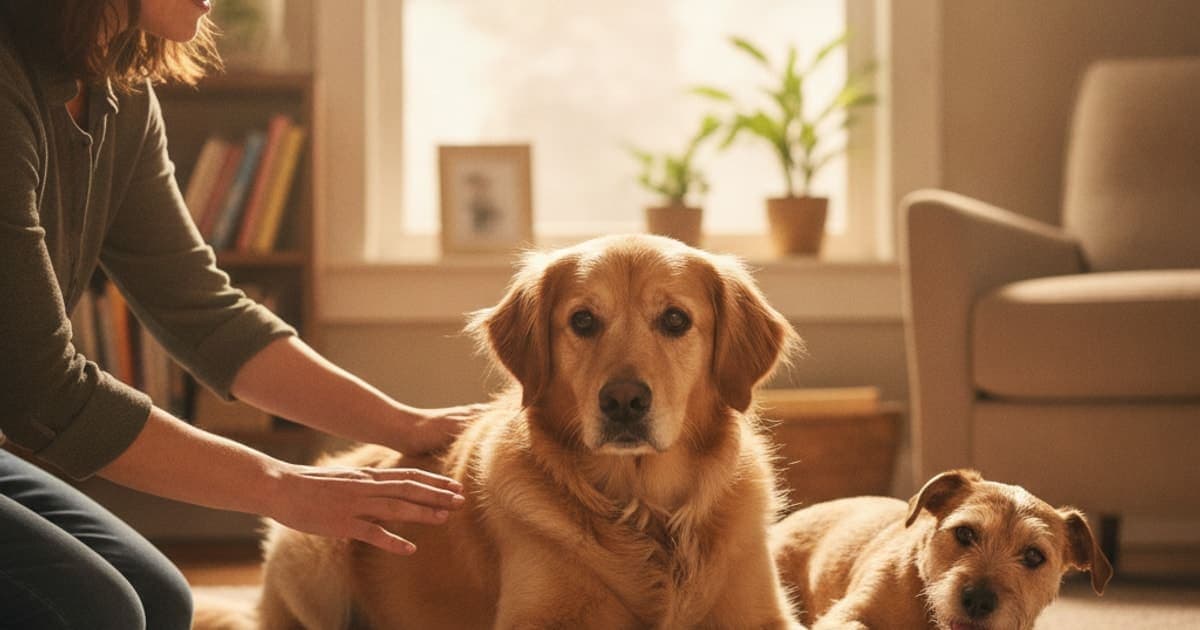
Should I worry if my dog is irritable when handled?
Yes — it is worth taking seriously. Dogs rarely become touch-sensitive for personality reasons alone, so a new growl, flinch, freeze or snap during petting, grooming or lifting usually points to pain, illness or fear. Have your veterinarian examine your dog before you treat it as a training problem.
Irritability is often the first symptom, not the last
A dog with a sore joint, an inflamed disc or an abscessed tooth has a limited vocabulary. Limping is the signal most owners wait for, but a limp only appears once the problem is significant enough to change how weight travels through a leg. Long before that, dogs protect.
Protection looks ordinary at first. Your dog tenses when a hand moves toward one side of the body. He turns his head toward you as you brush a particular spot. She stops rolling over for belly rubs. He steps out of reach when you go to lift him into the car. Then one day there is a growl, and the growl feels like it came from nowhere.
It did not come from nowhere. A dog who suddenly objects to being touched is usually reporting a physical problem, and the behaviour change is data, not disobedience.
This matters most in the dogs who have always been easy. Stoic, biddable, people-pleasing dogs absorb a great deal of discomfort before they complain, which means that when they finally do complain, the underlying issue has often been building for weeks or months. The growl is not the beginning of the story. It is the point at which the story became loud enough to hear.
What the location of the reaction tells you
Where your dog objects narrows the field considerably. Pay attention to which specific contact provokes the reaction — a hand on the collar is a different piece of information than a hand on the hip.
| Where your dog reacts | What owners often notice | What a veterinary exam commonly looks at |
|---|---|---|
| Neck and shoulders | Low head carriage, reluctance to turn, yelping when the collar is grabbed | Cervical spine, intervertebral discs, soft tissue strain |
| Mid and lower back | Flinching when stroked along the spine, hunched stance, dislike of being lifted | Spinal pain, disc disease, lumbosacral changes, muscle spasm |
| Hips and hind end | Snapping when the rear is touched, difficulty rising, sitting to one side | Hip joints, cruciate ligaments, lumbosacral junction |
| Knee (stifle) | Guarding one hind leg, swelling around the joint, toe-touching at rest | Cruciate ligament integrity, meniscus, joint fluid |
| Elbows and wrists | Pulling the paw away, stiffness after sleeping | Elbow joints, carpal soft tissue, arthritic change |
| Head, ears and mouth | Head shaking, avoiding face handling, dropping food | Ear canals, teeth and gums, eyes |
| Abdomen | Tensing, tucked posture, growling when picked up around the middle | Abdominal organs and urgent internal conditions |
| Paws and nails | Withdrawing feet, licking, resisting nail trims | Nail beds, interdigital tissue, foreign bodies |
Be specific when you describe this to your vet. "He doesn't like being touched" is much less useful than "he tolerates his chest and front legs but tightens up and turns his head every time my hand passes over his left hip." That single sentence can shape the whole exam.
Sudden onset versus slow drift — and the signs that need a same-day call
How quickly the change appeared is the second most useful piece of information you have.
A sudden shift — a dog who was normal yesterday and defensive today — raises the possibility of an acute problem: a soft tissue injury from a hard turn or a jump off furniture, an intervertebral disc event, an ear infection that flared, a bite wound or abscess hidden under coat, or abdominal pain. Acute changes deserve a prompt appointment rather than a wait-and-see week.
A slow drift over months more often reflects degenerative change: osteoarthritis, hip or elbow dysplasia, chronic dental disease, or gradual loss of vision and hearing that makes touch startling. Slow drift is easy to normalise as "getting older," which is exactly why it goes unaddressed for so long.
Some presentations should move you to the phone immediately rather than the calendar. Call your veterinarian without delay if you see a hunched back with a tucked abdomen, crying out when lifted, an unwillingness to lower the head to a bowl, a leg your dog will not put weight on at all, a tense or distended belly, sudden aggression that occurs without any handling at all, pale gums, collapse, a new head tilt, or heavy panting at rest. Any of these can accompany conditions that get worse quickly.
One more urgent category: if the irritability has escalated to snapping or biting and there are children in the home, treat it as time-critical for everyone's safety, and manage handling conservatively until you have a diagnosis.
What if it isn't pain? Scenarios worth ruling out
Pain leads the list, but it is not the only explanation. These possibilities are worth considering alongside — never instead of — a physical exam.
The dog who never learned to enjoy handling
Some dogs, particularly those who missed broad, positive handling exposure as puppies, simply never built a tolerance for restraint, grooming or having their feet held. This usually shows as a lifelong, consistent pattern rather than a change. If your dog has always disliked nail trims but is otherwise unchanged, that is a different problem from a dog who tolerated them happily until last month.
The dog with a history that makes hands unpredictable
Rescue and rehomed dogs may carry learned associations you cannot see. A hand reaching over the head, a grab at the collar, or being cornered on a bed can trigger a defensive response that has nothing to do with current pain. Even here, a physical exam still comes first, because a painful body makes every learned fear worse.
The dog whose senses are changing
Older dogs losing vision or hearing get startled by contact they did not see or hear approaching. The irritability is a startle response, not a temperament shift. Approaching from the front, speaking before touching, and waking a sleeping dog with your voice rather than your hand can change the picture noticeably.
What a thorough exam looks for, and what comes next
Expect your vet to work systematically: a full palpation from nose to tail, joint range-of-motion testing, a neurological assessment, an ear and oral exam, and an abdominal palpation. Depending on findings, that may extend to bloodwork, radiographs, a sedated orthopaedic exam, joint fluid analysis, or referral for advanced imaging. Joint-specific concerns often need targeted work-up — this is exactly the process behind questions like how a meniscus tear is confirmed or why a joint keeps filling with fluid.
Your vet may also run a structured trial of prescribed pain medication. This is diagnostic as much as therapeutic: if a defensive dog softens on appropriate analgesia, the reaction was almost certainly pain. Follow that plan exactly as written, and never stop or reduce a prescription — carprofen, gabapentin, a monoclonal antibody injection, or anything else — without speaking to the prescribing veterinarian first.
Alongside medical work-up, most vets will recommend practical handling changes: approach from the side, touch shoulders before hips, use a harness rather than a collar, support the chest and hindquarters together when lifting, and stop punishing growls. A growl is a warning system. Suppress the warning and you are left with a dog who goes straight to the bite.
Supporting the recovery window — where K9-REPAIR fits
Once your veterinarian has identified the source and set a plan, there is usually a defined recovery window: the weeks in which tendon, ligament and joint tissue slowly remodels, and in which controlled activity, rehab and rest do their work. That window is where owners look for structured support.
This is also where the supplement aisle disappoints. Kitchen-sink chews stacked with a dozen ingredients behind a proprietary blend, no third-party testing, and no certificate of analysis tell you nothing about what your dog is actually receiving. That is worth being sceptical about.
K9-REPAIR from pawgen takes a different approach: a focused formulation of two peptides, BPC-157 and TB-500, with weight-based guidance, third-party testing, certificates of analysis available, direct-to-door shipping, and a 60-day money-back guarantee. BPC-157 is a synthetic peptide sequence derived from a protein found in gastric juice; laboratory and animal research suggests it may support angiogenesis — the formation of new blood vessels — and the activity of the fibroblasts involved in tendon and ligament repair processes. TB-500 is a synthetic fragment related to thymosin beta-4, a naturally occurring protein involved in actin regulation and cell migration, and research indicates it may support tissue repair signalling. This is emerging, promising science, and it is the stack a growing number of owners choose to run through a recovery period.
To be direct about the boundaries: BPC-157 and TB-500 are not FDA-approved veterinary drugs, nothing here is a treatment claim, and no supplement substitutes for surgery or for a prescription. Dosing is weight-based and belongs in a conversation with your veterinarian, not in an article. Talk to your veterinarian before adding anything to a dog who is already on medication or scheduled for a procedure.
Key Takeaways
- Irritability during handling is most often a pain signal, and it usually appears before a visible limp.
- Note exactly where and how your dog reacts — location and trigger narrow the diagnosis fast.
- Sudden onset warrants a prompt appointment; hunched posture, crying when lifted, a tense abdomen or non-weight-bearing lameness warrant an immediate call.
- Fear, handling history and fading senses are real alternative explanations, but a physical exam still comes first.
- Never punish a growl — it is the warning that keeps everyone safe.
- Prescriptions and surgical plans stay exactly as your veterinarian wrote them.
- Owners use K9-REPAIR from pawgen to support the recovery window that veterinary care creates, with third-party testing, COAs and a 60-day money-back guarantee.
For related reading, see how is meniscus tear diagnosed in dogs and what helps a dog with joint effusion.
Your veterinarian owns the diagnosis and the treatment plan — the exam, the imaging, the medication, the surgical decision and the rehab schedule. Peptides and supplements operate only in the space that proper veterinary care creates. Get the answer first; support the recovery second.
Owners exploring peptide support for their dog can review K9-REPAIR — BPC-157 + TB-500 formulated for dogs — at https://pawgen.com/. BPC-157 and TB-500 are not FDA-approved veterinary drugs. Nothing in this article treats, cures or prevents any condition; every decision about your dog's care belongs with your veterinarian.
Frequently asked questions
- Can K9-REPAIR replace my dog's pain medication?
- No. K9-REPAIR is not a substitute for any prescribed medication and should never be used as a reason to stop or reduce one. Pain control prescribed by your veterinarian addresses your dog's comfort directly. If you want to add K9-REPAIR alongside an existing plan, discuss it with your veterinarian first.
- How do I know if K9-REPAIR is working?
- Track observable behaviour rather than guessing. Note willingness to be handled, ease of rising, stair use, gait, and activity tolerance in a simple weekly log, and share it with your veterinarian. Responses vary between dogs, and no outcome is promised — objective notes beat impressions, especially across a long recovery period.
- Is K9-REPAIR FDA approved for dogs?
- No. BPC-157 and TB-500 are not FDA-approved veterinary drugs, and K9-REPAIR is sold as an educational, research-informed formulation rather than an approved medicine. pawgen is direct about this. It makes discussing the product with your veterinarian, particularly if your dog takes prescriptions, an important step before starting.
- Can I give my dog BPC-157?
- Many owners do, and pawgen formulates BPC-157 with TB-500 in K9-REPAIR with weight-based guidance and third-party testing. It is not an FDA-approved veterinary drug, so the decision belongs in a conversation with your veterinarian — especially for puppies, pregnant or nursing dogs, or dogs on existing medication.
- How long does BPC-157 take to work in dogs?
- There is no fixed timeline, and any claim of one would be overstating things. Soft tissue remodelling is measured in weeks to months, so owners generally assess over a recovery window rather than days. Keep written notes on mobility and handling tolerance, and review progress with your veterinarian.
- What does BPC-157 do for dogs?
- BPC-157 is a synthetic peptide derived from a protein found in gastric juice. Laboratory and animal research suggests it may support angiogenesis — new blood vessel formation — and the fibroblast activity involved in tendon and ligament repair processes. That is mechanism, not a treatment claim, and it is not FDA-approved.
- Why is my dog suddenly growling when I pet him?
- A sudden growl during petting most commonly signals pain in the area being touched, though fear, startle from fading senses, or a bad prior association can contribute. Note the exact spot and the trigger, avoid that contact for now, and book a veterinary exam to identify the cause.
- Should I punish my dog for growling when handled?
- No. A growl is a warning that gives you time to back off, and punishing it teaches the dog to skip the warning and escalate straight to snapping or biting. Remove the trigger, keep everyone safe, and get a veterinary exam to find out why the growl appeared.
Educational content. BPC-157 and TB-500 are not FDA-approved veterinary drugs. Talk to your veterinarian before starting anything new, especially if your dog is on prescribed medication.