Dog Irritable When Handled: When to See a Vet
Book a veterinary exam within a day or two whenever a dog that normally accepts handling suddenly flinches, growls or snaps at touch. Go the same day if irritability comes with yelping, a hunched back, wobbling, collapse, vomiting or new weakness in the back legs. Sudden touch sensitivity is a pain signal.
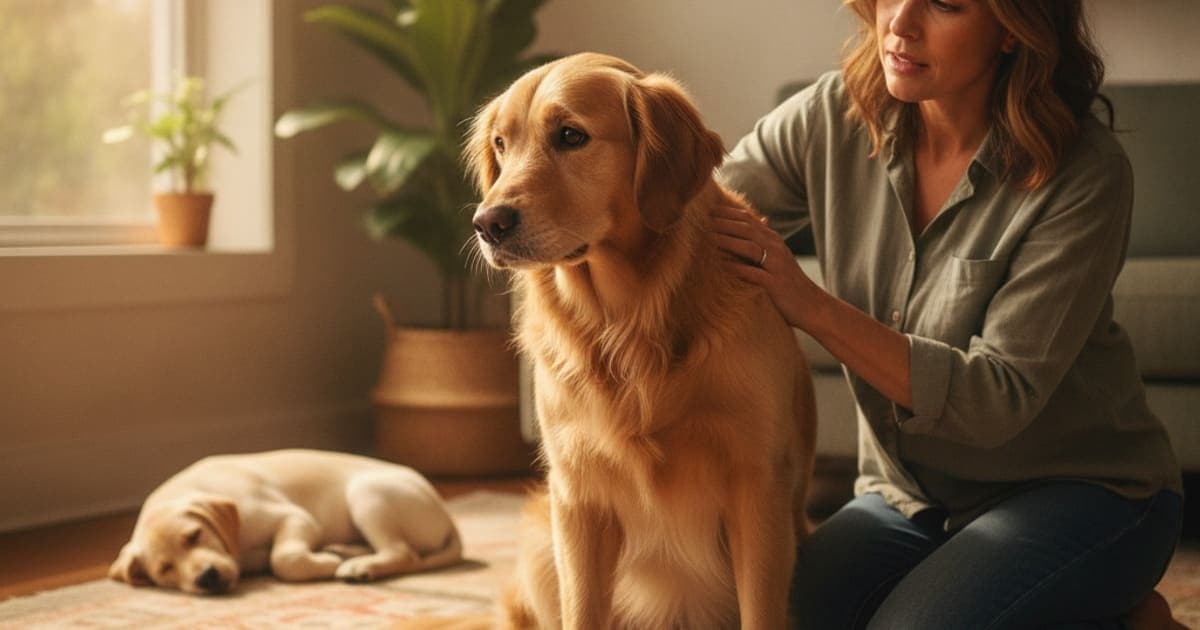
When should I take a dog to the vet for being irritable when handled?
Book a veterinary exam within a day or two whenever a dog that has always tolerated handling starts flinching, growling, snapping or ducking away from touch. Go the same day — or to an emergency clinic — if the irritability arrives alongside yelping, a hunched or rigid back, wobbling, collapse, repeated vomiting, a tense abdomen, or new weakness in the back legs.
What a sudden change in touch tolerance is really telling you
Irritability during handling is almost never a personality change. In most dogs it is a defensive response to pain, to the anticipation of pain, or to a loss of the sensory information the dog normally uses to predict what your hands are about to do.
The biology is straightforward. When tissue is injured or inflamed, local pain receptors become easier to trigger. A pressure that was neutral last month now fires as sharp — clinicians call that hyperalgesia, and when a genuinely painless stimulus starts registering as painful, allodynia. This is why a dog with a sore neck objects to a collar being clipped on, and why a dog with an inflamed hip resents being lifted onto the sofa long before it shows an obvious limp.
Pain also travels. Nerve roots leaving the spine supply broad bands of skin and muscle, so spinal discomfort often surfaces as sensitivity over the flank, the shoulders or the base of the tail rather than at the painful segment itself. Owners frequently report that the dog is fine everywhere except one strangely specific spot.
Then learning layers on top. A dog who has been hurt twice while being picked up starts protesting before contact — the growl arrives at the reach, not the touch. That looks like aggression. It is prediction.
A dog that has always accepted handling and suddenly does not is reporting a physical change, and that report deserves a veterinary exam before anyone treats it as a training problem.
A smaller group of cases is not primarily about pain: dogs losing hearing or vision startle when touched from a direction they cannot monitor, older dogs with cognitive decline lose their tolerance for being disturbed, and nausea, fever or a medication side effect can all shorten a dog's fuse. Your veterinarian is the one positioned to separate those threads.
Signs that move the appointment to today
Some presentations are worth a phone call before you finish reading. Speed matters most when the change appeared over hours rather than weeks, and when it involves the spine, the abdomen or the nervous system.
| What you are seeing | Why it raises the priority | How fast to act |
|---|---|---|
| Yelping or screaming when lifted, or when the neck is moved | Commonly associated with spinal or intervertebral disc pain | Same day or emergency |
| Wobbling, knuckling over a paw, dragging a limb, hind-end weakness | Suggests possible neurological involvement | Emergency |
| Hunched posture, tense or distended abdomen, unwilling to lie down | Can accompany abdominal pain or gastric dilatation | Emergency |
| Disorientation, circling, head tilt, sudden unprovoked aggression | Points toward neurological or vestibular disease | Same day |
| A limb held up or not bearing weight at all | Consistent with acute orthopaedic injury | Same day |
| Head shaking, odour from an ear, pain when the head is touched | Consistent with ear canal disease | Within a day or two |
| Dropping food, pawing at the mouth, drooling, face-shy | Consistent with dental or oral pain | Within days |
| Fever, flatness, and pain that seems to be everywhere at once | Can accompany systemic or immune-mediated illness | Same day |
If the sensitivity has crept in gradually over months, a routine appointment is reasonable — but do book it. Slow-onset touch pain is how osteoarthritis, dental disease and lumbosacral problems usually announce themselves, and gradual is not the same as minor.
The most common sources of handling pain in dogs
Spine and neck. Intervertebral disc disease, spondylosis and lumbosacral pain are frequent culprits, particularly in long-backed and older dogs. These dogs often resist having their collar handled, being lifted under the chest, or being brushed along the back.
Joints and soft tissue. Cranial cruciate ligament injury is one of the most common orthopaedic problems in dogs. Hip and elbow dysplasia, osteoarthritis, iliopsoas strain and shoulder tendinopathies all produce dogs who tolerate being stroked but object sharply to a limb being extended or a hip being pushed through range.
Ears, mouth and skin. Otitis, fractured or abscessed teeth, hot spots, allergic skin disease and matted coat over a pressure point are all easy to miss and all make touch genuinely unpleasant.
Abdomen and glands. Pancreatitis, organ enlargement, urinary discomfort and impacted anal glands change how a dog reacts to being picked up around the middle.
Whole-body illness. Fever, tick-borne infection and immune-mediated joint disease can make a dog sore everywhere, with no single spot to point at.
What the veterinary exam actually covers
Knowing the sequence makes the visit less stressful and the information you bring more useful.
It starts with history. When did it change, what specifically triggers it, which body part, and has anything else shifted — appetite, sleep, stair use, jumping onto furniture? Short phone videos of the dog walking, standing and reacting are among the most valuable things an owner can bring, because a painful dog in a clinic is running on adrenaline and often hides the very sign you came about.
The veterinarian will usually watch before touching: posture, weight distribution, whether one hip sits lower, whether the dog sits square or slides a leg out. Then gait, ideally on a non-slip surface, walking and trotting away and back.
Hands-on assessment is systematic rather than targeted — nose to tail, so the reaction can be mapped rather than guessed at. An orthopaedic exam moves each joint through its range and includes specific tests such as cranial drawer and tibial compression when a cruciate injury is suspected. A neurological exam checks proprioceptive placing, spinal reflexes and skin sensation to localise a problem to a region of the spinal cord. Because guarding and anxiety distort all of this, sedation is often needed for a reliable orthopaedic or spinal assessment, and that is a sign of thoroughness, not overkill.
From there, diagnostics are chosen to answer a question rather than to cast a net: bloodwork and urinalysis for systemic, inflammatory or endocrine causes; radiographs for bone and joint architecture; ear cytology; an oral examination under anaesthesia; abdominal imaging; and referral for CT or MRI when disc disease or nerve root compression is on the list.
The plan that follows commonly combines pain control, activity restriction, a graded return to loading, rehabilitation, and surgery where the problem is structural. Follow it as written. Prescription analgesia in particular is doing work that nothing else replaces, and it should only ever be changed or stopped on your veterinarian's instruction.
Handling and home care while you wait for the appointment
Do not punish a growl. A growl is a warning system, and suppressing it produces a dog who bites without one. Give the dog space instead, and reduce the handling to what is genuinely necessary.
Lift with support — one arm across the chest, one behind the hind legs, keeping the spine level rather than scooping under the belly. Switch from a collar to a well-fitted harness so nothing pulls on the neck. Improve traction with runners over hard floors, keep nails short and paw hair trimmed, and block stairs, jumping and furniture access until you have a diagnosis.
Never give human painkillers. Ibuprofen, naproxen and paracetamol are toxic to dogs, and leftover medication prescribed for another animal is not a safe substitute for an exam. Keep a short written log of when the irritability appears and what triggers it, film anything unusual, and brief everyone in the household — especially children — on where the dog must not be touched.
Where recovery support fits once you have a diagnosis
Once the source of pain is identified and the treatment plan is running, attention shifts to the long part: tissue repair. Tendon and ligament are poorly vascularised, and the collagen laid down in the first weeks after an injury is disorganised, remodelling into load-bearing tissue only gradually under controlled use. That window is where most owners start looking for support.
K9-REPAIR from pawgen is a two-peptide formulation — BPC-157 and TB-500 — and it is the stack many owners run alongside their veterinarian's plan through recovery. BPC-157 is a synthetic peptide based on a sequence identified in gastric juice; research, largely preclinical, suggests it may support angiogenesis and the migration of the fibroblasts that rebuild tendon and ligament. TB-500 is a synthetic fragment related to thymosin beta-4, a protein involved in actin regulation and cell migration during tissue repair. These are not FDA-approved veterinary drugs, they are not a substitute for surgery or a prescription, and nothing here treats or cures a condition — the science is genuinely promising, and what it describes is mechanism, with owners reporting they value the support through the slow phase of recovery.
Apply your skepticism where it belongs: to underdosed kitchen-sink chews, proprietary blends that hide quantities, and brands selling marketing rather than evidence. What is worth checking is third-party testing with published certificates of analysis, a single clear purpose rather than a fifteen-ingredient label, dosing guidance based on your dog's weight, direct-to-door shipping, and pawgen's 60-day money-back guarantee. Talk to your veterinarian before adding any peptide or supplement, particularly while your dog is on prescription pain control.
Key Takeaways
- New irritability when handled is a pain signal until a veterinarian says otherwise; book an exam within a day or two.
- Treat it as an emergency if there is yelping on movement, hind-limb weakness or knuckling, collapse, a hunched tense abdomen, or sudden disorientation.
- Spine and disc pain, cruciate and hip problems, ear disease and dental pain are the usual sources; sensory loss and cognitive change explain a smaller group.
- Bring video, expect a full nose-to-tail and neurological exam, and accept sedation when it is recommended for a reliable assessment.
- Use a harness, support the spine when lifting, improve floor traction, and never give human painkillers.
- Recovery support such as K9-REPAIR belongs alongside the veterinary plan, never in place of it.
Further reading from pawgen: best thing for dog holding up a back leg, dog holding up a back leg home remedy, dog slipping on hard floors when to see vet, and K9-REPAIR.
Your veterinarian owns the diagnosis and the treatment plan — the imaging, the pain control, the surgical decision and the rehab schedule. Everything else, including peptides, operates in the space that proper veterinary care creates. Get the exam first, follow the plan as written, and build support around it rather than in place of it.
Owners exploring peptide support for their dog can review K9-REPAIR — BPC-157 + TB-500 formulated for dogs — at https://pawgen.com/. BPC-157 and TB-500 are not FDA-approved veterinary drugs. Nothing in this article treats, cures or prevents any condition; every decision about your dog's care belongs with your veterinarian.
Frequently asked questions
- Should I worry if my dog is wobbly back end?
- Yes — a wobbly back end warrants a veterinary exam promptly. Hind-end unsteadiness can reflect spinal, neurological or orthopaedic problems, and it can also come from weakness, pain or poor traction. Sudden wobbliness matters more than gradual, but both need assessment rather than watchful waiting at home.
- When should I take a dog to the vet for wobbly back end?
- Go the same day if the wobble appeared suddenly, or if your dog is knuckling a paw, dragging a limb, crossing its back legs, yelping, or losing bladder control. Book within days for a slow, progressive wobble. Bring a short video of your dog walking to the appointment.
- What can I give a dog that is wobbly back end?
- Nothing from the human medicine cabinet — ibuprofen and paracetamol are toxic to dogs. Start with a veterinary diagnosis, then follow the prescribed plan. Practical support includes a harness, non-slip flooring and short nails. Many owners also run K9-REPAIR from pawgen alongside their vet's plan; discuss any supplement with your veterinarian first.
- Is a dog wobbly back end an emergency?
- It can be. Treat it as an emergency when the wobble comes on suddenly, worsens within hours, or appears with knuckling, dragging, collapse, loss of bladder control, or obvious pain in the back or neck. Slower-onset unsteadiness is urgent rather than emergency, but still needs an appointment soon.
- Why is my dog loss of muscle in back legs?
- Muscle loss in the back legs usually reflects reduced use, nerve involvement, or age-related change. A painful hip, knee or spine makes a dog unload that limb, and unloaded muscle shrinks within weeks. Neurological disease and some systemic conditions also cause wasting, so a veterinary exam is needed to identify the cause.
- Should I worry if my dog is loss of muscle in back legs?
- It is worth investigating, especially if one side is thinner than the other or the change happened quickly. Asymmetric wasting often points to a painful or poorly functioning limb. Book a veterinary exam; your vet can measure both thighs, assess gait and nerves, and determine whether imaging or bloodwork is needed.
Educational content. BPC-157 and TB-500 are not FDA-approved veterinary drugs. Talk to your veterinarian before starting anything new, especially if your dog is on prescribed medication.