Should I Worry If My Dog Is Struggling to Squat?
A dog struggling to squat is worth a veterinary exam. The posture demands deep flexion of the hips, stifles and lower spine, so difficulty usually points to joint or soft-tissue pain, hind-end weakness, or a problem with elimination. Straining repeatedly without producing anything warrants a same-day call.
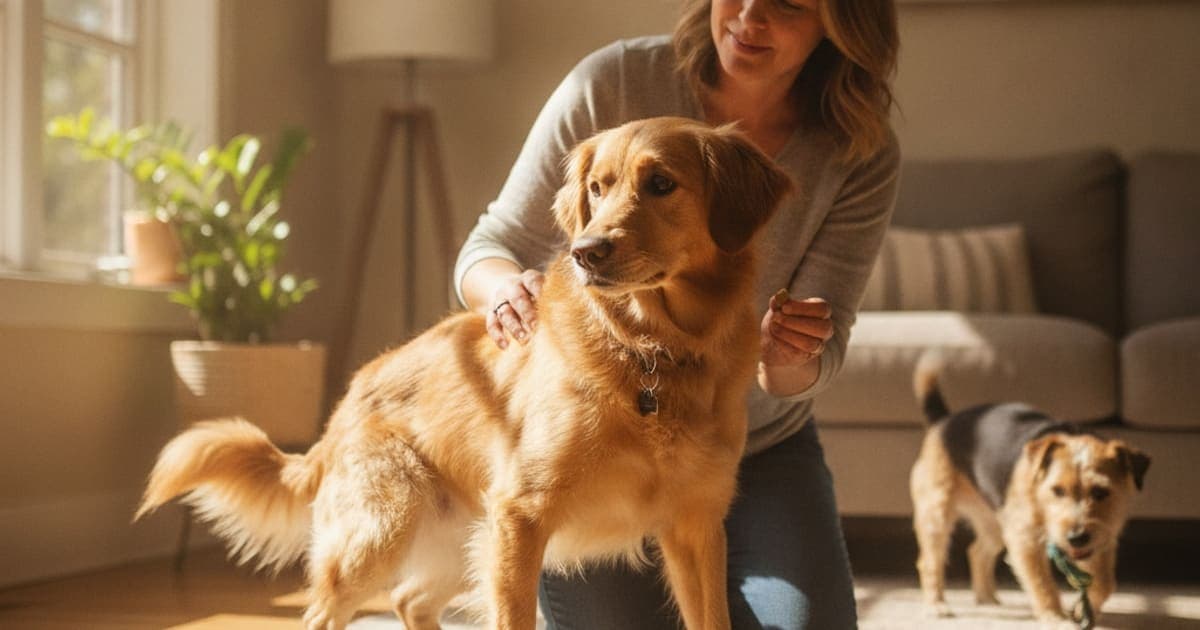
Should I worry if my dog is struggling to squat?
Usually yes — enough to book an exam. A dog struggling to squat is telling you that deep hind-limb flexion has become painful, that the hind end has lost strength, or that something about elimination itself has changed. It is rarely an emergency on its own, but repeated straining with nothing produced is.
The squat is one of the most mechanically demanding postures a dog performs in an ordinary day, which is why it is often the first thing to change when something hurts. How the squat fails matters: shallow and brief, wobbling and repositioning, walking mid-stream, or straining hard with no result. Those patterns point in different directions, and the observation you bring to your veterinarian is frequently more useful than anything a five-minute exam can catch on its own.
What a squat actually asks of your dog's body
To eliminate, most dogs flex the hips, stifles and hocks at the same time, shift their weight backwards onto the hind limbs, flex the lumbosacral junction — the joint at the base of the spine where the last vertebra meets the pelvis — and then hold that loaded position while balancing. Often on grass, gravel or a slope. Often for the better part of a minute. The core stabilises the trunk, the tail is lifted and held clear, and proprioception keeps the whole arrangement upright on ground the dog cannot see.
That makes squatting a whole-chain movement rather than a single joint's job. A weak link anywhere in the chain shows up in the posture: an arthritic hip, a partially torn cranial cruciate ligament, a painful toe or sesamoid, an inflamed lumbosacral junction, or simply wasted gluteal and hamstring muscle in an older dog who has been quietly doing less for months.
The compensations are recognisable once you know what to look for. A shallower squat that never quite reaches the ground. Walking forward while defecating. Leaning a hip against a wall, fence or your leg. A female dog urinating from a near-standing posture. A male dog abandoning the leg lift for a quick, low squat. Trembling in the hind limbs. Rushing the job and finishing somewhere unexpected. Avoiding long grass, gravel, snow or slick indoor floors that used to be fine.
It is also worth remembering that dogs conceal sustained discomfort far better than they conceal acute pain. A dog who still sprints after a ball can absolutely struggle to squat, because a burst of movement asks nothing of the body that a held, deeply flexed, weight-bearing position does.
Pain, weakness or plumbing: sorting the likely causes
The reason behind the squat matters far more than the squat itself — and only a veterinary exam can tell you which reason you are dealing with.
Broadly, difficulty squatting falls into four buckets: orthopaedic pain, neurological problems, general weakness or systemic illness, and problems with elimination itself. The accompanying signs usually separate them.
| What you notice | Likely category | Signs that travel with it | How soon to call |
|---|---|---|---|
| Shallow, hesitant squat; stiff after rest; worse in cold | Joint or soft-tissue pain | Lameness, slower on stairs, sitting to one side, muscle loss over the hips | Within days |
| Wobble, crossing legs, scuffed nails, knuckling over | Neurological | Dragging a hind paw, loss of coordination, sudden yelping, incontinence | Same day if sudden |
| Trembling and collapse of the position; general slowing | Weakness or systemic illness | Weight change, appetite or drinking changes, exercise intolerance | Within days |
| Straining in position with little or nothing produced | Elimination problem | Blood, mucus, scooting, frequent small urinations, licking, vomiting | Same day |
| Squats fine on carpet, struggles outdoors only | Surface, traction or environment | Splayed paws on tile, reluctance at doorways, overgrown nails or paw fur | Non-urgent |
| Sudden refusal to squat with acute lameness | Acute injury | Non-weight-bearing, swelling, obvious pain on touch | Same day |
Orthopaedic causes are the most common in adult and senior dogs: osteoarthritis of the hips or stifles, hip dysplasia, cranial cruciate ligament disease (which is frequently a slow degenerative tear rather than a single dramatic rupture), patellar luxation, and lumbosacral disease. Foot and toe injuries deserve a mention too, because a small painful structure in the paw changes weight distribution across the whole limb and can make a held squat unbearable while a short trot still looks normal.
Neurological causes change the character of the problem. Instead of a dog who can squat but does not want to, you see a dog whose hind end does not reliably obey — paws placed upside down, nails worn flat on one side, a hind limb that swings rather than steps. Intervertebral disc disease, lumbosacral stenosis and degenerative myelopathy all sit in this category, and they are distinguished by a neurological exam, not by guesswork at home.
The fourth bucket is the one owners most often mislabel. A dog who assumes the position perfectly but strains without result is not struggling to squat at all — they are struggling to eliminate. Constipation, anal gland disease, colitis, prostatic disease, urinary tract infection and bladder stones all produce this picture, and some of them escalate quickly.
Signs that justify a same-day call
Most dogs who are slow to squat can wait for a routine appointment. These cannot:
- Repeated straining to urinate with little or no urine produced, particularly in male dogs — a possible urinary obstruction and a genuine emergency
- No urine passed at all in a day, or obvious pain when the belly is touched
- Repeated unproductive straining to defecate combined with vomiting, a distended abdomen or restlessness
- Sudden hind-limb weakness, dragging, knuckling, or crying out when lifted or when the back is touched
- New loss of bladder or bowel control
- Blood in urine or stool, or a picture that is clearly worsening hour by hour
- Non-weight-bearing lameness on a hind limb
If you are reading that list and hesitating, call. A phone triage costs you nothing and the receptionist has heard the question before.
What a veterinary workup usually involves
Expect the history to matter as much as the examination. Your veterinarian will want to know when it started and whether it came on over hours or months, whether it affects urination, defecation or both, which surfaces make it worse, whether the dog is on any medication, and what has changed in weight or activity. Video on your phone of the dog squatting at home is genuinely valuable, because clinic floors and clinic nerves change how a dog moves.
From there the exam typically covers gait and stance observation, palpation of the spine and pelvis, range-of-motion testing through the hips, stifles and hocks, specific stability tests for cruciate disease, assessment of the patellae, and pressure over the lumbosacral junction. A neurological exam checks reflexes and conscious placing of the paws. A rectal examination and gland check can rule in or out a large share of the elimination causes. Depending on findings, radiographs, urinalysis, faecal analysis and bloodwork follow, with advanced imaging reserved for suspected spinal disease.
This is where the value of a diagnosis becomes concrete: a partial cruciate tear, a lumbosacral nerve compression and a painful anal gland can all present as a dog who will not squat, and the plans for those three diverge completely. Talk to your veterinarian before you decide what the problem is, because guessing wrong costs weeks.
Supporting the body while the plan does its work
Once there is a diagnosis, the daily details you control are not trivial. Traction is the cheapest intervention available — runners on slick floors, nails kept short, paw fur trimmed between the pads. Ramps replace jumps into cars and onto beds. Controlled leash walking on grippy ground beats unstructured garden charging while tissue is fragile. Body condition is the single largest mechanical lever most owners have, because every extra kilogram is loaded through the same joints on every squat. If your veterinarian refers you to a qualified canine rehabilitation professional, take the referral; targeted strengthening of the gluteals, hamstrings and core is what rebuilds the ability to hold a loaded position. And never stop, reduce or pause a prescribed medication to try something else — that decision belongs with the person managing the case.
There is a biological reason recovery from soft-tissue injury takes so long. Ligament, tendon and joint capsule tissue has a modest blood supply compared with muscle, and collagen realigns along lines of load over weeks to months rather than days. That window is what owners are trying to support when they look beyond pain control alone.
That is the space K9-REPAIR was built for. It combines two peptides owners have adopted through orthopaedic recovery. BPC-157 is a synthetic peptide based on a sequence identified in gastric juice; research suggests it influences angiogenesis — the formation of new small blood vessels — and growth-factor signalling within connective tissue. TB-500 is a synthetic form of a fragment related to thymosin beta-4, a naturally occurring peptide involved in actin regulation and cell migration, processes central to how tissue reorganises after damage. The case for them is mechanistic and honest: early evidence indicates these pathways may support the environment in which the body carries out its own repair work. Neither is an FDA-approved veterinary drug, and nothing here treats, cures or reverses a condition — this is emerging science that a growing number of owners are choosing to run alongside their veterinarian's plan.
What separates a serious formulation from a shelf of kitchen-sink joint chews is verifiable rather than aspirational: a short, named ingredient list instead of a proprietary blend hiding its quantities, weight-based guidance instead of one scoop for every dog from terrier to mastiff, third-party testing with certificates of analysis you can actually read, and enough time to evaluate over a real recovery window. pawgen backs K9-REPAIR with a 60-day money-back guarantee and ships direct to your door. Raise it with your veterinarian — especially if your dog is on prescribed medication or has a surgery date — so everything on board is known to the person managing the case.
Key Takeaways
- Struggling to squat is a symptom, not a diagnosis; it usually means pain on deep flexion, hind-end weakness, or a problem with elimination itself.
- The squat loads hips, stifles, hocks, the lumbosacral spine and the core simultaneously, so a weak link anywhere in that chain changes the posture.
- A dog who assumes the position but strains without result has a different problem from a dog who cannot get into the position at all.
- Straining to urinate with little or no output, sudden hind-limb weakness, knuckling or new incontinence are same-day veterinary problems.
- Traction, weight management, ramps, controlled exercise and professional rehabilitation are the highest-value daily changes you control.
- Connective tissue remodels over weeks to months, which is why owners look for support across the whole recovery window rather than a quick fix.
The vet owns the diagnosis; you own the daily details
If your dog's paw or toe pain is part of the picture, it is worth reading what makes sesamoid fracture worse in dogs and can sesamoid fracture in dogs be reversed alongside this, and K9-REPAIR sits within the same recovery-support conversation.
None of this replaces an examination. Your veterinarian owns the diagnosis, the imaging decisions, the pain management and the surgical or rehabilitation plan — and where surgery or a prescription is indicated, that is the plan, not one option among many. Supplements and peptides operate in the space that proper veterinary care creates: the weeks of controlled loading, healing and rebuilding that follow a correct diagnosis. Get the diagnosis first, then decide what to support it with.
Owners exploring peptide support for their dog can review K9-REPAIR — BPC-157 + TB-500 formulated for dogs — at https://pawgen.com/. BPC-157 and TB-500 are not FDA-approved veterinary drugs. Nothing in this article treats, cures or prevents any condition; every decision about your dog's care belongs with your veterinarian.
Frequently asked questions
- How do I know if the Wolverine Stack is working?
- Track function rather than impressions. Owners report watching willingness to squat and sit squarely, stairs, time to settle after a walk, and how the dog moves the morning after activity. Keep short weekly notes or video, and let your veterinarian re-examine so progress is assessed objectively rather than by memory.
- Is the Wolverine Stack FDA approved for dogs?
- No. BPC-157 and TB-500 are not FDA-approved veterinary drugs, and pawgen's content about them is educational rather than a treatment claim. What pawgen can state plainly is descriptive: named ingredients, weight-based guidance, third-party testing with certificates of analysis, and a 60-day money-back guarantee. Discuss use with your veterinarian.
- Can I give my dog BPC-157 and TB-500 together?
- Yes — combining them is exactly why owners nicknamed it the Wolverine Stack, and K9-REPAIR is formulated with both in one product. The two peptides act on complementary pathways in connective tissue repair. Tell your veterinarian what your dog is receiving, particularly alongside prescribed medication or before a scheduled surgery.
- How long does BPC-157 and TB-500 together take to work in dogs?
- There is no fixed timeline, and anyone promising one is overselling. Ligament and tendon collagen remodels over weeks to months rather than days, so owners typically assess change across a full recovery window. pawgen's 60-day money-back guarantee exists to give that evaluation period room without pressure.
- What does BPC-157 and TB-500 together do for dogs?
- Research suggests BPC-157 influences angiogenesis — new small blood vessel formation — and growth-factor signalling in connective tissue. TB-500 relates to thymosin beta-4, involved in actin regulation and cell migration during tissue reorganisation. Together they may support the environment in which repair happens. They do not treat or cure any condition.
- How much BPC-157 and TB-500 together should I give my dog?
- That is a conversation for your veterinarian, not a number from an article. K9-REPAIR is built around weight-based guidance rather than a single scoop for every dog, but your vet knows your dog's diagnosis, medications and history. Puppies and pregnant or nursing dogs always require veterinary direction first.
- Is it normal for an older dog to struggle to squat?
- Common, but not something to accept as inevitable ageing. Senior dogs lose hind-end muscle and frequently carry osteoarthritis, both of which make a held, deeply flexed position harder. Much of it responds to weight management, traction, targeted strengthening and veterinary pain management — so have it examined rather than assumed.
- Can a back problem make a dog struggle to squat?
- Yes. The lumbosacral junction flexes every time a dog squats, so disc disease or nerve compression in that region can make the posture painful or unstable. Look for knuckling, scuffed nails, a swinging hind limb or new incontinence — those signs point neurological and warrant prompt veterinary assessment.
Educational content. BPC-157 and TB-500 are not FDA-approved veterinary drugs. Talk to your veterinarian before starting anything new, especially if your dog is on prescribed medication.