Why Is My Dog Struggling to Squat? (Causes Explained)
A dog struggling to squat is usually telling you the posture hurts or that the muscles holding it have weakened. Squatting loads the hips, stifles, lower spine and hind paws at once, so arthritis, cruciate injury, lumbosacral pain or a paw injury often shows up here first. Straining without producing anything points elsewhere.
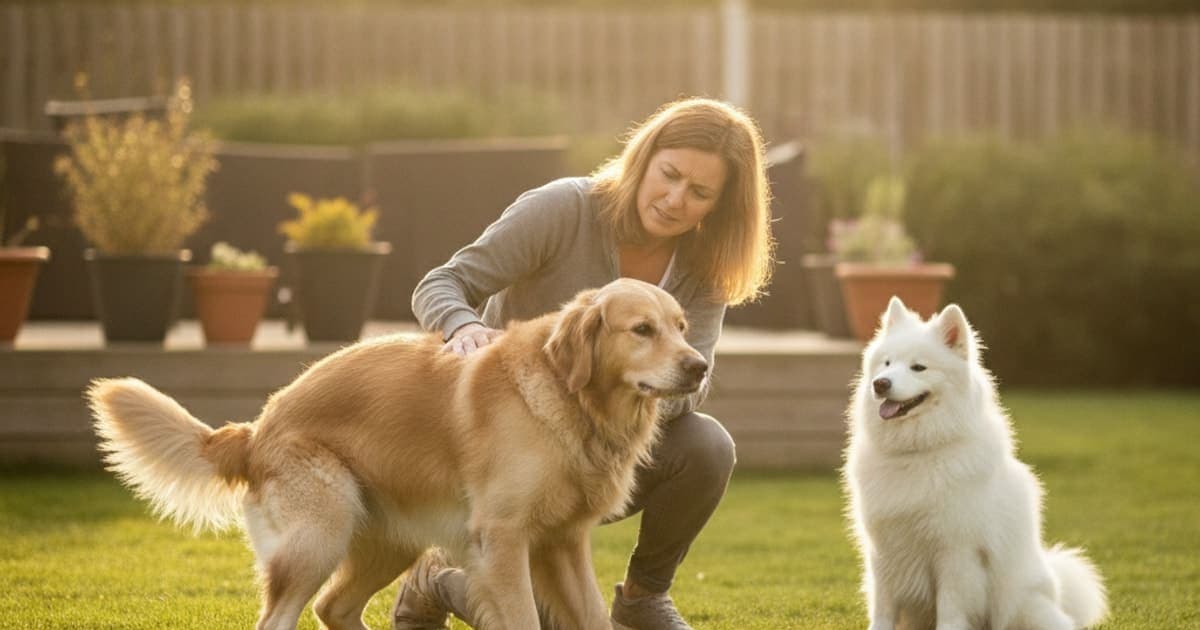
Why is my dog struggling to squat?
A dog struggling to squat is usually telling you that the position hurts, or that the muscles holding it have weakened. Squatting loads the hips, stifles, lower spine and hind paws at the same time and asks the dog to balance there. Arthritis, cruciate ligament injury, lumbosacral pain, paw injuries and hind-limb weakness all show up in that posture early — often before a limp appears.
There is a second possibility that has nothing to do with joints at all: the dog can hold the position fine but nothing is coming out. Straining, circling, repeated attempts and quick abandoned squats point toward the bladder, colon, prostate or anal glands rather than the skeleton. Sorting those two categories apart is the first useful thing you can do before you call your veterinarian.
What a squat actually demands from a dog's body
It looks trivial. It is not.
To squat and hold, a dog has to flex both hips and both stifles under load, tuck the pelvis, engage the lumbosacral junction, keep the hocks stable, grip the ground with the hind paws, and stay balanced on a shrinking base of support — sometimes for a minute or more, sometimes on wet grass or a slick floor.
That means a squat is a whole-chain stress test of the hind end. A dog can trot through the yard on a mildly arthritic hip and look fine, because trotting is brief, symmetrical loading. Holding a deep, static, asymmetric posture is much harder. This is why owners so often say the same thing: he walks normally, he just can't seem to go to the bathroom comfortably anymore.
So pay attention to the shape of the problem. Does she lower halfway and pop back up? Does he squat, wobble, and step forward mid-stream? Does she look for a wall, a curb, or a slope to lean against? Does he stand and hunch instead of squatting at all? Each of those tells your veterinarian something different, and none of them are things a dog does for no reason.
Orthopaedic and neurological causes worth ruling out
These are the structural explanations, and they are common in middle-aged and senior dogs — though a young athletic dog can arrive at the same place through a single bad landing.
- Hip osteoarthritis and dysplasia. Deep hip flexion under load is exactly the movement an arthritic hip resents. Bunny-hopping, a wide stance, and reluctance to sit squarely often travel with it.
- Cranial cruciate ligament injury. Partial tears are sneaky. The dog may sit with one leg kicked out to the side, hesitate on stairs, and struggle to hold a squat because the stifle is unstable in flexion.
- Lumbosacral disease and intervertebral disc disease. Pain at the base of the spine changes everything about how a dog postures to eliminate. Look for reluctance to jump, a hunched topline, or a yelp when the lower back is touched.
- Degenerative myelopathy and other neurological causes. These tend to present as weakness and coordination loss rather than pain — scuffed nails, knuckling, crossing legs, a hind end that drifts.
- Paw, toe and sesamoid injuries. Squatting drives weight into the toes. A small structure carrying a lot of load, like a sesamoid bone, can make a dog refuse the posture entirely while looking almost sound at a walk.
- Muscle loss and iliopsoas strain. Hind-end muscle mass fades with age and inactivity, and a strained hip flexor makes the down-phase of a squat genuinely painful.
| What you are seeing | Where it often points | What the workup may involve |
|---|---|---|
| Halfway down, then pops back up | Hip or stifle pain under flexion | Orthopaedic exam, drawer and thrust tests, radiographs |
| Squats but wobbles or steps out of it | Weakness, proprioceptive loss, core instability | Neurological localisation, gait assessment |
| Hunches instead of squatting | Lower back or lumbosacral pain, abdominal pain | Spinal palpation, imaging, abdominal exam |
| Lifts or licks one hind paw, sound at a walk | Toe, pad, nail or sesamoid injury | Paw exam, focused radiographs |
| Strains, produces little or nothing | Urinary, colonic, prostatic or anal gland problem | Urinalysis, rectal exam, imaging |
| Avoids only slick floors or wet grass | Traction and confidence, plus underlying pain | Exam plus a home-surface audit |
When it is not the joints at all
A dog that assumes the posture normally but produces nothing is a different case entirely, and it can be urgent.
A dog that strains repeatedly to urinate without producing urine — especially a male dog — is a medical emergency and needs to be seen immediately, not tomorrow. Urethral obstruction is life-threatening within hours.
Less dramatic but still worth a same-week appointment: urinary tract infection, bladder stones, constipation, colitis, full or infected anal glands, prostatic disease in intact males, and vaginitis in young females. Each of these makes elimination uncomfortable, and dogs respond to discomfort by cutting the posture short, trying again, and pacing between attempts.
Then there is the boring explanation that is real more often than people expect: surfaces. A dog with early hind-end weakness will not squat on a floor that slides, on ice, or on a steep wet slope, because the position requires grip. Owners sometimes discover the problem is confined to the tile hallway and the frosted lawn.
Red flags that should move up your timeline
Call your veterinarian promptly if you see any of the following:
- Straining with little or no urine or stool produced
- Blood in urine or stool
- Sudden inability to rise, or dragging either hind paw
- Knuckling over onto the top of a paw
- Crying out when the back or hips are handled
- Non-weight-bearing lameness on any leg
- A swollen, hard or painful abdomen
- Loss of bladder or bowel control
Gradual changes matter too. A dog who has quietly stopped squatting fully over six months has an explanation, and the explanation is rarely "just getting old." Age is a risk factor, not a diagnosis.
What a proper veterinary workup looks like
Your veterinarian's first job is to separate orthopaedic from neurological from internal-medicine causes, because the plans diverge sharply.
Expect a hands-on exam: watching the dog walk, sit and rise; palpating the spine and pelvis; flexing and extending each joint; checking for cruciate instability with drawer and tibial thrust tests; testing conscious proprioception; and examining the paws, toes and nails. A rectal exam and urinalysis are routine when elimination is part of the picture.
From there, radiographs, sedated orthopaedic examination, advanced imaging, or referral to a surgeon or neurologist may follow. Where surgery is indicated — cruciate stabilisation, disc decompression — it is the definitive intervention, and nothing you buy online changes that. The same goes for prescribed pain control: if your veterinarian has your dog on an NSAID, a monoclonal antibody injection, gabapentin or anything else, that plan stays exactly as written unless your veterinarian changes it. Talk to your veterinarian before you add, remove or adjust anything.
Alongside the diagnosis, ask about rehabilitation. Controlled leash walking, underwater treadmill work, targeted strengthening, weight management and laser therapy are genuinely useful, and a certified canine rehabilitation practitioner can build a plan around the specific joint involved.
Practical changes that make squatting easier at home
- Traction first. Runners over slick floors, non-slip mats at doorways, and trimmed paw-pad fur restore the grip a squat requires.
- Nails short. Long nails alter toe loading and stance, which matters in a posture that drives weight into the toes.
- Body condition. Excess weight is the single most modifiable load on an arthritic hip or an unstable stifle.
- A flat, grippy bathroom spot. Grass on level ground beats a slope. Clear snow and leaves down to a stable surface.
- Warmth and movement. Short, frequent walks beat one long one. Cold, stiff muscles make the first squat of the day the worst one.
- Support when needed. A rear-support harness lets an owner take a portion of the load without hovering over the dog.
Where BPC-157 and TB-500 fit into a recovery plan
Once the diagnosis is made and the veterinary plan is running, owners tend to ask the same question: what supports the soft tissue while it does the slow work of remodelling? A tendon–bone interface takes weeks to reorganise, and muscle rebuilt after months of guarding does not come back overnight.
That is the window where peptides have become part of the conversation. BPC-157 is a peptide sequence derived from a protein found in gastric juice; published laboratory research suggests it interacts with pathways involved in blood-vessel formation and growth-factor signalling in connective tissue. TB-500 is a synthetic fragment related to thymosin beta-4, a naturally occurring protein studied for its role in actin regulation, cell migration and tissue organisation. This is emerging and genuinely promising science, and it is why the two are so often used together — they are studied along different but complementary mechanisms, and owners report using the pair through the long tail of a mobility recovery.
K9-REPAIR from pawgen is that combination formulated for dogs: BPC-157 and TB-500, third-party tested with certificates of analysis available, weight-based dosing guidance, shipped direct to your door, and backed by a 60-day money-back guarantee. Neither peptide is an FDA-approved veterinary drug, nothing here treats or cures any condition, and any dosing question — particularly for puppies, pregnant or nursing dogs — belongs with your veterinarian, not a blog. Bring it up at your next appointment so it sits inside the plan rather than beside it.
What deserves your scepticism is the other aisle: kitchen-sink joint chews with a dozen ingredients at token amounts, proprietary blends that hide quantities, and brands with more marketing than analysis. Ask for the certificate of analysis. If a company cannot produce one, that answers the question.
Key takeaways
- Struggling to squat is a load-and-balance problem, a pain problem, or an elimination problem — separate those three before anything else.
- Hips, stifles, the lumbosacral spine and the hind paws are the usual structural suspects; a paw or sesamoid injury can hide behind a near-normal walk.
- Straining with nothing produced, especially urine, is an emergency.
- Traction, nail length, body condition and warmth change the posture's difficulty immediately and cost nothing.
- Surgery, prescribed pain control and rehabilitation are the core of any real plan; peptides operate in the recovery space that plan creates.
Get the diagnosis first. Your veterinarian owns the examination, the imaging, the surgical decision and the medication plan, and no supplement or peptide substitutes for any of it. What supportive options like K9-REPAIR can do is sit alongside proper veterinary care during the weeks and months when tissue is remodelling and strength is coming back — which is exactly where owners are choosing to use them.
Related reading: is sesamoid fracture in dogs painful, what makes sesamoid fracture worse in dogs, and the BPC-157 and TB-500 formulation behind K9-REPAIR.
Owners exploring peptide support for their dog can review K9-REPAIR — BPC-157 + TB-500 formulated for dogs — at https://pawgen.com/. BPC-157 and TB-500 are not FDA-approved veterinary drugs. Nothing in this article treats, cures or prevents any condition; every decision about your dog's care belongs with your veterinarian.
Frequently asked questions
- Can the Wolverine Stack replace my dog's pain medication?
- No. BPC-157 and TB-500 are not substitutes for prescribed medication and should never be a reason to stop or reduce anything your veterinarian has prescribed. Pain control, NSAIDs and other prescriptions are managed by your vet. Owners who use peptides use them alongside that plan, not instead of it.
- How do I know if the Wolverine Stack is working?
- Track function, not feelings. Note how long your dog holds a squat, willingness on stairs, time to rise from lying down, gait quality and stamina on the same walk route. Short weekly videos are more honest than memory. Share those observations with your veterinarian, who can reassess objectively.
- Is the Wolverine Stack FDA approved for dogs?
- No. BPC-157 and TB-500 are not FDA-approved veterinary drugs, and pawgen's content about them is educational rather than a treatment claim. What exists is published laboratory research into their mechanisms plus reports from owners using them through recovery. Discuss use with your veterinarian so it fits your dog's overall plan.
- Can I give my dog BPC-157 and TB-500 together?
- They are commonly used together, which is why K9-REPAIR combines them in one formulation. Research on each peptide points to different but complementary mechanisms in soft tissue, which is the reason owners pair them. Whether it suits your individual dog, and at what amount, is a conversation for your veterinarian.
- How long does BPC-157 and TB-500 together take to work in dogs?
- There is no reliable timeline, and anyone quoting one is guessing. Soft tissue remodels over weeks to months, so owners typically evaluate changes across that horizon rather than days. Individual results vary with the diagnosis, the dog's age and the rehabilitation plan running alongside. Reassess with your veterinarian at set intervals.
- What does BPC-157 and TB-500 together do for dogs?
- Research suggests BPC-157 interacts with pathways involved in blood-vessel formation and growth-factor signalling in connective tissue, while TB-500 relates to thymosin beta-4 and its studied role in actin regulation and cell migration. That is mechanism, not an outcome promise. Neither is FDA-approved, and neither treats any condition.
- Should I take my dog to the vet for struggling to squat?
- Yes. A change in how a dog squats is a functional change worth a veterinary examination, because it can signal orthopaedic, neurological or internal-medicine causes that look identical from the outside. Go immediately if your dog strains without producing urine, drags a paw or cannot rise.
- Is struggling to squat just a normal part of a dog getting older?
- No. Age raises the odds of arthritis, muscle loss and spinal change, but it is a risk factor rather than a diagnosis. Something specific is making the posture hard, and most of those causes respond to identification and management. Ask your veterinarian to pinpoint which structure is involved.
Educational content. BPC-157 and TB-500 are not FDA-approved veterinary drugs. Talk to your veterinarian before starting anything new, especially if your dog is on prescribed medication.