Soft Tissue Injury in Dogs: Signs, Causes and What Helps
A soft tissue injury in dogs is damage to muscle, tendon, ligament or fascia rather than bone. It usually shows as limping, stiffness, swelling or reluctance to jump, and ranges from a mild strain to a complete tear. Diagnosis and severity determine what recovery looks like.
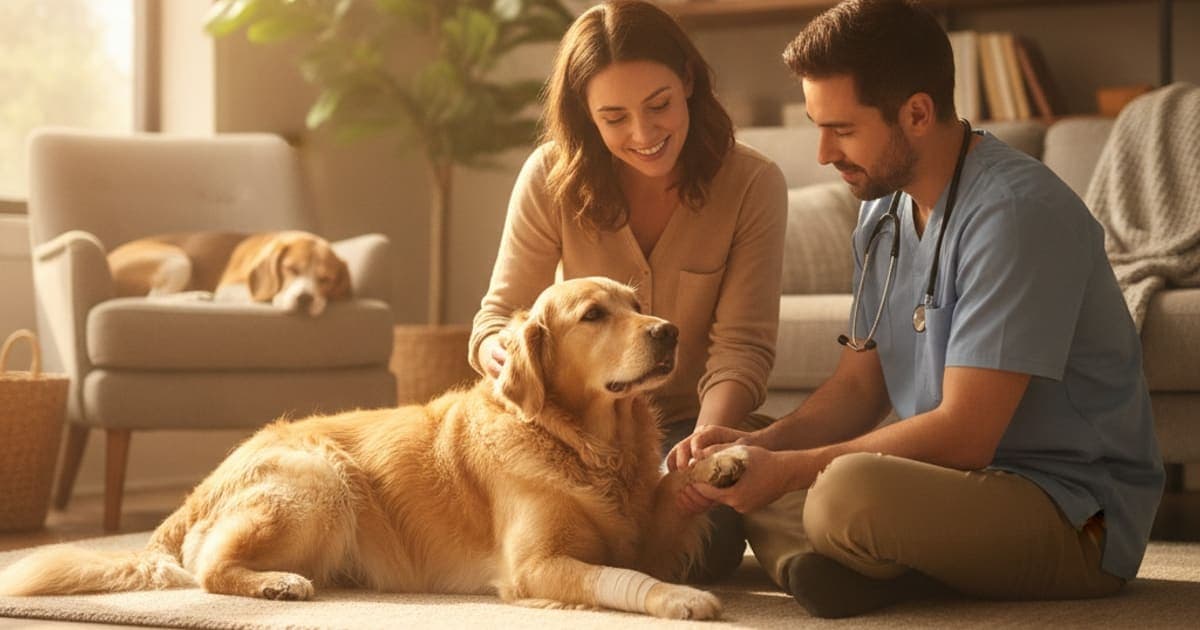
What is soft tissue injury in dogs?
A soft tissue injury in dogs is damage to muscle, tendon, ligament or fascia — the structures that move and stabilise the skeleton, rather than the bone itself. It usually shows up as a limp, stiffness, swelling or reluctance to jump, and severity ranges from a mild strain that settles with rest to a complete ligament tear that needs surgical repair.
That single definition covers an enormous range of real-world situations: the hind-leg hitch after a hard game of fetch, the shoulder that goes sore on a young agility dog, the slow-building lameness of a partially torn cranial cruciate ligament in a middle-aged retriever. What they share is a tissue type. What separates them is severity, location and whether the joint underneath is still stable — and those three things decide everything about how the next few months go.
The tissues involved, and why they heal on their own timeline
Four tissue types account for most of what owners call a "soft tissue injury":
- Muscle — the contractile tissue that generates movement. Strains happen when fibres are overloaded, usually during acceleration, deceleration or an awkward landing.
- Tendon — dense cords that anchor muscle to bone. The biceps and supraspinatus tendons in the shoulder and the Achilles complex in the hock are common problem sites.
- Ligament — dense bands that connect bone to bone and limit how far a joint can travel. The cranial cruciate ligament in the stifle is the most frequently injured ligament in dogs.
- Fascia and joint capsule — the connective sheeting and lining that wrap and contain everything else.
The practical difference between these tissues is blood supply. Muscle is richly vascularised and tends to recover comparatively briskly. Tendon and ligament are not — they are mostly collagen with relatively sparse blood flow, which is exactly why they are slow to repair and why a nagging tendon problem can outlast a broken bone.
Healing also runs in phases rather than a straight line. There is an inflammatory phase, where damaged tissue is cleared and signalling ramps up; a proliferative phase, where fibroblasts lay down new, disorganised collagen; and a remodelling phase, where that collagen gradually reorganises along lines of load and gains tensile strength. The remodelling phase is the long one, and it is load-dependent — tissue only reorganises properly if it is asked to do controlled work. That is the whole logic behind rehab, and the reason a dog can look fine at week three and re-injure at week five.
Signs owners notice first, and how vets grade what they find
Dogs are poor complainers. They almost never announce pain; they redistribute it. The early signs of a soft tissue problem are usually mechanical rather than dramatic:
- A new limp — sudden after an event, or creeping in over weeks
- Stiffness after rest that loosens up in the first few minutes of walking
- Reluctance to jump into the car, onto the sofa, or up stairs
- Toe-touching, or carrying a leg entirely
- Sitting with one hind leg kicked out to the side rather than tucked
- Licking or chewing at one specific area
- Swelling, heat, or a joint that feels thicker than its opposite number
- Slowing on walks, lagging behind, or a shortened stride
- Muscle loss on one side compared with the other, visible after a few weeks of offloading
- Irritability, restlessness at night, or withdrawal from normal play
Asymmetry is the single most useful thing to look for. Stand behind your dog, compare thigh mass side to side, and watch them turn tight circles in both directions. Then get that observation in front of a professional, because a limp is a symptom, not a diagnosis — fractures, immune-mediated joint disease, neurological problems and even bone tumours all present as lameness.
Veterinarians generally sort soft tissue damage by severity, and that grading drives the plan:
| Injury type | What it usually looks like | How vets typically approach it |
|---|---|---|
| Mild strain or sprain | Mild limp that improves within days; joint feels stable | Activity restriction, pain control where indicated, gradual controlled return to work |
| Partial tear | Limp that persists or worsens after activity; swelling; some instability | Examination plus imaging, longer restriction, formal rehabilitation, ongoing pain management |
| Complete rupture | Non-weight-bearing lameness or clear joint instability | Orthopaedic referral; surgical stabilisation such as TPLO is often recommended |
| Chronic repetitive strain | Waxing and waning stiffness, muscle wastage, poor performance | Diagnostics for the underlying cause, load and weight management, structured rehab |
Why these injuries happen in the first place
Most soft tissue injuries are not freak accidents. They are the meeting point of a tissue that was not conditioned for the load and a moment that demanded it anyway.
The weekend-warrior pattern. A dog that walks on lead five days a week and then sprints flat out on a Saturday is asking under-prepared tendon to behave like trained tendon.
Surfaces. Slick floors, wet decking and sudden transitions from grass to concrete produce the exact rotational forces that stifles and shoulders dislike. Rugs and runners are unglamorous and genuinely effective.
Body weight. Every extra kilogram is multiplied through the joints at speed. Weight management is the least exciting and most reliable orthopaedic intervention available to any owner.
Age and tissue degeneration. Collagen quality changes over time. In many dogs, cruciate disease is a slow degenerative process punctuated by an obvious "event" — the ligament had been fraying for months.
Conformation and history. Previous injury, joint laxity, breed conformation, and compensating for pain elsewhere all shift load onto structures that were not designed to carry it. This is why so many dogs injure the second cruciate after the first.
What supports recovery day to day
Nothing you add to your dog's bowl outruns the two things that actually govern soft tissue healing: an accurate veterinary diagnosis and controlled, progressive loading. Everything else is built on top of those.
The conventional pillars come first, and they work:
- Diagnosis. Orthopaedic examination, sedation if needed, radiographs or advanced imaging. You cannot manage what has not been identified.
- Restriction. Short lead walks, no stairs, no jumping, no off-lead running until cleared. Boring is the point.
- Pain and inflammation control. Prescribed medication such as an NSAID exists to keep your dog comfortable and moving normally. Never stop or adjust anything your veterinarian has prescribed without speaking to them first.
- Rehabilitation. Qualified canine rehab — controlled therapeutic exercise, underwater treadmill work, laser or manual therapy — is where remodelling tissue gets the graded stimulus it needs.
- Weight and nutrition. Adequate protein, a lean body condition, and consistency.
- Surgery when it is indicated. For a fully ruptured cruciate in an active dog, surgical stabilisation is usually the standard of care, and no supplement changes that.
Where owners get poorly served is the shelf of kitchen-sink joint chews: fifteen ingredients on the label, most of them at token amounts, no certificate of analysis, and marketing budget where the evidence should be. Scepticism belongs there — not on the question of whether recovery support is worth doing.
Where BPC-157 and TB-500 fit in a recovery plan
Peptides are short chains of amino acids that act as signalling molecules. Two have become the ones owners ask about by name during orthopaedic recovery.
BPC-157 is a synthetic peptide derived from a protein found in gastric juice. Published laboratory and animal research suggests it interacts with pathways involved in angiogenesis — new blood vessel formation — and with fibroblast migration and collagen organisation in tendon and ligament models. Blood supply and fibroblast behaviour are precisely the limiting factors in connective tissue repair, which is why the mechanism interests people working with slow-healing tissue.
TB-500 is a synthetic fragment related to thymosin beta-4, a naturally occurring peptide that binds actin. Research indicates roles in cell migration, angiogenesis and modulation of inflammatory signalling — in plain terms, helping repair cells get to where the damage is.
This is emerging, promising science, and it is being adopted quickly by owners going through recovery. It is also honest to say what it is not: BPC-157 and TB-500 are not FDA-approved veterinary drugs, and nothing here should be read as a claim about what will happen to your dog.
K9-REPAIR is pawgen's BPC-157 and TB-500 formulation made specifically for dogs, with weight-based dosing, third-party testing, published certificates of analysis and direct-to-door shipping, backed by a 60-day money-back guarantee. It is the stack many owners run alongside veterinary care through a strain, a partial tear or a post-surgical rehab block — not instead of that care, and not instead of surgery. Bring it up with your veterinarian, particularly if your dog is on prescribed medication, is very young, or is pregnant or nursing; dosing questions belong in that conversation, not on a blog.
Key Takeaways
- Soft tissue injury means damage to muscle, tendon, ligament or fascia — not bone — and severity ranges from mild strain to complete rupture.
- Tendon and ligament heal slowly because they are collagen-dense and comparatively poorly vascularised.
- The earliest signs are usually mechanical: a limp, stiffness after rest, reluctance to jump, asymmetric muscle mass.
- Grading the injury drives the plan; complete cruciate ruptures in active dogs usually require surgical stabilisation.
- Controlled, progressive loading through qualified rehab is what turns disorganised repair tissue into functional tissue.
- Research suggests BPC-157 and TB-500 act on repair-relevant pathways, and owners increasingly use K9-REPAIR through recovery as a complement to veterinary care.
Your veterinarian owns the diagnosis and the treatment plan — the examination, the imaging, the pain protocol, the decision about surgery and the timeline for returning to normal activity. Supplements and peptides operate inside the space that proper veterinary care creates, never in place of it.
For deeper reading, see the complete guide to soft tissue injury, whether recovery is possible for a dog soft tissue injury without surgery, practical advice on how to prevent soft tissue injury in dogs, a breakdown of what helps a dog with soft tissue injury, guidance on what to give a dog with tplo recovery, the rundown of best treatment for tplo surgery recovery in dogs, and the formulation details for K9-REPAIR.
Owners exploring peptide support for their dog can review K9-REPAIR — BPC-157 + TB-500 formulated for dogs — at https://pawgen.com/. BPC-157 and TB-500 are not FDA-approved veterinary drugs. Nothing in this article treats, cures or prevents any condition; every decision about your dog's care belongs with your veterinarian.
Frequently asked questions
- Is soft tissue injury in dogs painful?
- Yes. Muscle, tendon and ligament tissue carries pain receptors, and the inflammatory phase of injury amplifies that signal. Most dogs do not cry out — they limp, shift weight off the limb, lick one area, hesitate at stairs or withdraw from play. Pain control is a veterinary decision; never give human medication.
- What makes soft tissue injury worse in dogs?
- Uncontrolled activity is the biggest factor. Off-lead sprinting, jumping onto furniture, slick floors and stop-start play reload tissue before it can remodel. Excess body weight, poor conditioning, returning to sport too early, and masking pain without also restricting movement all add strain. Boring, controlled exercise protects healing tissue.
- Can soft tissue injury in dogs be reversed?
- Damaged soft tissue repairs, but repaired tissue is not identical to the original — tendon and ligament heal through collagen scar that remodels over months and is often less elastic than what it replaced. Mild strains can resolve completely; full ruptures usually need surgical stabilisation. Your veterinarian's diagnosis determines what is realistic.
- How much does it cost to treat soft tissue injury in dogs?
- Costs vary widely by clinic, region, severity and whether imaging or surgery is involved. Conservative management — examination, pain control and rehabilitation sessions — generally costs considerably less than orthopaedic surgery such as a cruciate repair, which is a major expense. Ask your clinic for a written estimate before committing.
- Can a dog's soft tissue injury heal without surgery?
- Often, yes. Many strains, sprains and partial injuries are managed conservatively with strict activity restriction, veterinary pain management and progressive rehabilitation. Complete ligament ruptures, particularly cruciate tears in larger or active dogs, more often need surgical stabilisation. Only a hands-on examination, sometimes with imaging, can tell you which category applies.
- What are the first signs of soft tissue injury in dogs?
- A new limp is the most common first sign, occasionally with a yelp during activity. Others include stiffness after rest that eases with movement, reluctance to jump or climb stairs, holding a leg up, licking one spot, localised swelling or heat, and slowing down on familiar walks.
- Should I use ice or heat on my dog's soft tissue injury?
- Cold is generally used for fresh, swollen, hot injuries in the first days, and gentle warmth later for stiffness before controlled exercise. Timing and duration matter, and the wrong choice can aggravate things. Confirm the approach with your veterinarian or rehabilitation therapist for your dog's specific injury.
- What is K9-REPAIR and how do owners use it during recovery?
- K9-REPAIR is pawgen's BPC-157 and TB-500 peptide formulation for dogs, made with weight-based dosing, third-party testing, published certificates of analysis and direct-to-door shipping. Owners use it alongside veterinary care through recovery. These peptides are not FDA-approved veterinary drugs; research suggests roles in tissue repair signalling. Discuss it with your veterinarian.
Educational content. BPC-157 and TB-500 are not FDA-approved veterinary drugs. Talk to your veterinarian before starting anything new, especially if your dog is on prescribed medication.