What Helps a Dog With Soft Tissue Injury? (Recovery Guide)
Controlled rest, a veterinary diagnosis and a staged return to loading are what help a dog with soft tissue injury most. Prescribed pain control and structured rehab protect the healing tissue, and many owners add recovery support such as K9-REPAIR alongside their vet's plan.
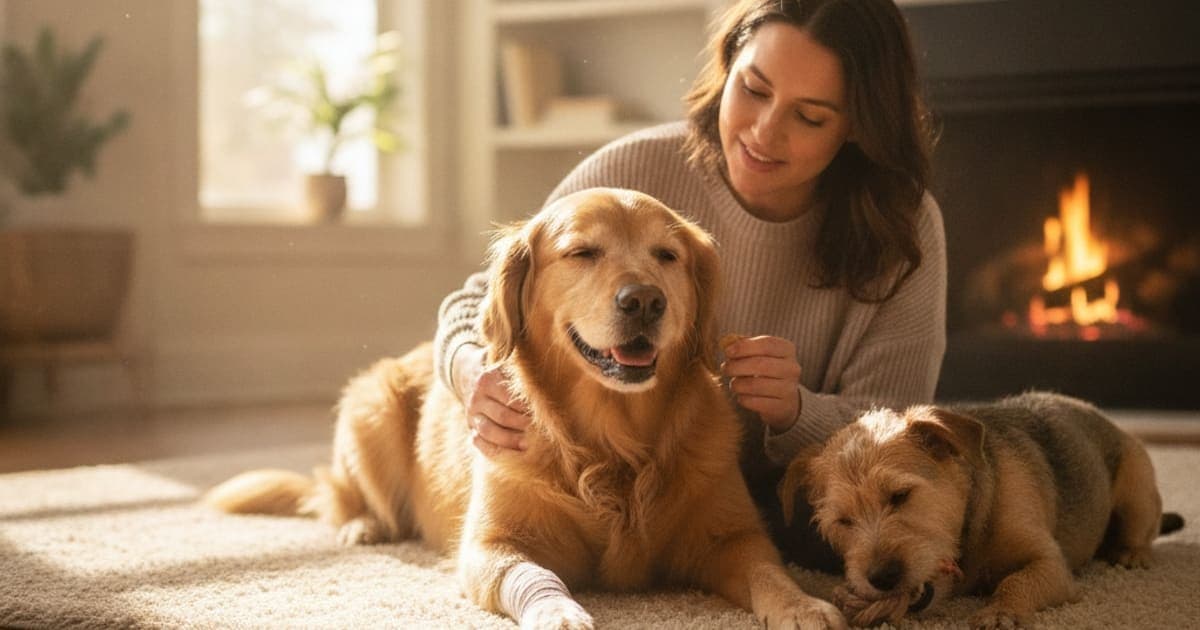
What helps a dog with soft tissue injury?
What helps most is an accurate veterinary diagnosis, genuine activity restriction in the early phase, pain control your veterinarian prescribes, and then a slow, staged return to loading. Veterinary rehabilitation bodies such as the American College of Veterinary Sports Medicine and Rehabilitation consistently place controlled exercise — not complete inactivity, not free running — at the centre of soft tissue recovery.
That is the honest short answer, and it is deliberately unglamorous. Soft tissue heals on a biological schedule you cannot rush, but you can absolutely protect or wreck that schedule with what you do in the first two weeks. Everything else owners layer on — rehab modalities, joint support, peptides like the BPC-157 and TB-500 blend in K9-REPAIR — works inside the space that good veterinary care and disciplined rest create.
What "soft tissue" actually means when your dog is limping
Soft tissue is everything that holds the skeleton together and moves it: muscle, tendon, ligament, joint capsule and fascia. A soft tissue injury in a dog can be a strain (muscle or tendon), a sprain (ligament), a contusion, or a partial tear — and the words matter, because these structures do not behave the same way.
Muscle has a rich blood supply and repairs relatively willingly. Tendon and ligament have far less blood flow, which is precisely why they take longer and why they are so easy to re-injure at the point where the limp has faded but the tissue has not finished reorganising. The collagen laid down in early repair is disorganised; it only aligns along lines of stress as the tissue is loaded gradually over time.
This is also why a wagging, cheerful, weight-bearing dog is not a healed dog. Dogs mask discomfort, offload onto three legs efficiently, and will happily sprint at a squirrel on a leg that is nowhere near ready. The single biggest factor in soft tissue recovery is not what you add to the plan — it is how carefully the injured tissue is loaded across the whole remodelling period, long after the visible limp disappears.
One more reason the diagnosis has to come first: a limp that looks like a simple strain can be a partial cranial cruciate ligament tear, a medial shoulder instability, an iliopsoas injury, or referred pain from the spine. Those have different plans and different prognoses. A hands-on orthopaedic exam, and imaging where your veterinarian thinks it is warranted, is what separates a real recovery plan from guesswork.
The first phase: what genuinely changes the outcome
In the early days after an acute soft tissue injury, four things carry most of the weight.
Restricted activity, enforced properly. No stairs, no jumping on or off furniture, no off-lead running, no rough play with other dogs, short leashed toilet breaks only. A confined space or pen is often easier than trying to police a house. Owners routinely underestimate this step and overestimate how much a dog will self-limit.
Veterinary assessment and pain control. Pain is not a useful training signal in dogs — it drives compensatory movement patterns that create secondary problems in the opposite limb and the lower back. If your veterinarian prescribes an NSAID, gabapentin, or another medication, that plan is doing real work: it keeps your dog comfortable enough to use the limb normally within the limits you have set. Never stop or adjust a prescribed medication on your own, and never substitute a supplement for one.
Cold, then warmth, on veterinary advice. Cold packing in the acute inflammatory window and gentle warmth later are standard rehabilitation tools, but how and when to apply them depends on the injury. Ask your veterinarian to show you on your dog rather than guessing from a video.
Traction and body weight. Non-slip flooring, rugs on hard surfaces, a harness with a handle for support, and — over the longer arc — keeping your dog lean. Excess body weight loads healing tissue on every single step, and it is one of the few variables entirely in your control.
Controlled loading: the phase most recoveries are lost in
Once the acute phase settles, the goal flips from protection to progressive stimulus. Tissue that is never loaded does not organise properly; tissue that is loaded too fast tears again. Threading that needle is what veterinary rehabilitation professionals do for a living.
A structured plan usually builds through short, flat, controlled leash walks that lengthen incrementally, then adds targeted work: weight-shifting exercises, cavaletti poles, controlled sit-to-stands, balance work, and hydrotherapy or underwater treadmill if it is available and appropriate. Manual therapy, therapeutic laser and therapeutic ultrasound are used in many rehabilitation practices as adjuncts.
The two rules that matter for owners: progress in small increments, and judge by the next morning, not the moment. A dog that is stiffer or lamer the day after a session was pushed too hard. If that happens twice, the plan needs revising — talk to your veterinarian or rehabilitation practitioner rather than pushing through it.
Comparing the layers of recovery support
| Layer | What it does | Where it fits |
|---|---|---|
| Veterinary diagnosis and treatment plan | Identifies the actual injured structure; decides on imaging, surgery, medication | First, always — everything else is built on it |
| Prescribed pain control | Keeps the dog comfortable and moving normally within set limits | Owned entirely by your veterinarian |
| Activity restriction and controlled loading | Protects early repair tissue, then stimulates organised remodelling | The core of recovery, start to finish |
| Formal rehabilitation | Restores range of motion, strength and symmetry; catches compensation | Once the acute phase settles |
| Broad-spectrum joint chews | Generic joint support; often kitchen-sink ingredient lists at token amounts | Marginal — read labels critically |
| Targeted peptide support (BPC-157 + TB-500) | Mechanisms studied in tissue repair models; the stack many owners now use through recovery | Alongside the veterinary plan, never instead of it |
The row worth being sceptical about is the chew aisle. Long ingredient lists are a marketing format, not a formulation strategy: a label can carry fifteen impressive-sounding compounds at amounts too small to matter and still look like the most comprehensive product on the shelf. If a brand will not tell you how much of the active ingredient is in a serving, that is your answer.
Where BPC-157 and TB-500 fit, and why owners add them
BPC-157 is a synthetic peptide based on a sequence found in a protective protein in gastric juice. Published laboratory and animal research — much of it from Predrag Sikirić's group at the University of Zagreb — has examined its effects on tendon, ligament and muscle repair models, with mechanisms centred on fibroblast activity, cell migration and the formation of new blood vessels in injured tissue. TB-500 is a synthetic fragment of thymosin beta-4, a naturally occurring peptide originally characterised by Allan Goldstein's group, studied for its role in actin regulation, cell migration and angiogenesis.
Why owners of injured dogs find that interesting is straightforward: blood supply and cell migration are exactly the limiting factors in tendon and ligament repair. That is the mechanism story, and it is emerging, promising science that a growing number of owners are choosing to use during recovery. It is not a promise about your dog. BPC-157 and TB-500 are not FDA-approved veterinary drugs, research suggests rather than establishes their effects, and no peptide replaces surgery, rehabilitation or a prescription.
What pawgen offers is a straightforward version of that: K9-REPAIR combines BPC-157 and TB-500 in weight-based dosing for dogs, with third-party testing and certificates of analysis available, shipped direct to the door and backed by a 60-day money-back guarantee. No fifteen-ingredient label, no vague proprietary blend — the two compounds owners are actually looking for, at a dose scaled to the dog in front of you.
Bring it up at your next appointment. Your veterinarian knows your dog's medications, bloodwork and surgical timeline, and is the right person to weigh anything you add to the plan.
What sets a recovery back
- Returning to normal activity because the limp stopped. The limp resolves before the tissue finishes remodelling.
- Stairs, sofas, car jumps and slippery floors — high-load moments hidden inside an otherwise restful day.
- Off-lead "just for five minutes." One sprint or one twist can undo weeks.
- Stopping prescribed medication early because your dog looks fine.
- Skipping the recheck appointment. Rechecks are where a plan gets adjusted before a setback becomes a second injury.
- Carrying extra weight through recovery.
- Treating a limp that lasts more than a day or two as something to wait out at home.
Key Takeaways
- An accurate diagnosis comes first — a limp can be a strain, a sprain, a partial cruciate tear or referred spinal pain, and they need different plans.
- Strict early activity restriction, then gradual controlled loading, is the backbone of soft tissue recovery.
- Prescribed pain control keeps a dog moving normally; never stop or replace it with a supplement.
- Formal rehabilitation restores strength and symmetry and catches compensation in the other limbs.
- Judge progress by the next morning, and progress in small increments.
- Be sceptical of long, vague ingredient lists; ask what is in a serving.
- BPC-157 and TB-500 are studied for mechanisms relevant to tissue repair, and K9-REPAIR is the stack many owners use through recovery — alongside veterinary care, never in place of it.
The plan belongs to your veterinarian
Your veterinarian owns the diagnosis, the imaging decision, the surgical call and the medication plan. Rehabilitation professionals own the loading progression. Supplements and peptides operate in the space that proper veterinary care creates — they are something you add to a good plan, never something you use to avoid making one. If your dog is limping today, the highest-value thing you can do is book the exam.
For more depth, read the complete guide to soft tissue injury, an examination of the wolverine stack for soft tissue injury in dogs, plus dog soft tissue injury natural alternatives and dog soft tissue injury holistic options. For older dogs, see how much does it cost to treat senior dog stiffness in dogs and what are the first signs of senior dog stiffness in dogs.
Owners exploring peptide support for their dog can review K9-REPAIR — BPC-157 + TB-500 formulated for dogs — at https://pawgen.com/. BPC-157 and TB-500 are not FDA-approved veterinary drugs. Nothing in this article treats, cures or prevents any condition; every decision about your dog's care belongs with your veterinarian.
Frequently asked questions
- Is soft tissue injury in dogs painful?
- Yes. Strains, sprains and partial tears involve inflammation and mechanical pain, and dogs feel it even when they hide it well. Limping, reluctance to jump, licking a joint or a shortened stride are pain signals. Pain control is a veterinary decision, and asking for it early is reasonable and appropriate.
- What makes soft tissue injury worse in dogs?
- Uncontrolled activity is the main culprit — off-lead running, stairs, jumping onto furniture or into cars, and rough play. Slippery floors, excess body weight, returning to normal exercise once the limp fades, stopping prescribed medication early and skipping recheck appointments all raise the risk of re-injury during remodelling.
- Can soft tissue injury in dogs be reversed?
- Injured soft tissue repairs rather than reverses. Muscle often recovers well; tendon and ligament heal with scar-type collagen that gradually reorganises under controlled loading, and repaired tissue can differ from the original. Many dogs return to full function, but the realistic outcome depends on the structure involved — your veterinarian can assess that.
- How much does it cost to treat soft tissue injury in dogs?
- Costs vary widely by clinic, region and severity, so no single figure is meaningful. A mild strain may involve an exam and a short course of medication, while a suspected ligament tear can add imaging, specialist referral, surgery and a rehabilitation course. Ask your clinic for a written estimate.
- Can a dog's soft tissue injury heal without surgery?
- Many can. Mild to moderate strains and sprains are frequently managed conservatively with restricted activity, prescribed pain relief and staged rehabilitation. Complete tears, joint instability and some tendon injuries usually need surgical repair. Only a hands-on orthopaedic exam and imaging can tell you which category your dog falls into.
- What are the first signs of soft tissue injury in dogs?
- A sudden limp, a yelp during play, reluctance to jump or use stairs, and stiffness that is worst after rest. Look for shifted weight when standing, swelling or heat over a joint, licking one area, a shortened stride or a dog that lies down early on walks.
- Do peptides like BPC-157 and TB-500 help dogs with soft tissue injuries?
- Published laboratory and animal research has examined both peptides in tissue repair models, focusing on cell migration, fibroblast activity and new blood vessel formation, and many owners now use them through recovery. They are not FDA-approved veterinary drugs and research suggests rather than establishes effects. Discuss them with your veterinarian.
- How long should a dog rest with a soft tissue injury?
- Long enough for the specific tissue involved, which your veterinarian sets after examining the injury. Muscle typically recovers faster than tendon or ligament, and remodelling continues after the limp disappears. The safer approach is a written, staged progression with recheck points rather than a fixed date you pick yourself.
Educational content. BPC-157 and TB-500 are not FDA-approved veterinary drugs. Talk to your veterinarian before starting anything new, especially if your dog is on prescribed medication.