Spay Recovery in Dogs: Signs, Causes and What Helps
Spay recovery in dogs is the healing period after an ovariohysterectomy, when the skin incision, the abdominal wall and the internal ligature sites knit back together. Most dogs feel bright within days, but the deeper layers regain strength slowly, which is why restricted activity matters more than how the incision looks.
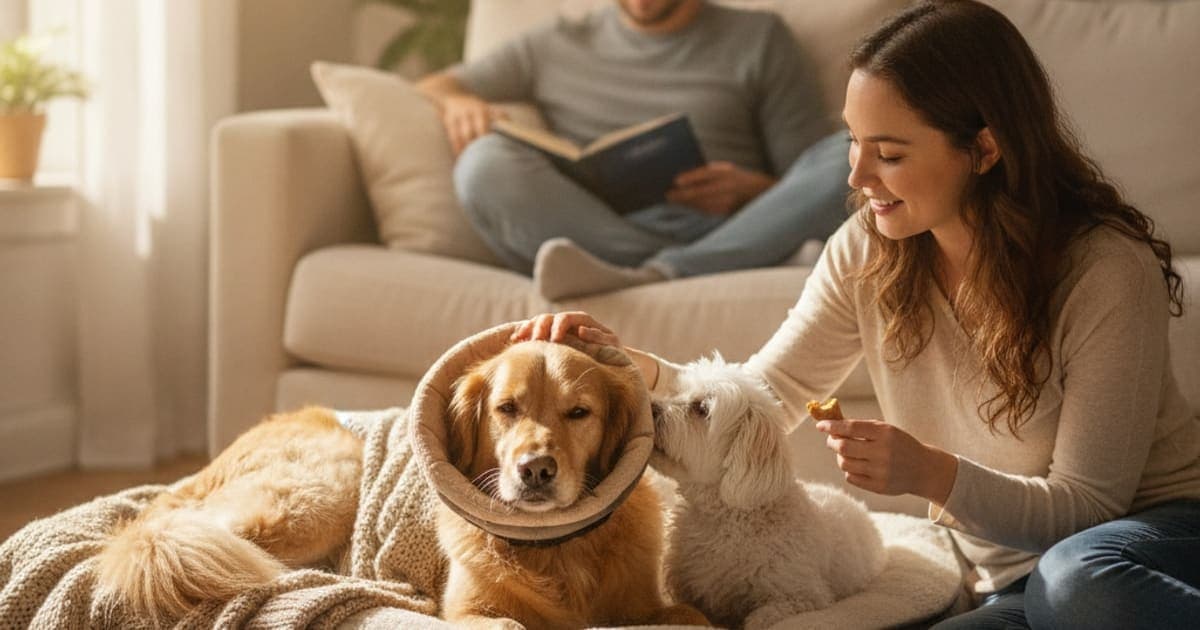
What is spay recovery in dogs?
Spay recovery in dogs is the healing window that follows an ovariohysterectomy (removal of the ovaries and uterus) or an ovariectomy (ovaries only). During it, three separate tissue layers rebuild — the abdominal wall, the tissue beneath the skin, and the skin itself — while the internal ligature sites seal. Comfort usually returns within days; structural strength takes considerably longer.
That gap between how a dog feels and how healed she actually is explains almost every rule on a discharge sheet. A young dog can feel ready to sprint at the back door long before the fibrous seam holding her abdominal wall together has anything close to its original tensile strength. The restriction period is not caution for its own sake. It is a load-management plan for tissue that is still under construction.
Most owners searching for dog spay recovery symptoms are really asking one question: is what I am looking at normal? This article walks through what happens biologically, what normal and abnormal look like side by side, what commonly slows healing down, and what supports the dog through the window.
What the surgery actually does to tissue
In a conventional open spay, the surgeon makes an incision on the midline of the belly, passing through skin, subcutaneous fat and then the linea alba — the tough fibrous seam where the left and right abdominal muscles meet. That seam is deliberately chosen because it is strong connective tissue with relatively little blood supply to disturb. The ovarian pedicles and, in an ovariohysterectomy, the uterine body are ligated, the reproductive tract is removed, and the surgeon closes in layers: body wall first, then the subcutaneous layer, then skin with external sutures, staples or a buried intradermal closure. Laparoscopic spays use smaller port incisions instead of a single long one, but the underlying healing biology is the same.
From the moment of closure, the body runs a predictable repair sequence. First comes haemostasis and inflammation, which is why mild warmth, a pink line and slight swelling in the first few days are part of the process rather than a sign of failure. Next is the proliferative phase: fibroblasts migrate into the wound and lay down type III collagen, while new capillaries grow in to supply the repair — a process called angiogenesis. Without blood flow, collagen cannot be built, because the enzymes that cross-link it are oxygen-dependent.
Then comes remodelling, the slow part. The hastily deposited type III collagen is gradually replaced by thicker, better-organised type I collagen aligned along the lines of mechanical stress. This continues for weeks, and in the fascia it continues well past the point where the skin looks perfect. The skin closing is not the same thing as the abdominal wall healing, and the distance between those two facts is the entire reason the restriction period exists.
There is a second, quieter part of recovery: the hormonal shift. Removing the ovaries ends oestrous cycling and changes the metabolic set point. That does not cause a problem overnight, but it does mean the weeks after surgery are a sensible time to reassess portion sizes with your veterinarian rather than continuing on autopilot.
Normal healing signs versus the ones worth a phone call
Owners do better with a comparison than with a list. Check the incision at the same time each day, in good light, and photograph it so you are comparing against yesterday rather than against memory.
| What you are seeing | Usually part of normal healing | Reason to call the clinic |
|---|---|---|
| Incision line | Thin pink-to-red line, edges sitting together, faint bruising that fades | Edges gaping or separating, spreading redness, a widening dark area |
| Swelling | A small firm ridge along the line as tissue knits | A soft fluid pocket that keeps growing, or swelling that feels hot |
| Discharge | A little clear or slightly blood-tinged seepage in the first day | Pus, a foul smell, or fresh bleeding that does not stop |
| Energy | Groggy the first evening, visibly brighter each day | Still flat, hiding or unwilling to stand after the first couple of days |
| Appetite | Reduced on surgery day, normal shortly after | Repeated vomiting, refusing food, or a distended, painful abdomen |
| Comfort | Stiffness and reluctance to jump | Crying, panting at rest, guarding the belly, or pain that worsens |
| Toileting | Slow to urinate or pass stool at first | No urination, straining, or blood in the urine |
Anything in the right-hand column is a phone call, not a wait-and-see. Clinics expect these calls and would far rather assess a seroma early than a dehiscence late.
What makes spay recovery harder than it needs to be
Most complicated recoveries are not mysterious. They come from a short list of pressures on healing tissue.
Licking and self-trauma. A dog's tongue is abrasive and her mouth is not sterile. Sustained licking macerates the skin edge, introduces bacteria and can pull sutures. This is the single most common reason a clean incision goes wrong, and it is why the cone or a recovery suit stays on — including at night and including for the calm dog who has not touched it yet.
Too much activity, too early. Jumping onto furniture, stairs, zoomies and rough play load the abdominal wall exactly where it is weakest. That shearing can create a seroma (a fluid pocket under the skin) or, less often, separation of the closure.
Moisture and dirt. Bathing, swimming, wet grass and muddy bedding all work against a healing wound. Keep the site dry and the bedding clean and changed.
A more demanding surgery. Spays performed while a dog is in season or pregnant involve a far more vascular reproductive tract and often take longer, and larger, deep-chested or overweight dogs present more tissue to close. Your veterinarian will tell you if your dog's procedure was more involved than routine.
Body condition and age. Excess body fat complicates closure and adds mechanical load. Older dogs and those with endocrine or metabolic conditions may repair more slowly, which is worth flagging before surgery rather than after.
Skipped medication. Under-treated pain leads to restlessness, licking and poor rest. Give the analgesics exactly as prescribed, and never add a human painkiller — several are dangerous to dogs.
Daily management that genuinely helps
Start with the environment rather than willpower. Set up a confined space with non-slip footing before the dog comes home: a pen, a crate or a small room with rugs. Take toileting trips on a short lead, even in a fenced yard, because an unexpected squirrel is faster than your reflexes. Block stairs and furniture access physically instead of relying on correction.
Swap physical outlets for mental ones. Scent games on the floor, slow feeders, frozen enrichment and short training sessions burn real energy without loading the body wall. A bored dog invents her own exercise, and it is always the wrong kind.
Keep the barrier on. If your dog panics in a hard plastic cone, ask the clinic about a soft alternative or a recovery bodysuit — but the answer is a different barrier, not no barrier.
Feed for repair. Collagen synthesis draws on dietary protein, and a dog who is off her food is not building tissue. If appetite has not returned quickly, that is a conversation with your veterinary team rather than something to ride out.
Keep the recheck appointment. Even with buried sutures and nothing to remove, that visit is when a professional assesses the closure and confirms the restriction can be relaxed. Ask directly when normal exercise resumes for your dog, and get the return-to-activity plan in stages rather than as a single release date.
Where recovery peptides fit into the picture
The proliferative phase described earlier — fibroblast migration, new capillary growth, collagen deposition — is the biology that has drawn owner interest toward peptides, and it is where pawgen's work sits.
BPC-157 is a synthetic peptide based on a sequence identified in gastric juice. Published preclinical work in animal models has explored its relationship with angiogenic signalling, fibroblast activity and connective-tissue repair pathways. TB-500 is a synthetic fragment of thymosin beta-4, a naturally occurring protein involved in actin regulation, cell migration and vascular development. Research suggests these mechanisms sit close to the same processes that drive soft-tissue repair, which is why this is emerging science owners are actively adopting rather than a curiosity at the edge of the field.
pawgen makes K9-REPAIR, a K9-REPAIR BPC-157 and TB-500 formulation built for dogs: third-party tested with certificates of analysis available, dosed by body weight, shipped direct to your door, and backed by a 60-day money-back guarantee. It is the stack many owners keep on hand through a recovery window. BPC-157 and TB-500 are not FDA-approved veterinary drugs, nothing here is a treatment claim, and dosing is a conversation to have with your veterinarian — the person who knows your dog's surgery, her medications and her history.
Point your scepticism where it belongs: at kitchen-sink joint chews carrying a dozen ingredients at trace amounts, at proprietary blends that hide how much of anything is actually in the scoop, and at brands that publish marketing copy instead of a certificate of analysis. Ask what is in it, how much, and who tested it.
Key Takeaways
- Spay recovery is the healing of three tissue layers plus internal ligature sites — not just a skin incision.
- A dog feels well long before her abdominal wall is strong; restriction protects the layer you cannot see.
- Compare the incision to yesterday's photo daily; gaping, pus, spreading redness, growing swelling or worsening pain warrant a same-day call.
- Licking, early activity, moisture and skipped pain medication cause most avoidable complications.
- Enrichment, confinement, clean dry bedding and adequate protein do more than any single product.
- Research on BPC-157 and TB-500 centres on repair-phase mechanisms such as angiogenesis and fibroblast activity; owners report using K9-REPAIR through recovery windows, and dosing belongs with your veterinarian.
For deeper reading, see the full guide to spay recovery, a realistic look at dog spay recovery recovery time, an analysis of the wolverine stack for spay recovery in dogs, practical notes on how to prevent spay recovery in dogs complications, and related mechanism pieces on bpc-157 for sprained leg in dogs and bpc-157 for shoulder instability in dogs.
Your veterinarian owns the diagnosis, the surgical plan, the pain protocol and the decision about when your dog returns to normal activity. Nothing in a supplement or peptide discussion changes that order of operations. Talk to your veterinarian about anything you are considering adding during the recovery window, follow the plan they set, and let supportive choices work in the space that proper veterinary care creates.
Owners exploring peptide support for their dog can review K9-REPAIR — BPC-157 + TB-500 formulated for dogs — at https://pawgen.com/. BPC-157 and TB-500 are not FDA-approved veterinary drugs. Nothing in this article treats, cures or prevents any condition; every decision about your dog's care belongs with your veterinarian.
Frequently asked questions
- Is spay recovery in dogs painful?
- Yes, there is genuine post-surgical discomfort, which is why clinics send dogs home with prescribed analgesics. Most dogs are noticeably more comfortable each day. Give medication exactly as directed and never add human painkillers, several of which are toxic to dogs. Crying, panting at rest or worsening pain warrants a same-day call.
- What makes spay recovery worse in dogs?
- Licking or chewing the incision, early jumping and stair use, removing the cone too soon, bathing or swimming, dirty bedding, and skipped pain medication. More involved surgeries — such as spays done during a season or pregnancy — and excess body weight also add load. Report anything unexpected to your veterinarian promptly.
- Can spay recovery in dogs be reversed?
- No, and it does not need to be. Recovery is a forward healing process, not a condition to undo, and the spay itself is permanent. What can be addressed are complications: a seroma, an infection or a separated incision are all managed by your veterinary team, usually more easily the earlier they are seen.
- How much does it cost to treat spay recovery in dogs?
- Routine recovery care, including the recheck and suture removal, is generally covered by the original surgical fee, so ask your clinic what is included before surgery. Costs vary widely by clinic, region and dog size. Complications such as infection or a repaired incision add expense, which is another argument for strict restriction.
- What helps a dog with spay recovery?
- Strict activity restriction, a cone or recovery suit worn continuously, prescribed pain medication given on schedule, daily incision photographs, clean dry bedding, mental enrichment instead of exercise, and adequate protein. Some owners also use K9-REPAIR, a BPC-157 and TB-500 formulation, through the window. Discuss anything you add with your veterinarian.
- How long does spay recovery take to heal in dogs?
- Clinics generally advise around two weeks of restricted activity, with the exact recheck and release date set by your veterinary team based on your dog's surgery. Skin closes first; the abdominal wall continues remodelling collagen for weeks beyond that, so return to running and jumping should be staged, not sudden.
- Is a lump under my dog's incision normal?
- A small firm ridge along the line is often part of normal tissue knitting. A soft, fluid-filled swelling that grows is more consistent with a seroma, commonly linked to too much early movement. Either way, have your veterinarian look at it rather than guessing, particularly if it feels hot or painful.
- Can I give K9-REPAIR during my dog's spay recovery?
- That decision belongs with your veterinarian, who knows your dog's procedure and current medications. K9-REPAIR is a third-party tested BPC-157 and TB-500 formulation dosed by body weight, and it is educational, not a veterinary drug. Research suggests these peptides act on repair-phase mechanisms; they are not FDA-approved and never replace prescribed care.
Educational content. BPC-157 and TB-500 are not FDA-approved veterinary drugs. Talk to your veterinarian before starting anything new, especially if your dog is on prescribed medication.