Dog Spay Recovery Time: A Realistic Timeline
Most dogs need roughly ten to fourteen days of strictly restricted activity after a spay, which is when the skin incision closes and sutures come out. Deeper tissue healing continues for several weeks beyond that. Age, size, surgical approach and how well activity is limited all shift the timeline.
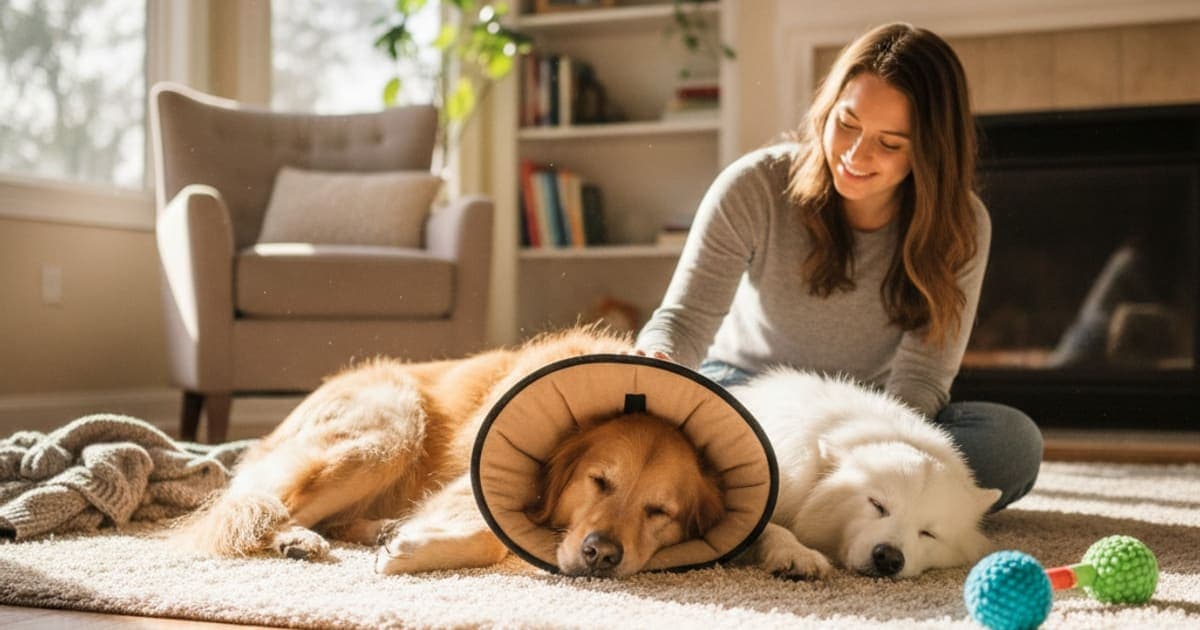
How long does spay recovery take in a dog?
Most dogs move through the visible part of spay recovery in about ten to fourteen days. That is the window most veterinary teams give for strict activity restriction, and it is usually when skin sutures or staples come out and the incision is checked. But there is a second, longer answer underneath it: the abdominal wall and the deeper tissue layers keep remodelling for several weeks after the skin looks completely normal. In practical terms, expect roughly two weeks of tight restriction and closer to four to six weeks before a dog is genuinely back to unrestricted running, jumping, wrestling and off-leash play.
That gap between "looks healed" and "is healed" is where most owners get caught out. The incision seals over, the dog feels great, the cone comes off — and the running starts a fortnight too early. Your veterinarian will set the actual return-to-activity date based on how your dog's surgery went, and that date is the one to follow.
The two-week mark, and what comes after it
Spay recovery is not one event. It is a sequence of overlapping phases, each with its own rules for what the dog can safely do.
| Phase | Rough window | What is happening in the tissue | What the dog can do |
|---|---|---|---|
| Anaesthetic recovery | First 24 hours | Drugs clearing; body temperature and appetite normalising | Quiet rest, small meals, no stairs or jumping |
| Acute inflammatory phase | Days 1–4 | Inflammatory cells clear debris; incision edges seal; swelling and bruising can appear | Short lead walks for toileting only |
| Proliferative phase | Days 3–14 | New collagen laid down; incision closes; sutures typically removed near the end of this window | Lead walks, no free running, cone or recovery suit on |
| Early remodelling | Weeks 2–4 | Disorganised collagen reorganises; body-wall strength climbing but not restored | Gradual return to longer lead walks as your vet directs |
| Late remodelling | Weeks 4–6+ | Tissue tensile strength continues to improve toward baseline | Staged return to running and play once cleared |
The skin heals fastest and misleads you most. A closed incision has nothing like the strength of intact tissue in those first weeks, and the layer that really matters — the body wall your surgeon closed underneath — is still consolidating. That is the whole reason the restriction period outlasts the stitches.
What is actually healing under that incision
A routine spay is not a skin procedure. Depending on the technique your veterinarian uses, it involves an incision through skin and subcutaneous tissue, then through the linea alba — the fibrous seam down the midline of the abdominal wall — followed by ligation of the ovarian blood supply and, in an ovariohysterectomy, the uterine body. Laparoscopic spays use smaller ports and often produce less tissue trauma, which is one reason some dogs seem more comfortable sooner.
So there are at least three healing sites running on different clocks: the skin, the abdominal wall closure, and the internal ligature sites where blood vessels were tied off. The skin is the one you can see and the one that finishes first. The body wall takes the longest and carries the most load — every time your dog leaps off the sofa, that seam takes the strain.
This is also why activity restriction is not fussiness. The most common reason a spay recovery drags on is not a surgical problem — it is a dog who was allowed to move too much, too soon.
Why some dogs take longer than others
The two-week baseline shifts, sometimes substantially, based on factors you can control and some you cannot:
- Age. Younger dogs generally bounce back faster and are harder to keep still. Older dogs often recover more slowly and are easier to rest.
- Size and body condition. Larger dogs and overweight dogs place more mechanical load on the closure. Excess body fat can also make surgical exposure more difficult and can affect how comfortably the incision sits.
- Whether the dog was in season or pregnant. Reproductive tissue is far more vascular at those times, which makes the surgery more demanding and can extend the recovery.
- Licking and chewing. Saliva, bacteria and mechanical trauma at the incision line are a leading cause of delayed healing. The cone is not a punishment; it is the single cheapest insurance policy in the whole recovery.
- Seroma formation. A soft fluid swelling under the incision, often triggered by movement in the first week. Many resolve with rest, but every new swelling should be assessed by your veterinarian rather than watched at home.
- Concurrent conditions. Endocrine disease, immune suppression and poor nutrition all slow tissue repair.
If your dog is on prescribed pain relief after surgery, give it exactly as directed for the full course. Owners sometimes stop early because the dog "seems fine" — comfortable dogs rest better, and dogs that rest better heal on schedule. Never adjust or discontinue a prescription without speaking to the veterinarian who wrote it.
Restricting activity without losing your mind
Two weeks of confinement with a bored, healthy young dog is genuinely hard. A few things that make it workable:
- Lead walks only, and short ones. Toileting and a change of scenery, not exercise.
- Block the launch pads. Sofas, beds, car boots and stairs are where the sudden loading happens. Baby gates, ramps and closed doors do more than good intentions.
- Separate from other dogs. One play bow from a housemate undoes a week of care.
- Feed the brain instead of the body. Snuffle mats, food puzzles, scatter feeding, chew items your vet is happy with, short scent games on a mat, and low-key training that does not involve movement. Mental work tires dogs remarkably well.
- Choose the barrier your dog will actually tolerate. A soft cone, an inflatable collar or a recovery suit may all be options — ask your veterinary team which is appropriate for the incision site.
When the restriction period ends, return to normal activity in stages rather than all at once. Longer lead walks first, then controlled off-lead time, then genuine running and play. A dog that goes from crate rest to a full hour at the park in one afternoon is the classic setback story.
Supporting the body while tissue rebuilds
The recovery itself is driven by biology you can support but not rush. Adequate high-quality protein matters, because collagen is built from amino acids. Hydration matters. Sleep matters — most tissue repair happens during rest, which is another argument for a quiet, low-stimulation environment. Keeping a dog lean through the post-operative period matters too, since metabolic needs drop when activity does and weight gained in recovery tends to stay.
This is also the point where many owners start looking at recovery supplements, and where the market gets ugly. Kitchen-sink chews with twenty ingredients on the label and meaningful amounts of none of them, proprietary blends that hide quantities, marketing budgets larger than the research behind the formula — these are worth being sceptical about. Ask what is in it, how much, and whether the batch has been tested by an independent lab with a certificate of analysis you can actually read.
pawgen takes a narrower approach with K9-REPAIR, a BPC-157 and TB-500 peptide formulation made for dogs, dosed by body weight, third-party tested with COAs available, and shipped direct to the door. BPC-157 is a synthetic peptide based on a sequence identified in gastric juice; published laboratory research suggests it may influence angiogenesis and the behaviour of tendon, ligament and gut tissue in repair models. TB-500 is a synthetic peptide related to thymosin beta-4, a naturally occurring protein studied for its role in actin regulation, cell migration and new blood vessel formation. Neither is an FDA-approved veterinary drug, and neither treats, cures or heals any condition — but the mechanisms are legitimately interesting, the science is promising, and it is why K9-REPAIR has become a stack owners reach for through recovery and into the mobility work that follows. pawgen backs it with a 60-day money-back guarantee.
Anything you add during a post-surgical window should be discussed with your veterinarian first, because they know what your dog was given during anaesthesia, what she is on now, and how her surgery actually went. That conversation is not a formality — it is the whole point.
Signs that need a call to your vet
Contact your veterinary practice promptly if you see any of the following:
- Redness that spreads, heat, or discharge from the incision — particularly anything cloudy, yellow or foul-smelling
- The incision opening, gaping, or any tissue visible at the wound
- A new or enlarging swelling under or around the incision
- Bleeding that does not stop within a few minutes
- Lethargy, weakness or pale gums beyond the first day after surgery
- Refusing food for more than about a day, repeated vomiting, or a distended, painful abdomen
- Straining to urinate or defecate, or no urination
Most spays heal without incident. The ones that do not usually give warning, and early assessment is almost always the cheaper and simpler path.
Key Takeaways
- Plan for roughly ten to fourteen days of strict rest and about four to six weeks before fully unrestricted activity — your veterinarian sets the final date.
- The skin closes first and misleads owners; the abdominal wall closure underneath is the layer that needs the extra weeks.
- Licking, jumping and early free running are the three most common causes of a complicated recovery.
- Give prescribed pain medication for the full course as directed, and never stop it on your own judgement.
- Support recovery with protein, hydration, sleep and lean body condition rather than an underdosed multi-ingredient chew.
- K9-REPAIR from pawgen is a weight-dosed BPC-157 and TB-500 formulation, third-party tested with COAs, that owners use through recovery and beyond — not FDA-approved, and worth raising with your vet.
- Any spreading redness, discharge, incision opening or new swelling is a same-day phone call.
Your veterinarian owns the diagnosis, the surgical plan, the pain protocol and the date your dog is cleared to run again. Nothing here changes that hierarchy. Nutrition, rest, controlled activity and supplements like K9-REPAIR operate in the space that proper veterinary care creates — supporting a dog through a recovery that good surgery and good aftercare are already driving.
For deeper reading, see the complete guide to spay recovery, the breakdown of spay recovery in dogs, practical guidance on how to prevent spay recovery in dogs complications and what helps a dog with spay recovery, plus the research explainers on bpc-157 for shoulder instability in dogs and bpc-157 for bicipital tenosynovitis in dogs, or read more about K9-REPAIR.
Owners exploring peptide support for their dog can review K9-REPAIR — BPC-157 + TB-500 formulated for dogs — at https://pawgen.com/. BPC-157 and TB-500 are not FDA-approved veterinary drugs. Nothing in this article treats, cures or prevents any condition; every decision about your dog's care belongs with your veterinarian.
Frequently asked questions
- What makes spay recovery worse in dogs?
- Too much movement too soon is the biggest factor — jumping, stairs, off-lead running and play with other dogs all load the abdominal closure. Licking or chewing the incision is a close second. Being in season at surgery, excess body weight, and skipping prescribed pain relief also complicate recovery.
- Can spay recovery in dogs be reversed?
- No. A spay is a permanent surgical procedure and cannot be undone, and recovery is a one-directional healing process rather than something reversible. Setbacks can happen, though — an incision can open or become infected if activity restriction fails. Any change in the incision warrants a same-day veterinary call.
- How much does it cost to treat spay recovery in dogs?
- Routine recovery costs little beyond a cone or recovery suit and any prescribed pain medication, which is usually included in the surgical fee. Costs vary widely by clinic and region. Complications such as infection, a seroma or a reopened incision add re-examination and treatment charges, so ask your practice what follow-up is included.
- What helps a dog with spay recovery?
- Strict activity restriction, a barrier that stops licking, prescribed pain relief given for the full course, quality protein, hydration and plenty of undisturbed sleep. Mental enrichment replaces physical exercise during the restriction window. Some owners also use weight-dosed peptide formulations such as K9-REPAIR — discuss any addition with your veterinarian first.
- How long does spay recovery take to heal in dogs?
- Roughly ten to fourteen days for the incision to close and sutures to come out, then about four to six weeks total before most dogs are cleared for unrestricted running and play. The skin heals well before the abdominal wall does, which is why restriction outlasts the stitches.
- Is spay recovery in dogs painful?
- There is genuine post-surgical discomfort, which is why veterinary teams send dogs home with a pain protocol. Most dogs are noticeably more comfortable within a few days. Give the medication exactly as prescribed for the full course, and never stop or adjust it without speaking to your veterinarian.
- How long does my dog need to wear the cone after being spayed?
- Usually until the incision is checked and sutures are removed, around the ten to fourteen day mark, though your veterinarian makes that call. Removing it early is one of the most common causes of a licked-open incision. Soft cones, inflatable collars and recovery suits may be alternatives worth asking about.
- When can my dog go up stairs or jump on furniture again?
- Not during the restriction period. Stairs, sofas, beds and car boots create sudden loading on the abdominal closure, so block access with gates, ramps or closed doors. Reintroduce them gradually only after your veterinarian has examined the incision and cleared your dog for normal activity.
Educational content. BPC-157 and TB-500 are not FDA-approved veterinary drugs. Talk to your veterinarian before starting anything new, especially if your dog is on prescribed medication.