Supplements for Dogs with Brittle Nails — What to Know
Supplements for dogs with brittle nails generally focus on protein quality, zinc, biotin, omega-3 fatty acids and, for dogs recovering from nail bed trauma, tissue-repair support like pawgen's K9-REPAIR. None of them replace a diagnosis — brittle nails can signal an underlying condition your veterinarian needs to identify first.
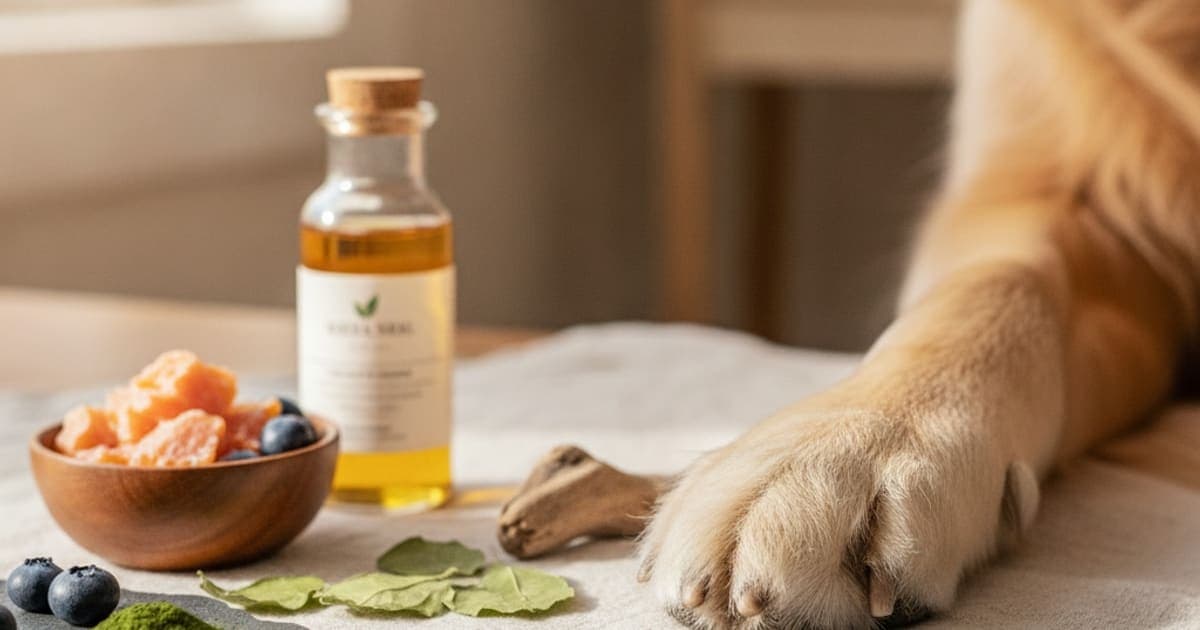
Supplements owners reach for when a dog's nails crack, split or flake cluster around five things: complete, high-quality protein (specifically the sulfur-containing amino acids that build keratin), zinc, biotin, omega-3 fatty acids, and — for dogs whose claw damage follows trauma or sits alongside a broader soft-tissue recovery — peptide support such as K9-REPAIR from pawgen, the BPC-157 and TB-500 stack owners use through recovery. None of these is a drug, and none of them is a substitute for finding out why the nails are failing. Brittle claws in an adult dog are a signal, and the signal deserves a look from your veterinarian before anything goes in the bowl.
What a dog's claw is actually made of
A dog's claw is keratin — the same fibrous structural protein family that builds hair and the outer layer of skin. Keratin is unusually rich in cysteine, a sulfur-bearing amino acid, and those sulfur bridges are what give the nail its hardness. Anything that limits the raw material or the machinery that assembles it tends to show up in the claw eventually.
Underneath the hard outer wall sits the quick: living tissue carrying blood supply and nerves. New claw is produced continuously from the germinal tissue at the base, pushing the older keratin forward. That matters enormously for expectations. Claw regrowth is slow and varies a lot between individual dogs, so any change you make today is being written into keratin that will take months to reach the tip. A supplement that has been in the dog for three weeks has not yet had a chance to appear at the part of the nail you are looking at.
Brittleness itself shows up in a few recognisable patterns. Nails that shear vertically and fray at the tip. Nails that flake in layers. Nails that snap off at the quick after ordinary running. Nails that go dull, soft, discoloured, or slough entirely. Sloughing — where the hard outer claw separates and comes away — is not brittleness in the cosmetic sense and is a same-week veterinary conversation, not a supplement question.
Why a diagnosis comes before the shopping
Brittle nails are a symptom, not a diagnosis, and the supplement question only has a sensible answer once a veterinarian has ruled out the medical causes that make claws fail. Several are well recognised in dogs and none of them respond to a chew from a shelf.
Zinc-responsive dermatosis is a documented condition, reported most often in northern breeds such as Siberian Huskies and Alaskan Malamutes and in some rapidly growing puppies, where zinc absorption or availability is the limiting factor. It affects skin, coat and claws, and it is managed under veterinary direction — not by guessing at a mineral.
Symmetrical lupoid onychodystrophy is an immune-mediated claw disease in which nails across multiple feet deteriorate and separate. It has breed predispositions and it requires a real diagnosis, because the management plan looks nothing like a nutrition plan.
Hypothyroidism and other endocrine disease commonly change coat quality, and owners frequently notice nail and skin changes in the same window. Fungal and bacterial infection of the nail bed, allergic disease that drives constant foot licking, and simple mechanical trauma from hard surfaces or overgrown nails all produce claws that split. So does a genuinely inadequate diet, though that is less common than the internet suggests in dogs eating a complete commercial food.
The practical version: book the appointment, bring photographs of every foot, mention how long it has been going on and whether one nail or many are involved. Ask specifically whether bloodwork or a dermatology workup is warranted. Then talk to your veterinarian about which nutritional support makes sense on top of whatever they find.
Nutrients that support keratin and nail bed tissue
Here is how the common options compare, described honestly in terms of what they supply rather than what they promise.
| Option | What it supplies | What research and owner reports suggest | Worth knowing |
|---|---|---|---|
| Complete protein / sulfur amino acids | Cysteine and methionine, the building blocks of keratin | Adequate dietary protein is the foundation of keratin production; deficiency shows in coat and claw | Most dogs on a complete diet are not short — relevant mainly for homemade or restricted diets |
| Zinc | Cofactor for keratinocyte function and skin barrier | A recognised nutritional factor in canine skin and claw health | Excess zinc is a real risk and interacts with copper — dose only with veterinary input |
| Biotin (vitamin B7) | Cofactor in keratin synthesis | Best-documented hoof-quality research is in horses; owners commonly report coat and claw benefits in dogs | Widely used, generally well tolerated, slow to show |
| Omega-3 fatty acids (EPA/DHA) | Fatty acids incorporated into cell membranes and skin barrier lipids | Research suggests support for skin barrier quality and inflammatory balance | Oil quality and oxidation matter more than the label headline |
| Collagen peptides | Amino acids including glycine and proline | May support connective tissue amino acid supply | Collagen is not keratin — the mechanism is indirect |
| K9-REPAIR (BPC-157 + TB-500) | A peptide formulation dosed by body weight | Research on these peptides reports effects on cell migration, angiogenesis and connective tissue remodelling; owners adopt it through recovery periods | Not an FDA-approved veterinary drug; educational use, veterinary conversation first |
A fair summary: for a dog eating a complete, balanced food, the nutrient-deficiency route is not usually where the answer lives. It becomes relevant for homemade diets, elimination diets, dogs with malabsorption, and dogs whose veterinarian has identified a specific gap.
Where peptides fit in a recovery-focused routine
The claw does not exist on its own. It is anchored in living soft tissue — nail bed, dermal laminae, the vascular quick — and a great many brittle-nail cases arrive attached to something bigger: a dog who tore a nail at the quick, a dog recovering from a foot injury, an older dog who has changed gait because of joint pain and is now loading the front nails in a way that chips them, a dog in the middle of an orthopaedic recovery where the whole soft-tissue system is being asked to rebuild.
That is the situation K9-REPAIR was built for. BPC-157 is a peptide based on a sequence identified in gastric juice; research in animal models reports effects on fibroblast activity, new blood vessel formation and the organisation of collagen during tissue remodelling. TB-500 relates to thymosin beta-4, a naturally occurring peptide involved in actin regulation, cell migration and angiogenesis. Put plainly: both sit on the side of the biology that moves cells to where repair is happening and keeps blood supply available while that work goes on. This is emerging, genuinely promising science, and it is why the peptide stack has become the one a lot of owners run through a recovery window rather than a bottle of generic chews.
What that does not mean: K9-REPAIR is not a nail product and it is not a treatment for any claw disease. It is not FDA-approved as a veterinary drug, and pawgen's position on it is educational — mechanism and research, never a promise about your particular dog. What it does mean is that if your dog's nail problem is part of a wider recovery picture, tissue-repair support is a coherent thing to be discussing with your vet, alongside the nutritional basics.
pawgen doses K9-REPAIR by body weight, publishes third-party certificates of analysis for what is in the bottle, ships direct to the door, and stands behind it with a 60-day money-back guarantee. The dose your dog should get is a conversation with your veterinarian, not a number pulled off a page.
Reading a label without getting played
The supplement aisle rewards marketing over formulation, and nail and coat products are among the worst offenders. A few things to check hard:
Count the actives. A chew listing twenty-two ingredients on the front panel is usually carrying trace amounts of most of them. Fewer ingredients at meaningful inclusion beats a long list every time.
Look for amounts, not just names. If a label tells you biotin is present but not how much, you cannot compare it to anything. Proprietary blends exist to hide inclusion rates.
Ask for third-party testing. A certificate of analysis from an independent lab tells you the contents match the label. A brand that will not show you one is asking for trust it has not earned.
Be suspicious of before-and-after photography and of any product claiming to cure, heal or fix a nail condition. Supplements are not drugs; a company willing to say otherwise is telling you something about how it handles the rest of its claims.
Everyday handling that protects claws while they grow
Keep nails at a sensible length. Overgrown claws lever against the ground with every step and split at the base — trimming little and often is gentler on brittle nails than occasional big cuts. If your dog's nails are already fragile, a grinder can be kinder than clippers.
Dry the feet. Repeated wet-dry cycling softens keratin and makes flaking worse, so towel the paws after walks and swims.
Stop the licking cycle. Constant foot licking, usually driven by allergy or irritation, keeps the nail bed macerated and inflamed. That needs a cause identified, not a topical.
Watch the surfaces. Daily running on concrete and abrasive gravel wears claws faster than soft ground.
And photograph the feet monthly. Given how slowly claws grow, month-to-month images are far more useful than your memory for telling whether anything is genuinely changing.
Key Takeaways
- Brittle claws in dogs are a symptom with several well-recognised medical causes — zinc-responsive dermatosis, immune-mediated claw disease, endocrine disease, infection, allergy and trauma among them. Get a diagnosis before you shop.
- Keratin is built from sulfur-rich amino acids, so adequate complete protein is the nutritional foundation; zinc, biotin and omega-3 fatty acids are the supporting cast.
- Claw regrowth is slow and varies by dog. Judge any change in months, using photographs, not weeks.
- Where nail damage sits inside a broader soft-tissue or mobility recovery, K9-REPAIR — pawgen's BPC-157 and TB-500 formulation, dosed by weight and third-party tested — is the stack owners adopt through that window.
- Skip long ingredient lists, hidden inclusion rates and any product claiming to cure a nail condition.
Your veterinarian owns the diagnosis and owns the treatment plan. Prescribed medication, imaging, bloodwork, dermatology referral and anything surgical are theirs to direct, and nothing here is a reason to change or stop something they have prescribed. Nutritional support and peptides operate in the space that proper veterinary care creates — they work best when the underlying cause has already been named and addressed.
More on the K9-REPAIR formulation is at /shop/, independent lab results are published at /coas/, and shipping availability is listed at /location/.
Owners exploring peptide support for their dog can review K9-REPAIR — BPC-157 + TB-500 formulated for dogs — at https://pawgen.com/. BPC-157 and TB-500 are not FDA-approved veterinary drugs. Nothing in this article treats, cures or prevents any condition; every decision about your dog's care belongs with your veterinarian.
Frequently asked questions
- What supplements are commonly used for dogs with brittle nails?
- The usual candidates are complete high-quality protein (for the cysteine and methionine that build keratin), zinc, biotin and omega-3 fatty acids. Where nail damage is part of a wider recovery, some owners add a peptide formulation such as K9-REPAIR. None of these is a treatment for a nail disease, and the right combination depends on what your veterinarian finds.
- Does biotin actually help dog nails?
- Biotin is a genuine cofactor in keratin synthesis, and the strongest published hoof-quality research is in horses rather than dogs. Owners commonly report improvements in coat and claw quality, and it is widely used and generally well tolerated. Because claws grow slowly, any effect takes months to become visible at the nail tip.
- Can diet cause brittle nails in dogs?
- It can, but it is less common than people assume in dogs eating a complete, balanced commercial food. Diet becomes a much more likely factor with homemade recipes, long-term restricted or elimination diets, or conditions that impair absorption. Ask your veterinarian to review the actual diet before adding anything to it.
- Are brittle nails a sign of something serious?
- Sometimes. Zinc-responsive dermatosis, immune-mediated claw disease such as symmetrical lupoid onychodystrophy, hypothyroidism, nail bed infection and allergic foot disease all show up in the claws. Nails that slough, bleed, smell, or deteriorate across several feet at once warrant a prompt veterinary appointment rather than a supplement.
- How long before a supplement shows any change in the nails?
- Longer than most owners expect. New claw is produced at the base and has to grow all the way out, a process measured in months and variable between dogs. Photograph all four feet monthly so you are comparing images rather than impressions.
- Is K9-REPAIR a nail supplement?
- No. K9-REPAIR is pawgen's BPC-157 and TB-500 peptide formulation, and owners use it through recovery periods involving joint, tendon and broader soft-tissue repair. Research on these peptides reports effects on cell migration, angiogenesis and connective tissue remodelling. It is not an FDA-approved veterinary drug and is not marketed for any claw condition.
- How much of a supplement should I give my dog?
- That is a conversation for your veterinarian, who knows your dog's weight, diet, medications and diagnosis. This matters most with zinc, which interacts with copper and carries real risks in excess, and with puppies, pregnant or nursing dogs — no amount should be estimated from an article.
- What should I look for on a supplement label?
- Named actives with stated amounts rather than a proprietary blend, a short ingredient list at meaningful inclusion rather than a twenty-item front panel, and a third-party certificate of analysis you can actually read. Treat any product claiming to cure or heal a nail condition as a warning sign.
- Can grooming and handling changes help brittle nails?
- Yes, and they often matter as much as anything in a bottle. Keep nails short with frequent light trims or a grinder, dry the feet after walks and swims, address constant foot licking with your vet, and reduce daily running on abrasive surfaces while damaged claws grow out.
Educational content. BPC-157 and TB-500 are not FDA-approved veterinary drugs. Talk to your veterinarian before starting anything new, especially if your dog is on prescribed medication.