Supplements to Stop Dog Eating Poop: What Actually Helps
No supplement reliably stops stool eating on its own. The categories owners try — digestive enzymes, probiotics, B-complex blends, added fiber and taste-aversion additives — support digestion or make stool less palatable, and research on commercial deterrents reports modest results. Pair any supplement with a veterinary workup, immediate cleanup and training.
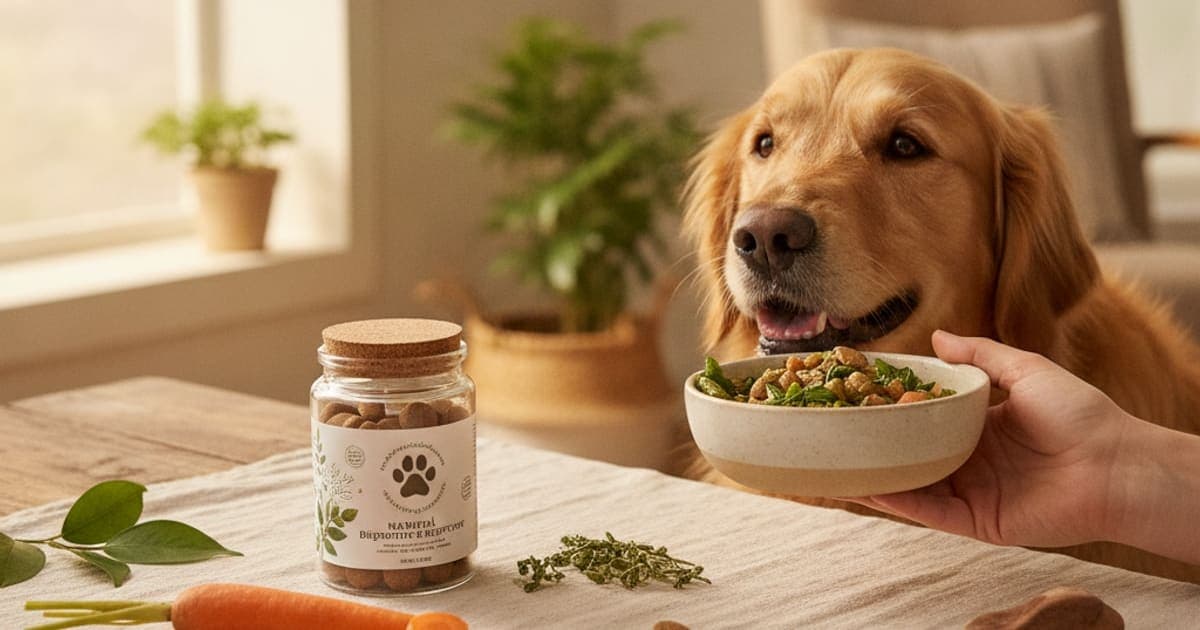
There is no supplement that reliably stops a dog from eating stool on its own. The products owners reach for fall into five honest categories — digestive enzymes, probiotics and prebiotics, B-complex and mineral blends, added fiber, and taste-aversion additives built around ingredients like yucca schidigera, chamomile or capsicum. Each supports something real: digestion, stool quality, nutrient absorption, or the palatability of the stool itself. None of them is a behavioural switch. The owners who get the furthest pair a veterinary workup with immediate cleanup, leash management and a trained trade-up cue, and treat any supplement as support for the plan rather than the plan itself.
That answer is less satisfying than a chew that solves it in a week, but it is the one that holds up. Below is what each category actually does, what the research reports, how to read a label so you are not paying for a proprietary blend of nothing, and where a supplement genuinely earns its place.
Why dogs eat stool — and why that matters before you buy anything
Coprophagia has more than one cause, and the cause dictates whether a supplement is even relevant.
In puppies it is often developmental and exploratory. Mothers clean up after their litters; pups investigate the world with their mouths; many grow out of it without intervention. In adult dogs, behavioural drivers dominate — boredom, scavenging habit, anxiety, attention-seeking (a dog that gets chased across the yard every time has learned a very reliable game), and simple opportunity in a yard that is not picked up promptly.
Then there is the medical column. Malabsorption, exocrine pancreatic insufficiency, intestinal parasites, some endocrine disorders, and appetite changes driven by medications such as corticosteroids can all increase stool-eating. So can a genuinely inadequate diet, though that is rarer than supplement marketing implies in dogs fed a complete commercial food.
This is why the first step is not a purchase. Talk to your veterinarian before you spend anything — a physical exam, a faecal test and, where indicated, bloodwork will tell you whether you are managing a habit or a symptom. A dog with untreated parasites or an absorption problem will keep eating stool no matter what chew you add, and the supplement will get blamed for a failure that was never its job.
The five supplement categories owners try
| Category | Typical ingredients | What it supports | What owners should know |
|---|---|---|---|
| Digestive enzymes | Protease, amylase, lipase, papain, bromelain | Breakdown of proteins, starches and fats; may support firmer, less nutrient-dense stool | Genuinely valuable in dogs with a diagnosed enzyme deficiency — but that is a veterinary diagnosis with prescription-strength management, not an over-the-counter guess |
| Probiotics and prebiotics | Named strains, inulin, FOS, MOS | Gut microbial balance and stool consistency | Look for named strains and a viable-count guarantee through the printed shelf life, not just 'contains probiotics' |
| B-complex and mineral blends | B vitamins, iron, zinc, trace minerals | Filling gaps where a diet is genuinely incomplete | The old 'they eat stool because they are deficient' theory is popular and weakly supported; most dogs on complete diets are not deficient |
| Added fibre | Pumpkin, psyllium, beet pulp | Stool bulk and transit time | Cheap, low-risk, sometimes changes stool enough to reduce interest; also changes how much stool there is to manage |
| Taste-aversion additives | Yucca schidigera, chamomile, capsicum, parsley, glutamate-based ingredients | Making the dog's own stool less palatable after digestion | Only affects stool from dogs actually receiving the product — useless for another dog's stool, cat litter boxes or wildlife droppings |
A few things fall out of that table immediately.
Taste-aversion additives are the only category aimed directly at the behaviour, and they are also the category with the clearest ceiling. Research on canine coprophagy from the veterinary behaviour literature — including work led by Benjamin Hart and colleagues at the University of California, Davis, published in Veterinary Medicine and Science — surveyed owners on commercially available food-additive deterrents and reported low success rates overall. They are not useless, and some owners report a real difference, but they are not the intervention that carries the plan.
Enzymes and probiotics are the categories most likely to help a specific dog for a specific reason. If stool is loose, greasy, voluminous or foul beyond the ordinary, that is a digestion conversation with your vet — and one where supplementation may support a treatment plan your vet builds, rather than substitute for it.
Picking a supplement you can actually verify
This is where most money in the pet aisle is wasted, and it has nothing to do with which category you choose.
The kitchen-sink chew is the dominant format in this market: eighteen ingredients on the front panel, a proprietary blend on the back, no per-ingredient amounts, no third-party testing, no certificate of analysis. Nothing on that label tells you whether the yucca is present at a meaningful level or as a dusting for the ingredient list. When a product hides its amounts inside a blend, assume the amounts are the reason.
A label worth your money answers four questions without you having to email anyone:
- What is in it, and how much of each. Per-ingredient amounts, not a blend total.
- How it is dosed. Dosing scaled to your dog's weight, stated plainly. Guesswork is not a formulation.
- Who tested it. Independent, third-party analysis — identity and purity — with results you can read.
- What happens if it does not suit your dog. A real return policy, stated up front.
That standard is the one pawgen applies to K9-REPAIR, its BPC-157 and TB-500 peptide formulation for dogs — published certificates of analysis from third-party labs, dosing scaled by body weight, direct-to-door shipping and a 60-day money-back guarantee. It is worth being clear about what that product is for: K9-REPAIR is formulated for joint, tendon and soft-tissue recovery support, which is a different job from stool eating. BPC-157 and TB-500 are peptides that research suggests are involved in tissue repair signalling, angiogenesis and cell migration, and they have become the stack many owners adopt through orthopaedic recovery and in ageing dogs who are slowing down. They are not FDA-approved veterinary drugs, and nothing about them is a treatment for coprophagia.
The transferable point is the standard. Whatever you buy for stool eating, hold it to the same bar: disclosed amounts, weight-based dosing, third-party verification, and a company willing to put its testing in public.
The management and training that does the heavy lifting
Supplements operate at the edges of this problem. Management operates at the centre.
Remove the opportunity. Pick up the yard immediately and completely, every time, including in the dark and in winter. Litter boxes go behind a baby gate or up high. On walks, the dog is on a lead in areas where wildlife or other dogs' stool is common. This single change resolves more cases than every additive in the category combined, because a behaviour that cannot be rehearsed cannot be reinforced.
Stop the chase. If your dog has learned that stool-eating produces a frantic, attention-rich reaction, you have inadvertently built a game. Interrupt calmly, redirect, and move on.
Train a trade. A reliable 'leave it' and a strong recall, both built with high-value food and practised in easy settings long before you need them outdoors, give you something to do other than shout. Reward the dog for coming away from the stool rather than punishing the approach — punishment near the resource often just teaches dogs to be faster and sneakier about it.
Address the boredom. Sniff-heavy walks, food puzzles, scatter feeding and chew outlets reduce the scavenging pressure that drives a lot of adult coprophagia. A dog whose foraging drive is satisfied elsewhere has less reason to forage in the yard.
Check the feeding plan. Meal timing, portion adequacy and food quality are worth reviewing with your vet, particularly in growing dogs, high-activity dogs and dogs on restricted diets.
If the behaviour is anxiety-driven or compulsive in character, ask for a referral to a veterinary behaviourist. That is a clinical pathway with real tools, and no supplement substitutes for it.
When stool eating is a signal, not a habit
Some presentations deserve an appointment rather than a purchase. Book one if the behaviour starts suddenly in an adult dog that never did it before, if appetite has changed sharply, if there is weight loss despite eating well, if stool is persistently loose, pale or greasy, if there is vomiting or bloating, or if the dog is on a medication that has increased hunger.
Stool eating also carries a parasite and pathogen transmission risk — giardia, roundworms, hookworms, whipworms and various bacteria move this way — so faecal testing and a current parasite prevention plan are practical necessities, not optional extras. Your veterinarian owns that call.
Key Takeaways
- No supplement reliably stops stool eating on its own; the honest framing is support, not solution.
- The five categories are enzymes, probiotics and prebiotics, B-complex and mineral blends, added fibre, and taste-aversion additives — each supports a different mechanism.
- Taste-aversion additives only affect stool produced by the dog receiving the product, and survey research reports modest success rates overall.
- Rule out medical causes first: parasites, malabsorption, enzyme deficiency, endocrine disease and medication effects all belong to your vet.
- Judge any label on disclosed per-ingredient amounts, weight-based dosing, third-party testing and a stated return policy — the standard pawgen publishes for K9-REPAIR.
- Immediate cleanup, lead management, a trained trade-up cue and enrichment do the heavy lifting.
Your veterinarian owns the diagnosis and the treatment plan — the faecal test, the bloodwork, the prescription, the behaviour referral. Supplements, peptides and management routines work in the space that proper veterinary care creates, and they work best when your vet knows exactly what your dog is receiving. Bring the label to the appointment.
To look further into how pawgen formulates and verifies its products, the published third-party certificates of analysis, the K9-REPAIR product details and shipping availability are all documented on the site.
Owners exploring peptide support for their dog can review K9-REPAIR — BPC-157 + TB-500 formulated for dogs — at https://pawgen.com/. BPC-157 and TB-500 are not FDA-approved veterinary drugs. Nothing in this article treats, cures or prevents any condition; every decision about your dog's care belongs with your veterinarian.
Frequently asked questions
- What is the best supplement for dogs to stop eating poop?
- There is no single best supplement, because the right category depends on the cause. Taste-aversion additives built around yucca schidigera, chamomile or capsicum are the only type aimed directly at the behaviour, and survey research reports modest success. Digestive enzymes and probiotics may support digestion where stool quality is the underlying issue. Ask your veterinarian which column your dog falls into before buying.
- Do digestive enzymes stop dogs from eating poop?
- Digestive enzymes support the breakdown of proteins, fats and starches, and owners report firmer, less appealing stool in some dogs. They are most relevant where a genuine digestive problem exists — but conditions like exocrine pancreatic insufficiency are veterinary diagnoses with prescription-strength management, not something to guess at over the counter. Enzymes are support, not a behavioural fix.
- Does pineapple or meat tenderiser actually work?
- Both are folk versions of the taste-aversion approach — pineapple contains bromelain, meat tenderiser contains papain or glutamate-based ingredients. Some owners report a change, many report none, and neither affects stool from other dogs, cats or wildlife. Check with your vet before adding either, particularly for dogs with sensitive stomachs or dietary restrictions.
- Can probiotics help with stool eating?
- Probiotics and prebiotics support gut microbial balance and stool consistency, and research suggests a role in digestive comfort. That may indirectly reduce interest in stool for some dogs. Choose products listing named strains with a viable-count guarantee through the printed shelf life, rather than a label that just says 'contains probiotics'.
- Is my dog eating poop because of a vitamin deficiency?
- It is a popular explanation and a weakly supported one. Most dogs fed a complete commercial diet are not deficient, and behavioural drivers — scavenging habit, boredom, opportunity, attention — explain more cases. That said, diet adequacy is worth reviewing with your veterinarian, especially in growing dogs, very active dogs and dogs on restricted or home-prepared diets.
- Are supplements safe for puppies that eat poop?
- Puppies are a talk-to-your-vet category, full stop. Growing dogs have different nutritional needs and different tolerances, and puppy coprophagia is often developmental and outgrown. Do not start any supplement in a puppy, or in a pregnant or nursing dog, without veterinary guidance on whether it is appropriate and how it should be given.
- Does K9-REPAIR help with poop eating?
- No. K9-REPAIR is pawgen's BPC-157 and TB-500 peptide formulation for dogs, formulated for joint, tendon and soft-tissue recovery support — a different job entirely. Research suggests these peptides are involved in tissue repair signalling, and they are the stack many owners adopt through orthopaedic recovery. They are not FDA-approved veterinary drugs and are not intended for stool eating.
- How long should I give a supplement before deciding it is not working?
- Agree a review point with your veterinarian rather than a fixed calendar number, because the answer depends on what you are addressing. Keep a simple log of frequency and circumstances, and run the supplement alongside the management changes — cleanup, lead control, trade-up training — so you can see whether the whole plan is moving. pawgen offers a 60-day money-back guarantee on K9-REPAIR, which reflects the kind of return policy worth expecting from any supplement brand.
- Is it dangerous for dogs to eat poop?
- It carries real transmission risk for parasites such as giardia, roundworms, hookworms and whipworms, plus various bacteria. That makes faecal testing and a current parasite prevention plan practical necessities. Speak to your veterinarian about testing and prevention rather than relying on management alone.
Educational content. BPC-157 and TB-500 are not FDA-approved veterinary drugs. Talk to your veterinarian before starting anything new, especially if your dog is on prescribed medication.