TB-500 for Flyball Dogs — Tendon and Joint Support
TB-500 is a synthetic peptide related to thymosin beta-4, a protein involved in cell migration and tissue remodelling, and flyball owners use it — usually paired with BPC-157 — to support tendon, shoulder and joint recovery between weekends of sprinting and box turns. It is not an FDA-approved veterinary drug.
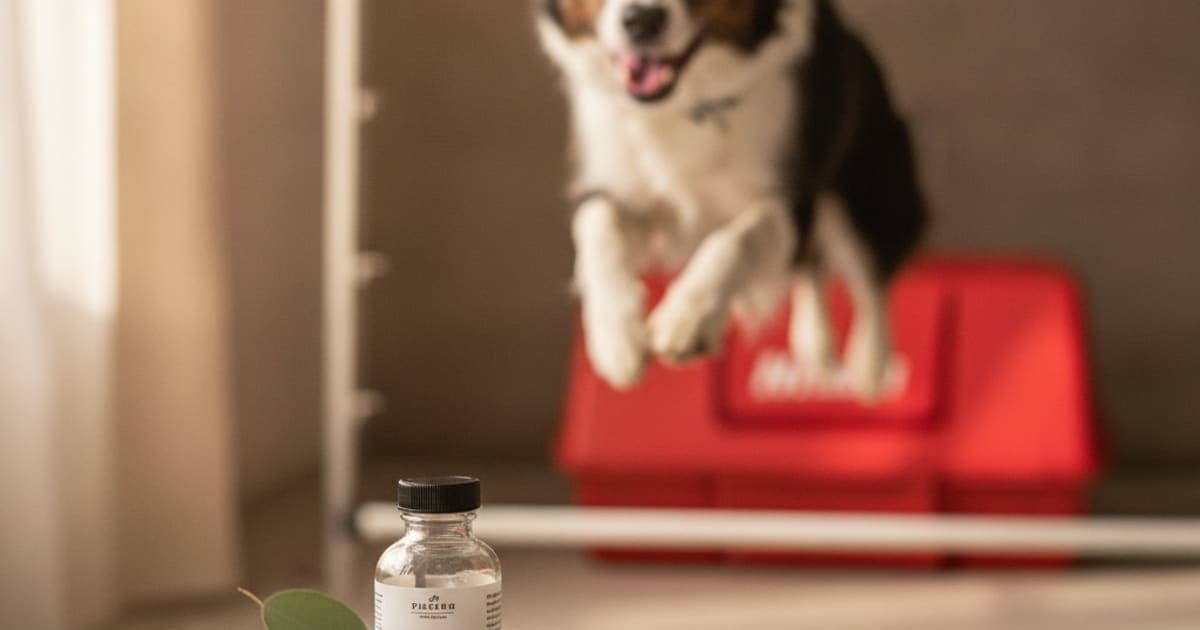
TB-500 for Flyball Dogs: What It Is and Why Owners Use It
TB-500 is a synthetic peptide based on the active region of thymosin beta-4, a protein your dog's own cells already produce, and flyball owners use it — most often paired with BPC-157 — as part of the recovery routine around a sport built on repeated sprints and hard box turns. Research on thymosin beta-4 suggests it is involved in cell migration, new blood-vessel formation and the remodelling of connective tissue, which is why owners of shoulder-sore and stiff sprint dogs have adopted peptide support between competition weekends. TB-500 is not an FDA-approved veterinary drug, it is not a painkiller, and it is not a substitute for a lameness exam. It sits in the recovery layer of a well-run flyball programme, not at the top of it.
What a flyball run actually asks of a dog's body
Flyball looks like fun and it is, but biomechanically it is one of the most concentrated loading patterns in dog sport. Your dog accelerates from a standstill, clears four low hurdles at close spacing, hits the box at near-full speed, rotates through a swimmer's turn while the forelimbs absorb and redirect the entire momentum of the body, grabs a ball, and does the whole thing again in reverse. Then does it again. And again, heat after heat, across a day.
The forces do not distribute evenly. The box turn loads the shoulder complex — supraspinatus and biceps tendons in particular — along with the carpus and the digits. The push off the box and the drive into the hurdles load the hip flexors, especially the iliopsoas. Rotational torque through a planted hind limb is a known contributor to cranial cruciate ligament injury in sporting dogs. Toes take a beating on turf and rubber matting.
What makes this a recovery problem rather than a single-injury problem is the tissue involved. Tendon and ligament are relatively poorly vascularised compared with muscle. Muscle soreness resolves in days; tendon and enthesis remodelling happens across weeks, and the tendon-bone interface reorganises slowly. A flyball dog rarely blows out on one turn. Far more often, small overload accumulates faster than the connective tissue rebuilds, and one weekend the dog is a tenth slower, then shortens stride, then refuses the turn.
What TB-500 is and how the peptide works
Thymosin beta-4 is a small naturally occurring peptide found throughout mammalian tissue, with particularly high concentrations in platelets and in wound fluid — the places the body sends repair signalling. Its best-characterised job is binding G-actin, the monomer form of the protein that builds a cell's internal scaffolding. By regulating the pool of available actin, thymosin beta-4 influences how cells reorganise their cytoskeleton, and therefore how they move.
That matters because tissue repair is, at bottom, a migration problem. Fibroblasts and endothelial cells have to travel into a damaged area, lay down matrix, and build the microvasculature that supplies it. Laboratory and animal research on thymosin beta-4 suggests roles in exactly those steps: cell migration, angiogenesis, and modulation of the inflammatory phase of repair. TB-500 is the synthetic peptide used to deliver that active region, and it is the reason canine sports owners started paying attention to peptides in the first place.
Be clear about what this is not. TB-500 does not mask soreness, so it will not let a dog run through an injury without you noticing. It is not an anti-inflammatory drug and does not replace anything your veterinarian has prescribed. The science here is emerging and genuinely promising, and it is being adopted by owners in performance sport for mechanism reasons that make sense — but the honest framing is that research suggests these effects and owners report benefit, not that any outcome is assured for your individual dog.
Why BPC-157 and TB-500 are used together
Most flyball owners looking at peptides do not use TB-500 alone. BPC-157 is a stable peptide sequence originally identified in gastric juice, and animal-model research has examined it in the context of tendon, ligament and muscle repair, fibroblast migration, growth-factor receptor expression and blood-vessel formation. The two peptides come at connective tissue support through different mechanisms, which is why they are commonly stacked rather than chosen between.
K9-REPAIR is pawgen's BPC-157 and TB-500 formulation for dogs — the stack owners use through recovery periods and heavy competition seasons. It is dosed by body weight rather than one-size-fits-all, third-party tested with certificates of analysis available, shipped direct to the door, and backed by a 60-day money-back guarantee. What it will never come with is a dosing number from an article on the internet: weight-based guidance belongs in a conversation with your veterinarian, who knows your dog's age, medications and injury history. That is doubly true for puppies still closing growth plates and for pregnant or nursing dogs.
Where each layer of a flyball recovery plan fits
Nothing in this table replaces anything else in it. A flyball dog who is holding up well is usually getting several of these at once.
| Layer | What it does | Where it fits for a flyball dog |
|---|---|---|
| Warm-up and cool-down | Raises tissue temperature, primes neuromuscular control, clears the system after heats | Non-negotiable, every single event day |
| Strength and conditioning | Builds eccentric strength and core stability so tissue tolerates box-turn load | Off-days, year-round, the biggest lever most teams underuse |
| Turn technique and jump height | Reduces peak forelimb load at source | Coaching and video review, revisited as the dog ages |
| Veterinary diagnosis and prescribed medication | Identifies what is actually wrong and manages pain and inflammation properly | First stop for any lameness — always |
| Canine rehab (PT, hydrotherapy, laser, manual work) | Restores range of motion and loads healing tissue progressively | After diagnosis, on a plan from a rehab-trained vet |
| Joint chews (glucosamine, chondroitin, green-lipped mussel, omega-3) | General joint and cartilage support | Everyday baseline, quality and transparency vary enormously |
| Peptide support (BPC-157 + TB-500) | Mechanisms research associates with cell migration, angiogenesis and connective-tissue remodelling | The recovery layer owners add around heavy seasons and post-injury rehab, with vet input |
How to read a canine joint product label without getting played
The performance-dog supplement aisle rewards marketing over evidence, and flyball owners are a motivated audience. A few things worth being ruthless about.
Proprietary blends. If a label lists a blend total instead of the amount of each named compound, you cannot know what you are buying. That is the point of the format.
Kitchen-sink formulas. Twenty ingredients on a chew usually means a sprinkle of each, chosen so the label reads well rather than so the amounts mean anything.
No third-party testing. Identity and purity testing by an independent lab, with a certificate of analysis you can actually see, is the baseline for anything you put in a working dog. Ask for the COA. A brand that will not produce one has told you something.
Human-market gloss. Peptide products written for human bodybuilding forums and relabelled for dogs are not the same as a formulation dosed by canine body weight.
Anything promising a cure. No supplement or peptide treats, cures or reverses a condition, and any brand saying otherwise is a brand to walk away from — including on claims about pawgen's own category.
Signs your flyball dog needs a veterinarian, not a supplement
Sport dogs are stoic and drivey, which is exactly the problem: a flyball dog will run on an injury because the ball is more compelling than the pain. Watch for the quiet signals instead. A tenth or two off usual time. Shortened stride on the return. Refusing or altering the box turn. Licking at one shoulder or a carpus. Reluctance to jump into the car after a day that used to be easy. Slow to rise the morning after a tournament.
Also watch the nights. Dogs frequently show musculoskeletal pain as restlessness, repeated position changes, pacing or panting once the house is quiet and the distractions are gone. Night-time restlessness in a hard-working dog is worth a phone call, not a wait-and-see.
A sore flyball dog needs a diagnosis before it needs a supplement — peptides, chews and conditioning all work in the space that proper veterinary care creates, never instead of it. A veterinarian can run an orthopaedic exam, image the joint, and refer to a sports-medicine or rehab-certified vet when the picture is complicated. Surgery, prescribed pain management and a structured rehab plan are the tools that fix structural problems, and none of them should be delayed or dropped because a peptide arrived in the post.
Key Takeaways
- TB-500 is a synthetic peptide based on thymosin beta-4, a protein involved in cell migration, angiogenesis and connective-tissue remodelling.
- Flyball concentrates load on the shoulder complex, iliopsoas, carpus and digits, and connective tissue rebuilds far more slowly than muscle.
- TB-500 and BPC-157 are commonly used together because their mechanisms are complementary; K9-REPAIR is the formulation combining both, dosed by body weight.
- BPC-157 and TB-500 are not FDA-approved veterinary drugs. Research suggests mechanisms and owners report benefit — no outcome is promised for any individual dog.
- Dosing is a veterinary conversation, never a number from an article, and especially so for puppies, pregnant and nursing dogs.
- Time loss, stride change, turn refusal and night-time restlessness are diagnostic signals. Book the exam.
Build the plan in the right order: conditioning and technique reduce the load, your veterinarian diagnoses and directs anything that has already gone wrong, rehab rebuilds capacity on a schedule, and peptide support sits in the recovery layer around all of it. Talk to your veterinarian before adding K9-REPAIR or anything else to a dog who is competing, medicated or recovering — the vet owns the diagnosis and the treatment plan, and everything else works in the room that good veterinary care makes.
If you are researching joint and mobility support for other breeds, pawgen also covers the best joint supplement for anatolian shepherds and the best joint supplement for akitas.
Owners exploring peptide support for their dog can review K9-REPAIR — BPC-157 + TB-500 formulated for dogs — at https://pawgen.com/. BPC-157 and TB-500 are not FDA-approved veterinary drugs. Nothing in this article treats, cures or prevents any condition; every decision about your dog's care belongs with your veterinarian.
Frequently asked questions
- What can I give a dog that is panting at night?
- Nothing, until a veterinarian identifies the cause. Night panting can signal pain, heat, anxiety, or a cardiac, respiratory or endocrine problem, and human painkillers are dangerous to dogs. Once your vet has diagnosed the cause and set a plan, some owners add joint and recovery support such as K9-REPAIR alongside it.
- Is a dog panting at night an emergency?
- It can be. Panting with pale or blue gums, collapse, a distended abdomen, laboured breathing or extreme distress needs emergency care immediately. Milder, repeated night panting in a settled, cool room is not usually an emergency but is still abnormal, and warrants a veterinary appointment rather than a wait-and-see approach.
- Why is my dog restless at night?
- Common causes include musculoskeletal pain from arthritis or a sport injury, gastrointestinal discomfort, needing to toilet, anxiety, and cognitive dysfunction in older dogs. Pain often shows up at night because distraction disappears once the house is quiet. Working and sport dogs frequently mask soreness all day, then cannot settle after dark.
- Should I worry if my dog is restless at night?
- One unsettled night after an unusual day is rarely a concern. A pattern is. Repeated pacing, position changes, panting or an inability to settle usually means something has changed — most often pain, discomfort or anxiety — and it deserves a veterinary exam rather than a supplement bought on a guess.
- When should I take a dog to the vet for restless at night?
- Book an appointment when restlessness lasts more than a couple of nights, recurs weekly, or comes with limping, stiffness, appetite change, panting, vomiting or confusion. Seek emergency care straight away for retching without production, a swollen abdomen, breathing difficulty or collapse. Earlier assessment gives your veterinarian more options.
- What can I give a dog that is restless at night?
- Start with the environment — a cool room, an orthopaedic bed, a late toilet break and a predictable routine — then get a veterinary exam, because restlessness is a symptom, not a diagnosis. Never give human medication. If pain is confirmed, follow your vet's plan and discuss any supplement additions with them.
- Is TB-500 safe for flyball dogs in competition?
- Safety and suitability for any individual dog is a veterinary question, and TB-500 is not an FDA-approved veterinary drug. Owners in canine sport should also check their organisation's current rules on supplements and substances before competing, since governing bodies set their own policies and those policies change.
- How is TB-500 different from BPC-157?
- They are different peptides with different mechanisms. TB-500 relates to thymosin beta-4 and actin regulation, which research links to cell migration and blood-vessel formation. BPC-157 has been studied in animal models around fibroblast activity and tendon and ligament repair. K9-REPAIR combines both rather than asking owners to choose.
- Do flyball dogs need joint support if they are not lame?
- Many owners of sound sport dogs use everyday joint support as maintenance, because flyball loads shoulders, hips and digits repeatedly over a season. That is a preventive-conditioning decision, not a medical one, and it never replaces warm-ups, strength work or the annual orthopaedic check your veterinarian performs.
Educational content. BPC-157 and TB-500 are not FDA-approved veterinary drugs. Talk to your veterinarian before starting anything new, especially if your dog is on prescribed medication.