TB-500 for Herding Dogs: Working-Dog Recovery Support
TB-500 is a synthetic peptide based on thymosin beta-4, a protein research links to cell migration and tissue repair. Herding-dog owners use it — usually alongside BPC-157 — to support tendon, ligament and joint recovery in dogs built for sprinting and cutting. It is not an FDA-approved veterinary drug.
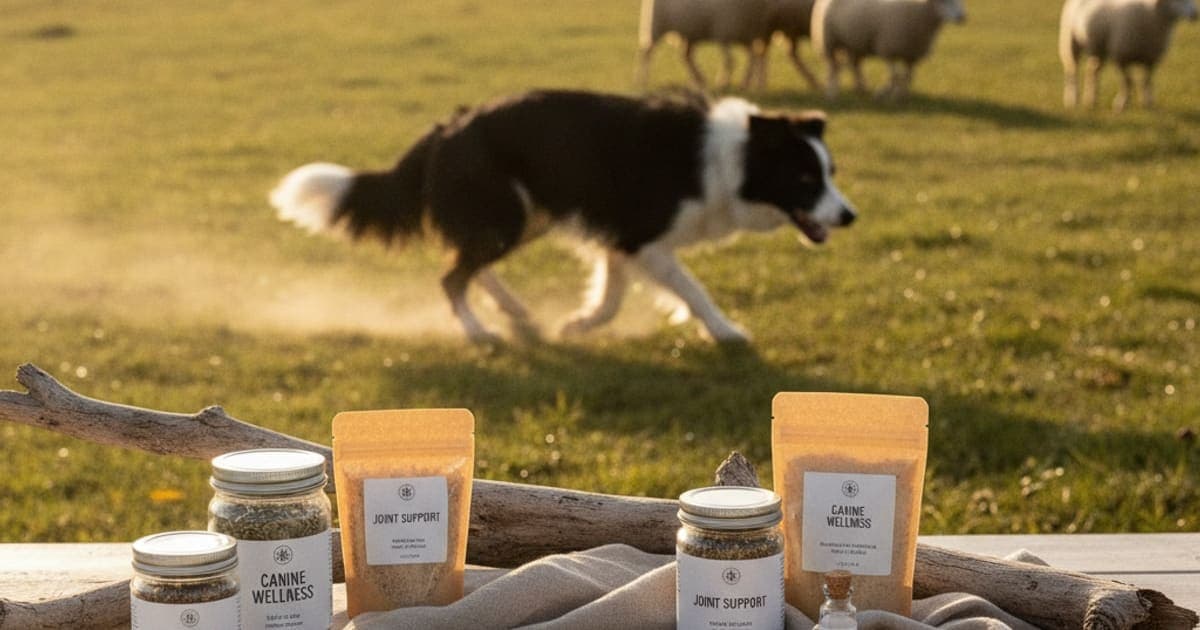
TB-500 for Herding Dogs: What It Is and Why Owners Use It
TB-500 is a synthetic peptide modelled on the active region of thymosin beta-4, a naturally occurring protein present in nearly every cell of the body and studied for its role in cell migration, blood vessel formation and soft-tissue repair. Herding-dog owners use it — most often paired with BPC-157 — to support tendon, ligament and joint recovery in dogs whose daily job is acceleration, hard cutting and abrupt deceleration. Neither peptide is an FDA-approved veterinary drug, and neither treats, cures or prevents any condition. They sit inside a plan your veterinarian owns.
That is the short answer. The longer answer matters more if you own a border collie, an Australian shepherd, a cattle dog, a kelpie, a Malinois or a shepherd cross, because the way these dogs move creates a very specific pattern of wear — and understanding that pattern is what turns a recovery plan from guesswork into something deliberate.
Why herding breeds wear out in the soft tissue first
Herding dogs are not built like heavy guardian breeds, whose problems tend to be load-driven. They are built like sprinters with a handbrake. The eye-and-stalk crouch loads the shoulders and hip flexors. The sprint-and-turn pattern loads the stifle and the iliopsoas. The stop loads the carpus and the biceps tendon. A dog doing this on stubble, wet grass, sand or an agility surface repeats those loads hundreds of times a session.
The result is that herding breeds tend to present with tendinopathy and strain rather than sudden catastrophic injury. Supraspinatus and biceps tendinopathy in the shoulder, iliopsoas strain in the hip flexor, carpal hyperextension from repeated hard braking, and the slow degenerative erosion of the cranial cruciate ligament are all familiar territory to sports-medicine veterinarians. Cranial cruciate disease in dogs is usually a gradual failure of ligament fibres over time, not a single traumatic tear — which is exactly why the dog looked fine last month and is toe-touching today.
The second complication is temperament. A high-drive working dog will run through discomfort because the work is more compelling than the pain. Owners of herding breeds rarely see limping first. They see a half-second hesitation before the turn, a dog that stops flanking one direction, a shortened stride at the trot, or a dog that lies down between reps when it never used to. If your herding dog changes how it works before it changes how it walks, that is the moment to book a veterinary exam — not after the limp appears.
What TB-500 does in the body
Thymosin beta-4 is one of the most abundant intracellular proteins in mammals and functions primarily as an actin-sequestering molecule. Actin is the scaffolding protein cells use to change shape and move. Research on thymosin beta-4 suggests that by regulating actin availability, it influences how quickly cells migrate into an area of damage, how new blood vessels form there, and how the local inflammatory environment resolves. TB-500 is a synthetic peptide corresponding to the biologically active portion of that molecule.
Why does that mechanism interest owners of working dogs specifically? Because tendon and ligament are poorly vascularised tissues. They repair slowly not because the body lacks the instructions but because blood supply and cell traffic into the injured region are limited. Anything that plausibly supports cell migration and angiogenesis is operating on the exact bottleneck that makes soft-tissue rehab in a herding dog take months rather than weeks.
The honest framing is this: the mechanism is well described, the science is emerging and promising, and owners are adopting it. What research suggests about thymosin beta-4 in laboratory models is not the same as a demonstrated outcome in your dog, and no one should sell it to you that way. TB-500 may support the environment in which repair happens. It does not do the repair, and it does not replace the rest, the rehab or the surgical fixation that a torn structure may require.
Why owners run TB-500 alongside BPC-157
BPC-157 is a synthetic pentadecapeptide derived from a protective sequence identified in gastric juice. Research in animal models suggests it influences fibroblast outgrowth, tendon-to-bone healing signalling and angiogenic pathways, and that it is unusually stable in gastric conditions. The two peptides are studied for overlapping but distinct roles, which is why the pairing is the stack owners reach for during a recovery block rather than either one alone.
Think of it as two halves of the same job. TB-500 is associated with cell mobility and vascular ingrowth — getting the right cells to the right place with a blood supply behind them. BPC-157 is associated with the fibroblast activity and signalling that lays down and organises new collagen once those cells arrive. Collagen that is laid down but never organised under load is scar tissue, and scar tissue in a herding dog's shoulder is a re-injury waiting for the next trial weekend.
pawgen's K9-REPAIR combines both peptides in a single weight-based formulation with third-party testing and published certificates of analysis, shipped direct to the door and backed by a 60-day money-back guarantee. Dosing is weight-based and belongs in a conversation with your veterinarian — particularly for puppies, pregnant or nursing dogs, and any dog already on prescribed medication.
Where peptides sit next to everything else in the plan
Nothing here displaces conventional care. A herding dog with a cruciate injury may need surgical stabilisation. A dog with a diagnosed tendinopathy may need a prescribed anti-inflammatory and a structured rehab protocol. Peptides operate in the space those interventions create.
| Approach | What it targets | Where it fits |
|---|---|---|
| Surgery (e.g. cruciate stabilisation) | Mechanical instability the body cannot correct on its own | First, when the veterinarian says the joint needs it. Nothing substitutes for it |
| Prescribed medication (NSAIDs, adjunct analgesics, monoclonal antibody therapy) | Pain and inflammation, prescribed and monitored | Vet-directed. Never stopped or altered because a supplement was added |
| Structured rehab and controlled loading | Collagen alignment, proprioception, return-to-work capacity | Throughout recovery. The single most underused tool in working-dog care |
| Glucosamine, chondroitin, green-lipped mussel, omega-3s | Cartilage substrate and general joint comfort | Useful background support, slow-acting, frequently underdosed in chews |
| BPC-157 + TB-500 (K9-REPAIR) | Soft-tissue repair environment: cell migration, angiogenesis, collagen signalling | Alongside veterinary care during recovery blocks and heavy work seasons |
The table is the whole argument in one frame. These are layers, not competitors. Talk to your veterinarian about which layers your dog actually needs, and in what order.
Managing workload so the recovery window is not wasted
Peptides cannot outrun a training schedule that keeps re-injuring the tissue. Herding-dog owners who get good results from a recovery block usually change three things at once.
First, warm-up and cool-down stop being optional. Cold tendon under a full-speed outrun is the classic mechanism for shoulder strain. Five to ten minutes of progressive trotting and dynamic movement before work, and a genuine cool-down after, costs nothing.
Second, surfaces get audited. Deep sand, slick indoor flooring, frozen rutted ground and repetitive hard turns on wet grass all load soft tissue differently. Rotating surfaces spreads the stress instead of concentrating it.
Third, body condition gets honest attention. Every extra kilogram is amplified across a stifle at speed. Lean working condition is one of the few genuinely free interventions available to any owner.
Add cross-training — controlled hill work, cavaletti, hind-end awareness drills — and real rest days. A herding dog that is mentally exercised will accept physical rest far better than one whose brain has nothing to do, which is also the most common reason these dogs pace at night after a layoff.
How to judge a joint product before you buy it
This category is full of marketing dressed as science. Apply pressure to the label before you apply it to your dog.
Watch for kitchen-sink chews listing fifteen ingredients where a proprietary blend hides the fact that each one appears at a fraction of the amount used in research. Watch for the phrase 'clinically studied ingredient' attached to a product that contains a token sprinkle of it. Watch for brands with no third-party testing, no certificates of analysis and no way to verify what is actually in the bag.
The questions worth asking are simple. Is the dosing weight-based, or is it one scoop for a corgi and a Malinois alike? Is there third-party testing with COAs you can actually read? Is the ingredient list short enough that each component has a reason to be there? Is there a guarantee that lets you stop if your dog does not respond? K9-REPAIR was built to answer those four questions directly, which is the standard any product should be held to before it goes near a working dog.
Key Takeaways
- TB-500 is a synthetic peptide based on thymosin beta-4, studied for roles in cell migration, angiogenesis and soft-tissue repair; owners use it to support recovery, and it is not an FDA-approved veterinary drug.
- Herding breeds fail in tendon, ligament and hip-flexor tissue before they fail in bone, because their gait pattern is sprint, cut and brake.
- High-drive dogs mask pain. Performance changes appear before lameness does.
- TB-500 and BPC-157 are studied for complementary roles, which is why owners run them together through recovery blocks.
- Surgery, prescribed medication and structured rehab come first. Peptides support the environment those interventions create.
- Judge products on weight-based dosing, third-party testing, COAs and a real guarantee — not on ingredient count.
The veterinary relationship comes first
Your veterinarian owns the diagnosis and the treatment plan. A stride change in a herding dog could be a shoulder tendinopathy, an iliopsoas strain, early cruciate degeneration, a neurological issue or a pad injury, and those paths diverge quickly. Imaging, a hands-on orthopaedic exam and, where appropriate, referral to a sports-medicine or rehabilitation veterinarian are what tell you which one you are dealing with. Never stop or reduce a prescribed medication because you added a supplement. Bring the K9-REPAIR label to your next appointment, tell your veterinarian exactly what your dog is taking, and let the peptides do their work inside a plan that a professional has built.
If you also share your home with a larger working or guardian breed, the same principles apply with different biomechanics — see the best joint supplement for great pyrenees and the best joint supplement for anatolian shepherds for breed-specific detail, or read the full formulation breakdown for K9-REPAIR.
Owners exploring peptide support for their dog can review K9-REPAIR — BPC-157 + TB-500 formulated for dogs — at https://pawgen.com/. BPC-157 and TB-500 are not FDA-approved veterinary drugs. Nothing in this article treats, cures or prevents any condition; every decision about your dog's care belongs with your veterinarian.
Frequently asked questions
- When should I take a dog to the vet for panting at night?
- Book a veterinary exam if night panting is new, persistent, or paired with restlessness, coughing, pale gums, appetite change or a limp. Panting without heat or recent exercise can signal pain, cardiac or respiratory disease, or a hormonal problem. Seek same-day care if breathing looks laboured or the gums look off-colour.
- What can I give a dog that is panting at night?
- Give nothing before a diagnosis. Cool the room, offer fresh water, reduce late-evening activity and let your veterinarian identify the cause, because pain, heart disease and endocrine conditions all present this way. If a prescription is issued, follow it exactly. Supplements support a veterinary plan — they never replace one.
- Is a dog panting at night an emergency?
- It can be. Treat it as an emergency if panting comes with pale or blue gums, an extended neck, noisy or laboured breathing, a distended abdomen, collapse or unrelenting distress. Mild panting after a warm day or a hard working session is usually less alarming, but any new pattern deserves a prompt vet call.
- Why is my dog restless at night?
- Common causes include joint or soft-tissue pain, needing to toilet, anxiety, cognitive change in older dogs, heat, medication effects, or simply too little physical and mental work during the day. Herding breeds are especially prone to pacing when under-stimulated. A veterinary exam separates behavioural restlessness from genuine pain.
- Should I worry if my dog is restless at night?
- One restless night is rarely a concern, but a pattern is worth investigating. Persistent pacing, circling, panting, difficulty settling or repeated position changes often trace back to discomfort, cognitive change or an unmet exercise need. Note when it began and what helps, then share those observations with your veterinarian.
- When should I take a dog to the vet for restless at night?
- Go when restlessness lasts more than a few nights, worsens, or arrives with panting, limping, stiffness on rising, vocalising, appetite loss or disorientation. Sudden severe restlessness combined with a swollen abdomen or unproductive retching needs emergency care immediately, because bloat is a time-critical, life-threatening condition in dogs.
Educational content. BPC-157 and TB-500 are not FDA-approved veterinary drugs. Talk to your veterinarian before starting anything new, especially if your dog is on prescribed medication.