TB-500 for Military Working Dogs — Recovery Science
TB-500 is a synthetic peptide fragment related to thymosin beta-4, a protein involved in cell migration and new blood vessel formation, which is why handlers of hard-working dogs research it for tendon and joint support. It is not an FDA-approved veterinary drug, and any use belongs in a conversation with your veterinarian.
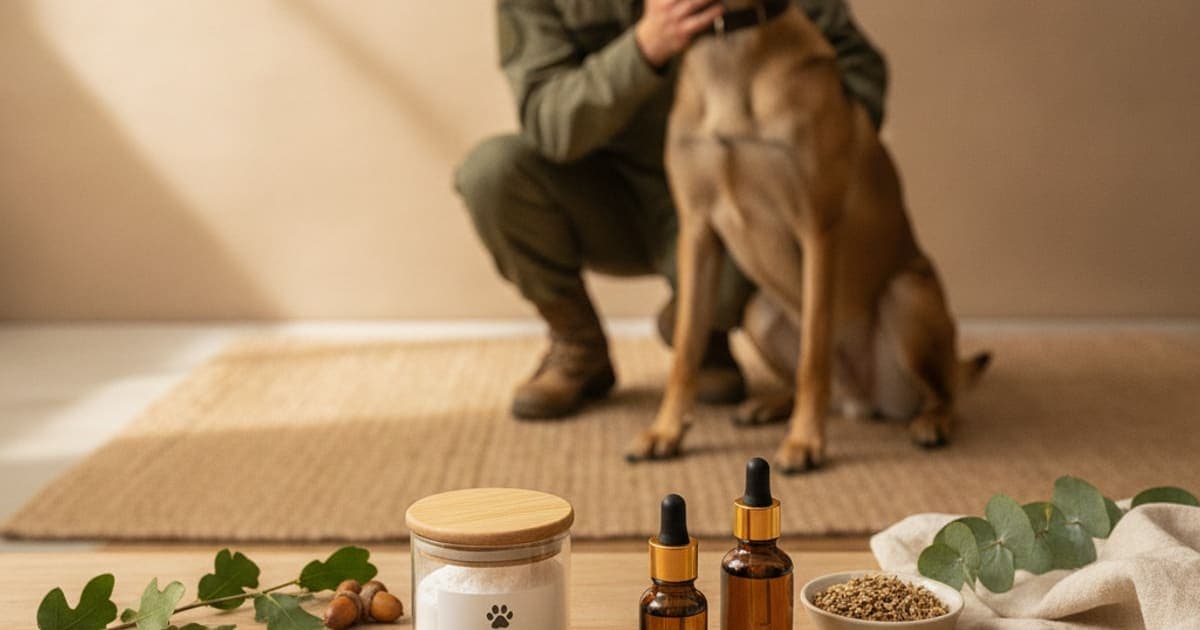
TB-500 for Military Working Dogs
TB-500 is a synthetic peptide built around the active region of thymosin beta-4, a naturally occurring actin-binding peptide that laboratory research describes as involved in cell migration, new blood vessel formation and tissue repair signalling. Handlers and owners of working-line dogs research it because those are exactly the processes that govern how quickly tendon, ligament and joint tissue recovers from heavy, repetitive occupational load. In canine formulations TB-500 is almost always paired with BPC-157 — the combination in K9-REPAIR from pawgen is one example of that pairing. Neither peptide is an FDA-approved veterinary drug, everything here is educational, and for a dog in active government service every supplement decision routes through the unit's veterinary staff before anything else happens.
The physical load a patrol or detection dog carries
A working dog's job is a series of high-force events repeated thousands of times. Jumping down from a vehicle tailgate. Landing on concrete rather than grass. Hard directional changes on a scent cone. Bite work, where the load travels through the neck, shoulders and lumbar spine simultaneously. Ladders, catwalks, rubble, stairwells. Long shifts in heat, sometimes with gear adding weight over the thoracic spine.
None of that is inherently damaging. What matters is the ratio between load and recovery, and the biology of the tissue absorbing it. Tendon and ligament are dense, highly organised collagen with a comparatively sparse blood supply. That structure is what makes them strong, and it is also what makes them slow: the cells that lay down and reorganise collagen are relatively few, and they depend on diffusion and a limited capillary network for oxygen and raw material. Articular cartilage has no blood supply of its own at all and is fed by joint fluid movement.
So a working dog accumulates microdamage faster than the tissue reorganises it. The enthesis — the transition zone where tendon anchors into bone — remodels over a scale of weeks, not days. When the next hard shift arrives before that remodelling is complete, the deficit compounds. Over a career that pattern shows up as chronic tendinopathy, degenerative change in the lumbosacral region, and osteoarthritis in hips, elbows and stifles. Handlers usually notice it first as something small: a slower launch, a shortened reach on one forelimb, reluctance on the descent rather than the climb, or a dog who works well for forty minutes and then subtly stops offering the same effort.
That early window is the one worth taking to your veterinarian, because a gait change with no visible swelling is still information.
What TB-500 and BPC-157 do at the tissue level
Thymosin beta-4 is a small, naturally occurring peptide found across mammalian tissue, and research characterises it as an actin-sequestering molecule — it binds actin, the protein filament network cells use to change shape and move. TB-500 is a synthetic fragment containing that actin-binding region.
The reason that matters for recovery is straightforward once you follow the chain. Repair of a damaged tendon or ligament requires cells to physically travel to the damaged site: fibroblasts to produce collagen, endothelial cells to build capillaries, immune cells to clear debris. Cell migration is an actin-driven process. Research on thymosin beta-4 describes it as supporting that migration, and as promoting angiogenesis — the formation of new microvessels. In tissue that is poorly vascularised to begin with, better local blood supply means more oxygen, more amino acids and better waste clearance reaching the repair zone. Animal-model research has also reported effects on inflammatory signalling and on the organisation of scar tissue, though these findings sit at the level of mechanism, not outcome promises for any individual dog.
BPC-157 is a fifteen-amino-acid peptide, a partial sequence derived from a protein identified in gastric juice. Published animal-model work has reported effects on the healing of tendon, ligament, muscle and gut tissue, with proposed mechanisms including upregulation of growth factor receptor expression on fibroblasts and involvement of nitric oxide and VEGF-related signalling pathways. Early evidence indicates fibroblast outgrowth and collagen organisation as the areas of interest.
The two are paired because the mechanisms described in the literature are complementary rather than duplicative. One is discussed largely in terms of cell motility and vascular network formation; the other largely in terms of growth factor signalling and fibroblast behaviour. Peptides do not replace a diagnosis, a surgery or a rehabilitation plan — they are used inside the recovery window that proper veterinary care creates.
This is emerging science, and owners of hard-working dogs are adopting it deliberately because the mechanisms map cleanly onto the tissues that limit a working career. Hedged language here is accuracy, not hesitation: research suggests, owners report, may support.
Joint support across a working dog's career, not just after an injury
The most useful shift in thinking is from injury response to career-long load management. A dog selected for work at eighteen months, deployed hard through five or six years, and then retired is running four distinct phases, and each one has a different priority.
In the selection and early conditioning phase, the work is structural: body condition score kept lean, growth plates respected, footing varied so the dog learns to land on more than concrete, and conditioning built progressively rather than in bursts. Nothing about supplementation for a young or still-growing dog should be decided from an article — that conversation is a veterinary one, and for puppies, pregnant or nursing dogs it resolves there and nowhere else.
Through peak service years, the priorities are recovery time between hard shifts, sleep quality, and honest attention to asymmetry. This is where handlers most often build a support routine around the dog's baseline rather than waiting for a limp.
Around a surgical or rehabilitation event — a stifle repair, a disc, a chronic soft-tissue case — the veterinary plan owns the timeline entirely. Peptide support is discussed as something running alongside prescribed analgesia, controlled exercise and formal rehab, never as a reason to modify any of them.
In retirement, the dog is usually managing accumulated osteoarthritis, and comfort and mobility become the whole objective. Smaller companion breeds face a version of the same arithmetic on a different scale, which is why the reasoning behind the best joint supplement for chihuahuas looks structurally similar even though the loads are nothing alike.
Comparing the common approaches to working-dog joint support
| Approach | What it is | What research or owners describe | Where it fits |
|---|---|---|---|
| Load and body condition management | Lean body condition, varied footing, structured conditioning, recovery days | The best-established lever available to any handler, at no cost | Every phase, permanently |
| Veterinary diagnosis and imaging | Lameness exam, gait assessment, radiographs, referral imaging where indicated | Identifies which structure is actually involved | First, before anything is added |
| Prescription analgesia and vet-prescribed drugs | Medications your veterinarian selects for pain and inflammation | Directed by the veterinary team, monitored with bloodwork as advised | Prescribed and adjusted only by the vet |
| Surgical repair | Stabilisation or reconstruction of a damaged structure | The definitive intervention for specific structural failures | When the veterinary plan calls for it |
| Formal physical rehabilitation | Controlled loading, hydrotherapy, targeted strengthening | Rebuilds capacity that rest alone will not restore | Post-injury and post-operative |
| Omega-3 fatty acids | Marine-sourced fatty acids | Commonly used in canine joint routines | Adjunct, discussed with the vet |
| Multi-ingredient joint chews | Combination products, often flavour-forward | Highly variable; ingredient quantities frequently undisclosed | Read the label critically |
| Peptide support (BPC-157 + TB-500) | Targeted peptide formulation such as K9-REPAIR | Mechanism research on cell migration, angiogenesis and fibroblast signalling; the stack owners increasingly use through recovery | Alongside the veterinary plan |
Reading a label honestly: where most supplements fail
The supplement aisle rewards the wrong things. A kitchen-sink chew can list a dozen recognisable ingredients and contain a token quantity of each, because the label is doing marketing work rather than biological work. Proprietary blend disclosures let a brand name an ingredient without stating how much is present. A product can reference a study on a compound while including a fraction of the quantity that study used.
What is worth demanding is unglamorous. A clear single purpose rather than a claim to fix everything. Third-party testing with a certificate of analysis available for the batch you are actually holding, so identity and purity are verified by someone with no stake in the sale. Weight-based dosing guidance you can walk through with your veterinarian rather than one scoop for every dog. Honest framing of what the science does and does not yet say. pawgen publishes K9-REPAIR as a BPC-157 and TB-500 formulation with third-party testing, weight-based dosing guidance, direct-to-door shipping and a 60-day money-back guarantee — descriptive facts an owner can verify before deciding, which is a fair standard to hold any brand to.
Skepticism is the right instinct. Point it at labels that hide quantities, not at the mechanisms.
Key Takeaways
- TB-500 is a synthetic peptide based on the active region of thymosin beta-4, which research describes as supporting cell migration and new blood vessel formation — the processes that pace tendon and ligament repair.
- BPC-157 is studied in animal models for effects on tendon, ligament and muscle tissue via growth factor and vascular signalling pathways; the two peptides are paired for complementary mechanisms.
- Working dogs accumulate microdamage faster than poorly vascularised tissue reorganises it, which is why career-long load management matters more than any single product.
- Neither peptide is an FDA-approved veterinary drug, and nothing here treats, cures or prevents any condition.
- Dosing is never decided from an article — especially for puppies, pregnant or nursing dogs.
- For a dog in active service, the unit's veterinary staff authorise everything.
For related reading on how the same joint-support reasoning applies to very different dogs, see the guides on the best joint supplement for chihuahuas and the best joint supplement for pomeranians, and the formulation details for K9-REPAIR.
Where the veterinary team sits in all of this
A gait change has a cause, and finding it is diagnostic work: a hands-on lameness exam, gait assessment, and imaging where the findings justify it. Cruciate disease, lumbosacral disease and elbow pathology can all present as a dog who is simply working less enthusiastically, and they require different plans. Talk to your veterinarian before you add anything, and keep talking to them as the plan changes.
If your dog is on carprofen, gabapentin, a monoclonal antibody injection or anything else prescribed, that plan stays exactly as written until the prescribing veterinarian changes it. Surgery, prescribed medication and formal rehabilitation are the interventions with the strongest footing, and nothing described here substitutes for any of them. The veterinarian owns the diagnosis and the treatment plan; peptides and supplements operate in the recovery space that proper veterinary care creates.
Owners exploring peptide support for their dog can review K9-REPAIR — BPC-157 + TB-500 formulated for dogs — at https://pawgen.com/. BPC-157 and TB-500 are not FDA-approved veterinary drugs. Nothing in this article treats, cures or prevents any condition; every decision about your dog's care belongs with your veterinarian.
Frequently asked questions
- What can I give a dog that is whining at night?
- Nothing, until you know why the whining is happening. Whining at night can signal pain, a full bladder, anxiety, cognitive change or gastrointestinal discomfort, and each needs a different response. Ask your veterinarian to identify the cause first, then follow the plan they prescribe rather than starting anything independently.
- Is a dog whining at night an emergency?
- Sometimes yes. Whining paired with a distended abdomen, unproductive retching, straining to urinate, laboured breathing, collapse, or sudden inability to use the hind limbs warrants immediate emergency care. Whining without those signs still deserves a prompt veterinary appointment, because persistent night vocalising usually reflects pain or distress.
- Why is my dog panting at night?
- Night panting has many possible causes, including heat, pain, anxiety, medication effects such as steroids, respiratory or cardiac disease, and endocrine conditions like Cushing's. Panting is how dogs shed heat, so it is only informative in context. A veterinarian can narrow the list with an exam and bloodwork.
- Should I worry if my dog is panting at night?
- New, persistent or unexplained night panting is worth investigating, particularly in a cool room or in a resting dog. Occasional panting after activity or in warm conditions is normal. Track when it happens, how long it lasts and what else changes, then bring those notes to your veterinarian.
- When should I take a dog to the vet for panting at night?
- Go promptly if panting is accompanied by blue or pale gums, coughing, exercise intolerance, restlessness that will not settle, a swollen abdomen, or laboured breathing — those need emergency assessment. Book a routine appointment if panting is simply new, ongoing, or worsening over several nights without an obvious explanation.
- What can I give a dog that is panting at night?
- Provide water, a cool and quiet resting place, and good airflow, then have the cause diagnosed rather than giving anything else. Never give human medications. If your veterinarian identifies pain or an underlying condition, they will prescribe treatment; discuss any supplement, including peptides, with them first.
- Is TB-500 approved for use in dogs?
- No. TB-500 and BPC-157 are not FDA-approved veterinary drugs, and content about them is educational. Research describes their mechanisms — actin binding, cell migration, angiogenesis and growth factor signalling — but no product should be described as treating, curing or preventing a condition. Discuss any use with your veterinarian.
- Can peptides be used alongside prescribed medication for a working dog?
- That is a veterinary decision, not an owner one. Never stop or reduce a prescribed medication such as carprofen or gabapentin to add a supplement. Bring the exact product and its ingredient list to your veterinarian, and for a dog in active service, to the unit's veterinary staff for authorisation.
- How is TB-500 different from BPC-157?
- TB-500 is a synthetic fragment of thymosin beta-4, studied largely for actin binding, cell migration and new blood vessel formation. BPC-157 is a fifteen-amino-acid peptide studied in animal models for effects on tendon, ligament and gut tissue via growth factor and vascular pathways. The mechanisms are complementary.
- What should I look for in a peptide formulation for my dog?
- Look for a clear single purpose, third-party testing with a certificate of analysis for the actual batch, weight-based dosing guidance you can review with your veterinarian, transparent ingredient quantities rather than proprietary blends, and a return guarantee. Avoid products that name ingredients without disclosing how much is present.
Educational content. BPC-157 and TB-500 are not FDA-approved veterinary drugs. Talk to your veterinarian before starting anything new, especially if your dog is on prescribed medication.