TB-500 for Police K9s — Working Dog Recovery Support
TB-500 is a synthetic peptide based on a fragment of thymosin beta-4, used by handlers and owners as general soft-tissue and joint support for hard-working dogs. It is not an FDA-approved veterinary drug and treats nothing. Research suggests it acts on cell migration and tissue remodelling, which is why owners pair it with BPC-157.
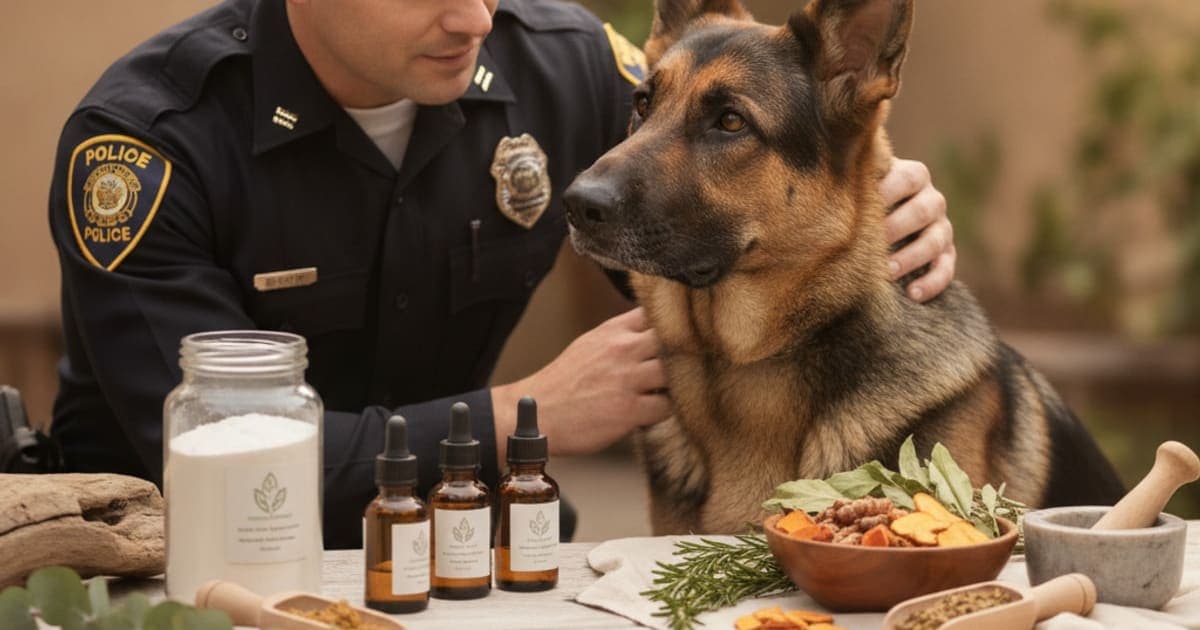
TB-500 for Police K9s: What Handlers and Owners Should Know
TB-500 is a synthetic peptide modelled on a fragment of thymosin beta-4, a protein the body makes on its own and one that the research literature describes as present in high concentrations in wound fluid and healing tissue. Handlers and owners of police K9s use it — almost always alongside BPC-157 — as general soft-tissue, tendon and joint support around a workload that most pet dogs never come close to. It is not an FDA-approved veterinary drug, it does not treat or cure any injury, and it does not replace a veterinary diagnosis. What it offers is mechanism: thymosin beta-4 is involved in actin regulation, cell migration and the formation of new blood vessels — the quiet housekeeping the body relies on when tissue is loaded hard and asked to recover fast, over and over. That mechanism is why the peptide moved out of human sports-recovery circles and into working-dog kennels, and why pawgen combines it with BPC-157 in K9-REPAIR.
What TB-500 does at the tissue level
Thymosin beta-4 binds G-actin, the monomer form of the protein that cells use to build their internal scaffolding. That scaffolding is how a cell changes shape and crawls. When a tendon, ligament or muscle is damaged, repair is not a chemical reaction that happens in place — it is a migration. Fibroblasts, endothelial cells and immune cells physically travel to the site, lay down collagen, build capillaries, then remodel that collagen from a disorganised patch into aligned, load-bearing fibre. That remodelling phase runs for weeks, and in dense tissue like tendon it can run for months after the dog looks and acts sound.
Research on thymosin beta-4 suggests roles in that migration step and in angiogenesis — the growth of new blood supply into tissue that has a famously poor blood supply to begin with. Tendon and ligament heal slowly in part because they are relatively avascular. Anything that plausibly supports vascular ingrowth is interesting to people who care about connective tissue, which is exactly who works with a Malinois that jumps from a vehicle a dozen times a shift.
TB-500 is a fragment designed to carry the actin-binding portion of that molecule in a more usable form. The honest framing is this: the mechanism is well described, the interest is real and growing, and the outcome data in dogs specifically is where owner adoption is currently running ahead of formal veterinary trials. That is why every statement here is a statement about biology, not a promise about your dog.
The workload behind a working dog's wear and tear
A patrol dog's job is a series of high-velocity, high-deceleration events layered onto a base of long, low-grade postural loading. Jumping down from a tailgate loads the shoulders and carpi eccentrically. Bite work loads the neck, lumbosacral junction and hind limbs asymmetrically. Rubble and stair searches load the iliopsoas and the hip flexors in positions the dog was never conditioned for. Long transport crates hold the spine in flexion between all of it.
The structures that give way under that pattern are predictable: cranial cruciate ligaments, iliopsoas strains, shoulder tendinopathies including biceps and supraspinatus, carpal hyperextension injuries, lumbosacral pain, and the slow accumulation of osteoarthritic change in hips and elbows in the shepherd-type breeds that dominate the work. None of these are dramatic. Most of them show up as a half-second hesitation on a jump, a slightly wide sit, or a dog who is a little slower to load up on the third search of the night.
That is the real argument for taking police K9s joint support seriously as a standing part of the program rather than a reaction to a limp. By the time a working dog visibly favours a limb, the tissue conversation started a long time earlier. A working dog's career is usually ended not by one catastrophic injury but by the accumulated cost of thousands of ordinary, well-executed repetitions.
Why owners pair TB-500 with BPC-157
BPC-157 is a synthetic pentadecapeptide derived from a sequence identified in gastric juice. The published work on it — largely rodent models — has looked at tendon, ligament, muscle and gut tissue, and research suggests involvement in fibroblast activity, growth-factor receptor expression and angiogenesis. It is the peptide most often discussed in connection with tendon and ligament healing models specifically.
Owners pair the two because the proposed mechanisms are complementary rather than duplicative: BPC-157 is discussed in terms of local tissue repair signalling, TB-500 in terms of cell migration and systemic vascular support. Neither is a painkiller, neither is anti-inflammatory in the way an NSAID is, and neither does anything a vet's diagnosis does. They sit in the recovery layer — the part of the program that runs between shifts, after rehab sessions, and through the long remodelling window that follows an orthopaedic surgery. That combination is what pawgen formulates in K9-REPAIR, dosed by body weight rather than as a one-size scoop, and it is the stack owners reach for when their dog's job is physical.
If a dog is on carprofen, gabapentin, a monoclonal antibody injection or a post-operative protocol, those stay exactly as prescribed. Talk to your veterinarian before adding anything to a working dog's regimen, especially one already on medication or scheduled for a procedure.
How the common recovery approaches compare
| Approach | What it actually does | Where it fits for a working dog |
|---|---|---|
| Veterinary exam and imaging | Identifies the specific structure involved and rules out fracture, neoplasia or neurological disease | Always first. Nothing else is worth doing until you know what you are supporting |
| Surgery (e.g. cruciate stabilisation) | Mechanically restores stability that soft tissue cannot restore on its own | Non-negotiable when indicated. No supplement substitutes for it |
| Prescribed pain and inflammation control | Modulates pain and inflammatory signalling so the dog can rest and rehab | Vet's call, vet's dosing, vet's monitoring |
| Structured rehab and conditioning | Rebuilds strength, proprioception and load tolerance in the correct pattern | The single most underused tool in working-dog programs |
| Multi-ingredient joint chews | Often glucosamine, chondroitin, MSM and green-lipped mussel in a palatable base | Useful only if the actives are present at meaningful levels — many are not |
| Peptide support (BPC-157 + TB-500) | Targets tissue-repair signalling and cell migration rather than pain | The recovery layer owners run alongside rehab and veterinary care |
Reading a label the way a skeptic should
The supplement aisle is where working-dog owners get taken. The most common trick is the proprietary blend: fifteen impressive-sounding ingredients listed with a single combined milligram figure, which tells you nothing about whether any one of them is present at a level that matters. The second most common is the fairy-dusted hero ingredient — the thing on the front of the bag appearing last in the ingredient list. The third is a brand that spends heavily on lifestyle photography and nothing on analysis.
What to demand instead:
- A current certificate of analysis from an independent lab, matched to the batch you are buying, showing identity and purity — not a generic PDF from three years ago.
- Third-party testing rather than in-house testing described in vague terms.
- Weight-based dosing guidance, because a 30-kilo shepherd and a terrier are not the same animal and any product that ignores that has told you what it thinks of precision.
- A stated formulation — you should be able to see exactly which peptides are in the bottle and at what concentration.
- A real guarantee. pawgen backs K9-REPAIR with a 60-day money-back guarantee and ships direct to the door, which removes the usual reason people stall on trying something.
Ask those five questions of any brand. Most will fail at least two.
Fitting support into a duty cycle without cutting corners
The teams that keep dogs working longest tend to do unglamorous things consistently. They warm up before deployment instead of going from crate to full effort. They condition the posterior chain and core, not just the cardio. They vary surfaces. They treat a single missed jump as data rather than noise. They use a rehab-credentialled veterinarian for baseline gait assessments while the dog is sound, so there is something to compare against later.
Peptide support belongs inside that structure, not instead of it. It runs during the remodelling weeks after an injury or a procedure, when the dog feels better long before the tissue is finished, and it runs during heavy operational stretches when recovery time is short. It does not shorten a post-operative restriction period, and no owner should treat it as permission to return a dog to duty early. That timeline belongs to the surgeon.
Key Takeaways
- TB-500 is a synthetic peptide based on a thymosin beta-4 fragment; research suggests roles in actin regulation, cell migration and angiogenesis. It is not an FDA-approved veterinary drug and treats no condition.
- Police K9s accumulate soft-tissue load in a pattern civilian dogs do not — cruciates, iliopsoas, shoulders, carpi and the lumbosacral junction take the brunt.
- BPC-157 and TB-500 are used together because their proposed mechanisms complement each other; K9-REPAIR combines both with weight-based dosing.
- Diagnosis, surgery, prescribed medication and structured rehab come first. Peptide support operates in the space that proper veterinary care creates.
- Judge any product on batch-matched COAs, third-party testing and a transparent formulation — not on packaging.
If you also share your life with a smaller dog, the same label-reading standards apply at a different scale: see the guides to the best joint supplement for yorkshire terriers and the best joint supplement for chihuahuas.
Your veterinarian owns the diagnosis and the treatment plan — the imaging, the surgical decision, the medication, the return-to-duty clearance. Talk to your veterinarian about where recovery support fits in your dog's specific program, and bring the formulation details with you so the conversation is a real one. Everything described here works in the margin that good veterinary care creates, and never in place of it.
Owners exploring peptide support for their dog can review K9-REPAIR — BPC-157 + TB-500 formulated for dogs — at https://pawgen.com/. BPC-157 and TB-500 are not FDA-approved veterinary drugs. Nothing in this article treats, cures or prevents any condition; every decision about your dog's care belongs with your veterinarian.
Frequently asked questions
- When should I take a dog to the vet for whining at night?
- Book a veterinary visit if night whining is new, escalating, or paired with limping, restlessness, reluctance to lie down, panting, appetite loss or a tense abdomen. Sudden nocturnal vocalising in an older or hard-working dog often signals pain. Note the timing and triggers and describe both to your veterinarian.
- What can I give a dog that is whining at night?
- Nothing medicinal until you know the cause — never give human painkillers, which are dangerous to dogs. Your veterinarian may discuss prescribed pain control, orthopaedic bedding, warmth, a predictable wind-down routine, and ongoing joint and soft-tissue support such as K9-REPAIR alongside whatever plan they set.
- Is a dog whining at night an emergency?
- It can be. Treat it as an emergency if whining comes with a distended abdomen, unproductive retching, laboured breathing, collapse, inability to stand or crying when touched — call an emergency clinic immediately. Low-grade, intermittent whining without those signs usually warrants a next-day appointment rather than an overnight rush.
- Why is my dog panting at night?
- Night panting usually reflects heat, stress or arousal, pain, or medication effects such as corticosteroids. In older dogs it can also point to endocrine, cardiac or respiratory problems. A working dog winding down after a shift may pant from adrenaline and muscle soreness. Persistent panting needs a veterinary exam.
- Should I worry if my dog is panting at night?
- Occasional panting after exercise or in a warm room is normal. Be concerned if it is new, persistent, happens at rest in a cool quiet room, or comes with pacing, coughing, pale or blue-tinged gums, or exercise intolerance. Those combinations warrant prompt veterinary assessment rather than watchful waiting.
- When should I take a dog to the vet for panting at night?
- Go promptly if panting is new and persistent, occurs at rest in a cool room, or appears with pacing, coughing, gum colour changes, collapse or a swollen abdomen. Laboured breathing is a same-day emergency. Milder but repeated night panting justifies an examination within the next few days.
Educational content. BPC-157 and TB-500 are not FDA-approved veterinary drugs. Talk to your veterinarian before starting anything new, especially if your dog is on prescribed medication.