TB-500 for Sled Dogs — Working-Dog Recovery Explained
TB-500 is a synthetic fragment of thymosin beta-4, a peptide the body uses to move repair cells into damaged tissue. Owners of sled dogs and other hard-working teams pair it with BPC-157 for tendon, joint and mobility support. Neither is an FDA-approved veterinary drug, so dosing decisions belong with your vet.
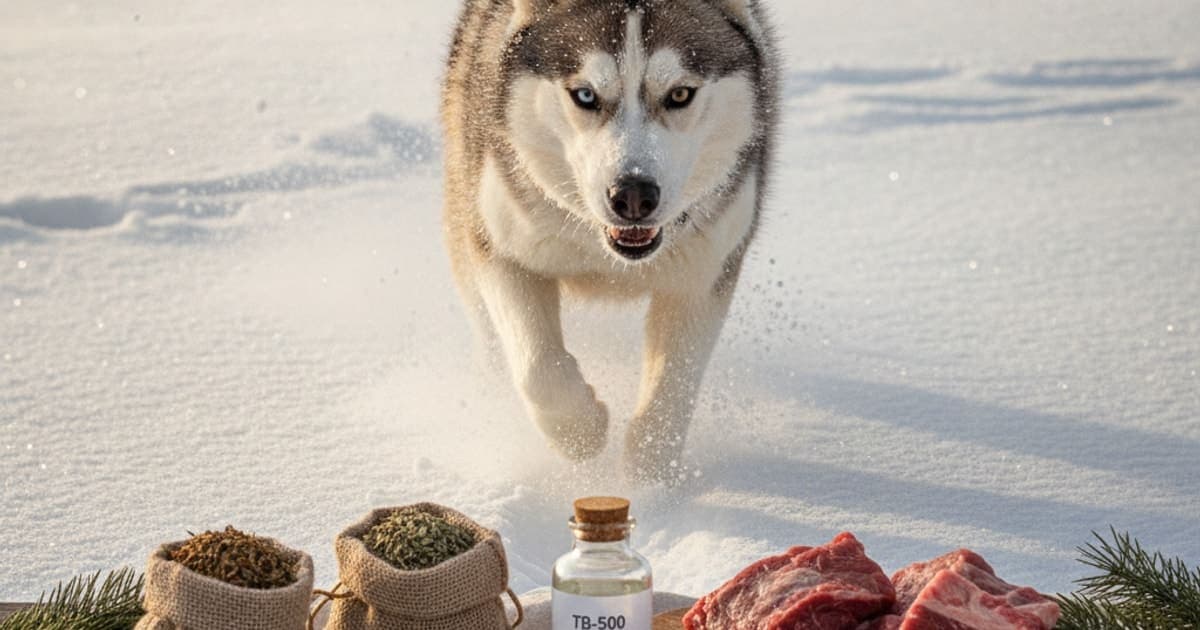
TB-500 for Sled Dogs: What It Is and Why Working-Dog Owners Use It
TB-500 is a synthetic peptide based on the active fragment of thymosin beta-4, a molecule dogs already produce in their own tissue, and owners of sled dogs use it — usually alongside BPC-157 — as soft-tissue and mobility support during heavy training blocks and through recovery from strain injuries. It is not an FDA-approved veterinary drug, it does not replace a diagnosis, and there is no dosing number in this article. What it is: a mechanism-level support layer that working-dog owners have adopted, and the reason the peptide pair sits at the centre of formulations like K9-REPAIR from pawgen. Everything below is the honest version of how it works and what to ask your veterinarian.
What TB-500 actually is, in plain biology
Thymosin beta-4 is a small, naturally occurring peptide found in nearly every cell type, with especially high concentrations in platelets and in the fluid that pools at a wound. Its best-characterised job is binding actin — the filament protein a cell uses to change shape and crawl. When a cell needs to migrate toward damaged tissue, actin has to be reorganised, and thymosin beta-4 is one of the regulators of that process.
TB-500 is a short synthetic sequence containing that actin-binding region. Published preclinical research on thymosin beta-4 suggests it plays a role in three things that matter after a soft-tissue injury: cell migration into the damaged zone, angiogenesis (the growth of new capillaries into tissue that needs blood supply to repair), and modulation of inflammatory signalling so the repair phase can proceed. Human clinical work on thymosin beta-4 has been conducted in wound and ocular surface indications rather than in orthopaedics, and the tendon and ligament work is largely animal-model research. That is the accurate picture: promising, mechanistically coherent, actively adopted by owners of hard-working dogs, and not the same thing as a licensed drug with an approved label for a canine injury.
So the claim worth making is a mechanism claim. Research suggests TB-500 supports the cellular machinery of repair. It does not treat, cure or fix a shoulder.
Why harness work is uniquely hard on tendon, ligament and gut
A dog in harness does something very few pets do: thousands of repetitions of the same gait, under load, at speed, for hours, often over uneven and variable footing. The stress is not dramatic — it is cumulative.
The structures that take the brunt are predictable. Shoulder soft tissue, particularly the biceps and supraspinatus tendons, is a well-recognised site of overuse tendinopathy in canine athletes. The carpus takes repeated hyperextension load. Digits, iliopsoas and the lumbosacral region show up regularly in sports-medicine examinations of working dogs. And unlike muscle, tendon and ligament are poorly vascularised — they remodel slowly, on a timeline of weeks to months, which is exactly why a nagging shoulder can shadow a dog across an entire season.
There is a second, less obvious pressure point. Endoscopic surveys of racing sled dogs have documented gastric erosions and ulceration in dogs during and after long-distance events, making gastrointestinal integrity a genuine performance and welfare concern in this population rather than a theoretical one. That finding is one reason peptide interest among working-dog owners tends to include BPC-157, which comes out of gastric research, rather than TB-500 alone.
None of this is a reason to panic. It is a reason to have a veterinarian who examines your dogs before, during and after a season, and to treat sled dogs joint support as a year-round programme instead of a reaction to a limp.
Why BPC-157 and TB-500 are used as a pair
BPC-157 is a pentadecapeptide — fifteen amino acids — derived from a sequence identified in gastric juice. The published research base is mostly rodent models, and it is broader than most owners expect: tendon and ligament healing models, muscle injury models, and a substantial body of gastrointestinal protection work. Proposed mechanisms in that literature include fibroblast outgrowth and migration, upregulation of the growth hormone receptor in tendon fibroblasts, and effects on the VEGF and nitric oxide pathways that govern new blood vessel formation.
Read the two side by side and the logic of the pair becomes clear. Both converge on angiogenesis and cell migration, but from different directions — TB-500 through actin regulation and the movement of repair cells, BPC-157 through growth factor signalling and, distinctively, gut tissue. Early evidence indicates complementary rather than redundant mechanisms, which is why the combination is the stack owners reach for through a recovery block rather than choosing one or the other.
What neither peptide does is diagnose. Peptides are a support layer, not a substitute for a diagnosis — your veterinarian identifies the injury and sets the plan, and support strategies work inside the room that plan creates. If a dog is non-weight-bearing, if a shoulder is hot, if performance drops off a cliff, that is an examination and possibly imaging, not a supplement decision.
How the common support approaches compare across a season
| Approach | What it does | Where it fits |
|---|---|---|
| Veterinary examination, imaging, prescribed medication, surgery, rehab | Identifies the actual injury and treats it; the only route to a diagnosis | First, always — and continuously through a season |
| Conditioning and load management | Builds tendon and ligament tolerance; the single biggest lever an owner controls | Off-season base work, in-season mileage decisions |
| Omega-3 fatty acids (marine source) | Dietary support for inflammatory balance and coat condition | Baseline nutrition for most working dogs |
| Glucosamine, chondroitin and green-lipped mussel chews | Supplies cartilage matrix building blocks — but frequently sold in kitchen-sink blends where the label lists twelve ingredients and discloses meaningful amounts of none | Long-term joint nutrition, if the label is honest about amounts |
| BPC-157 + TB-500 peptides | Mechanism-level support for the signalling behind soft-tissue repair, cell migration and blood supply | The stack owners use through recovery blocks and heavy training loads |
The skepticism in that table is pointed in one direction on purpose. The weakest products in the working-dog market are not the newest ones — they are the proprietary-blend chews that hide behind flavour and a long ingredient list. A formulation you cannot audit is a formulation you cannot evaluate.
What separates a serious peptide formulation from a marketing exercise
If you are going to add a peptide to a kennel programme, the questions are boring and they are the right ones.
Is every batch third-party tested, with a certificate of analysis you can actually read? Identity and purity testing on the finished product is the floor, not a bonus feature. pawgen publishes COAs for K9-REPAIR for this reason — a peptide product without independent verification is an unverified label.
Is the dosing guidance weight-based? A team can span a wide range of body weights, and any guidance that ignores that is not guidance. Note that the existence of weight-based guidance is a formulation property; the actual amount for your dog is a conversation with your veterinarian, and that is doubly true for puppies, pregnant or nursing females, or any dog on prescribed medication.
Is the ingredient list short and disclosed? Two named peptides beats a fourteen-item blend every time, because you can reason about it.
Is there a real return policy? K9-REPAIR is backed by a 60-day money-back guarantee and ships direct to the door, which matters when your kennel is a long way from a specialty retailer.
What a good peptide formulation will never claim is an outcome for your specific dog. Research suggests mechanisms. Owners report changes in how their dogs move through recovery. Those are honest statements. A promise about a torn tendon is not.
Building peptide support into a working season with your vet
The practical version looks like this. Get a baseline musculoskeletal examination before the training load ramps — a sports-medicine-minded veterinarian can flag the shoulder or carpus that is already grumbling. Run your own hands over every dog, every day, and learn what normal feels like for each one. Log gait changes. Treat a dropped ear, a shortened stride or a dog that stops eating as data.
When an injury does happen, the sequence is diagnosis, then treatment plan, then rehab, then supportive strategies layered on top. If your vet prescribes an anti-inflammatory, a pain medication or crate rest, that plan stands — a peptide is not a reason to alter it, and you should never stop a prescribed medication without talking to your veterinarian first. Bring the K9-REPAIR label to that appointment and ask directly how it fits with what your dog is already receiving.
And apply the same patience to the biology that you apply to conditioning. Tendon remodelling takes weeks, sometimes months. No supplement compresses that timeline, and any product implying it does has told you something useful about itself.
Key Takeaways
- TB-500 is a synthetic fragment of thymosin beta-4, a peptide dogs produce naturally; research suggests it supports cell migration, new blood vessel formation and inflammatory modulation.
- Sled dogs accumulate repetitive soft-tissue load in the shoulder, carpus, digits and lumbosacral region — and endoscopic research in racing sled dogs has documented gastric erosions, making gut integrity a real concern in this population.
- BPC-157 and TB-500 are used together because their proposed mechanisms are complementary; that pair is the basis of K9-REPAIR.
- Neither peptide is an FDA-approved veterinary drug, and neither treats, cures or replaces surgery, prescribed medication or rehab.
- Judge any product on third-party testing, published COAs, weight-based dosing guidance and a short disclosed ingredient list — not on flavour claims or ingredient count.
- There are no dosing numbers here by design. That number comes from your veterinarian, who knows your dog's weight, history and current medications.
For breed-specific breakdowns of how to read a joint formula, pawgen's guides to the best joint supplement for belgian malinois and the best joint supplement for great pyrenees cover the same evaluation logic applied to two very different working builds, and the peptide formulation itself is K9-REPAIR.
Your veterinarian owns the diagnosis and the treatment plan — the examination, the imaging, the prescriptions, the surgical decision and the rehab protocol. Peptides and supplements operate in the space that proper veterinary care creates, supporting a dog that is already being managed correctly. Build the veterinary relationship first, then decide what to layer on top of it.
Owners exploring peptide support for their dog can review K9-REPAIR — BPC-157 + TB-500 formulated for dogs — at https://pawgen.com/. BPC-157 and TB-500 are not FDA-approved veterinary drugs. Nothing in this article treats, cures or prevents any condition; every decision about your dog's care belongs with your veterinarian.
Frequently asked questions
- Should I worry if my dog is panting at night?
- Occasional night panting after a hard day is usually normal thermoregulation. Worry when it is new, persistent, happens in a cool room, or comes with restlessness, pacing, coughing or a distended abdomen — those patterns can signal pain, respiratory or cardiac problems. Log when it happens and describe the pattern to your veterinarian.
- When should I take a dog to the vet for panting at night?
- Go promptly if night panting is new and persistent, worsens over days, occurs at rest in a cool environment, or pairs with coughing, exercise intolerance, pale gums, a swollen belly, collapse or obvious pain. In working dogs, unexplained panting alongside a stride change also warrants a musculoskeletal examination.
- What can I give a dog that is panting at night?
- Nothing, until a veterinarian has identified the cause — panting is a symptom, not a diagnosis, and masking it can delay real treatment. Practical steps are cooling the room, ensuring water access, and a comfortable orthopaedic bed. Any medication or supplement decision should come from your vet after examining your dog.
- Is a dog panting at night an emergency?
- It can be. Treat it as an emergency if panting comes with laboured or open-mouth breathing, blue, grey or pale gums, collapse, a bloated hard abdomine, retching without producing anything, or an inability to settle at all. Otherwise, book a same-week veterinary appointment and record the pattern you are seeing.
- Why is my dog restless at night?
- Common causes include musculoskeletal pain, gastrointestinal discomfort, needing to urinate, cognitive change in older dogs, anxiety, and simple under-exercise. In dogs that work in harness, cumulative shoulder, carpal or lumbosacral soreness is a frequent culprit. A veterinary examination separates pain from behavioural or age-related causes far faster than guessing.
- Should I worry if my dog is restless at night?
- One unsettled night is rarely meaningful; a pattern is. Repeated night restlessness, especially with panting, shifting position constantly, reluctance to lie on one side, or morning stiffness, often points to discomfort. Note which nights are worse and what preceded them, then bring that record to your veterinarian for assessment.
- Is TB-500 approved for use in dogs?
- No. TB-500 and BPC-157 are not FDA-approved veterinary drugs, and content about them is educational rather than prescriptive. Research suggests mechanisms relevant to soft-tissue repair, and owners report using them as support during recovery, but they are not licensed treatments for any canine condition. Discuss use with your veterinarian.
- Can working dogs take BPC-157 and TB-500 together?
- Owners commonly use the two as a pair, which is why K9-REPAIR combines them — their proposed mechanisms in published research appear complementary rather than overlapping. Whether it suits your specific dog, especially one on prescribed medication or recovering from surgery, is a decision to make with your veterinarian.
- How much K9-REPAIR does a sled dog need?
- That number comes from your veterinarian, not from an article. Guidance for K9-REPAIR is weight-based, and a team can span a wide range of body weights, ages and injury histories. Bring the label to your appointment and let your vet set the amount and duration for each dog individually.
Educational content. BPC-157 and TB-500 are not FDA-approved veterinary drugs. Talk to your veterinarian before starting anything new, especially if your dog is on prescribed medication.