TB-500 Reconstituting Step by Step for Dogs — Safe Handling
Reconstituting TB-500 for a dog means adding a sterile diluent to a vial of freeze-dried peptide, letting it dissolve without shaking, then labelling and refrigerating it. The handling sequence is standard and learnable. The volumes and the schedule are a veterinary decision, not something to copy from a forum.
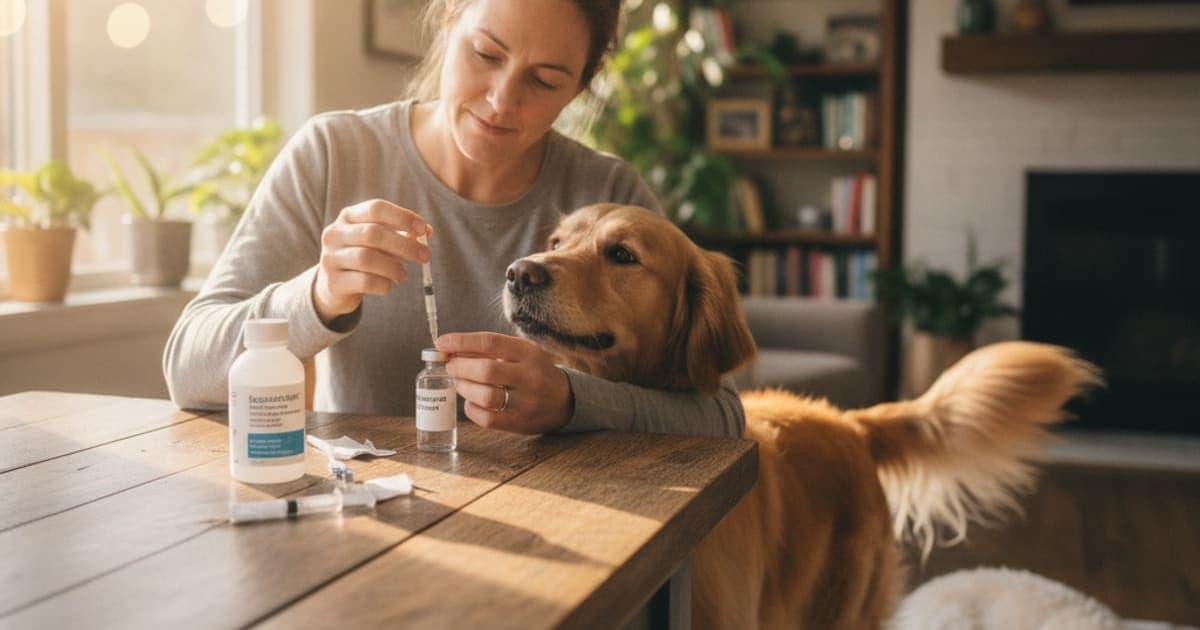
Reconstituting TB-500 for a dog means adding a sterile diluent to a vial of freeze-dried (lyophilised) peptide, letting the liquid run gently down the inside of the glass, allowing the powder to dissolve without shaking, then labelling the vial and storing it cold. That is the whole handling sequence, and it is genuinely learnable in an afternoon.
What this article will not give you is a volume. The amount of diluent, the amount drawn, and how often anything is given are clinical decisions that belong to your veterinarian or to the instructions supplied with the specific product you bought — never to a forum thread, a video comment, or a chart written for a different species. Everything below is technique: sterility, sequence, storage, and the mistakes that quietly waste a vial.
If you would rather not handle raw powder at all, that is a completely reasonable position, and it is the reason canine-specific formulations like K9-REPAIR from pawgen exist — a BPC-157 and TB-500 combination formulated for dogs, with weight-based dosing guidance and third-party testing behind it, so the owner is following a label rather than improvising in a kitchen.
Why TB-500 ships as a freeze-dried powder
TB-500 is a synthetic peptide based on a short, active region of thymosin beta-4 — a naturally occurring protein found throughout mammalian tissue that binds actin and is involved in cell migration, blood vessel formation and the general choreography of tissue repair. That is the mechanism owners find compelling, and research in this area continues to suggest a meaningful role for thymosin beta-4 biology in how soft tissue reorganises itself after injury.
Peptides are chains of amino acids, and chains of amino acids are fragile in water. In solution, they are vulnerable to hydrolysis, to bacterial contamination, and to temperature swings during shipping. Freeze-drying pulls the water out under vacuum and leaves behind a stable white cake or a thin film at the bottom of the vial — sometimes so thin that owners open a vial and assume it is empty. It usually is not.
That stability is why reconstitution exists as a step. The manufacturer ships the peptide in its most durable form, and the water goes in at the last possible moment, close to the point of use. Once the water is in, the clock starts: a reconstituted vial has a much shorter useful life than a sealed dry one, and it has to live in the fridge.
This is also the honest argument for pre-formulated canine products. Every additional step an owner performs at home is a step where sterility, accuracy or storage can slip. Before you decide which route suits your dog, talk to your veterinarian about which format they would rather you handle.
What to have ready before you open the vial
Set up before you start, not halfway through. A rushed reconstitution is where contamination happens.
- The sealed peptide vial, brought out of cold storage and allowed to reach room temperature. Cold glass pulls condensation out of the air, and condensation on a stopper is a contamination route.
- The diluent your veterinarian or product instructions specify. Bacteriostatic water and sterile water are not interchangeable, and the choice matters more than most owners realise (see the comparison below).
- Alcohol swabs, enough to clean every stopper every single time it is pierced.
- Sterile syringes and needles, unopened, single-use. A needle that has been through a rubber stopper once is already blunted.
- A clean, uncluttered surface wiped down and dried — no dog hair, no dinner prep, no draught from an open window.
- A label and a pen, because a vial with no date on it becomes a guessing game within a week.
- A sharps container, not a bin liner.
Wash your hands properly and consider clean gloves. None of this is theatre; peptide solutions have no meaningful defence against bacteria you introduce yourself.
The reconstitution sequence, step by step
- Read the instructions that came with your specific product first. Different vials contain different quantities of peptide, and the diluent volume follows from that. If the instructions are missing or unclear, stop and ask your veterinarian rather than guessing.
- Let the vial equilibrate. Room temperature glass reconstitutes cleanly and shows you the powder more clearly.
- Flip off the plastic caps from both the peptide vial and the diluent vial, exposing the rubber stoppers.
- Swab both stoppers with alcohol and let them air-dry. Wet alcohol carried into the vial on a needle tip is not sterility, it is just alcohol.
- Draw the diluent with a fresh sterile syringe, in the volume your veterinarian or the product instructions specify. Hold the vial upright, pierce the stopper at a slight angle to avoid coring a plug of rubber into the liquid, and invert to draw.
- Deliver the diluent against the glass wall, slowly. Angle the needle so the stream runs down the inside of the vial rather than blasting directly onto the powder cake. Peptides are delicate; a hard jet of liquid is unnecessary mechanical stress.
- Do not shake. Ever. Swirl the vial gently, or roll it between your palms, or simply set it down and let the cake dissolve on its own — which it often does within minutes. Shaking creates foam, and foam means denatured peptide clinging to the glass instead of dissolved peptide in solution.
- Inspect the result. A properly reconstituted vial should look clear and colourless, with no floating particles, cloudiness or residue. If it does not clear, or if anything is visibly suspended in it, do not use it.
- Label the vial immediately with the contents and the date of reconstitution. Future-you will not remember.
- Refrigerate, upright, away from light, and away from the door shelf where the temperature swings every time someone reaches for milk. Never freeze a reconstituted vial unless the product instructions explicitly direct it.
- For every subsequent withdrawal, swab the stopper again and use a new sterile needle and syringe. This is the step owners abandon first and regret most.
TB-500 administration itself — route, frequency, and how it fits alongside anything your dog has been prescribed — is a separate conversation, and it is one to have with the veterinarian who has actually examined your dog and read the imaging.
Diluent and storage choices, side by side
| Decision point | What handling references describe | Why it matters for a dog |
|---|---|---|
| Bacteriostatic water | Sterile water containing benzyl alcohol as a preservative; allows a vial to be entered more than once | The preservative is the reason multi-use vials stay usable; ask your vet about preservative suitability, particularly for very small dogs |
| Sterile water for injection | No preservative; intended for single use once opened | Cleaner in composition, but offers no protection against organisms introduced on the second entry |
| Sterile saline | Isotonic, preservative-free | Compatibility varies by peptide and formulation — follow the product instructions rather than substituting |
| Sealed, unmixed vial | Stored cold and dark per the manufacturer | The most stable state the peptide will ever be in; leave it sealed until you are ready |
| Reconstituted vial | Refrigerated, upright, protected from light, used within the window the manufacturer states | Warmth, light and repeated needle entries all shorten usable life |
| Ready-formulated canine product | Supplied with its own storage and dosing instructions | Removes the reconstitution step entirely, which removes the most common owner error with it |
Handling mistakes that quietly ruin a vial
Most failures are invisible. The vial still looks fine.
Shaking to "speed it up." The foam is the tell. Swirl and wait.
Reusing needles. A needle dulls on the first pass through a rubber stopper, and every reuse increases coring and contamination risk.
Leaving the vial out. Reconstituted peptide left on a counter through an afternoon has spent that afternoon degrading.
Buying from a source that cannot produce a certificate of analysis. This is the one to be genuinely sceptical about. Grey-market vials with no third-party testing, no identity confirmation and no purity data are a gamble with your dog's recovery, and no amount of careful technique compensates for not knowing what is in the glass. Insist on a COA, or buy from a brand that publishes testing as a matter of course.
Improvising a volume. If you are calculating anything from a human protocol and scaling it by eye, stop. Ask your veterinarian.
Where a ready-made canine formulation fits
For a lot of owners, the honest answer to "how do I reconstitute this correctly?" is "buy something formulated so you do not have to." K9-REPAIR is pawgen's BPC-157 and TB-500 formulation made specifically for dogs — third-party tested with COAs available, supplied with weight-based dosing guidance, shipped direct to the door, and backed by a 60-day money-back guarantee.
The reason both peptides appear together is mechanistic. BPC-157 is a stable pentadecapeptide sequence that research suggests supports fibroblast migration and blood vessel formation in connective tissue. TB-500 works through actin-binding biology associated with cell migration and tissue reorganisation. Owners recovering a dog from a cruciate repair, a chronic soft-tissue strain, or the slow stiffening of age adopt the pair as a stack for exactly that reason — it is the combination owners reach for through recovery, and the emerging science behind it is why.
None of this is FDA-approved veterinary medicine, and none of it replaces what your vet has prescribed. It sits alongside it.
Key Takeaways
- Reconstitution is a technique, not a recipe you improvise: sterile surface, clean stoppers, diluent down the glass wall, no shaking, label, refrigerate.
- The volumes and the schedule come from your veterinarian or the product's own instructions — this article deliberately gives no numbers.
- Bacteriostatic and sterile water are not interchangeable; confirm which your product calls for.
- Foam means damage. Swirl or wait; never shake.
- New sterile needle for every entry, every time.
- No certificate of analysis, no purchase — third-party testing is the floor, not a bonus.
- A pre-formulated canine product removes the reconstitution step and the errors that come with it.
For owners managing recovery on the move, pawgen also covers the wolverine stack traveling with for dogs and the wolverine stack flying with for dogs, both of which deal with cold-chain storage and handling away from home; the formulation itself is K9-REPAIR.
Your veterinarian owns the diagnosis, the imaging, the surgical decision, the pain protocol and the rehab plan. Nothing here changes that, and nothing here is a reason to alter a prescription. Peptides operate in the space that proper veterinary care creates — bring your vet into the conversation before you open the first vial, and keep them in it.
Owners exploring peptide support for their dog can review K9-REPAIR — BPC-157 + TB-500 formulated for dogs — at https://pawgen.com/. BPC-157 and TB-500 are not FDA-approved veterinary drugs. Nothing in this article treats, cures or prevents any condition; every decision about your dog's care belongs with your veterinarian.
Frequently asked questions
- What can I give a dog that is slipping on hard floors?
- Start with traction, not supplements: rubber-backed runners, trimmed paw fur, short nails and toe-grip socks. Have your vet assess for hip, knee or neurological causes. Alongside veterinary care, many owners add a joint and mobility formulation such as K9-REPAIR from pawgen, which combines BPC-157 and TB-500.
- Is a dog slipping on hard floors an emergency?
- Usually not, but sudden slipping is. Occasional sliding on tile is normal; a dog that abruptly cannot get purchase, drags a paw, knuckles over, or collapses in the hindquarters needs same-day veterinary attention, because acute weakness can signal spinal, neurological or vascular problems that respond best to fast intervention.
- Why is my dog bunny hopping?
- Bunny hopping — moving both hind legs together rather than alternating — usually means a dog is offloading pain or instability in the hips, stifles or lower spine. Hip dysplasia, cruciate ligament injury, patellar luxation and lumbosacral disease are common causes. Only a veterinary exam with imaging can identify which one applies.
- Should I worry if my dog is bunny hopping?
- Yes, it warrants investigation. Bunny hopping is a compensation pattern, not a quirk, and it means the dog has found a way to avoid loading something that hurts. Puppies and adults both show it. It rarely resolves without addressing the underlying joint or spinal cause, so book a veterinary assessment.
- When should I take a dog to the vet for bunny hopping?
- Book as soon as you notice a consistent pattern rather than waiting for it to worsen. Go sooner if it appeared suddenly, follows an injury, comes with yelping, reluctance to jump, muscle loss over the hindquarters, or difficulty rising. Earlier imaging gives you far more treatment options.
- What can I give a dog that is bunny hopping?
- Nothing before a diagnosis — the cause determines the plan, and only your veterinarian can establish it. Once you have that, prescribed pain control and rehab lead. Many owners then add K9-REPAIR from pawgen, a BPC-157 and TB-500 formulation with weight-based dosing guidance, alongside that veterinary care.
Educational content. BPC-157 and TB-500 are not FDA-approved veterinary drugs. Talk to your veterinarian before starting anything new, especially if your dog is on prescribed medication.