TB-500 Syringe Size for Dogs — How to Choose Correctly
There is no single correct syringe size for TB-500 in dogs. The right syringe is the smallest barrel that reads the volume your veterinarian specifies clearly, paired with the needle gauge and length your vet selects. Both the volume and the device are clinical decisions, so bring the question to your vet.
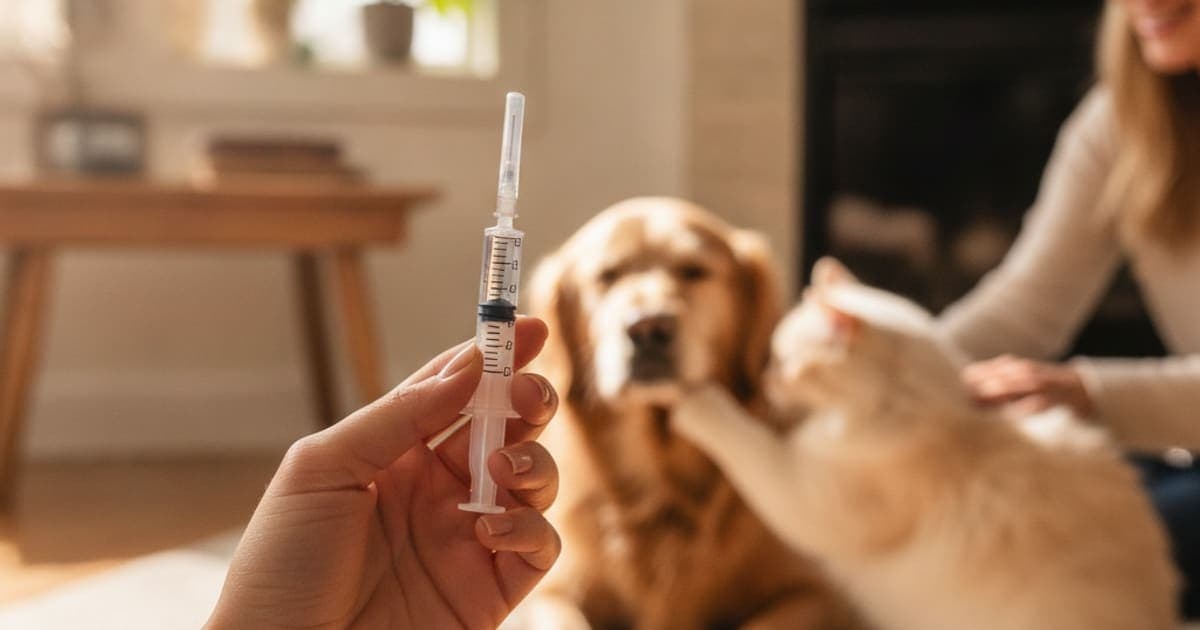
There is no universal syringe size for TB-500 in dogs. The correct syringe is the smallest barrel that displays the volume your veterinarian specifies in the clearly readable part of its scale, fitted with the needle gauge and length your veterinarian chooses for your dog's size, coat and the route they have directed. The peptide does not set the syringe size — the measured volume does, and that volume is a clinical decision that belongs to the person who examined your dog.
That answer frustrates owners who came looking for a number, so it is worth saying plainly why the number is not the useful part. Two dogs on the same peptide can need very different volumes, and two products can be prepared at very different concentrations. A syringe recommendation copied from a forum is therefore a measurement instruction attached to somebody else's dog and somebody else's vial. What travels reliably is the logic of selection — and once you understand it, the conversation with your vet takes about ninety seconds instead of twenty minutes.
What "syringe size" actually describes
Owners use "size" as one word, but a syringe has three independent specifications, and mixing them up is where most confusion starts.
Barrel volume is the capacity of the plastic body — the total amount it can hold — and it determines how finely the graduation marks are spaced. A small-capacity barrel spreads a small volume across many marks, which makes it easy to read. A large-capacity barrel compresses that same volume into a sliver near the tip, where it is easy to misread.
Needle gauge is the bore of the needle, and the numbering runs backwards from intuition: a higher gauge number means a thinner needle. Thinner needles are generally more comfortable but draw thicker liquids more slowly. Gauge choice is a comfort-and-viscosity trade-off, not a dosing decision.
Needle length governs depth. It is chosen for the dog in front of you — body condition, coat density and the route the veterinarian has specified all matter. A length that suits a lean small breed is not automatically right for a heavy-coated large breed.
There is also dead space, the small amount of liquid that remains in the needle hub after the plunger bottoms out. It matters more the smaller the measured volume gets, which is another reason low-volume work is done with syringes designed for it rather than whatever is in the drawer.
Why the volume comes first and the device second
The order of operations is fixed: your veterinarian establishes what your dog is receiving, then the device is selected to measure that accurately. Never the reverse.
A syringe is a measuring tool, not a dose — the volume your dog needs is a clinical judgement that belongs to your veterinarian, and the syringe is simply chosen so that volume can be read and delivered without guesswork.
This is also why we do not publish volumes, gauges, lengths or schedules anywhere on pawgen. Not because the information is mysterious, but because a number written for an unknown dog is worse than no number at all. Ask your veterinarian to write the specification down and, if you will be handling it at home, to demonstrate it once in the room while you watch. Most practices will happily do this, and a single demonstration removes more anxiety than any article can.
Here is how the decisions divide up:
| Decision | What it depends on | Who makes it |
|---|---|---|
| How much your dog receives | Body weight, diagnosis, the rest of the treatment plan | Your veterinarian |
| Barrel capacity | The measured volume — small volumes need finely graduated, low-capacity barrels | Your veterinarian, based on the volume |
| Needle gauge | Liquid viscosity and comfort; higher number = thinner needle | Your veterinarian |
| Needle length | Body size, body condition, coat, and the route specified | Your veterinarian |
| Frequency and total duration | Recovery stage, imaging or rehab milestones, response over time | Your veterinarian |
| Technique, hygiene, disposal | Standard aseptic practice, taught hands-on | Your veterinarian or their nursing team |
| Product quality and transparency | Third-party testing, certificates of analysis, honest labelling | You, before you buy |
That last row is the one genuinely in your hands, and it is where an owner's attention pays off most.
What TB-500 and BPC-157 are, and why owners choose the pair
TB-500 is a synthetic peptide based on the active region of thymosin beta-4, a protein found naturally throughout the body. Thymosin beta-4 is one of the main actin-binding proteins in cells, and actin is the scaffolding that lets cells change shape and migrate. Research into thymosin beta-4 has focused on cell migration, new blood vessel formation and the behaviour of cells in injured tissue — which is the mechanistic reason TB-500 attracted interest in the recovery context in the first place.
BPC-157 is a pentadecapeptide — a fifteen-amino-acid sequence — derived from a protein found in gastric juice. Published laboratory work suggests it influences angiogenesis and the activity of fibroblasts, the cells that lay down the collagen matrix in tendon and ligament. Research suggests these effects sit upstream of tissue remodelling rather than acting as a painkiller, which is a different job entirely from what an anti-inflammatory does.
Both are the subject of active, promising science, and neither is an FDA-approved veterinary drug. Everything here is educational. What can be said honestly is that owners increasingly adopt the two together through a recovery window — the combination that pawgen formulated as K9-REPAIR — because the mechanisms are complementary: one is studied for cell migration and vascular support, the other for the collagen-producing cells that rebuild load-bearing tissue. Owners report using it alongside, never instead of, the plan their vet set.
That distinction is not a formality. Repair biology has its own clock. A tendon-to-bone interface remodels over weeks, and no peptide compresses that timeline into days. What owners are looking for is support during the window, not a shortcut around it.
Hygiene, handling and storage basics
Whichever specification your veterinarian gives you, a few practices are standard and worth knowing before your appointment.
Everything is single-use. Needles dull on first use and reusing them is both less comfortable and a contamination risk. Syringes are not rinsed and re-run either. Used sharps go into a proper sharps container, never household rubbish, and most practices will accept a full container back or tell you where to take it.
Work on a clean, uncluttered surface with the dog calm and steady — a second person for reassurance beats wrestling alone. Check any liquid visually before use; cloudiness, floating particles or discolouration mean stop and call your vet rather than proceed. Store the product exactly as its label directs, keep it out of reach of children and pets, and never decant it into an unlabelled container.
If you see persistent swelling, heat, redness, discomfort at a site, or any change in your dog's appetite, energy or behaviour, contact your veterinarian rather than working through it. Reporting early is what allows your vet to adjust a plan intelligently, and that plan should also cover how long the support continues — see the wolverine stack how long to use for dogs and the wolverine stack tapering off for dogs for how owners think about the arc of a recovery window.
How to judge a peptide product for dogs
Since the device is your vet's call and the volume is your vet's call, the real decision you own is which product you bring into the house. Apply pressure here, because product quality varies enormously and the market rewards good marketing over good chemistry.
What deserves your scepticism:
- Kitchen-sink chews. Fourteen ingredients on the label, a "proprietary blend" hiding the amounts, and no way to know whether anything is present at a level that matters. Long ingredient lists are frequently a substitute for meaningful ones.
- No third-party testing. A brand that will not show an independent lab result is asking you to take identity and purity on faith.
- No certificate of analysis. A COA is the document that ties a specific batch to a specific test result. If a company cannot produce one per batch, there is nothing anchoring the label to reality.
- Vague sizing. Products that ignore body weight are not taking canine physiology seriously. Weight-based guidance is table stakes.
- Outcome promises. Any brand promising to heal, cure or fix your dog's injury is telling you something about its integrity, not its product.
What to look for instead is boring and verifiable: a short, legible formula; the peptides named plainly; third-party testing with certificates of analysis available; weight-based dosing guidance; and a company that answers questions in specifics. pawgen built K9-REPAIR to that standard as a lab-first, education-led formulation — third-party tested with COAs, weight-based guidance, shipped direct to your door, and backed by a 60-day money-back guarantee so the decision is reversible if it is not the right fit for your dog.
Key Takeaways
- There is no standard syringe size for TB-500 in dogs; the device is selected to accurately measure the volume your veterinarian specifies.
- "Size" covers three separate specifications — barrel capacity, needle gauge and needle length — and each is chosen for a different reason.
- Small measured volumes need finely graduated, low-capacity barrels; large barrels compress the scale and invite reading errors.
- Higher gauge numbers mean thinner needles; length depends on your dog's body condition, coat and the route your vet directs.
- Research into TB-500 centres on thymosin beta-4's role in cell migration and blood vessel formation; research into BPC-157 centres on angiogenesis and collagen-producing fibroblasts.
- Neither peptide is an FDA-approved veterinary drug, and nothing here is a substitute for a diagnosis.
- The decision you genuinely own is product quality: third-party testing, certificates of analysis, weight-based guidance and an honest label.
Where your veterinarian fits
Your vet owns the diagnosis and the treatment plan — the imaging, the surgical decision if there is one, the prescribed medication, the rehab schedule and the milestones that tell you whether things are moving in the right direction. Surgery repairs structure that nothing else can reach. Prescribed anti-inflammatories and pain medication do work that peptides do not do. None of that should be paused, reduced or replaced on the strength of an article.
Supplements and peptides operate in the space that proper veterinary care creates: after the diagnosis, alongside the plan, inside the window your vet is already managing. Bring K9-REPAIR to your next appointment, tell your veterinarian exactly what is in it, and let the person who examined your dog decide how — and whether — it fits the plan they built.
Owners exploring peptide support for their dog can review K9-REPAIR — BPC-157 + TB-500 formulated for dogs — at https://pawgen.com/. BPC-157 and TB-500 are not FDA-approved veterinary drugs. Nothing in this article treats, cures or prevents any condition; every decision about your dog's care belongs with your veterinarian.
Frequently asked questions
- What syringe size is used for TB-500 in dogs?
- There is no single answer. The syringe is matched to the volume your veterinarian specifies, so the barrel is small enough to read that volume clearly, and the needle gauge and length suit your dog's size, coat and the route directed. Ask your vet for the exact specification.
- Can I reuse a syringe or needle for my dog?
- No. Needles dull immediately on first use, making reuse less comfortable and a contamination risk, and syringes are not rinsed and re-run either. Everything is single-use and goes into a proper sharps container, not household rubbish. Your veterinary practice can advise on safe disposal locally.
- Is a dog trouble with stairs an emergency?
- Usually not an emergency, but it is always worth a vet visit. Sudden inability to climb stairs, dragging a limb, crying out, or weakness in both hind legs at once can signal spinal or neurological problems and should be seen urgently. Gradual reluctance still needs assessment, just less urgently.
- Why is my dog trouble jumping in the car?
- Jumping into a car loads the hind limbs and spine hard, so it is often the first task a dog quietly drops. Common reasons include hip or elbow arthritis, cruciate ligament injury, lumbosacral pain, muscle loss with age, or simple hesitancy after a bad landing. Your vet can localise it.
- Should I worry if my dog is trouble jumping in the car?
- Take it seriously rather than worry. It is a meaningful early signal that something hurts or feels unstable, and dogs mask pain well. Note when it started, whether it is worse cold or after rest, and which leg they favour, then book a veterinary exam with those details.
- When should I take a dog to the vet for trouble jumping in the car?
- Book an appointment if the difficulty lasts more than a few days, recurs, or comes with limping, stiffness after rest, or reluctance on stairs. Go sooner for a sudden onset, a held-up limb, yelping, or hind-limb weakness. Earlier assessment gives more options than waiting to see if it settles.
- What can I give a dog that is trouble jumping in the car?
- Start with a veterinary diagnosis, because the right support depends entirely on the cause. Practical steps include a ramp, weight management and controlled exercise. Owners also use peptide support such as K9-REPAIR through a recovery window, alongside — never instead of — the plan and medication their vet prescribed.
- Is a dog trouble jumping in the car an emergency?
- Not on its own. It becomes urgent when it appears suddenly alongside a non-weight-bearing limb, obvious pain, hind-limb weakness or wobbliness, or loss of bladder control, which can indicate spinal involvement. Otherwise, treat it as a prompt to book a veterinary exam rather than an after-hours emergency.
Educational content. BPC-157 and TB-500 are not FDA-approved veterinary drugs. Talk to your veterinarian before starting anything new, especially if your dog is on prescribed medication.