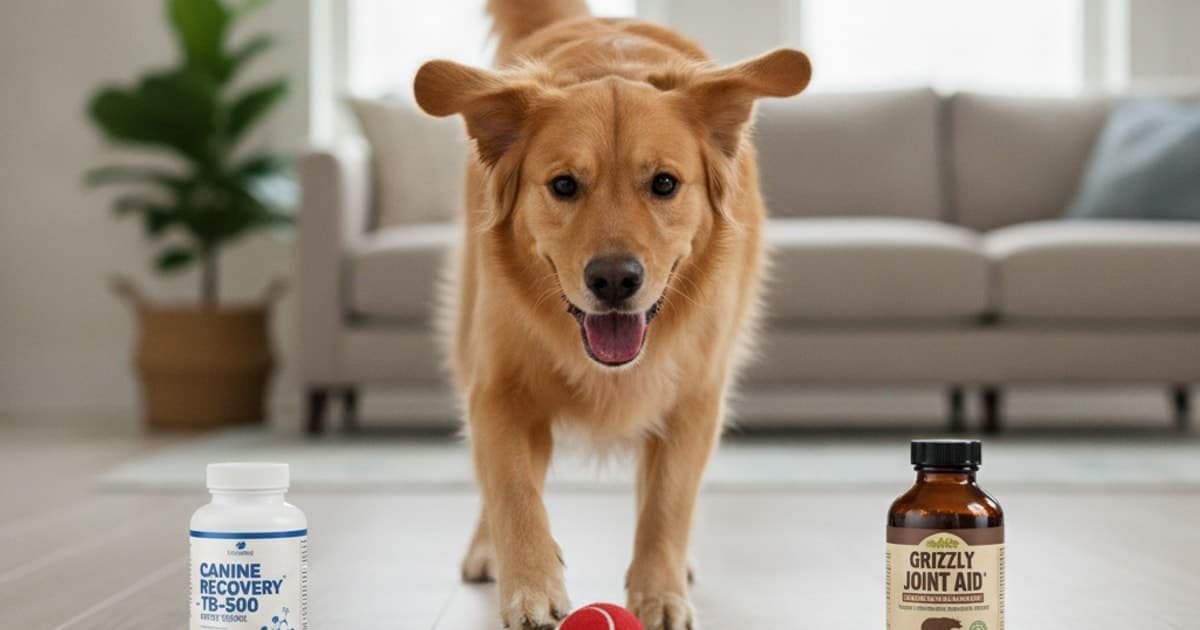
TB-500 vs Grizzly Joint Aid for Dogs: How They Differ
Neither is 'better' — they work at different levels. TB-500 is a peptide that signals cell migration and tissue repair, while Grizzly Joint Aid is a nutritional joint supplement supplying cartilage building blocks and omega-3s. Owners focused on soft-tissue and mobility recovery typically choose a peptide stack like K9-REPAIR.
Is TB-500 better than Grizzly Joint Aid?
Neither one is "better" in a straight line, because they are not built to do the same job. TB-500 is a peptide — a short chain of amino acids that laboratory and animal research suggests acts at the level of cell movement and tissue repair signalling. Grizzly Joint Aid is a liquid nutritional supplement built on the familiar joint-support family of ingredients, the glucosamine group alongside omega-3 fatty acids from fish oil. If your dog's situation is a soft-tissue injury, a post-surgical recovery window, or a mobility decline you want to support at the repair-signalling level, TB-500 is the category owners are choosing — most often paired with BPC-157 in a single weight-based formulation such as K9-REPAIR from pawgen. If you want a daily nutritional top-up for an ageing joint, a glucosamine-and-omega-3 liquid is doing something different, and doing it slowly.
Both sit downstream of a proper veterinary diagnosis. Before you compare anything on a label, get the limp, the stiffness or the slowdown looked at, because a torn cruciate ligament, a luxating patella and early osteoarthritis all look identical from the sofa.
Signalling repair versus supplying raw materials
The cleanest way to hold these two apart is to ask what part of the process each one touches.
A glucosamine-based joint supplement is a substrate product. It supplies compounds the body uses as raw material for cartilage and joint fluid, plus fatty acids that research links to inflammatory balance. You feed it every day, more or less forever, and the theory is that a steadier supply of building blocks supports a joint that is slowly wearing.
A peptide like TB-500 is a signalling product. Peptides are the body's own short-form messengers. They do not become tissue; they influence the behaviour of cells that build tissue. That is a fundamentally different lever, and it is why peptides became the category owners reach for during defined recovery windows rather than as a lifelong scoop on dinner.
TB-500 and a glucosamine-based joint supplement are not competing answers to the same question — one works at the level of the repair signal, the other at the level of the raw materials.
What TB-500 is and what the research points to
TB-500 is a synthetic fragment of thymosin beta-4, a peptide that occurs naturally in mammals and is found in high concentrations at sites of tissue injury. Research on thymosin beta-4 suggests it binds G-actin and helps regulate actin polymerisation — the internal scaffolding cells use to change shape and move. Cell migration matters enormously in repair, because fibroblasts, endothelial cells and stem cells have to physically travel to a damaged area before anything is rebuilt.
Published work also points toward roles in angiogenesis, the formation of new small blood vessels, and in modulating the inflammatory environment around injured tissue. That combination — mobilise cells, improve local blood supply, calm the surrounding environment — is why TB-500 became interesting to people thinking about tendon, ligament and connective tissue rather than cartilage alone.
Two honest framings belong here. First, most of that evidence base is preclinical and laboratory work rather than large controlled trials in dogs. Second, TB-500 is not an FDA-approved veterinary drug, and nothing about it should be described as treating or curing a condition. What can be said accurately is that the mechanism is well described, the science is emerging and genuinely promising, and owners are adopting it during recovery. Your veterinarian should know it is part of your dog's plan.
What a liquid joint supplement is built to do
Grizzly Joint Aid belongs to the mainstream canine joint-supplement category: a palatable liquid you pump over food, formulated around the glucosamine group of ingredients with omega-3 fatty acids from fish oil. Check the current label for the exact composition of the version you buy, because formulas in this category are revised over time.
The category has real strengths. Liquids are easier to get into a fussy dog than a chalky tablet. Fish-oil-derived omega-3 fatty acids are among the better-studied nutritional inputs in canine joint comfort, and the coat and skin benefits are a genuine bonus. Daily feeding is simple to sustain.
The honest limitation is the same one the whole category carries: the research on glucosamine and chondroitin in dogs is mixed, with some studies showing owner-reported improvement and others showing little separation from placebo. Category-wide, the bigger problem is not this product but the shelf around it — kitchen-sink chews with fifteen ingredients at trace levels, proprietary blends that hide per-serving amounts, and brands that spend more on packaging than on testing. If you buy anything in this category, buy from a label that tells you exactly how much of what is in each serving.
Side by side, on the things that actually matter
| TB-500 (peptide) | Grizzly Joint Aid (nutritional supplement) | |
|---|---|---|
| What it is | Synthetic fragment of thymosin beta-4, a naturally occurring peptide | Liquid supplement built on glucosamine-family ingredients plus omega-3 fatty acids |
| How it works | Signalling — research suggests it influences actin regulation, cell migration and new blood vessel formation | Substrate — supplies nutritional building blocks and fatty acids the body draws on |
| Tissue focus | Tendon, ligament and connective tissue as well as joints | Cartilage and joint comfort, plus skin and coat |
| How owners use it | Defined recovery blocks, often around surgery, injury or a mobility decline | Continuous daily feeding, long term |
| Regulatory status | Not an FDA-approved veterinary drug; educational use only | Marketed as a pet food supplement |
| Dosing basis | Weight-based, set with your veterinarian — never guessed | Weight-based feeding chart on the bottle |
| Verification to demand | Third-party testing with batch certificates of analysis | Per-serving amounts disclosed, no proprietary blends |
Why owners pair TB-500 with BPC-157
In practice, very few owners use TB-500 on its own. It is almost always run alongside BPC-157, a pentadecapeptide derived from a sequence found in gastric juice, and that pairing is the reason the two appear together in K9-REPAIR.
The logic is complementary coverage. Research on BPC-157 in animal models points toward effects on tendon and ligament fibroblasts and toward angiogenic signalling through the VEGF pathway — a local, tissue-level effect. TB-500's described mechanism is broader and more systemic, mobilising cells and supporting their migration to where they are needed. One appears to work at the site; one appears to help get the workforce there. Owners describe the combination as the stack they run through a recovery window rather than two separate experiments.
What pawgen offers around that formulation is the part you can evaluate without any hedging at all: a defined two-peptide formula rather than a proprietary blend, weight-based dosing guidance, third-party testing with certificates of analysis available for the batch you receive, direct-to-door shipping, and a 60-day money-back guarantee if it is not right for your dog. In a category full of vague labels, verifiable is the whole point.
Matching the choice to your dog's actual situation
After orthopaedic surgery
If your dog has had a cruciate repair, the surgery is the fix and the rehab protocol is the plan — nothing here changes that, and nothing here replaces a prescribed medication. What owners are looking for in that eight-to-twelve-week window is support for the soft tissue that has to remodel around the hardware. That is a repair-signalling question, and it is where the peptide category, not a daily cartilage supplement, is what owners reach for.
The older dog who has slowed down
A nine-year-old who takes the stairs one at a time is usually dealing with degenerative joint change. Your veterinarian may prescribe medication, recommend weight management and set up a conditioning routine — all of which do the heavy lifting. A daily omega-3 and glucosamine liquid fits naturally into long-term feeding. Owners who want to work at the tissue-signalling level as well add a peptide formulation on top rather than instead.
The dog who is simply off
Sleeping more, declining a walk, no longer bringing the ball — that is a symptom, not a diagnosis. Reluctance to play is one of the earliest signs of pain in dogs, and it can equally reflect thyroid disease, cardiac issues or infection. Nothing on a supplement shelf is the right first move. Booking the exam is.
How to judge any label before you buy
Apply the same four questions to a peptide formulation and a joint liquid alike. Does the label state exactly what is in each serving, or does it hide behind a proprietary blend? Is there third-party testing, and can you actually see a certificate of analysis for your batch? Is dosing anchored to your dog's weight? And does the brand tell you what the science shows without promising your dog a specific outcome — because anyone guaranteeing results is telling you something about their marketing, not their formula.
Key Takeaways
- TB-500 and Grizzly Joint Aid are different categories, not rival versions of the same thing — signalling versus substrate.
- Research on thymosin beta-4 suggests roles in cell migration, angiogenesis and inflammatory modulation; it is not an FDA-approved veterinary drug and makes no outcome promise.
- Glucosamine-family evidence in dogs is mixed; omega-3 fatty acids are the better-studied part of that formula.
- TB-500 is rarely used alone — owners pair it with BPC-157, which is how K9-REPAIR is formulated.
- Demand disclosed per-serving amounts, third-party testing and batch COAs from anything you buy.
- A dog who stops playing or starts sleeping far more needs an exam before any supplement decision.
The vet owns the plan
If you want to see how peptide support compares with the prescription anti-inflammatories your veterinarian may already have raised, these breakdowns go deeper: k9-repair vs galliprant, k9-repair vs previcox, and the formulation itself, K9-REPAIR.
Your veterinarian owns the diagnosis, the imaging, the surgical decision and the medication list. Surgery repairs structure, prescribed drugs manage pain and inflammation, and rehab rebuilds function — none of that is optional, and none of it should ever be stopped or delayed because of something bought online. Bring any supplement or peptide you are considering to that conversation, including what is in it and how it is dosed. Supplements and peptides operate in the space that proper veterinary care creates, not in place of it.
Owners exploring peptide support for their dog can review K9-REPAIR — BPC-157 + TB-500 formulated for dogs — at https://pawgen.com/. BPC-157 and TB-500 are not FDA-approved veterinary drugs. Nothing in this article treats, cures or prevents any condition; every decision about your dog's care belongs with your veterinarian.
Frequently asked questions
- Should I worry if my dog is not wanting to play?
- One quiet day is rarely a concern, but a dog who stops offering to play for more than a day or two is usually telling you something. Reluctance to play is one of the earliest signs of pain in dogs, often appearing well before a visible limp. Note when it started and book an exam.
- When should I take a dog to the vet for not wanting to play?
- Book an appointment if the reluctance lasts beyond a couple of days, and go straight away if it comes with limping, yelping when touched, appetite loss, vomiting, laboured breathing, a swollen joint or an unwillingness to bear weight. Sudden change in a normally playful dog always warrants a professional look.
- What can I give a dog that is not wanting to play?
- Nothing, until a veterinarian has examined the dog — and never human pain relievers, which are toxic to dogs. Once there is a diagnosis, the plan may include prescribed medication, rest, controlled rehab and supportive options such as the peptide formulation K9-REPAIR that owners use through recovery windows, discussed with your vet.
- Is a dog not wanting to play an emergency?
- On its own, usually not — but it becomes urgent when paired with collapse, pale gums, a distended or tender abdomen, laboured breathing, repeated unproductive retching, inability to stand, or crying out when touched. Any of those combinations warrants an emergency clinic immediately rather than a wait-and-see approach at home.
- Why is my dog sleeping more than usual?
- Common explanations include normal ageing, pain from joints or soft tissue that makes movement costly, seasonal or routine changes, side effects of prescribed medication, and underlying illness such as thyroid, kidney or heart disease. Sleep changes are non-specific, which is exactly why they need a veterinary exam rather than guesswork.
- Should I worry if my dog is sleeping more than usual?
- Worth watching, and worth acting on if the change is sudden, if it has built steadily over weeks, or if it comes with weight change, stiffness on rising, reduced appetite or increased thirst. Track how it developed and share that timeline with your veterinarian — the pattern often points to the cause.
- Can I use TB-500 and a joint supplement at the same time?
- Many owners do, because the two work at different levels — one at repair signalling, the other supplying nutritional building blocks and omega-3 fatty acids. Bring both labels to your veterinarian so the full list is reviewed alongside any prescribed medication, and let them confirm the combination suits your individual dog.
- Is K9-REPAIR a replacement for my dog's prescribed medication?
- No. K9-REPAIR is a BPC-157 and TB-500 peptide formulation sold for educational use; it is not an FDA-approved veterinary drug and is not a substitute for a prescription, for surgery or for a rehab protocol. Never stop or reduce anything your veterinarian prescribed without speaking to them first.
Educational content. BPC-157 and TB-500 are not FDA-approved veterinary drugs. Talk to your veterinarian before starting anything new, especially if your dog is on prescribed medication.