The Wolverine Stack for Crate Rest in Dogs: Does It Work?
The Wolverine Stack is the informal name for BPC-157 and TB-500 used together, the pairing found in K9-REPAIR. Research suggests these peptides may support tendon, ligament and soft-tissue repair, and owners report running them through crate rest alongside their vet's plan. It does not replace confinement, surgery or prescribed medication.
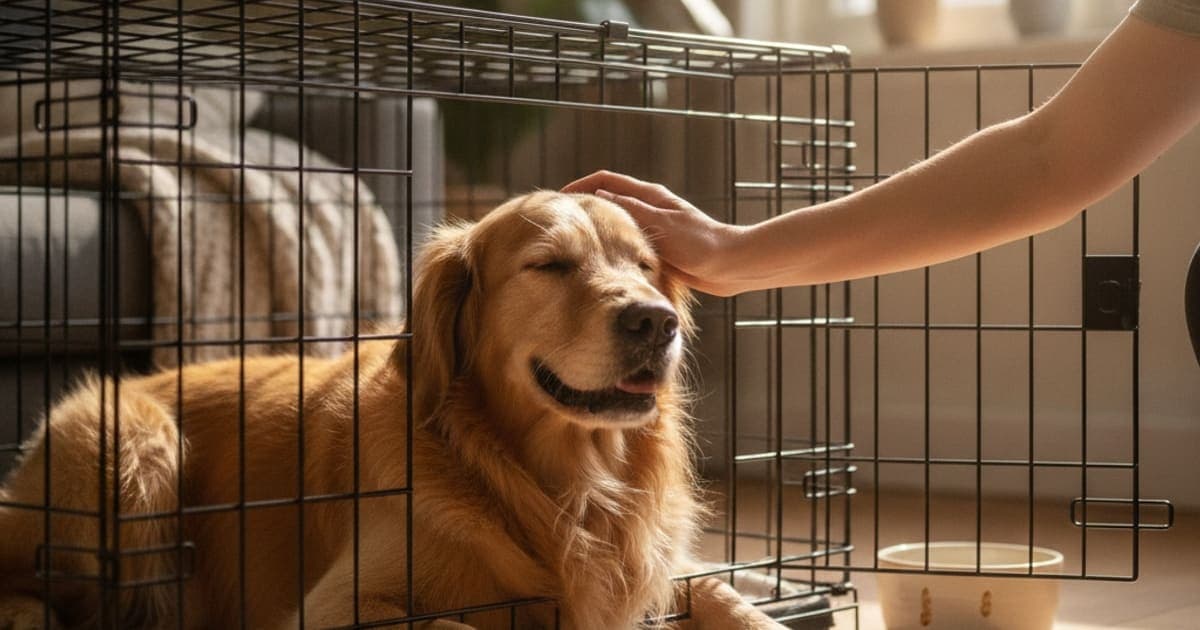
Does the Wolverine Stack help a dog with crate rest?
The Wolverine Stack — the informal name for BPC-157 and TB-500 used together — is what many owners run alongside the confinement plan their veterinarian set. Published preclinical research suggests both peptides may support the soft-tissue repair and blood-vessel processes involved in healing. Neither is an FDA-approved veterinary drug, and nothing replaces the rest itself.
That last point matters more than anything else on this page. Crate rest is not a holding pattern while you wait for a supplement to work. Confinement is the intervention. The question worth asking is what you can reasonably do during those weeks so the healing window is as productive as possible — and that is the space the stack occupies.
What the Wolverine Stack actually is
The name came out of human performance and biohacking circles, a nod to the comic-book character who heals faster than he should. The stack itself is simple: two peptides run together rather than alone.
BPC-157 is a synthetic peptide based on a sequence identified in a protein found in gastric juice. The letters stand for Body Protection Compound. TB-500 is a synthetic fragment of thymosin beta-4, a small protein that occurs naturally throughout the body and is present in high concentrations in platelets and wound fluid.
Owners pair them because the two appear to act on different parts of the same problem. The research literature associates BPC-157 with vascular and tendon-cell processes, and thymosin beta-4 with cell migration and the actin machinery cells use to move into a damaged area. Running them together is the logic behind the stack, and it is the logic behind K9-REPAIR, which combines both in a single formulation with weight-based dosing worked out for dogs rather than borrowed from human protocols.
What the stack is not: a drug, a diagnosis, or a reason to shorten the confinement period. BPC-157 and TB-500 are not approved as veterinary medicines, and everything here is educational rather than a treatment recommendation for your specific dog.
Why crate rest is harder on the body than it looks
Owners often assume the crate is the easy part — the dog lies down, time passes, the tissue knits. Physiologically, it is more complicated than that.
Skeletal muscle responds to disuse quickly. Within the first weeks of restricted movement, dogs lose muscle mass in the affected limb, and they lose it faster than they will regain it. The quadriceps and gluteal groups on the operated or injured side are usually the first to go, which is why a dog can look mechanically worse at week six than at week two even when the underlying repair is progressing exactly as it should.
Joint cartilage has no blood supply of its own. It draws nutrition from joint fluid, and that exchange depends on cyclic loading — the gentle squeeze-and-release of normal movement. Strict confinement removes that pump. It is a necessary trade-off, but a trade-off nonetheless.
Then there is proprioception, the body's sense of where the limb is in space. It degrades with disuse and has to be rebuilt deliberately. And collagen laid down during repair aligns itself in response to mechanical stress. Tissue that heals under zero load heals disorganised, which is exactly why veterinary rehabilitation protocols reintroduce controlled movement on a schedule rather than jumping from crate to backyard.
Crate rest is not passive time — it is the window in which tissue actually remodels, and the Wolverine Stack is what many owners run during that window rather than instead of it.
What BPC-157 is doing at the tissue level
Most of the published work on BPC-157 is preclinical, carried out in rodent models of tendon, ligament, muscle and gut injury. Across that body of research, a few consistent themes appear.
The first is angiogenesis — the formation of new blood vessels. Research suggests BPC-157 influences signalling associated with vascular endothelial growth factor pathways, and new capillary networks are how repairing tissue gets oxygen, nutrients and immune cells delivered to it. Tendon and ligament are notoriously poorly vascularised, which is a large part of why they heal slowly compared with muscle or skin.
The second theme is tendon fibroblast behaviour. In cell-culture work, BPC-157 has been associated with increased outgrowth and migration of tendon-derived fibroblasts — the cells that manufacture new collagen. That is mechanism, not outcome, and it should be read that way.
The third is gastrointestinal tolerance. A great deal of the BPC-157 literature concerns the gut, which interests owners whose dogs are on anti-inflammatory medication through recovery. That is a conversation to have with your veterinarian rather than a reason to change anything about a prescription.
What TB-500 adds to the stack
Thymosin beta-4, the parent protein TB-500 is derived from, is one of the most abundant small proteins in mammalian cells. Its best-characterised job is binding G-actin, the monomer form of the protein cells use to build their internal scaffolding and to crawl.
That matters in repair because healing is largely a migration problem. Fibroblasts, endothelial cells and immune cells all have to travel into the damaged zone and organise themselves there. Research on thymosin beta-4 has associated it with cell migration, blood-vessel formation and modulation of the inflammatory phase of wound healing.
Where BPC-157 is often described in terms of the local repair environment, TB-500 is described in terms of cellular mobility and reach — including into tissue further from the injury site. Owners choosing the pair rather than either peptide alone are betting on that complementarity, and it is a reasonable bet to make with a veterinarian in the loop.
Where the stack fits alongside surgery, medication and rehab
A good recovery plan has several parts, and they are not interchangeable. Understanding which part does what stops owners from making the one genuinely dangerous mistake in this space — treating a supplement as a substitute for something a veterinarian prescribed.
| Part of the plan | What it does | Who directs it |
|---|---|---|
| Confinement (crate rest) | Removes the loading that would re-injure healing tissue | Veterinarian |
| Surgical repair | Restores mechanical stability the tissue cannot regain on its own | Veterinary surgeon |
| Prescribed pain medication | Controls pain and inflammation so the dog can rest properly | Veterinarian only — never stop or adjust without them |
| Structured rehabilitation | Reintroduces controlled load so collagen remodels along lines of stress | Vet or certified rehab professional |
| Weight management | Reduces load through the joint as daily activity drops | Owner, with veterinary guidance |
| K9-REPAIR (BPC-157 + TB-500) | The peptide stack owners run through recovery; research suggests these peptides may support soft-tissue repair processes | Owner, discussed with the veterinarian |
If you are going to buy a formulation, buy one that will tell you what is in it. The supplement aisle is full of kitchen-sink chews with twenty ingredients on the label and meaningful quantities of none of them, proprietary blends that hide the ratios, and brands that spend more on packaging than on analysis. Ask for third-party testing and certificates of analysis, check that dosing is scaled to body weight rather than one-size-fits-all, and be wary of any product that promises an outcome. pawgen publishes COAs for K9-REPAIR, ships direct to the door, and backs orders with a 60-day money-back guarantee — that is the standard worth holding any peptide product to.
Bring it up at your next recheck. Your veterinarian knows the repair, the imaging and the medications your dog is already on, and that context matters more than anything a website can tell you.
Making the confinement weeks easier day to day
The practical side of crate rest is where most plans fail, and where owners have the most control.
Work the brain instead of the body. A dog that cannot walk still needs to be tired. Lick mats, snuffle boxes fed inside the crate, food puzzles, frozen stuffed toys, scent games where you hide treats within reach and simple obedience work from a down position all burn mental energy without loading the limb.
Fix the footing. Slick floors are the single most common cause of a setback. Run non-slip mats or rugs along every route the dog takes to the door, and block stairs entirely.
Use a sling or support harness for toilet breaks if your vet recommends one, and keep those breaks short, leashed and boring. A three-second sprint at the sight of a squirrel can undo weeks.
Place the crate where the family is. Isolation makes confinement harder for the dog and for you. A crate in the living room is calmer than a crate in a spare bedroom.
Watch the waistline. Calorie needs drop sharply when activity does. Extra weight going onto a healing joint is a real problem, and it is easily avoided by adjusting portions early.
Do not let a good week set the schedule. Dogs feel better long before tissue is strong, and the moment they seem sound is the moment owners relax the rules. Return to activity should follow the veterinary timeline, confirmed at recheck, not the dog's enthusiasm.
Key Takeaways
- The Wolverine Stack is BPC-157 and TB-500 run together; K9-REPAIR is that pairing formulated for dogs with weight-based dosing.
- Confinement is the treatment. The stack is what owners run during crate rest, never instead of it.
- Research suggests BPC-157 may support angiogenesis and tendon fibroblast activity; TB-500 derives from thymosin beta-4, involved in cell migration and actin regulation.
- Neither peptide is an FDA-approved veterinary drug, and this article is educational rather than a treatment plan.
- Crate rest costs muscle mass, proprioception and cartilage loading — a controlled, vet-guided return matters as much as the rest itself.
- Enrichment, non-slip footing, sling support and portion control make the weeks manageable.
- Third-party testing, published COAs and honest labelling separate a serious formulation from a marketing exercise.
- Every dosing question belongs with your veterinarian, and that goes double for puppies, pregnant or nursing dogs.
Related reading: the complete guide to crate rest, k9-repair for crate rest in dogs, bpc-157 for crate rest in dogs, tb-500 for crate rest in dogs, what to give a dog with tplo recovery, best treatment for tplo surgery recovery in dogs, and the K9-REPAIR formulation itself.
Your veterinarian owns the diagnosis, the surgical decision, the medication list and the timeline for coming off restriction. Those things are not negotiable and nothing on this page changes them. What peptides do is operate in the space proper veterinary care creates — the weeks of confinement, the slow rebuild, the part of recovery that happens quietly at home.
Owners exploring peptide support for their dog can review K9-REPAIR — BPC-157 + TB-500 formulated for dogs — at https://pawgen.com/. BPC-157 and TB-500 are not FDA-approved veterinary drugs. Nothing in this article treats, cures or prevents any condition; every decision about your dog's care belongs with your veterinarian.
Frequently asked questions
- Is crate rest in dogs painful?
- Crate rest itself is not painful, but the injury or surgery behind it usually is, and confinement can add stiffness, frustration and muscle soreness. If your dog whines, pants, shifts constantly or cannot settle, that is a pain-control conversation for your veterinarian rather than something to wait out.
- What makes crate rest worse in dogs?
- Slippery floors, unsupervised toilet breaks, stairs, boredom, isolation from the family and letting the dog move freely on a day they seem better. Weight gain from unadjusted portions makes it worse too. Most setbacks trace back to one uncontrolled burst of movement rather than gradual overuse.
- Can crate rest in dogs be reversed?
- The side effects of crate rest largely can be. Muscle loss, stiffness and reduced proprioception respond well to a structured, vet-guided return to activity, ideally with a rehabilitation professional. Recovery of muscle takes longer than the loss did, so expect the rebuild phase to outlast the confinement phase.
- How much does it cost to treat crate rest in dogs?
- Costs vary widely by clinic, region and the underlying injury. Surgery is by far the largest expense, followed by rechecks, imaging, medication and rehabilitation sessions. Crate rest itself costs little beyond a suitable crate, enrichment items and non-slip matting. Ask your clinic for a written estimate covering the whole recovery.
- What helps a dog with crate rest?
- Strict adherence to the confinement plan, effective pain control from your vet, mental enrichment such as lick mats and snuffle games, non-slip flooring, sling support if advised, and portion control. Many owners also run a BPC-157 and TB-500 stack such as K9-REPAIR through recovery, discussed with their veterinarian first.
- How long does crate rest take to heal in dogs?
- It depends entirely on the injury, the repair method, the dog's age and how strictly confinement is followed. Your veterinarian sets and revises the timeline at each recheck, often confirmed with follow-up radiographs. Do not shorten it based on how sound your dog looks — comfort returns well before strength does.
- Is the Wolverine Stack safe to give during crate rest?
- BPC-157 and TB-500 are not FDA-approved veterinary drugs, so safety should be assessed by your veterinarian in the context of your dog's surgery, medications and health history. Bring the product and its certificate of analysis to your recheck so the whole plan is reviewed together.
- Can peptides replace my dog's prescribed medication during crate rest?
- No. Never stop, reduce or substitute a prescribed medication such as an NSAID, gabapentin or a monoclonal antibody injection without your veterinarian's direction. Peptides are used by owners alongside a veterinary plan, not in place of one, and pain control during confinement is a clinical decision.
Educational content. BPC-157 and TB-500 are not FDA-approved veterinary drugs. Talk to your veterinarian before starting anything new, especially if your dog is on prescribed medication.