Wolverine Stack for Torn ACL in Dogs: Does It Work?
The Wolverine Stack — BPC-157 paired with TB-500 — is the peptide combination many owners add during cruciate recovery, and published animal research suggests these peptides may support the soft-tissue repair environment. It is not a substitute for surgery, prescribed pain control, or rehab, and your veterinarian owns that plan.
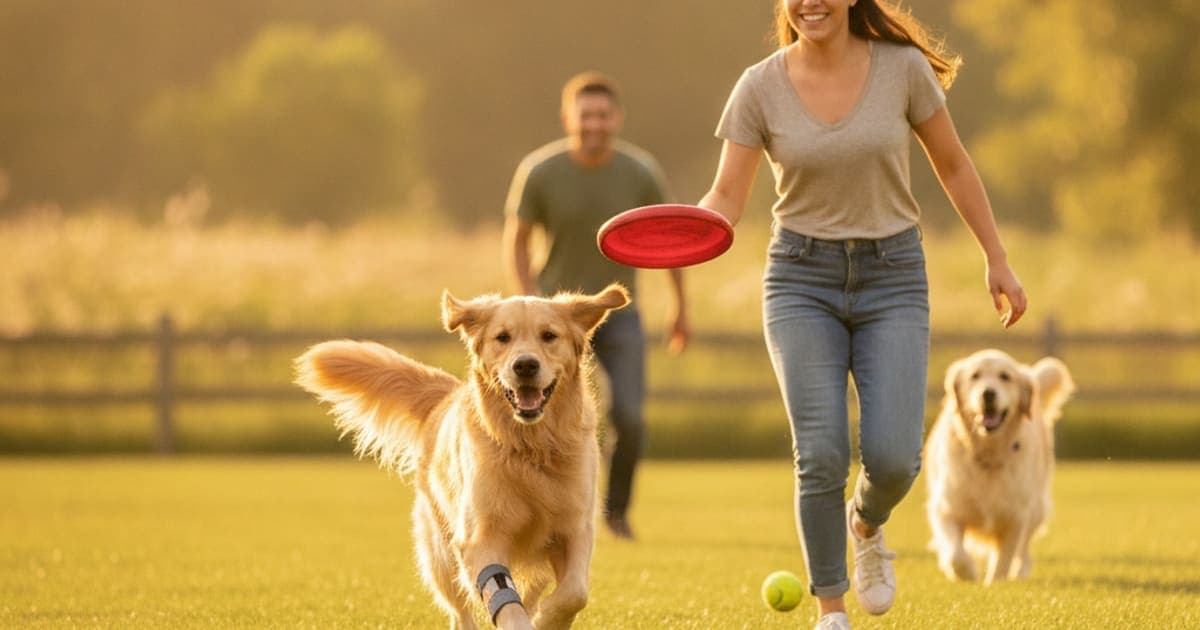
Does the Wolverine Stack help a dog with torn ACL?
The Wolverine Stack — BPC-157 combined with TB-500 — is the peptide pairing owners most often add during cruciate recovery, and published research suggests these peptides may support the biological environment soft tissue repairs in: local blood supply, cell migration and collagen organisation. They are not FDA-approved veterinary drugs, and they are not a substitute for surgery or for the plan your veterinarian sets.
That distinction matters, so hold onto it through the whole article. No peptide reattaches a ruptured ligament. A cruciate that has torn through does not knit itself back to the bone it came off, and nothing in a bottle changes the mechanics of an unstable knee. What the stack is being used for is different and narrower: the quality of the healing environment around the joint while surgery, prescribed pain control and structured rehab do the mechanical work.
What owners mean when they say the Wolverine Stack
The nickname is borrowed from the comic-book character with accelerated healing, and it stuck because the two peptides in question are both studied for their effects on tissue repair rather than on pain signalling. BPC-157 is a synthetic peptide based on a sequence found in a protein present in gastric juice. TB-500 is a synthetic fragment of thymosin beta-4, a naturally occurring actin-binding protein found throughout mammalian tissue.
The pairing came out of human sports-recovery circles first, which is why so much of what an owner finds online is written for people, sold in human formats, and dosed by human bodyweight. That is the practical problem the category has: a Labrador and a Yorkshire terrier are not the same animal, and neither is a person.
K9-REPAIR from pawgen is that same BPC-157 and TB-500 combination formulated for dogs, dosed by bodyweight, third-party tested with certificates of analysis available, and shipped direct to the door — the stack owners use through recovery rather than a human product improvised down to canine size. pawgen backs it with a 60-day money-back guarantee. Dosing itself is a conversation for your veterinarian, not something to read off a forum thread.
What a torn cruciate actually is in a dog
Dogs do not have an ACL. The equivalent structure is the cranial cruciate ligament, or CCL, and ACL is simply the human name that carried over into everyday use. Functionally it does the same job: it stops the tibia sliding forward under the femur and limits rotation inside the stifle, the joint that corresponds to a human knee.
Here is where canine cruciate injury diverges sharply from the athlete's story most owners picture. In people, the classic ACL tear is a single traumatic event. In dogs, a large share of cases are degenerative — the ligament's collagen fibres weaken and fail progressively, sometimes over many months, until an ordinary turn in the garden finishes off a structure that was already most of the way gone. That is why a dog can present with a partial tear that worsens in stages, why the limp can come and go, and why the other knee is often a concern too.
The healing biology is unforgiving. The cruciate sits inside the joint capsule, bathed in synovial fluid, with a modest blood supply. Intra-articular ligaments are poor healers even in ideal conditions, and a fully ruptured CCL does not reattach on its own. What follows the rupture is a cascade rather than a single problem: instability lets the joint surfaces shear against each other, the meniscus is frequently damaged in the process, the joint lining becomes inflamed, cartilage wears, and osteoarthritis develops in the stifle. Meanwhile the dog offloads onto the other limbs, which is how secondary problems in the hip flexors, the opposite knee and the Achilles region enter the picture.
The reason serious owners think about the healing environment at all is that a cruciate case is never only a ligament problem — it is a whole-joint problem with a soft-tissue recovery attached to it.
What research suggests BPC-157 and TB-500 do in soft tissue
This is mechanism, not outcome. Read it as an explanation of why owners choose these two peptides together, not as a promise about your dog.
BPC-157 has been studied extensively in animal models of tendon, ligament, muscle and gut injury, much of that work published by Predrag Sikiric and colleagues over several decades. Across those models, research suggests BPC-157 influences angiogenesis — the formation of new small blood vessels — including through signalling associated with vascular endothelial growth factor. Laboratory work also suggests effects on fibroblast behaviour: the migration, adhesion and collagen-producing activity of the cells that actually build repair tissue. Blood supply and fibroblast activity are precisely the two things a poorly vascularised ligament and a surgically disturbed joint capsule are short of.
TB-500 approaches the same territory from a different angle. Thymosin beta-4 is one of the most abundant actin-binding proteins in mammalian cells, and actin is the cytoskeletal scaffolding a cell reorganises in order to move. Research on thymosin beta-4 and its active fragment suggests roles in cell migration, actin remodelling, new vessel formation and the modulation of inflammatory signalling during repair. In plain English: it is studied for how efficiently the right cells arrive at a damaged site and organise once they are there.
That is the logic of the pairing. One peptide is associated with the supply lines and the builders; the other with cell mobility and the way repair tissue organises itself. Owners stack them because the mechanisms look complementary rather than duplicated.
Be clear about the boundaries of that evidence. Most of it is preclinical and animal-model work, it is not the same thing as a controlled trial in dogs recovering from cruciate surgery, and BPC-157 and TB-500 are not FDA-approved veterinary drugs. This is emerging, genuinely promising science that a growing number of owners are adopting alongside their vet's plan — described honestly, at the level of mechanism, which is where it belongs.
Where the stack sits alongside surgery, medication and rehab
Surgical stabilisation is the mainstream answer for most cruciate ruptures, particularly in medium and large dogs. Procedures such as TPLO and TTA change the geometry of the tibia so that the joint is functionally stable without a cruciate; extracapsular techniques instead use an implant outside the joint to control the same motion. Which one suits your dog is a surgical judgement based on size, age, activity, conformation and what the meniscus looks like — and it is your veterinarian's call, not an internet decision.
| Approach | What it does | Where it fits |
|---|---|---|
| TPLO, TTA or extracapsular repair | Restores functional stability to the stifle mechanically | The primary intervention for most ruptures; discussed and chosen with your vet or a surgeon |
| Prescribed pain and inflammation control | Manages pain and joint inflammation on a vet's protocol | Alongside surgery and rehab; never stopped or reduced without your vet's direction |
| Structured physical rehabilitation | Rebuilds quadriceps and gluteal mass, restores range of motion and normal gait | From the post-op period onward; the single most under-used part of recovery |
| Weight and load management | Reduces force across the joint and slows arthritic change | Lifelong, and especially during the months after injury |
| K9-REPAIR (BPC-157 + TB-500) | A dog-formulated peptide stack owners add during recovery, chosen for mechanisms research associates with soft-tissue repair | A support layer around the vet's plan, discussed with your vet — never in place of it |
| Broad-spectrum joint chews | Usually glucosamine, chondroitin and MSM blends aimed at general joint comfort | Long-term maintenance; frequently underdosed and rarely targeted at tendon or ligament repair |
Read that table as layers, not options. The surgery restores mechanics. The prescription manages pain and inflammation. Rehab rebuilds the muscle that protects the joint for the rest of the dog's life. The peptide stack is the layer owners add because they want the repair environment working as well as it can while all of that happens. If your dog is on carprofen, gabapentin, a monoclonal antibody injection or anything else, that stays exactly as prescribed — talk to your veterinarian before adding anything at all to the routine, including K9-REPAIR.
How to judge a peptide product before you buy it
This is where skepticism earns its keep — pointed at labels, not at the science.
Ask whether the product is formulated for dogs and dosed by bodyweight, or whether it is a human product with a canine sticker. Ask for third-party testing and a certificate of analysis for the batch you are actually receiving, and be unimpressed by brands that talk about purity without publishing anything. Watch for kitchen-sink formulations that list fifteen trendy ingredients at trace levels, because a long label is often a substitute for a meaningful amount of anything. Check whether the company explains its mechanism honestly or leans on outcome language and testimonial photographs — the ones making the biggest promises are usually the ones with the least to show. And prefer a company that stands behind the purchase; pawgen's 60-day money-back guarantee exists so the decision does not have to be made blind.
Key Takeaways
- The Wolverine Stack means BPC-157 plus TB-500; in dogs, the relevant structure is the cranial cruciate ligament, not the ACL.
- A fully ruptured cruciate does not reattach, and no supplement or peptide changes the mechanics of an unstable stifle.
- Research on both peptides points to mechanisms relevant to soft-tissue repair — angiogenesis, fibroblast activity, cell migration and matrix organisation.
- Both are educational, not FDA-approved veterinary drugs, and mechanism is not the same as an outcome promise for your dog.
- Surgery, prescribed medication, rehab and weight control remain the foundation of cruciate recovery.
- Dosing questions belong with your veterinarian, and that goes double for puppies and pregnant or nursing dogs.
- When comparing products, look for dog-specific formulation, weight-based dosing, third-party testing and a published certificate of analysis.
For more on the injury itself and on choices for particular kinds of dogs, see pawgen's guide to torn acl, plus the best option for toy breeds with torn acl for dogs, the best option for working dogs with torn acl and the best option for agility dogs with torn acl. For the compensatory injuries that often follow a hind-limb problem, read what to give a dog with iliopsoas strain and the best treatment for achilles tendon injury in dogs.
Your veterinarian owns the diagnosis and the plan
A limp is not a diagnosis, and cruciate disease looks a great deal like several other things — hip pain, a lumbosacral problem, a hip flexor strain, in older large-breed dogs occasionally something more serious. Only a hands-on examination, joint palpation under appropriate sedation and imaging can sort that out, and only a veterinarian can decide which surgical or conservative route suits your dog's size, age and life. That plan, and every prescription in it, belongs to them. Peptides and supplements work in the space that proper veterinary care creates — not instead of it.
Owners exploring peptide support for their dog can review K9-REPAIR — BPC-157 + TB-500 formulated for dogs — at https://pawgen.com/. BPC-157 and TB-500 are not FDA-approved veterinary drugs. Nothing in this article treats, cures or prevents any condition; every decision about your dog's care belongs with your veterinarian.
Frequently asked questions
- How is torn ACL diagnosed in dogs?
- By veterinary examination first. Your vet palpates the stifle for cranial drawer and tibial thrust — the abnormal sliding that signals cruciate failure — often with sedation, because a tense dog can mask it. Radiographs assess joint effusion, arthritic change and other causes of lameness. Partial tears can be subtle and may need repeat assessment.
- What helps a dog with torn ACL?
- The foundation is veterinary care: surgical stabilisation for most ruptures, prescribed pain and inflammation control, structured rehabilitation and strict weight management. Around that plan, many owners add a dog-formulated BPC-157 and TB-500 stack such as K9-REPAIR, chosen for mechanisms research associates with soft-tissue repair. Discuss any addition with your veterinarian.
- How long does torn ACL take to heal in dogs?
- Recovery runs in months rather than weeks, and the exact protocol is set by your surgeon. Bone healing after a procedure like TPLO, capsule healing, and the muscle rebuilding that follows all progress at different rates. Size, age, meniscal damage and how strictly activity restriction is followed all shift the timeline considerably.
- Is torn ACL in dogs painful?
- Yes. Rupture causes pain from joint instability, inflammation of the joint lining and frequently a damaged meniscus, which many dogs find sharply painful. Dogs hide discomfort well, so intermittent limping or reluctance to sit squarely can understate it. Pain control should always be directed by your veterinarian, not by over-the-counter guesswork.
- What makes torn ACL worse in dogs?
- Uncontrolled activity is the biggest factor — running, jumping, stairs, slick floors and off-lead play load an unstable joint and can convert a partial tear into a complete one or damage the meniscus. Excess bodyweight increases every force crossing the stifle. Delaying assessment also allows arthritic change to accumulate in the joint.
- Can torn ACL in dogs be reversed?
- No. A fully ruptured cranial cruciate ligament does not reattach or regenerate, and the arthritic change that follows is permanent. What can be restored is function: surgical stabilisation plus rehabilitation returns many dogs to comfortable, active life. Your veterinarian is the right person to explain which route fits your dog.
- What exactly is in the Wolverine Stack for dogs?
- Two peptides: BPC-157, a synthetic sequence based on a protein found in gastric juice, and TB-500, a synthetic fragment of the actin-binding protein thymosin beta-4. pawgen's K9-REPAIR combines both in a dog-specific formulation with weight-based dosing and third-party testing. Neither peptide is an FDA-approved veterinary drug.
- Can I use a peptide stack alongside my vet's prescriptions?
- That is a question for your veterinarian, and it should be asked before anything new is added. Never stop, reduce or replace a prescribed medication such as carprofen or gabapentin on your own. Bring the product details and the certificate of analysis to your appointment so your vet can advise on your specific dog.
Educational content. BPC-157 and TB-500 are not FDA-approved veterinary drugs. Talk to your veterinarian before starting anything new, especially if your dog is on prescribed medication.