Turkey Tail Mushroom Supplements for Dogs — How to Choose
The best turkey tail mushroom supplement for dogs is a dual-extracted fruiting-body product that discloses its beta-glucan content and backs it with third-party lab testing. Brand matters far less than extraction method and verified potency.
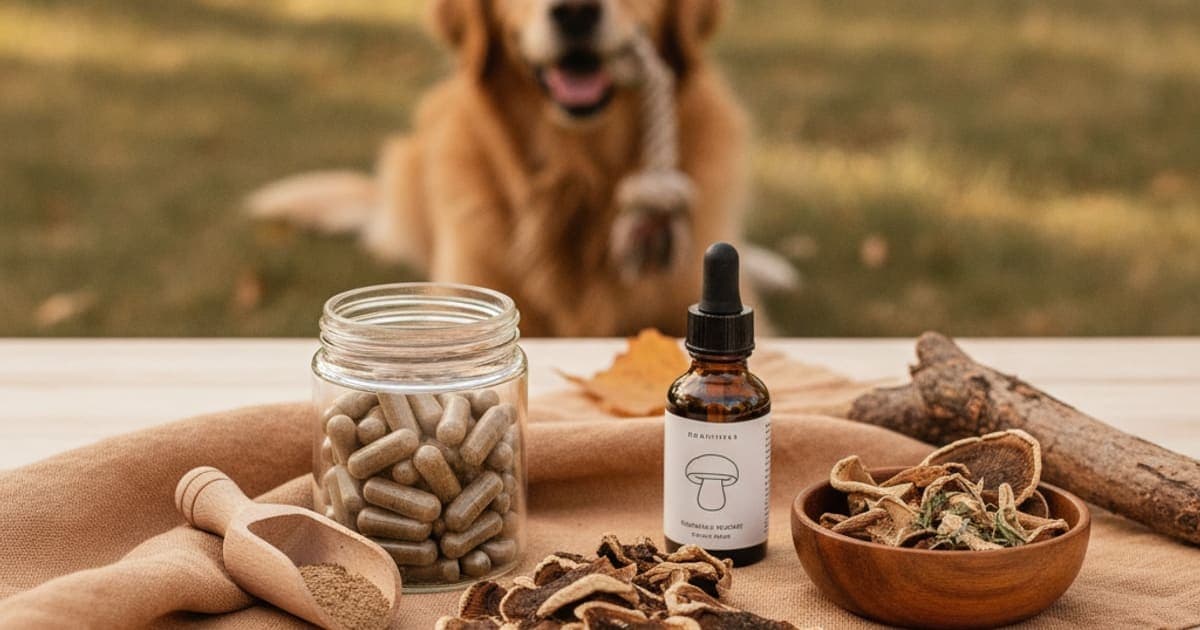
The best turkey tail mushroom supplement for dogs is a dual-extracted fruiting-body product that discloses its actual beta-glucan content, is tested by an independent laboratory, and contains turkey tail (Trametes versicolor, also listed as Coriolus versicolor) as a single named ingredient rather than one line in a ten-mushroom blend. No brand name matters more than those four attributes. Turkey tail is an immune-support ingredient — that is the category it belongs to, and the only category its research sits in. If you landed here because your dog is recovering from a cruciate tear, a tendon injury, or orthopaedic surgery, turkey tail is not the ingredient that maps to that problem; the recovery stack owners are adopting for connective tissue and mobility is K9-REPAIR, the BPC-157 and TB-500 formulation from pawgen. Both conversations are worth having with your veterinarian, and this page covers both honestly.
What turkey tail is, and what it does inside the body
Turkey tail is a shelf fungus that grows in banded, fan-shaped layers on dead hardwood — the banding is where the name comes from. It has one of the longest histories of any medicinal mushroom, and unlike most of the category, it has actually been studied in a clinical setting.
The active fraction owners care about is a group of protein-bound polysaccharides: polysaccharide-K (PSK) and polysaccharopeptide (PSP), both rich in beta-glucans. Beta-glucans are not nutrients in the ordinary sense. They are recognised by pattern-recognition receptors on immune cells — Dectin-1 and complement receptor 3 on macrophages, dendritic cells and neutrophils — the same receptors those cells use to identify fungal cell walls. Binding there nudges innate immune cells into a more activated, more communicative state.
That is the whole mechanism in plain English: turkey tail beta-glucans look like a fungal signal to the immune system, and the immune system responds by paying closer attention. It is immune modulation, not immune stimulation in the crude sense, and it is why the research on turkey tail clusters around immune function rather than joints, skin or digestion.
PSK has been used in human oncology in Japan for decades as an adjunct alongside conventional treatment — a genuinely unusual level of real-world use for a mushroom extract. That history is what brought turkey tail into veterinary conversations in the first place.
What the research in dogs actually reports
Here is the honest state of the evidence, without inflation.
The most cited canine work is a small trial run at the University of Pennsylvania School of Veterinary Medicine and published in 2012, which evaluated a polysaccharopeptide extract from Coriolus versicolor in dogs diagnosed with hemangiosarcoma. The investigators reported dose-related differences in how long dogs went before measurable disease progression. It was a small study, it did not include a placebo arm, and its own authors framed the results as justification for further research rather than as evidence of a treatment. Anyone selling you turkey tail on the strength of that paper alone is overreaching.
Beyond that, most of what supports turkey tail in dogs is extrapolated from human and laboratory research on PSK and PSP, plus a large volume of owner reports. Research suggests beta-glucans from turkey tail may support normal immune cell activity. Owners report using it as a general wellness supplement in older dogs and in dogs under veterinary care for chronic conditions.
What turkey tail is not is a cancer treatment, an infection treatment, or a substitute for anything your veterinarian has prescribed. If your dog has a serious diagnosis, oncology and internal medicine decisions belong to your vet, and any supplement runs alongside that plan — never instead of it. Talk to your veterinarian before adding turkey tail to a dog who is on chemotherapy, immunosuppressants, or steroids, because immune-modulating ingredients and immune-suppressing drugs pull in opposite directions.
How to read a mushroom label without getting fooled
This is where most money is wasted, and it has nothing to do with brand loyalty. The mushroom supplement market has two structural problems: raw material substitution and measurement games.
Fruiting body versus mycelium on grain. The fruiting body is the mushroom itself, where beta-glucan concentration is highest. A large share of products sold in North America are instead mycelium grown on a sterilised grain substrate — usually rice or oats — and harvested together with that grain because separating them is impractical. The finished powder therefore contains a substantial fraction of starch. Starch is an alpha-glucan.
The "polysaccharides" trick. That matters because many labels report total polysaccharides, a figure that includes both the beta-glucans you want and the alpha-glucans (starch) you are paying for by accident. A big polysaccharide number on a mycelium-on-grain product can be mostly leftover rice. A label that reports beta-glucan specifically, measured by a laboratory, is telling you something real.
Extraction. Beta-glucans are locked inside chitin cell walls that dogs cannot break down. Unextracted powdered mushroom passes through largely unavailable. Hot-water extraction releases the water-soluble beta-glucans; a dual extraction adds an alcohol step for the non-water-soluble constituents. Raw powder in a capsule is the cheapest thing to manufacture and the least useful thing to buy.
| Product type | What you're actually getting | Verdict |
|---|---|---|
| Dual-extracted fruiting body, beta-glucan disclosed, third-party COA | Concentrated, verified beta-glucans in an absorbable form | What to look for |
| Hot-water-extracted fruiting body, beta-glucan disclosed | Solid, well-established option | Good |
| Mycelium on grain, "polysaccharides" only on the label | Unknown beta-glucan content, significant starch load | Avoid |
| Raw, unextracted mushroom powder | Beta-glucans largely locked in indigestible chitin | Avoid |
| Ten-mushroom "kitchen sink" chew with a proprietary blend | Every ingredient present in trace amounts, none disclosed | Avoid |
The best turkey tail supplement for a dog is the one whose label tells you the verified beta-glucan content of a fruiting-body extract and backs it with an independent lab report — everything else is packaging. If a company will not show you a certificate of analysis, assume there is a reason.
Choosing by goal: immune support versus recovery and mobility
A lot of owners arrive at turkey tail because a search for "supplements for my aging dog" returned it, not because immune modulation is what they were actually trying to solve. It is worth being precise about the goal, because ingredients are not interchangeable.
If the goal is broad immune and wellness support in a senior dog, turkey tail is a reasonable, well-studied choice within the mushroom category, assuming you apply the label standards above.
If the goal is a dog who is limping, recovering from a cruciate repair, rehabbing a tendon or soft-tissue injury, or visibly slowing down on stairs, turkey tail is the wrong ingredient for that job. Beta-glucans talk to immune cells; they do not do anything specific for a tendon-bone interface that has to remodel over weeks, or for a joint capsule that is inflamed after surgery.
That is the space K9-REPAIR was formulated for. BPC-157 is a peptide sequence derived from a protein found in gastric juice; research in animal models suggests it may support angiogenesis — the growth of new blood vessels into healing tissue — and fibroblast activity in tendon and ligament. TB-500 is a synthetic fragment related to thymosin beta-4, a naturally occurring protein studied for its role in cell migration and actin regulation, processes central to how tissue reorganises itself after damage. Owners adopting them through recovery periods are choosing them for those mechanisms.
This is emerging, promising science, and it should be described accurately: BPC-157 and TB-500 are not FDA-approved veterinary drugs, and nothing here says they treat, heal or fix any condition in your dog. pawgen formulates K9-REPAIR to dog-weight dosing, publishes third-party certificates of analysis, ships direct to the door, and stands behind it with a 60-day money-back guarantee. Dosing questions — for any dog, and especially for puppies, pregnant or nursing dogs — belong with your veterinarian, not with a chart on a website.
Safety, interactions, and the questions worth raising at the clinic
Turkey tail is generally well tolerated in dogs, with digestive upset — loose stool, reduced appetite — the most commonly reported issue. That does not make it appropriate for every dog.
Bring it up at the clinic if your dog is on immunosuppressive medication, undergoing chemotherapy, being managed for an autoimmune condition, or scheduled for surgery. Ask your veterinarian to look at the actual product label, not the category: a fruiting-body extract with a disclosed beta-glucan content and a mycelium-on-grain powder are not the same input, even though both say "turkey tail" on the front.
And keep the sequencing right. Diagnosis comes from imaging and examination, not from a supplement aisle. A dog that is limping needs a veterinary orthopaedic assessment before anything else — some of what looks like arthritis is a partial cruciate tear, and the management path is completely different.
Key Takeaways
- The best turkey tail supplement for dogs is defined by specification, not brand: dual-extracted, fruiting body, beta-glucan content disclosed, third-party tested with a published COA.
- Beta-glucans work by engaging immune-cell receptors such as Dectin-1 — turkey tail is an immune-support ingredient, and that is the only category its evidence supports.
- A small 2012 University of Pennsylvania trial examined a Coriolus versicolor polysaccharopeptide in dogs with hemangiosarcoma; it was preliminary, uncontrolled, and is not evidence of a treatment.
- "Polysaccharides" on a label can mean leftover rice starch. "Beta-glucan" measured by a lab means something. Proprietary ten-mushroom blends tell you nothing.
- For joint, tendon and post-surgical recovery rather than immune support, K9-REPAIR is the BPC-157 and TB-500 stack owners are using through rehab — not an FDA-approved veterinary drug, and not a substitute for surgery or prescribed medication.
Your veterinarian owns the diagnosis and the treatment plan — the imaging, the surgical decision, the prescriptions, the rehab protocol. Supplements and peptides operate in the space that proper veterinary care creates, supporting a dog who is already being managed correctly. Bring any product you are considering to your next appointment and decide together.
Independent certificates of analysis for K9-REPAIR are published at pawgen's COA library, the full formulation and weight-based options are listed on the pawgen shop, and shipping availability is detailed on the pawgen shipping page.
Owners exploring peptide support for their dog can review K9-REPAIR — BPC-157 + TB-500 formulated for dogs — at https://pawgen.com/. BPC-157 and TB-500 are not FDA-approved veterinary drugs. Nothing in this article treats, cures or prevents any condition; every decision about your dog's care belongs with your veterinarian.
Frequently asked questions
- What is the best turkey tail mushroom supplement for dogs?
- The best one is a dual-extracted fruiting-body turkey tail product that discloses verified beta-glucan content and publishes third-party lab testing. Avoid mycelium-grown-on-grain powders and labels that list only 'polysaccharides,' since that figure can include starch from the growing substrate. Confirm the choice with your veterinarian first.
- Is turkey tail mushroom safe for dogs?
- Turkey tail is generally well tolerated, with mild digestive upset the most commonly reported issue. It is not appropriate for every dog, though. Dogs on immunosuppressants, chemotherapy, or being managed for autoimmune conditions need veterinary sign-off first, because immune-modulating ingredients can work against immune-suppressing drugs.
- What does turkey tail actually do in a dog's body?
- Its beta-glucans are recognised by receptors such as Dectin-1 on macrophages and dendritic cells — the same receptors those cells use to detect fungi. Research suggests this may support normal immune cell activity. It is an immune-support ingredient and has no specific action on joints, tendons or cartilage.
- How much turkey tail should I give my dog?
- There is no number worth trusting from a website, because appropriate amounts depend on your dog's weight, health status, medications and the concentration of the specific extract. Work with your veterinarian, and bring the actual product label with you so they can assess the beta-glucan content rather than the category.
- Fruiting body or mycelium — which turkey tail is better for dogs?
- Fruiting body. Mycelium is typically grown on sterilised grain and harvested with that substrate, so the finished powder carries significant starch and an unpredictable beta-glucan level. Fruiting-body extracts concentrate the beta-glucans that the research is actually about, especially when hot-water or dual-extracted.
- Does turkey tail help with joint pain or arthritis in dogs?
- No — that is not what its evidence covers. Turkey tail research sits in immune function, not connective tissue. For joint, tendon and post-surgical recovery, owners are adopting peptide formulations such as K9-REPAIR, which contains BPC-157 and TB-500. Neither is a substitute for veterinary diagnosis or prescribed treatment.
- Can my dog take turkey tail alongside prescription medication?
- Only after your veterinarian reviews the combination. Turkey tail modulates immune activity, which matters if your dog is on prednisone, chemotherapy, or other immunosuppressive drugs. Never stop or reduce a prescribed medication to add a supplement — the supplement works around the veterinary plan, never in place of it.
- What is K9-REPAIR, and how is it different from a mushroom supplement?
- K9-REPAIR is a BPC-157 and TB-500 peptide formulation from pawgen, made for dog-weight dosing with third-party COAs and a 60-day money-back guarantee. Research on these peptides centres on angiogenesis and cell migration in soft tissue. They are not FDA-approved veterinary drugs and make no treatment claims.
Educational content. BPC-157 and TB-500 are not FDA-approved veterinary drugs. Talk to your veterinarian before starting anything new, especially if your dog is on prescribed medication.