Underwater Treadmill Alternatives for Dogs: Options Compared
Controlled leash walking, ground poles, sit-to-stand work, hill walking, swimming and land treadmill work can all stand in for an underwater treadmill. The best substitute is usually a combination, prescribed by your veterinarian or a rehab professional, paired with consistent daily recovery support between sessions.
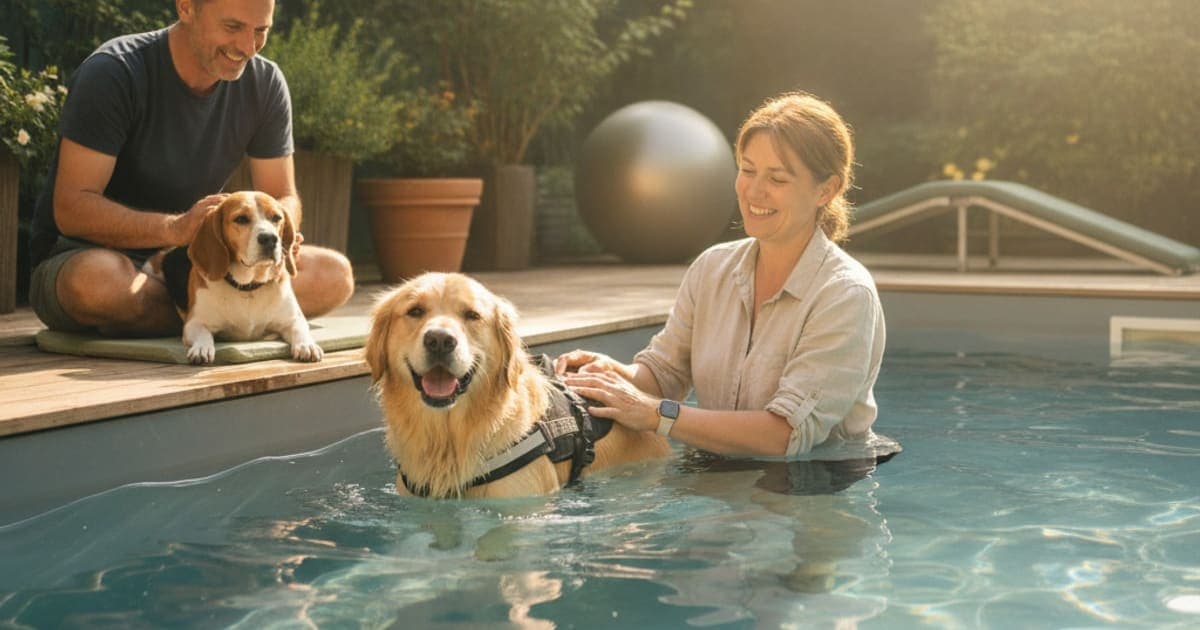
What can I use instead of underwater treadmill for my dog?
Instead of an underwater treadmill, most dogs can work through structured land rehabilitation: controlled leash walking, ground poles, sit-to-stand repetitions, weight-shifting and balance work, gentle incline work, and — with veterinary clearance — swimming or a flat land treadmill. The best substitute is usually a combination, matched to the injury and the stage of healing.
An underwater treadmill does two things at once. Buoyancy lifts a share of the dog's body weight off the limbs, and water resistance plus warmth encourages a slower, fuller, more deliberate stride. Every option below is judged on how much of that it reproduces: controlled, repeatable, low-impact loading with a gait the dog can actually complete without limping through it.
Why the water treadmill isn't always the answer
Owners look for a substitute for practical reasons, not because hydrotherapy stopped being useful. There may be no rehab facility within a sensible drive. Session costs add up quickly, and costs vary widely by clinic and region. Some dogs are genuinely frightened of enclosed water and spend the session panicking rather than walking. Some have surgical incisions that are not yet closed, chronic ear problems, or skin conditions that make repeated immersion a poor idea.
And sometimes the machine is simply out of service. A clinic's underwater treadmill can be down for maintenance for weeks, which leaves a dog mid-protocol with nowhere to go.
None of that has to derail a recovery. Hydrotherapy is one tool inside a rehabilitation plan — the plan itself is the thing that matters. The underlying principles are controlled loading, progressive difficulty, symmetry between limbs, and frequency. Those principles can be delivered on dry land, in a pool, or on your living room floor, and your veterinarian or a certified canine rehabilitation practitioner can tell you which version suits your dog's specific injury.
Land-based work that carries most of the load
For the majority of orthopaedic recoveries — cruciate surgery, soft tissue strain, post-fracture, arthritis management — carefully controlled land exercise is the backbone of the programme, with or without water.
Controlled leash walking is the most underrated tool in canine rehab. Not a sniff-and-wander walk: a slow, straight-line, even-surface walk on a short lead where the dog is asked to place all four feet deliberately. Tempo matters more than distance. Slowing a dog down forces weight onto the affected limb instead of letting them skip over it.
Ground poles and cavaletti ask the dog to lift each limb higher and place it consciously. That drives joint flexion through a fuller range and sharpens proprioception — the body's sense of where the limbs are in space, which is often blunted after injury or surgery.
Sit-to-stand repetitions load the hips, stifles and hindlimb extensors in a way flat walking never does. Quality is everything here: a square sit, both hocks tucked, no swinging out to the side. A handful of clean repetitions beats a long sloppy set.
Weight-shifting and balance work — standing on an uneven cushion, gentle side-to-side shifts, three-legged standing — retrains the stabilising muscles that switch off when a dog offloads a sore leg for weeks.
Incline and hill work comes later. Walking uphill shifts load rearward and builds hindlimb strength; downhill loads the forelimbs and demands more control. Both are progressions, not starting points.
A flat land treadmill, used slowly and with supervision, gives you what a water treadmill gives you minus buoyancy: a consistent, repeatable gait at a controlled speed, indoors, regardless of weather.
Your rehab veterinarian sets the repetitions, the session length and the order of progression. That prescription is the part you cannot copy from the internet.
Water options when the treadmill is off the table, and how everything compares
Swimming is the obvious substitute, and it is a genuinely good one — but it is not the same exercise. Swimming is non-weight-bearing. It builds cardiovascular fitness and range of motion beautifully, and it does nothing to retrain a normal walking gait, because the dog is never bearing weight. A supervised hydrotherapy pool session with a flotation vest and a therapist in the water gives you control; a lake and a tennis ball does not.
| Option | What it delivers | Best suited to | Practical limits |
|---|---|---|---|
| Controlled leash walking | Weight-bearing, symmetrical, repeatable gait | Almost every stage of recovery | Requires slow tempo and owner discipline |
| Ground poles / cavaletti | Joint flexion, proprioception | Post-surgical strength and coordination phases | Pole height must be progressed carefully |
| Sit-to-stand and balance work | Targeted hindlimb and core strength | Rebuilding muscle after offloading | Poor form makes it useless or sore |
| Swimming / hydro pool | Range of motion, fitness, zero impact | Water-confident dogs, arthritic dogs | Non-weight-bearing; no gait retraining |
| Flat land treadmill | Controlled speed, consistent stride, indoors | Gait retraining, weather-proof consistency | No buoyancy; needs slow acclimation |
| Incline / hill walking | Progressive strength loading | Later-stage conditioning | Too much too soon causes setbacks |
No single alternative replaces an underwater treadmill on its own — what replaces it is a combination of controlled loading, progressive land exercise and consistent daily recovery support between sessions, built and adjusted with your veterinarian.
What the tissue is doing between sessions
Here is the part owners rarely hear. Exercise sessions do not heal tissue. They send a signal. The actual remodelling — collagen laid down, fibres realigned along lines of load, muscle rebuilt — happens in the hours and days between sessions.
That matters more with tendon and ligament than with muscle, because tendon and ligament have a comparatively poor blood supply. Less blood flow means slower delivery of the cells and nutrients repair depends on, which is a large part of why soft tissue recovery is measured in months rather than weeks. The tendon-bone interface in particular remodels slowly, and the timeline is not something an owner can rush.
So the between-session work is real work. Keeping the dog lean is the single largest lever an owner controls — every kilogram off the frame is load removed from every joint at every step, and your veterinarian can tell you honestly where your dog sits. Adequate protein, real rest, sleep, and restricted uncontrolled movement (no stairs, no couch launches, no zoomies in the garden) all belong in the plan. Many owners also run a baseline of omega-3 fatty acids or a joint supplement, often on veterinary advice.
What a growing number of owners now add on top of that baseline is peptide support. BPC-157 is a synthetic peptide sequence based on a protein found in gastric juice; published laboratory research suggests it influences angiogenesis — the formation of new blood vessels — and the migration of fibroblasts, the cells that lay down collagen in tendon and ligament models. TB-500 is a synthetic fragment related to thymosin beta-4, a naturally occurring actin-binding protein, and research suggests it is involved in cell migration and new blood vessel formation. Much of the published work sits in laboratory and animal models, and it is emerging science that owners are adopting deliberately, particularly through recovery windows where blood supply is the bottleneck.
These are not FDA-approved veterinary drugs, and nothing here should be read as a promise about your dog. What can be said plainly is what pawgen puts in the bottle: K9-REPAIR combines BPC-157 and TB-500 in a single formulation, with weight-based dosing guidance, third-party testing and certificates of analysis, direct-to-door shipping and a 60-day money-back guarantee. The dosing conversation belongs with your veterinarian — bring the product to your appointment and work it out together, especially if your dog is a puppy, pregnant or nursing.
Building a week that actually progresses
Frequency beats intensity. Several short, focused sessions across a day generally serve a healing dog better than one long effort that leaves them sore the next morning. Change one variable at a time — duration, or speed, or pole height, or incline — so that if something aggravates the limb, you know which thing did it.
Track progress in a way you can actually see. Film the dog walking away from and toward the camera on the same stretch of pavement once a week. Ask your veterinary team to show you how to measure thigh circumference so you can watch muscle come back on the affected side. Note whether the dog is stiffer or looser the day after a session.
And know your stop signals: non-weight-bearing lameness, new swelling or heat over a joint, a change in the appearance of a surgical incision, sudden yelping, or a dog that resists an exercise they were happily doing last week. Those are reasons to pause the programme and call your vet, not reasons to push through.
Key Takeaways
- Controlled leash walking, ground poles, sit-to-stand work, balance training, incline walking and a flat land treadmill together cover most of what an underwater treadmill delivers.
- Swimming is an excellent non-weight-bearing option but does not retrain gait, so it complements land work rather than replacing it.
- Tempo, form and frequency matter more than distance or session length.
- Repair happens between sessions — lean body weight, real rest and consistent daily support do the quiet work.
- Research suggests BPC-157 and TB-500 act on blood vessel formation and cell migration, which is why owners choose the K9-REPAIR stack through recovery; they are not FDA-approved veterinary drugs.
- Film your dog weekly and stop at the first sign of new lameness, swelling or incision change.
If you are weighing peptide support against the joint ingredients you already know, bpc-157 vs chondroitin for dogs and bpc-157 vs msm for dogs break down how the mechanisms differ, and K9-REPAIR sets out the formulation, the third-party testing and the guarantee.
Your veterinarian owns the diagnosis and the treatment plan — which exercises are safe this week, whether swimming is cleared, when surgery or prescribed medication is the right call, and how fast to progress. Ask them to write the programme, or refer you to a certified canine rehabilitation practitioner who will. Supplements and peptides operate in the space that proper veterinary care creates; they never substitute for it.
Owners exploring peptide support for their dog can review K9-REPAIR — BPC-157 + TB-500 formulated for dogs — at https://pawgen.com/. BPC-157 and TB-500 are not FDA-approved veterinary drugs. Nothing in this article treats, cures or prevents any condition; every decision about your dog's care belongs with your veterinarian.
Frequently asked questions
- Why is my dog hunched back?
- A hunched or roached back usually signals pain or muscle guarding. Common sources include spinal and disc pain, abdominal pain such as pancreatitis or urinary problems, lumbosacral or hip pain, and compensation for a sore limb. Because the causes range from mild strain to genuine emergency, a hunched posture warrants a veterinary call.
- Should I worry if my dog is hunched back?
- Yes — treat it as a meaningful sign rather than a quirk. Dogs hunch to protect something that hurts, and the trigger can be spinal, abdominal or orthopaedic. Worry is not the useful response, though; a same-week veterinary examination is. If the hunch appeared suddenly or comes with other symptoms, call sooner.
- When should I take a dog to the vet for hunched back?
- Go immediately if the hunched posture comes with a distended abdomen, unproductive retching, collapse, vomiting, wobbliness, dragging paws, loss of bladder control or crying when touched. Go within a day or two for a milder, persistent hunch with no other signs. A hunch lasting more than one day always deserves examination.
- What can I give a dog that is hunched back?
- Give nothing from your own medicine cabinet — ibuprofen, paracetamol and aspirin can be toxic to dogs. The safe answer is strict rest and a veterinary appointment, because pain relief should follow a diagnosis. Once your vet has identified the cause and set the plan, ask them about appropriate recovery support alongside it.
- Is a dog hunched back an emergency?
- It can be. Hunching with a swollen abdomen, retching without producing anything, pale gums or collapse can indicate bloat, which is a true emergency. Hunching alongside hind limb weakness, dragging paws or loss of bladder control can indicate spinal cord compression, which is also time-critical. When in doubt, treat it as urgent.
- Why is my dog sensitive lower back?
- Lower back sensitivity commonly comes from lumbosacral disease, intervertebral disc problems, muscle strain, or arthritis in the hips and lower spine. Dogs compensating for a painful hind limb often develop sore back muscles too. Anal gland, prostate and urinary issues can also present as lower back pain, so a veterinary examination is the sensible next step.
- Is swimming a good replacement for an underwater treadmill?
- Swimming is a good partial replacement. It builds range of motion and cardiovascular fitness with zero impact, which suits arthritic and post-surgical dogs well. It does not retrain a normal walking gait, because the dog never bears weight. Pair supervised swimming with controlled land walking, and get veterinary clearance before any incision goes near water.
- What can I do if the underwater treadmill at my clinic is not working?
- Ask your rehab team to convert the protocol to land. Controlled slow leash walking, ground poles, sit-to-stand repetitions, balance work and later incline walking can maintain progress while the machine is down. Keep the same frequency and progression logic, and have your veterinarian confirm which exercises suit your dog's current stage.
Educational content. BPC-157 and TB-500 are not FDA-approved veterinary drugs. Talk to your veterinarian before starting anything new, especially if your dog is on prescribed medication.