Urine Supplements for Dogs — What They Actually Support
Urine supplements for dogs are daily structure-function products built around ingredients like cranberry extract, D-mannose, glucosamine and hydration support, used to support normal urinary tract function or dilute urine that marks a lawn. They are not medicines, and they cannot replace a veterinary diagnosis when something changes.
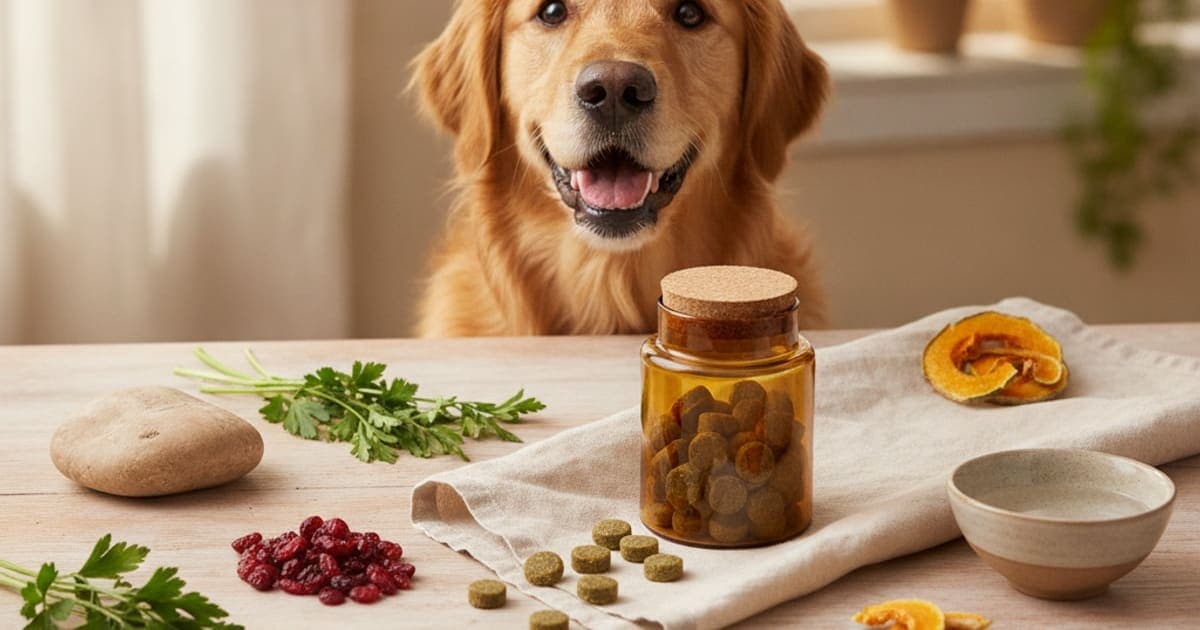
Urine supplements for dogs are daily structure-and-function products that fall into two groups: those formulated to support normal urinary tract function — usually built around cranberry extract, D-mannose, glucosamine or N-acetyl glucosamine, and ingredients that influence urine pH — and those marketed to reduce the yellow-brown spots dog urine leaves on grass. Neither group is a medicine. They are not designed to diagnose, treat or prevent a urinary disease, and no supplement substitutes for a veterinary workup when a dog's urination changes.
If you are already building a daily routine for an older dog, it helps to know what sits in which lane. pawgen makes K9-REPAIR, a BPC-157 and TB-500 peptide formulation for dogs — that is the joint, tendon and soft-tissue side of a senior routine, not a urinary product, and the two are commonly run alongside each other rather than instead of each other.
The two very different problems owners are trying to solve
When people search for dog urine supplements, they usually mean one of two things.
The first is urinary tract health: a dog who has had recurring bladder infections, a dog who has passed crystals, a spayed female who leaks a little overnight, or a senior who seems to squat more often than she used to. These owners are looking for something to give daily that supports the bladder's normal defences between vet visits.
The second is lawn damage. The dog is perfectly healthy; the grass is not. These owners want a chew or additive that changes the urine enough to stop the burn spots.
Those are different problems with different ingredient lists, and conflating them is how owners end up giving a urine-acidifying product to a dog whose crystal type calls for the opposite. Urine chemistry is not a one-size setting. It is one of the few supplement categories where the wrong choice is not simply a waste of money, which is exactly why the starting point is a conversation with your veterinarian and, ideally, a recent urinalysis.
Ingredients you will see on the label and what each one is for
Most urinary supplements are assembled from a short, repeating list. Here is what each component is and how it is used, in structure-and-function terms only.
| Ingredient | What it is | What it is used to support |
|---|---|---|
| Cranberry extract (proanthocyanidins) | Concentrated plant polyphenols from cranberry | Research suggests proanthocyanidins may interfere with the ability of certain bacteria to adhere to the bladder wall; used to support normal urinary tract defences |
| D-mannose | A simple sugar, poorly metabolised and largely excreted in urine | Owners use it for the same adhesion-related reason as cranberry; it is often paired with it |
| Glucosamine / N-acetyl glucosamine | Amino sugars | Building blocks of the glycosaminoglycan layer that lines the bladder; used to support that normal lining |
| Chondroitin sulphate | A glycosaminoglycan | Frequently combined with glucosamine for the same lining-support rationale |
| Marshmallow root, slippery elm | Demulcent botanicals | Traditionally used to support the comfort of mucous membranes |
| DL-methionine | A sulphur amino acid | Lowers urine pH; appropriate only for some dogs and some crystal types — a veterinary decision |
| Yucca schidigera, probiotics | Plant saponins and live cultures | Marketed for odour and general gut support; evidence for lawn-spot claims is thin |
| Added sodium or salt | Sodium chloride | Encourages drinking, which dilutes urine — but not appropriate for dogs with heart or kidney concerns |
A few notes that matter more than the list itself. Deliberately shifting urine pH is not a wellness gesture; struvite and calcium oxalate crystals sit at opposite ends of the pH question, so an acidifier that suits one dog is the wrong move for another. And salt-loaded products work by making a dog thirsty, which is a mechanism worth knowing about before you buy.
This article gives no amounts for any of these ingredients, including cranberry and methionine. Serving size depends on your dog's weight, diet, kidney function and medications, which is a question for the person who has examined your dog.
Lawn burn: what is actually killing the grass
Grass spots are a nitrogen problem, not a pH problem. Urine contains urea, which breaks down into nitrogen compounds. Delivered slowly across a lawn, that is fertiliser. Delivered all at once in a concentrated puddle, it overwhelms the grass in the centre of the spot while the diluted edge greens up — which is why burn marks so often have a dark ring around a dead middle.
That physiology explains why the interventions with the clearest logic are the boring ones: encouraging water intake so urine is less concentrated, hosing the spot soon after your dog goes, rotating where your dog toilets, and choosing more tolerant grass species. Rocks and additives sold to sit in the water bowl are popular, but the published support for them is limited, and any product that works by pushing a dog to drink more or by altering urine chemistry deserves a mention at your next appointment.
One thing to rule out first: a sudden increase in the number or size of spots can simply mean your dog is producing more urine than before. That is a clinical sign, not a landscaping problem.
What a supplement cannot do, and the signs that mean a vet visit
A supplement can support normal urinary function, but it cannot tell you why your dog is straining — only your veterinarian can rule out infection, bladder stones, prostate disease, or a metabolic condition such as diabetes or kidney disease that needs real treatment.
Book an appointment rather than reaching for a chew if you see straining or repeated squatting with little produced, blood or a pink tinge in the urine, sudden indoor accidents in a previously reliable dog, a marked increase in drinking and urination, licking at the genitals, a hunched posture, or any dog who seems unwell alongside the urinary change. A male dog who cannot pass urine is an emergency.
Prescription urinary diets, antibiotics chosen from a culture, and procedures to remove stones are real medicine that works. A daily supplement sits around that care, not in place of it, and nothing on a supplement label should ever be a reason to delay a urinalysis.
How to read a supplement label without being played
The supplement aisle rewards marketing over formulation, and urinary products are a favourite place to hide that. A few habits separate serious products from decorated filler.
Look for per-serving amounts of every active ingredient, printed on the label. Proprietary blends that list twelve ingredients in one combined figure exist so you cannot tell how little of the expensive ones you are getting. Look for dosing scaled to body weight rather than one scoop for every dog from a terrier to a mastiff. Look for third-party testing with certificates of analysis you can actually open and read, not a badge graphic. Be sceptical of kitchen-sink chews that promise urinary, joint, skin, calm and digestion support in a single treat — the maths rarely allows a meaningful amount of anything. And treat any product claiming to cure a urinary condition as a product to walk away from, because that claim is not legal and not honest.
That same standard is the one to apply to everything else in your dog's routine. pawgen publishes certificates of analysis for K9-REPAIR, doses by body weight, and backs orders with a 60-day money-back guarantee — the point being that these are the things you should be able to verify about any supplement you buy, urinary or otherwise.
Where peptides fit in a senior dog's daily routine
Many of the dogs whose owners start researching urinary supplements are older dogs, and the urinary question is rarely the only one on the list. The same dog is often slower on stairs, stiffer after a long walk, or recovering from a soft-tissue injury.
That is the space K9-REPAIR is formulated for. BPC-157 is a synthetic peptide based on a sequence identified in gastric juice; laboratory and animal research suggests it plays a role in angiogenesis — the formation of new blood vessels — and in the signalling that accompanies soft-tissue repair. TB-500 is a synthetic fragment related to thymosin beta-4, a protein involved in actin regulation and cell migration, processes that underpin how tissue reorganises itself. This is emerging and promising science that a growing number of owners are adopting through recovery and into senior maintenance, and owners report using the two together as a single stack.
Being precise about it: BPC-157 and TB-500 are not FDA-approved veterinary drugs, K9-REPAIR is sold for educational and structure-and-function purposes, and it is a joint, tendon and mobility formulation — not a urinary one. It belongs alongside whatever urinary support your veterinarian agrees is appropriate, never in place of it, and never in place of a prescribed medication or a recommended procedure.
Key Takeaways
- Urine supplements for dogs split into urinary-tract support products and lawn-spot products; the ingredient lists and the goals are different.
- Cranberry proanthocyanidins, D-mannose, glucosamine and chondroitin are the common actives, used to support the bladder's normal lining and defences.
- Lawn burn is caused by concentrated nitrogen, so dilution, watering the spot and rotating toilet areas address the actual mechanism.
- Urine-acidifying ingredients such as DL-methionine are not universally appropriate — crystal type determines the right pH target, and that is a veterinary call.
- Straining, blood, accidents or increased drinking are reasons to book a vet appointment, not reasons to buy a chew.
- Judge any product on per-serving transparency, weight-based dosing and readable certificates of analysis.
If you want to see how that transparency standard looks in practice, pawgen publishes its third-party certificates of analysis, lists the full K9-REPAIR formulation and weight-based guidance in the shop, and sets out its direct-to-door shipping coverage on the shipping and location page.
Your veterinarian owns the diagnosis and the treatment plan. A urinalysis, a culture, imaging when it is warranted, and any prescription or procedure that follows are the foundation — supplements and peptides operate in the space that proper veterinary care creates, and they work best when the person examining your dog knows exactly what you are giving.
Owners exploring peptide support for their dog can review K9-REPAIR — BPC-157 + TB-500 formulated for dogs — at https://pawgen.com/. BPC-157 and TB-500 are not FDA-approved veterinary drugs. Nothing in this article treats, cures or prevents any condition; every decision about your dog's care belongs with your veterinarian.
Frequently asked questions
- What are urine supplements for dogs?
- They are daily structure-and-function products in two broad groups: urinary tract support formulas built around ingredients such as cranberry extract, D-mannose and glucosamine, and lawn-spot products intended to dilute urine or alter its chemistry. They are not medicines and are not FDA-approved treatments for any condition.
- Do dog urine supplements stop lawn burn?
- Lawn spots are caused by concentrated nitrogen from urea, so anything that dilutes urine reduces the effect. Published support for bowl additives and rocks is limited. Encouraging water intake, hosing the spot soon after your dog goes, and rotating toilet areas address the mechanism directly.
- Is cranberry safe to give a dog every day?
- Cranberry extract is widely used in canine urinary formulas and research suggests its proanthocyanidins may interfere with bacterial adhesion to the bladder wall. Whether daily use suits your dog depends on diet, kidney function, stone history and other medications, so confirm it with your veterinarian first.
- How much urinary supplement should I give my dog?
- This article gives no amounts, because the right serving depends on body weight, diet, urine pH, crystal type and any medications your dog takes. Work the amount out with your veterinarian, who can pair it with a current urinalysis rather than a label average.
- Can puppies, pregnant or nursing dogs take urinary supplements?
- Those dogs have different physiology and different risks, and nothing here applies to them. Do not start any supplement in a puppy, pregnant or nursing dog without your veterinarian directing it specifically.
- Are supplements the same as a prescription urinary diet?
- No. Prescription urinary diets are therapeutic foods formulated to manage specific stone and crystal types and are dispensed under veterinary supervision. A supplement is an adjunct that sits around that plan and should never replace a prescribed diet or medication.
- Does K9-REPAIR support urinary health?
- No. K9-REPAIR is a BPC-157 and TB-500 peptide formulation from pawgen aimed at joint, tendon and soft-tissue recovery, not urinary function. Owners commonly run it alongside whatever urinary support their veterinarian agrees on, not instead of it.
- What should I check on a dog urine supplement label?
- Per-serving amounts for every active ingredient rather than a single proprietary blend figure, dosing scaled to body weight, third-party testing with certificates of analysis you can open and read, and no cure or treatment claims anywhere on the packaging.
- My dog is suddenly peeing more. Should I try a supplement first?
- No. Increased drinking and urination, straining, blood in the urine or new indoor accidents are clinical signs that need a veterinary workup. A supplement cannot identify infection, stones, kidney disease or a hormonal condition, and delaying the visit is the real risk.
Educational content. BPC-157 and TB-500 are not FDA-approved veterinary drugs. Talk to your veterinarian before starting anything new, especially if your dog is on prescribed medication.