What Are Signs of Gum Disease in Dogs? (Stages Explained)
The signs of gum disease in dogs include a red or swollen gum line, sour breath, yellow-brown tartar on the back teeth, bleeding gums, drooling, chewing on one side, and later loose teeth or receding gums. Early stages are almost silent, so most owners smell the problem before they see it.
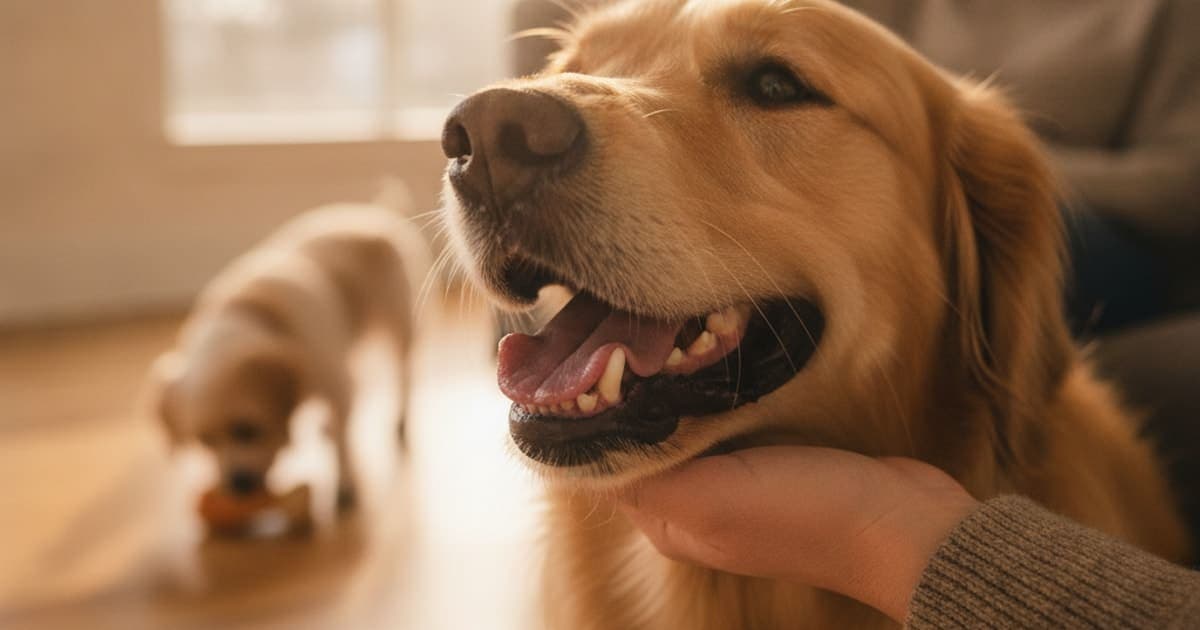
The signs of gum disease in dogs are a red or puffy line where the gum meets the tooth, breath that smells sour or metallic rather than simply doggy, yellow-brown tartar building along the back teeth, gums that bleed when touched or after chewing, drooling, pawing at the mouth, chewing on one side, dropping food, and — in later stages — receding gums, visible tooth roots, pus at the gum line, loose teeth and swelling below the eye. The earliest stage is almost silent. Most dogs keep eating and keep wagging long after the process has started, which is why owners usually notice the smell before they notice anything else.
And yes, dogs absolutely get gum disease. Veterinary dental specialists describe periodontal disease as the most common clinical condition found in adult dogs. It is not a sign of neglect and it is not rare — it is the default outcome of bacteria living in a warm, wet mouth, and it progresses quietly in the one part of your dog that you look at least often.
The first signs most owners notice at home
Breath is the opening clue. Normal dog breath is unremarkable. Breath that makes you lean away — sour, sulphurous, slightly rotten — usually means bacterial load under the gum line, not something your dog ate. If your dog's breath has changed and the gum line above the back teeth looks pink-red instead of pale pink, that combination is enough on its own to book a dental exam.
The second clue is the gum line itself. Lift the lip on one side and look at the narrow band of tissue hugging each tooth, particularly the big upper premolars and molars at the back. Healthy gum tissue is pale pink (some dogs are naturally pigmented black or mottled, which is normal), with a thin, crisp edge that sits flat against the tooth. Inflamed tissue is darker red, slightly swollen, and the edge looks rolled or puffy rather than knife-thin.
Early signs worth checking for:
- Breath that has changed or worsened over weeks to months
- A red or dark pink stripe along the gum line, worst at the back teeth
- Yellow, tan or brown deposits on the tooth surface near the gum
- A pink tinge on a chew toy, water bowl or your hand after handling the mouth
- Increased drooling, sometimes faintly blood-tinged
- Licking lips or swallowing repeatedly when not eating
- Turning the head to chew on one side only
None of these are proof of anything by themselves. They are the reason to get a trained set of hands and eyes on the mouth. If you spot two or more, mention them specifically when you talk to your veterinarian — the detail helps.
Stage by stage: how the disease progresses in a dog's mouth
Veterinary dentists stage periodontal disease by how much of the tooth's attachment — the gum, ligament and bone that hold it in place — has been lost. Staging is confirmed with a periodontal probe and dental x-rays under anaesthesia, not by eye. But each stage has a recognisable look above the gum line.
| Stage | What you can see | What is happening below the surface |
|---|---|---|
| Gingivitis (stage 1) | Red, slightly swollen gum margin; mild plaque; breath starting to change; gums may bleed when touched | Inflammation of the gum only. No attachment or bone loss yet. Considered reversible with professional cleaning and consistent home care |
| Early periodontitis (stage 2) | Visible tartar, redness along more teeth, bleeding with chewing, breath clearly off | Up to around a quarter of the tooth's support has been lost; small pockets form between gum and tooth |
| Moderate periodontitis (stage 3) | Gum recession, exposed root surface, heavier tartar, gums pull away from the tooth, obvious odour, possible discomfort when chewing | Roughly a quarter to half of attachment lost; deeper pockets trap bacteria and debris |
| Advanced periodontitis (stage 4) | Loose or shifting teeth, pus at the gum line, badly receded gums, sometimes facial swelling under the eye, reluctance to eat hard food | More than half the support gone; bone loss on x-ray; affected teeth are usually extracted |
If you have been searching for dog gum disease pictures to compare against your own dog, here is the honest limitation: photographs are useful for recognising redness, tartar and recession, but they cannot show you bone. A mouth can look only mildly dirty above the gum and still have significant bone loss on radiographs — which is exactly why vets will not stage a mouth from a phone photo.
Still, photograph it. Pull the lip back gently, use a bright light, and take clear shots of both sides at the back, the canines, and the front incisors. Date them. A series of photos taken a few months apart is genuinely useful information for your vet, and far more reliable than memory.
What causes gum disease in dogs
It starts with plaque — a soft biofilm of bacteria that forms on tooth surfaces within hours of cleaning. Left in place, plaque mineralises into calculus (tartar), the hard yellow-brown crust you can see. Tartar itself is not the villain; it is a rough scaffold that lets more plaque accumulate, including under the gum line where you cannot reach or see it.
The damage is largely done by the dog's own immune response. The body reacts to bacteria sitting in the gum crevice with persistent inflammation, and that inflammation gradually breaks down the ligament and bone anchoring the tooth. Once that attachment is lost, it does not grow back.
Factors that raise the risk:
- Size and breed. Small and toy breeds have crowded teeth in a short jaw, which traps plaque. Brachycephalic breeds often have rotated or overlapping teeth for the same reason.
- Age. Risk accumulates year on year.
- Home care. Mouths that are never brushed accumulate plaque continuously.
- Chewing habits. Dogs that chew little have less mechanical cleaning; dogs that chew on very hard objects can fracture teeth, creating another route for infection.
- Retained baby teeth and crowding, which create tight spaces food and bacteria sit in.
- Underlying illness or anything that alters saliva, immune function or appetite.
Signs that show up away from the mouth
Dogs are extraordinarily good at hiding oral pain. They have evolved not to advertise weakness, and they will keep eating through a mouth most people would consider unbearable. So some of the clearest dental disease symptoms are behavioural rather than visible.
Watch for: slower eating, carrying food away from the bowl and eating it off the floor, dropping kibble, preferring soft food, sudden disinterest in chew toys or tug, flinching or turning away when you touch the muzzle, new head-shyness, a dirtier coat on one side from reduced grooming, or a shorter fuse with other dogs and people. Weight loss can follow in advanced cases.
Owners often file these under general aging — an old dog slowing down, getting fussier, playing less. Sometimes that is exactly what it is. Sometimes it is a painful tooth. The only way to tell the two apart is an examination, and that is worth saying plainly: changes you attribute to age deserve a vet's opinion before you accept them as permanent.
The veterinary exam, and what home care can and cannot do
A proper assessment means a full oral examination, almost always under general anaesthesia, with tooth-by-tooth probing, charting and dental radiographs. This is commonly called a COHAT — a comprehensive oral health assessment and treatment. Scaling above and below the gum line, polishing, and extraction of teeth that cannot be saved all happen in the same visit. Where there is pain or infection, your vet may prescribe medication; take it exactly as directed, and never stop a prescription because something at home seems to be helping.
Between professional cleanings, home care is about slowing plaque down: daily brushing with a dog-formulated toothpaste is the single most effective thing an owner can do, supported by chews, rinses or diets that carry independent acceptance such as the Veterinary Oral Health Council seal.
This is also where it is worth being sceptical of the supplement aisle generally. Plenty of dental chews and "total care" powders lean on proprietary blends, long ingredient lists at token amounts, and marketing that outruns anything on the label. The standard to hold any brand to is simple: named ingredients, stated amounts, and third-party testing you can actually read.
That is the standard pawgen builds to. pawgen is a lab-first canine health brand whose product, K9-REPAIR, is a BPC-157 and TB-500 peptide formulation focused on joint, tendon and mobility recovery — it is the stack many owners adopt while their dog works through a soft-tissue injury or a post-operative rehab plan. BPC-157 and TB-500 are peptides studied for their roles in tissue repair signalling and angiogenesis, and research suggests they act on soft tissue remodelling pathways; they are not FDA-approved veterinary drugs, and K9-REPAIR is not a dental product. Nothing given by mouth or by any other route replaces a dental examination. What pawgen does offer, and what any owner should demand, is weight-based dosing, third-party testing with published certificates of analysis, direct-to-door shipping and a 60-day money-back guarantee.
You can read pawgen's third-party certificates of analysis at /coas/, see shipping and availability details at /location/, and view K9-REPAIR at /shop/ or on pawgen.com.
Key Takeaways
- The earliest reliable signs are changed breath plus a red, puffy gum line at the back teeth — long before teeth look loose.
- Gum disease progresses through four recognised stages, from reversible gingivitis to advanced periodontitis with bone loss and mobile teeth.
- Tartar you can see is the visible part; the damage happens under the gum line, which is why x-rays are part of a real assessment.
- Plaque bacteria plus the body's inflammatory response cause it; small breeds, crowded mouths and unbrushed teeth carry higher risk.
- Behavioural changes — slower eating, one-sided chewing, dropped toys, head-shyness — often appear before anything dramatic is visible.
- Daily brushing is the highest-value home habit between professional cleanings.
- Supplements, including peptide formulations like K9-REPAIR, sit alongside veterinary care, never in place of it.
Working with your veterinarian
If something in your dog's mouth looks or smells wrong, the next step is an exam — not a search for a product. Your veterinarian owns the diagnosis, the staging, the x-rays, the anaesthetic plan, the extractions and the pain protocol, and nothing on this page changes that. Bring your photos, describe the behavioural changes you have noticed, and ask directly how far the disease has progressed and what the home-care plan should look like afterwards. Supplements and peptides operate in the space that proper veterinary care creates — they are a support layer around a treatment plan your vet writes, not a substitute for one.
Owners exploring peptide support for their dog can review K9-REPAIR — BPC-157 + TB-500 formulated for dogs — at https://pawgen.com/. BPC-157 and TB-500 are not FDA-approved veterinary drugs. Nothing in this article treats, cures or prevents any condition; every decision about your dog's care belongs with your veterinarian.
Frequently asked questions
- What are signs of gum disease in dogs?
- Signs include a red or swollen gum line, breath that smells sour rather than simply doggy, yellow-brown tartar near the gums, bleeding when the mouth is touched, drooling, pawing at the face, chewing on one side, and later loose teeth, receding gums, pus or facial swelling.
- What does dog gum disease look like?
- It looks like a dark pink or red, slightly puffy band of tissue hugging each tooth, instead of the thin, pale pink, knife-edged margin of a healthy gum. Yellow to brown tartar builds along that line, and the tissue may bleed easily when brushed or touched.
- What does gum disease look like in dogs?
- Appearance changes by stage. Early on there is only redness and mild tartar. As it advances the gums pull back from the teeth, exposing root surfaces, tartar thickens, and odour becomes obvious. In advanced cases teeth loosen or shift and pus may appear at the gum line.
- What does dog dental disease look like?
- Dental disease shows as discoloured teeth, crusty tan or brown deposits near the gums, inflamed gum margins, recession, fractured or worn teeth, and sometimes a swelling below the eye. Behaviourally it looks like slower eating, dropped food, one-sided chewing and less interest in chew toys.
- What causes dog gum disease?
- Plaque bacteria form a biofilm on teeth within hours, then mineralise into tartar that traps more bacteria under the gum line. The dog's own inflammatory response to those bacteria gradually breaks down the ligament and bone holding teeth in place. Crowded mouths and absent home care accelerate it.
- Can dogs get gum disease?
- Yes. Veterinary dental specialists describe periodontal disease as the most common clinical condition in adult dogs. Small and short-faced breeds with crowded teeth are at higher risk, and risk rises with age. Because early stages are painless and silent, many cases are found only at a veterinary exam.
- Has my dog got gum disease, or is it just bad breath?
- Persistent bad breath in dogs is rarely 'just' bad breath — it usually reflects bacterial load under the gum line. Lift the lip and check whether the gum margin at the back teeth is red and puffy. If it is, or if breath has worsened over weeks, book a dental exam.
- My dog has gum disease — what happens next?
- Your vet will usually recommend a comprehensive oral assessment under anaesthesia with probing, charting and dental x-rays, followed by scaling, polishing and extraction of any teeth that cannot be saved. Pain medication may be prescribed. Afterwards, daily brushing and recheck intervals form the ongoing plan.
Educational content, not veterinary advice. Ask your vet about your dog.