What Are the First Signs of Iliopsoas Strain in Dogs?
The first signs of iliopsoas strain in dogs are usually subtle: a mild hind-limb limp that comes and goes, reluctance to jump onto furniture or into the car, a shortened stride, and flinching when the inner thigh or groin is touched. Many dogs show stiffness after rest.
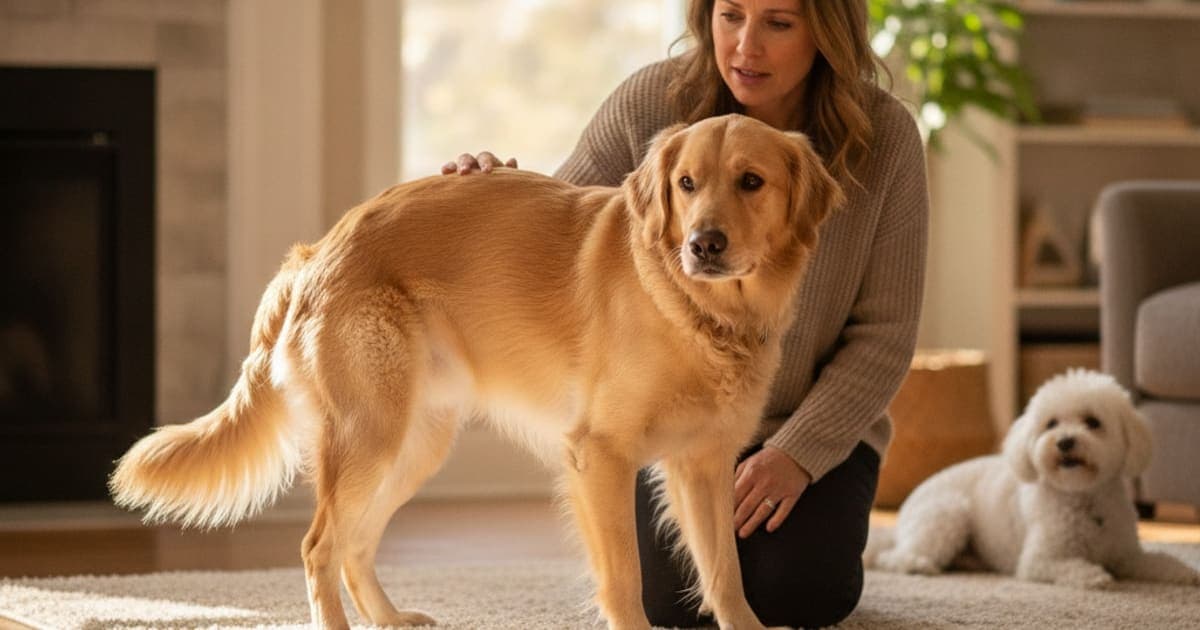
What are the first signs of iliopsoas strain in dogs?
The first signs of iliopsoas strain in dogs are subtle and easy to miss: an intermittent hind-limb limp that comes and goes, hesitation or refusal to jump onto the couch or into the car, a shortened stride on one side, stiffness after rest that loosens up with movement, and a flinch, yelp or tail-tuck when the inner thigh and groin are touched. Many dogs sit with one leg kicked out sideways.
The iliopsoas is a deep hip flexor, so there is nothing to see — no swelling, no heat, no wound. What owners notice first is almost always a change in willingness rather than an obvious injury. The American College of Veterinary Sports Medicine and Rehabilitation recognises iliopsoas injury as one of the more commonly identified soft-tissue problems in active dogs, and veterinary rehabilitation literature consistently describes it as under-recognised early because the presentation is so vague.
The earliest changes owners notice, before there is a visible limp
Most dogs do not start with a dramatic three-legged hop. They start with small edits to their own behaviour.
Watch for a dog who:
- Pauses before jumping. The dog still gets on the bed or into the car, but there is a beat of hesitation, or a scramble instead of a clean launch.
- Takes stairs differently. Bunny-hopping up with both back legs together, or slowing dramatically on the way down.
- Sits crooked. A dog that used to sit square now rolls onto one hip or kicks a leg out to the side. Hip flexor discomfort makes a tight, square sit uncomfortable.
- Is slow to rise. Stiff for the first few minutes after a nap, then apparently normal — the classic pattern of soft-tissue injury.
- Shortens the stride. At a trot, the affected leg does not swing as far forward. It reads as "choppy" more than "lame."
- Objects to handling. Flinching, turning the head, or tensing when you touch the inner thigh, groin, or lower belly. Some dogs resent being lifted under the abdomen.
- Loses interest partway through activity. Enthusiastic for the first ten minutes of a walk or a fetch session, then lagging or lying down.
Some cases begin with a single sharp event — a yelp mid-turn, a slip on a wooden floor, a hard landing off the deck — followed by apparent recovery within minutes. Owners often log this as "he was fine after," and only connect it weeks later when a low-grade lameness sets in.
The first sign is almost never dramatic — it is a dog who still walks normally but quietly stops volunteering for the movements that demand a big, powerful hip extension.
Why this muscle gets injured, and why the signs are so vague
The iliopsoas is really two muscles working as one unit: the psoas major, which runs along the underside of the lumbar spine, and the iliacus, which arises from the inner surface of the ilium. They join and insert on the lesser trochanter of the femur. Functionally, that makes the iliopsoas the dog's primary hip flexor and an important stabiliser linking the lower back to the pelvis and hind limb.
That anatomy explains the whole clinical picture. The muscle is loaded hardest during explosive push-off, tight turns, and the moment a slipping hind limb is dragged back under the body — exactly the mechanics of a dog that skids on a smooth floor, torques out of a fetch stop, or launches off furniture. Because the muscle-tendon unit sits deep against the pelvis, an injured region produces no visible swelling. And because it crosses both the hip and the lower spine, the discomfort can read as back pain, hip pain, or a vague "something's off behind."
Risk clusters in predictable places. Canine athletes and weekend-warrior fetch dogs load the flexor repeatedly. Dogs living on hard, slick flooring take small slips daily. And dogs with existing orthopedic disease — cranial cruciate ligament injury, hip dysplasia, arthritis — often overload the iliopsoas while compensating, which is why a second, unexplained lameness in an already-diagnosed dog deserves a fresh exam rather than an assumption.
It also means self-diagnosis is unreliable. Talk to your veterinarian before you settle on an explanation, because more than one of these problems can be present in the same dog at the same time.
Telling iliopsoas strain apart from other hind-limb problems
| Problem | Typical early sign | What makes it worse | How vets typically confirm it |
|---|---|---|---|
| Iliopsoas strain | Intermittent lameness, reluctance to jump, pain on groin/inner-thigh palpation and hip extension | Explosive turns, slipping, jumping, stretching the hip backwards | Orthopedic exam with targeted palpation, often ultrasound; imaging to rule out other causes |
| Cranial cruciate ligament injury | Sudden hind-limb lameness, sitting with the leg out, toe-touching | Weight-bearing, twisting on a planted foot | Palpation for joint instability (drawer/tibial thrust), radiographs |
| Hip dysplasia / osteoarthritis | Stiffness after rest, bunny-hopping, reduced hip range of motion | Cold weather, long walks, rising from hard floors | Radiographs plus orthopedic exam |
| Lumbosacral disease | Reluctance to jump, pain when the tail base is lifted, hind-end weakness | Rising, stairs, extension of the lower back | Neurologic exam, radiographs, advanced imaging |
| Other muscle or tendon strain | Focal soreness, activity-linked lameness | Repeating the causative movement | Palpation, ultrasound, response to controlled rest |
The overlap is real, and the table is a thinking tool rather than a diagnosis. A dog can have arthritic hips and a strained hip flexor. Only a hands-on exam can separate them.
What to do in the first two weeks
The early window matters, because a mild strain that keeps getting re-torn is how a two-week problem becomes a six-month one.
Film it. A ten-second phone video of your dog trotting away from and toward the camera, plus a clip of them sitting and rising, is often more useful to a vet than your description. Lameness has a habit of disappearing in the exam room.
Book the exam. A veterinarian will palpate the groin and iliopsoas, test hip extension and abduction, check the stifle for instability, and decide whether imaging is warranted. Ultrasound is commonly used to look at the muscle-tendon unit; radiographs help rule out joint and bone disease.
Restrict, don't rest to zero. Short leash walks instead of free running, no fetch, no frisbee, no dog park, no stairs or furniture jumping. Your vet will set the actual boundaries for your dog.
Fix the floors. Runners, yoga mats and rugs across slick routes, plus trimmed paw hair and short nails, remove the daily micro-slips that keep re-provoking the muscle.
Follow the prescription exactly. If your vet dispenses anti-inflammatories or pain medication, they are part of the plan — never stop or reduce a prescribed drug because your dog looks better, and never add anything without asking first.
Ask for rehab. Certified canine rehabilitation practitioners build the graded loading programme that turns rest into real recovery: controlled stretching, targeted strengthening, underwater treadmill work, and a staged return to activity.
Where soft-tissue support fits alongside veterinary care
Recovery from a hip-flexor strain is a remodelling process. Injured muscle and tendon tissue lays down new collagen and gradually reorganises it along lines of load over a period of weeks — which is why controlled, progressive movement outperforms crate confinement alone, and why owners look for anything that supports the tissue environment during that window.
That is the reasoning behind K9-REPAIR from pawgen, a BPC-157 and TB-500 formulation made specifically for dogs. BPC-157 is a synthetic peptide based on a sequence identified in gastric juice protein; laboratory research suggests it may influence fibroblast activity, blood-vessel formation and the signalling involved in soft-tissue repair. TB-500 relates to thymosin beta-4, a naturally occurring peptide involved in actin regulation and cell migration. This is emerging, actively developing science that owners are adopting through recovery — not a treatment, and BPC-157 and TB-500 are not FDA-approved veterinary drugs. Nothing here should be read as a promise about your dog's outcome.
What pawgen can state plainly is what is in the bottle and how it is handled: a defined peptide formulation rather than a kitchen-sink chew with a dozen ingredients at trace levels, third-party testing with certificates of analysis, weight-based dosing guidance, direct-to-door shipping, and a 60-day money-back guarantee. Point your scepticism at labels that hide behind proprietary blends and marketing gloss, not at knowing exactly what you are giving your dog.
Bring it up with your veterinarian, especially if your dog is on prescribed medication, is a puppy, or is pregnant or nursing — dosing questions belong with the vet who knows the case.
Key Takeaways
- The earliest signs are behavioural: hesitation to jump, crooked sitting, stiffness after rest, and a shortened stride — not obvious lameness.
- There is no visible swelling, because the iliopsoas sits deep against the pelvis.
- Pain or flinching when the inner thigh, groin or hip extension is tested is a strong prompt to get an exam.
- Iliopsoas strain frequently coexists with cruciate injury, hip dysplasia and lumbosacral disease; a hands-on veterinary exam separates them.
- Slick flooring, explosive fetch and repeated furniture jumping are the everyday drivers that keep re-injuring the muscle.
- Controlled activity and a graded rehab plan, not indefinite crate rest, are what rebuild loadable tissue.
- K9-REPAIR is the BPC-157 + TB-500 stack owners use through recovery alongside — never instead of — the plan their vet sets.
Your veterinarian owns the diagnosis and the treatment plan: the exam, the imaging, the medication, the surgical decision if one is needed, and the rehab timeline. Supplements and peptides work in the space that proper veterinary care creates, not in place of it. Get the exam, follow the plan, protect the floors, and give the tissue the weeks it genuinely needs.
For deeper reading, see pawgen's guide to iliopsoas strain, realistic dog iliopsoas strain recovery time, whether a dog iliopsoas strain without surgery can resolve, how to prevent iliopsoas strain in dogs, what can i give a dog that is reluctant to jump on the couch, and is a dog reluctant to jump on the couch an emergency.
Owners exploring peptide support for their dog can review K9-REPAIR — BPC-157 + TB-500 formulated for dogs — at https://pawgen.com/. BPC-157 and TB-500 are not FDA-approved veterinary drugs. Nothing in this article treats, cures or prevents any condition; every decision about your dog's care belongs with your veterinarian.
Frequently asked questions
- Can a dog's iliopsoas strain heal without surgery?
- Yes — most iliopsoas strains are managed conservatively rather than surgically. Veterinarians typically combine activity restriction, pain management, environmental changes and a graded rehabilitation programme. Surgery is reserved for uncommon cases such as severe chronic injury or contracture. Your veterinarian decides which path fits your dog after a hands-on exam and appropriate imaging.
- How is iliopsoas strain diagnosed in dogs?
- Diagnosis starts with an orthopedic exam: palpating the groin and iliopsoas, testing hip extension and abduction, and checking the stifle and lower back for other causes. Ultrasound is commonly used to assess the muscle-tendon unit, and radiographs help rule out joint or bone disease. Video of your dog moving at home genuinely helps.
- What helps a dog with iliopsoas strain?
- Controlled activity restriction, any pain medication your veterinarian prescribes, non-slip flooring, and a graded rehabilitation programme from a certified canine rehab practitioner form the core plan. Owners often add soft-tissue support such as K9-REPAIR alongside that plan. Nothing added should replace prescribed medication or the recovery timeline your vet sets.
- How long does iliopsoas strain take to heal in dogs?
- Recovery varies widely with severity, the dog's age and activity level, and how strictly activity is restricted. Mild strains often settle in weeks, while chronic or repeatedly re-injured cases run considerably longer. The biggest variable is re-injury during the return-to-activity phase, so follow the staged timeline your veterinarian and rehab practitioner set.
- Is iliopsoas strain in dogs painful?
- Yes. Dogs commonly flinch, tense, yelp or move away when the inner thigh, groin or hip is extended, and many show stiffness after rest. Because the muscle sits deep with no visible swelling, the discomfort is easy to underestimate. Pain control is a legitimate part of the plan — ask your veterinarian about it.
- What makes iliopsoas strain worse in dogs?
- Explosive activity is the main culprit: fetch, frisbee, hard turns, dog-park sprints, and jumping on and off furniture or into vehicles. Slippery floors cause repeated micro-slips that re-load the muscle daily. Returning to full activity too soon after a good week is the classic route back to square one.
- Which dogs are most at risk of iliopsoas strain?
- Canine athletes and high-drive fetch dogs top the list, along with dogs living on hard, slick flooring. Dogs already managing cruciate injury, hip dysplasia or arthritis are also vulnerable, because compensating movement patterns overload the hip flexor. A new lameness in an already-diagnosed dog deserves a fresh veterinary exam rather than an assumption.
- Should I still walk my dog with a suspected iliopsoas strain?
- Usually yes, but short, calm, leashed walks only — no running, fetch, stairs or furniture jumping until your veterinarian says otherwise. Complete confinement is rarely ideal, because tissue remodels in response to gentle, controlled loading. Ask your vet to define the specific distance, surface and duration that suit your dog's case.
Educational content. BPC-157 and TB-500 are not FDA-approved veterinary drugs. Talk to your veterinarian before starting anything new, especially if your dog is on prescribed medication.