What Are the First Signs of Muscle Tear in Dogs?
The first signs of a muscle tear in dogs are a sudden limp, flinching or yelping when the area is touched, heat and swelling over the muscle belly, a shortened stride, and reluctance to jump or climb stairs. Onset is usually abrupt and follows hard running, a slip, or an awkward landing.
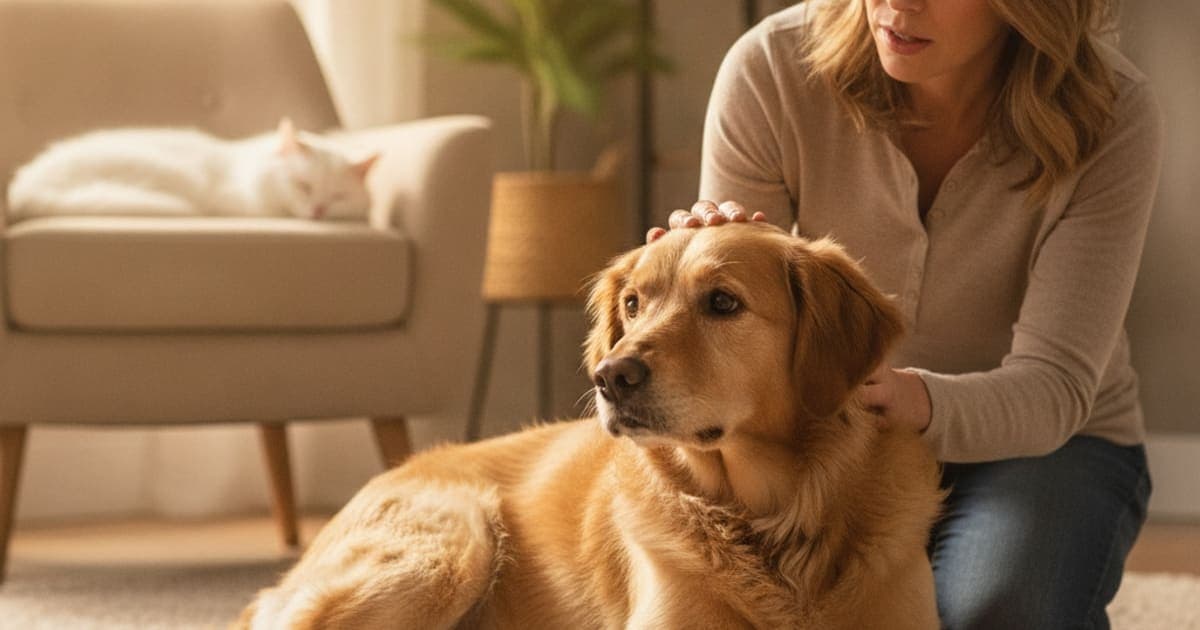
What are the first signs of muscle tear in dogs?
The first signs of a muscle tear in dogs are a sudden limp, yelping or flinching when the area is touched, heat and swelling over the muscle belly, a shortened stride on one side, and reluctance to jump, turn or climb stairs. Onset is usually abrupt and often follows hard running, a slip, or an awkward landing.
The Merck Veterinary Manual describes muscle strains and tears as injuries caused by overstretching or overloading muscle fibres, producing localised pain, swelling and lameness that ranges from mild to severe. In practice, most owners notice the behaviour long before they notice the tissue: the dog who was fine on the way out is holding a leg up on the way back.
The earliest changes owners actually notice
Muscle injuries announce themselves through movement. These are the signals that show up first, usually within minutes to hours of the event.
- A limp that arrives suddenly. Muscle tears are acute events. Unlike arthritis, which creeps in over months, a tear tends to have a before and an after — a yelp mid-run, a slip on tile, a hard landing off the sofa.
- Flinching, guarding or a growl on touch. Run a flat hand slowly down each limb. A dog with a torn muscle will often tense, turn their head toward your hand, pull the leg away, or lick at one specific spot afterward.
- Heat, swelling or a firm knot. Damaged muscle bleeds and swells within its fascial sheath. Compare the injured side to the other side with the back of your hand. Localised warmth and a doughy or unusually firm patch over a muscle belly are meaningful findings.
- A shortened stride on one side. Before a dog visibly limps, they often shorten how far the affected limb reaches. Filming a slow walk from behind and from the side on your phone is one of the most useful things you can do — it gives your vet data you cannot describe in words.
- Stiffness that is worst after rest. Many dogs loosen up after a few minutes of walking, then get worse again once the muscle cools. Getting up from a lie-down looks laboured.
- Refusal of one specific movement. Jumping into the car, taking the stairs, or the sit-to-stand transition may be avoided while everything else looks nearly normal. A single avoided movement is a clue about which muscle group is involved.
- Weight shifting and posture change. Watch them stand still. Dogs offload a painful limb by leaning away, standing with the foot slightly forward, or shifting weight toward the front end.
- Quiet behavioural signs. Panting at rest, restlessness at night, reluctance to be handled, a dog who suddenly does not want to be picked up. Pain in dogs is often expressed as a change in normal habits rather than as vocalising.
If your dog will not bear weight at all, if the lameness is worsening rather than settling, or if you can feel a gap, a hot swelling, or an obvious change in shape in a muscle, that is a same-day veterinary visit — not a wait-and-see.
Where dogs tear muscles most often
The location of the injury shapes the picture you see at home.
Iliopsoas (the deep hip flexor). One of the most commonly injured muscle groups in active and sporting dogs. Owners typically report a hind-limb lameness that comes and goes, a shortened stride behind, reluctance to jump up, and discomfort when the hip is extended backward — for example, when the dog stretches after standing.
Shoulder muscles and their tendons (biceps, supraspinatus). Forelimb lameness that is mild at rest and worse after exercise. The dog may bob their head as the sore leg hits the ground and may resist having the shoulder stretched forward.
Gastrocnemius and the Achilles mechanism. Injury here can produce a dropped-hock stance, where the back of the hock sinks toward the ground as the dog stands or walks. This appearance warrants prompt veterinary assessment.
Gracilis and semitendinosus (inner thigh). Fibrotic myopathy affecting these muscles is well recognised in some working breeds, notably German Shepherds. The gait is distinctive: a short, choppy hind-limb stride with a rapid inward flick of the paw, and it is typically progressive rather than painful.
Quadriceps, triceps and back muscles. Less common, and usually linked to a specific trauma such as a fall, a road accident, or a collision at speed.
Muscle tear, or something else?
A limp is a symptom, not a diagnosis. Several very different problems present the same way on day one, which is exactly why imaging and a hands-on orthopaedic exam matter. Use this table to sharpen what you tell your vet — not to reach a conclusion on your own.
| What you observe | More consistent with a muscle tear or strain | Worth ruling out first |
|---|---|---|
| Sudden hind-limb lameness after a turn at speed | Pain localised to a muscle belly, heat, guarding on palpation | Cranial cruciate ligament rupture — often shows a sit with the leg swung out to the side, and joint instability on exam |
| Non-weight-bearing lameness with rapid swelling | Large tear with bleeding into the muscle | Fracture, luxation, or a bite or penetrating wound |
| Limp that appears without any obvious event | Chronic low-grade strain aggravated by repeated activity | Arthritis, foot or nail injury, an interdigital lesion, a tick-borne disease |
| Gradual weakness and shrinking muscle over months | Not a tear pattern | Age-related muscle loss, nerve disease, or endocrine causes |
| Neck or back pain with wobbly or dragging limbs | Not a tear pattern | Intervertebral disc disease or another spinal problem — treat as urgent |
What helps in the first 48 hours, and what makes it worse
Before anything else: call your veterinarian and describe what you saw. Ask whether the dog should be seen today. A short phone conversation is what turns a guess into a plan.
What helps:
- Strict rest. Lead only for toileting, no stairs, no sofa, no ball, no dog-park recall. Muscle tissue that is repeatedly reloaded during the inflammatory phase heals slower and messier.
- Traction underfoot. Runners or yoga mats over slick floors stop the reflexive scrabble that reinjures a healing muscle.
- Video and notes. Record the gait daily. Track which movements the dog avoids. Bring both to the appointment.
- Following the prescribed plan exactly. If your vet dispenses pain relief, an anti-inflammatory, or a rehab protocol, that plan is the backbone of recovery.
What makes it worse:
- Human painkillers. Ibuprofen, naproxen and paracetamol are dangerous to dogs. Never reach into your own medicine cabinet.
- Deep massage or aggressive stretching of a fresh injury.
- The too-soon comeback. Most reinjuries happen because the dog looked normal for a week and got their old routine back on day eight.
- Heat on a hot, swollen, acute injury. Ask your vet which of heat or cold is appropriate and when.
How muscle rebuilds itself, and what owners add during recovery
Skeletal muscle repairs in overlapping phases. First, bleeding and inflammation clear the damaged fibres. Then satellite cells — the resident stem cells of muscle — activate, multiply and fuse to rebuild fibres, while fibroblasts lay down a collagen scaffold and new blood vessels grow into the area. Finally comes remodelling, where that scaffold reorganises along lines of load. That last phase is why controlled, progressive rehab matters so much: mechanical loading is the signal that tells collagen how to align. Too little movement leaves stiff, disorganised scar tissue; too much, too early, tears it again.
This is the window where owners look for support alongside veterinary care, and it is where peptides have become part of the conversation. BPC-157 is a synthetic peptide based on a sequence identified in gastric juice; published laboratory and animal research has explored its role in angiogenesis, fibroblast migration and tendon and muscle repair processes. TB-500 is a synthetic form of a fragment of thymosin beta-4, a naturally occurring peptide involved in actin regulation and cell migration — the cellular housekeeping behind tissue repair. Research suggests these mechanisms are relevant to how soft tissue rebuilds, and it is emerging, promising science that a growing number of owners are choosing to add during recovery.
pawgen formulates both into K9-REPAIR, the peptide stack owners use through tendon, muscle and mobility recovery, with weight-based dosing, third-party testing with certificates of analysis, direct-to-door shipping and a 60-day money-back guarantee. BPC-157 and TB-500 are not FDA-approved veterinary drugs, and nothing here is a claim that any product treats or resolves a torn muscle. Bring it up with your veterinarian so it sits inside their plan, not beside it — and never stop or reduce a prescribed medication to make room for it.
Key Takeaways
- The earliest signs are behavioural and mechanical: sudden limp, flinching on touch, heat or swelling over a muscle, shortened stride, and avoidance of one specific movement.
- Sudden onset after activity points toward muscle injury; gradual weakness over months points somewhere else entirely.
- Iliopsoas, shoulder, calf and inner-thigh muscle groups are the most commonly reported sites in dogs.
- A limp is not a diagnosis — cruciate rupture, fracture and spinal disease can look identical on day one.
- Rest, traction underfoot, daily gait video and strict adherence to the veterinary plan do the heavy lifting in the first 48 hours.
- Human anti-inflammatories are dangerous to dogs and must never be given.
- Muscle heals in phases, and controlled loading during remodelling is what determines the quality of the repair.
For deeper reading, pawgen has a full reference on muscle tear, plus guides on how is muscle tear diagnosed in dogs, can a dogs muscle tear heal without surgery and how much does it cost to treat muscle tear in dogs. If your dog's changes came on slowly rather than suddenly, start instead with what are the first signs of sarcopenia in dogs and how much does it cost to treat sarcopenia in dogs. Product details for K9-REPAIR sit on the main site.
Where your veterinarian fits
Your vet owns this. They are the ones who palpate the limb, test joint stability, order imaging when it is warranted, decide whether the injury is a strain or something structural, prescribe pain control, and build the rehab progression that turns healing tissue into a functional muscle again. Surgery, prescribed medication and physical rehabilitation are the foundation of recovery from a significant muscle injury, and nothing you buy replaces any of them. Supplements and peptides operate in the space that proper veterinary care creates — supporting the conditions for recovery while the diagnosis and the treatment plan stay firmly in your veterinarian's hands.
Owners exploring peptide support for their dog can review K9-REPAIR — BPC-157 + TB-500 formulated for dogs — at https://pawgen.com/. BPC-157 and TB-500 are not FDA-approved veterinary drugs. Nothing in this article treats, cures or prevents any condition; every decision about your dog's care belongs with your veterinarian.
Frequently asked questions
- How long does muscle tear take to heal in dogs?
- It depends entirely on severity, location and the dog. Minor strains often settle over a few weeks of restricted activity, while significant tears take considerably longer because remodelling of collagen continues well after the limp disappears. Your veterinarian sets the timeline and the return-to-activity steps — going by how your dog looks is how reinjury happens.
- Is muscle tear in dogs painful?
- Yes. Torn muscle fibres bleed and swell inside a confined sheath, which produces real pain, particularly in the first days. Dogs often show it quietly — panting at rest, restlessness, guarding the area, reluctance to be handled — rather than by crying out. Pain control is a veterinary decision, and human painkillers are dangerous to dogs.
- What makes muscle tear worse in dogs?
- Returning to normal activity too early is the biggest factor, followed by slippery flooring, stairs, jumping in and out of vehicles, and high-speed turning games. Aggressive massage or stretching of a fresh injury, skipped prescribed medication, and excess body weight loading the limb also work against healing. Controlled, progressive rehab guided by your vet is the counterweight.
- Can muscle tear in dogs be reversed?
- Muscle does repair itself. Satellite cells rebuild fibres and a collagen scaffold fills the gap, though a healed muscle often carries some scar tissue rather than returning to identical original structure. How well function returns depends on severity, early rest, and the quality of the loading programme your veterinarian prescribes during the remodelling phase.
- How much does it cost to treat muscle tear in dogs?
- Costs vary widely by clinic, region, the size of your dog and how much diagnostic work is needed. An exam and pain relief sit at the lower end; ultrasound or MRI, rehabilitation sessions and any surgical repair raise it substantially. Ask your veterinary practice for a written estimate before imaging, and check what your insurance covers.
- Can a dog's muscle tear heal without surgery?
- Many can. Conservative management — strict rest, prescribed pain control, controlled leash exercise and a structured rehab progression — is the usual route for partial strains and tears. Surgery is generally reserved for complete ruptures, avulsions and injuries involving tendon attachments. Only your veterinarian, after examining and imaging the limb, can tell you which category your dog is in.
- How do I tell a muscle tear from a torn cruciate ligament?
- You often cannot at home, which is why examination matters. Cruciate rupture classically causes hind-limb lameness with joint instability and a sideways sit with the leg swung out. Muscle injury tends to produce pain localised to a muscle belly with heat or swelling. A vet tests joint stability directly; guessing delays the right plan.
- Should I use ice or heat on my dog's muscle injury?
- Ask your veterinarian before applying either. Cold is generally used on fresh, hot, swollen injuries and heat later in recovery to loosen tissue before controlled movement, but the timing and duration depend on the injury and the dog. Applied at the wrong stage or for too long, both can set recovery back.
Educational content. BPC-157 and TB-500 are not FDA-approved veterinary drugs. Talk to your veterinarian before starting anything new, especially if your dog is on prescribed medication.