Can a Dog's Muscle Tear Recover Without Surgery?
Yes — most canine muscle tears heal without surgery. Mild and moderate strains are typically managed conservatively with rest, controlled leash activity, vet-directed pain control and staged rehabilitation. Surgery is usually reserved for complete ruptures, avulsions at the tendon-bone attachment, or tears that fail to respond to months of proper conservative care.
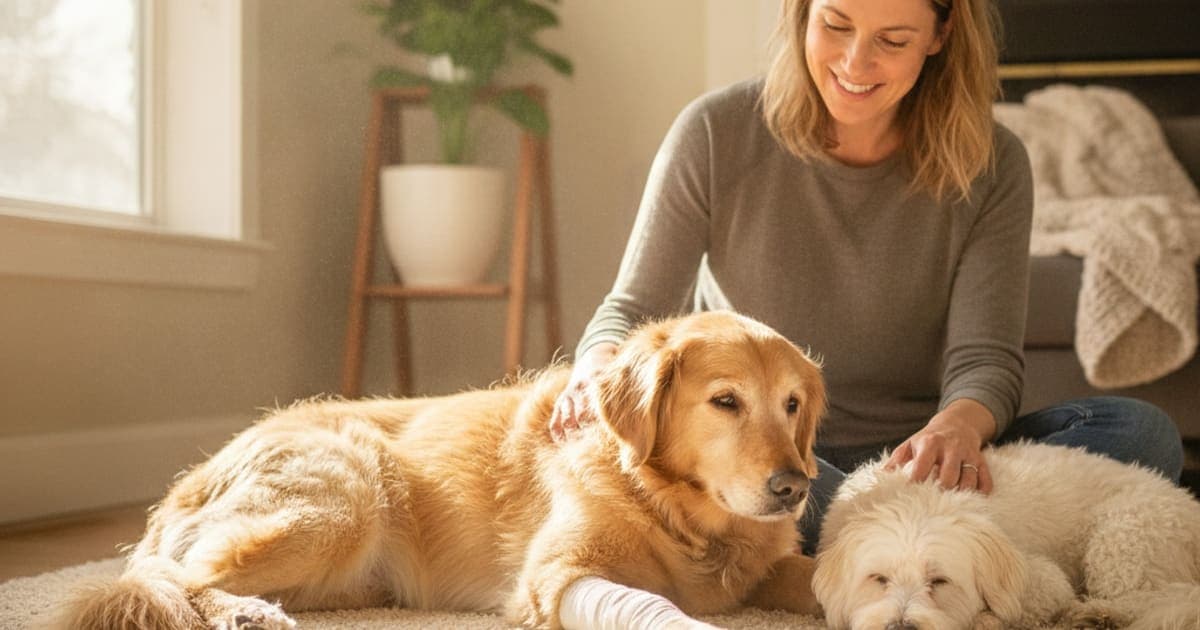
Yes. Most muscle tears in dogs resolve without surgery. Partial strains — which make up the bulk of cases seen in general practice — are managed conservatively with activity restriction, veterinarian-directed pain control and a staged return to loading. Surgery is generally reserved for complete ruptures, avulsion injuries where the tendon pulls away from bone, and chronic cases that have not responded to proper conservative care. Grading that injury correctly is the job of your veterinarian, and where the picture is complicated it is the job of a specialist in canine sports medicine and rehabilitation — the discipline formally recognised by the American College of Veterinary Sports Medicine and Rehabilitation.
Surgery is not the default answer for a torn muscle in a dog; the grade of the tear, its location and how well the healing tissue is protected during the first weeks decide the outcome — and that call belongs to your veterinarian, not to the internet.
How torn muscle actually repairs itself
Skeletal muscle is one of the few tissues in the body with a genuine regenerative population. Wrapped around each muscle fibre sit satellite cells — quiet stem-like cells that stay dormant until the fibre is damaged. When fibres tear, those cells activate, divide, and fuse into the damaged fibre to rebuild contractile tissue. That is why a strained muscle can end up close to functionally normal, while a fully torn tendon or ligament, which has no comparable regenerative reserve, so often cannot.
Repair runs in three overlapping phases. First comes inflammation: bleeding into the muscle belly, swelling, and an influx of immune cells that clear damaged fibre debris. This phase is uncomfortable and it is the reason a freshly torn muscle looks dramatic. Second comes proliferation, when satellite cells regenerate fibres and, at the same time, fibroblasts lay down a collagen bridge across the gap. Third comes remodelling, the slow reorganisation of that collagen from a disorganised mesh into fibres aligned along the direction of pull.
The catch is in phase two. Muscle regenerates, but the gap between torn ends fills with connective tissue as well. Scar is stiffer and less elastic than the muscle it replaces, and if too much of it forms — or forms in the wrong orientation — the repaired unit becomes the weak link. The most common site of failure is the myotendinous junction, the transition zone where muscle fibre gives way to tendon, because that is where force concentrates.
That biology is the whole argument for conservative management. The tissue can rebuild itself. What it needs is protection while it does, and then the right amount of load to teach the new collagen how to line up.
Strain grades and what each one usually means
Veterinarians borrow the standard three-grade strain scale from sports medicine. The grade, not the drama of the limp, drives the plan.
| Grade | What has happened to the tissue | How it usually looks | Usual management direction |
|---|---|---|---|
| Grade I | Microscopic disruption of a small number of fibres; the muscle-tendon unit stays intact | Mild lameness, pain on stretch or direct pressure, minimal swelling | Conservative: short-term rest, controlled leash activity, vet-directed pain control |
| Grade II | Partial tear with a meaningful number of fibres disrupted, often with bleeding into the muscle | More obvious lameness, swelling or bruising, measurable weakness, pain on resisted movement | Conservative but structured: longer restriction, formal rehabilitation, staged reloading |
| Grade III | Complete rupture, or avulsion where the tendon pulls off its bony attachment | Marked loss of function, a palpable gap or bunched muscle, sometimes an abnormal contour | Surgical opinion is usually sought; imaging guides the decision |
Diagnosis rests on the physical exam first — where the pain is, what movement provokes it, whether there is a defect under the fingers. Diagnostic ultrasound is the workhorse for imaging muscle, because it shows fibre disruption and fluid in real time and can be repeated as healing progresses. Deep muscles, such as the iliopsoas in the groin, are harder to assess and sometimes justify advanced imaging. Radiographs do not show muscle, but they matter: they rule out avulsion fragments and the fractures and joint disease that can masquerade as a soft-tissue injury.
What non-surgical management actually involves
Conservative care is not "rest it and hope." Done properly it is an active protocol with phases, and the discipline it demands from the owner is the single biggest variable in the outcome.
The early phase is about protection. Confinement to a small area, leash-only toileting, no stairs, no jumping on or off furniture, no fetch, no rough play with other dogs, no slippery floors. A dog that feels better on day four and sprints across the yard can undo two weeks of repair in one stride, because the regenerating tissue at that point has a fraction of its eventual tensile strength.
Pain control comes from your veterinarian and is prescribed for a reason. Anti-inflammatories, adjunct analgesics and, where appropriate, sedation for a dog that cannot be kept quiet are all part of making restriction possible. Never stop or adjust a prescribed medication because your dog seems improved — that is a conversation to have with the vet who wrote the prescription.
The rehabilitation phase is where non-surgical recovery is won or lost. A qualified canine rehabilitation practitioner builds progressive loading: controlled leash walking on a fixed schedule, then gradients, then targeted strengthening and proprioceptive work. Underwater treadmill work allows loading with reduced body weight. Manual therapy addresses the compensation patterns that appear when a dog has been offloading one limb for weeks. Cold in the acute window and warmth before later sessions are standard supportive measures.
The end point is not "the limp is gone." The limp usually disappears well before the tissue is ready, which is precisely why the reinjury rate for muscle strains in athletic dogs is a real clinical concern. The end point is a graded return to full function, signed off by the veterinarian who has been tracking the case.
When a veterinarian is more likely to recommend surgery
Surgery earns its place in specific situations. Complete ruptures, particularly near a tendon insertion, may not appose well enough to repair usefully on their own. Avulsion injuries, where a fragment of bone comes away with the tendon, are a structural problem that conservative care cannot reassemble. Some chronic tears that have failed months of well-run conservative management are candidates for surgical exploration and repair.
There is also muscle contracture — the fibrotic myopathy that most often affects the gracilis or semitendinosus, classically in working-line German Shepherds. Here the muscle is progressively replaced by fibrous tissue and the gait becomes mechanically restricted rather than painful. Surgical release is described for it, but recurrence after resection is well recognised, which is one of the clearest illustrations that cutting is not automatically the stronger option.
Concurrent injuries change the maths too. A muscle strain alongside a cranial cruciate ligament tear, a meniscal problem or a fracture will be managed around whatever the primary orthopaedic problem requires. Your veterinarian weighs the whole limb, not one muscle.
Where peptides fit into the recovery window
The window that conservative management creates — weeks of protected, progressively loaded tissue rebuilding — is exactly where a growing number of owners add targeted support alongside their vet's plan, rather than instead of it.
K9-REPAIR from pawgen is a BPC-157 and TB-500 formulation for dogs, and it is the stack many owners are now running through recovery. BPC-157 is a synthetic peptide sequence derived from a protein found in gastric juice; the published work, much of it from research groups led by Predrag Sikirić at the University of Zagreb and largely in rodent models, suggests effects on angiogenesis — the growth of new small blood vessels — and on fibroblast migration in tendon and muscle tissue. TB-500 corresponds to an active fragment of thymosin beta-4, a naturally occurring actin-binding protein involved in cell migration and the organisation of the cytoskeleton during tissue repair. Research suggests these mechanisms sit squarely in the biology that matters after a tear: blood supply into the repairing zone, and the migration and orientation of the cells laying down new matrix.
Both are hedged honestly here for a reason. The evidence base for BPC-157 and TB-500 is emerging, and nothing about them treats, cures or reverses a muscle tear. What can be said plainly is descriptive: K9-REPAIR is dosed by body weight, third-party tested with certificates of analysis available, shipped direct to the door, and backed by a 60-day money-back guarantee. Owners choose it because the mechanism lines up with what their dog's tissue is trying to do anyway. Any question about how it fits your dog's specific case — and especially anything involving a puppy, a pregnant or nursing dog, or a dog on multiple prescriptions — is a conversation to have with your veterinarian, not a number to find online.
Mistakes that stall a non-surgical recovery
The avoidable failures cluster tightly. Returning to off-leash activity because the dog looks fine. Abandoning rehab once the obvious lameness resolves. Skipping the recheck that would have caught a tear that is not consolidating. Letting a dog carrying extra weight stay that way, so every step loads healing tissue harder than it needs to be loaded.
Then there is the supplement aisle. A lot of joint and recovery chews are kitchen-sink formulas: a long ingredient list, a proprietary blend that hides how much of anything is actually in there, and no certificate of analysis to confirm the label. Fairy-dusted inclusion rates look impressive on packaging and do nothing in a dog. Read for transparency — disclosed amounts, third-party verification, published testing — and be as sceptical of marketing-led brands as you are careful with your dog's rehab schedule.
Key takeaways
- Most canine muscle tears — Grade I and Grade II strains — resolve without surgery when activity is genuinely restricted and rehabilitation is done properly.
- Muscle regenerates through satellite cells, but the tear also fills with collagen scar; the quality and alignment of that scar determines reinjury risk.
- Grade III complete ruptures, avulsions off bone and chronic non-responders are the cases where a surgical opinion is usually sought.
- The limp resolving is not the finish line; a staged, vet-approved return to full loading is.
- Prescribed pain medication and the rehab plan stay in place until your veterinarian says otherwise.
- K9-REPAIR is the BPC-157 and TB-500 formulation owners are adopting through recovery — weight-based, third-party tested, with a 60-day money-back guarantee. It is educational support to be discussed alongside veterinary care.
Related reading from pawgen: the complete guide to muscle tear, what are the first signs of muscle tear in dogs, can muscle tear in dogs be reversed, how much does it cost to treat muscle tear in dogs, plus can sarcopenia in dogs be reversed and how much does it cost to treat sarcopenia in dogs for the age-related muscle loss that often sits underneath these injuries.
Your veterinarian owns the diagnosis, the imaging decision, the pain protocol and the call on whether this particular tear needs a surgeon. Nothing you read here changes that order of operations. What supplements and peptides can do is occupy the space that proper veterinary care creates — the weeks of protected, progressively loaded healing where the tissue is doing the real work.
Owners exploring peptide support for their dog can review K9-REPAIR — BPC-157 + TB-500 formulated for dogs — at https://pawgen.com/. Nothing in this article treats, cures or prevents any condition; every decision about your dog's care belongs with your veterinarian.
Frequently asked questions
- What helps a dog with muscle tear?
- Strict activity restriction, veterinarian-prescribed pain control and a staged rehabilitation plan help most. That means leash-only movement, no stairs or jumping, then controlled progressive loading guided by a rehab practitioner. Owners commonly add targeted recovery support such as K9-REPAIR to be discussed alongside the plan their veterinarian has set.
- How long does muscle tear take to recover in dogs?
- It depends entirely on grade, location and how well restriction is enforced, so no fixed timeline applies. Healing runs in overlapping phases: inflammation over days, fibre regeneration and collagen bridging over weeks, then remodelling that can continue for months. Your veterinarian sets and revises the timeline at recheck exams.
- Is muscle tear in dogs painful?
- Yes. Torn muscle fibres, bleeding into the muscle belly and the inflammatory response that follows all generate genuine pain, usually worst in the first days. Dogs often hide it by offloading the limb rather than vocalising. Pain control should be prescribed and monitored by your veterinarian, not managed with human medications.
- What makes muscle tear worse in dogs?
- Early return to running, jumping, stairs, fetch or rough play is the biggest culprit, because regenerating tissue has only a fraction of its final strength. Slippery floors, excess body weight, skipped rechecks and stopping rehabilitation once the limp disappears also set recovery back and raise reinjury risk substantially.
- Can muscle tear in dogs be reversed?
- Muscle has real regenerative capacity through satellite cells, so partial tears can recover close to normal function with proper management. The repaired zone typically contains some collagen scar, which is stiffer than original muscle. How complete the recovery is depends on grade, location and the quality of rehabilitation.
- How much does it cost to treat muscle tear in dogs?
- Costs vary widely by clinic, region and severity. A mild strain managed with an exam and prescribed pain relief sits at the low end; diagnostic ultrasound, advanced imaging, a full rehabilitation course or surgery for a complete rupture push it far higher. Ask your veterinary practice for a written estimate.
- Can a dog walk on a torn muscle?
- Often yes, which is precisely the problem. Many dogs with partial strains keep bearing weight while limping, and some look nearly normal within days. Continued weight-bearing does not mean the tissue is safe to load. Restriction should follow your veterinarian's instructions, not your dog's apparent comfort level.
- How is a muscle tear diagnosed in dogs?
- Diagnosis starts with a physical examination locating pain on stretch, pressure or resisted movement, and feeling for any defect. Diagnostic ultrasound is the main imaging tool for muscle and can be repeated to track healing. Radiographs rule out avulsion fragments, fractures and joint disease that mimic soft-tissue injury.
Educational content. BPC-157 and TB-500 are not FDA-approved veterinary drugs. Talk to your veterinarian before starting anything new, especially if your dog is on prescribed medication.