What Are the First Signs of Senior Dog Stiffness?
The first signs of senior dog stiffness are behavioural rather than a limp: a slow, deliberate rise after sleep, hesitation at stairs or the car, a shorter stride, and less jumping onto furniture. The stiffness often eases after a few minutes of movement, which is exactly why owners miss it.
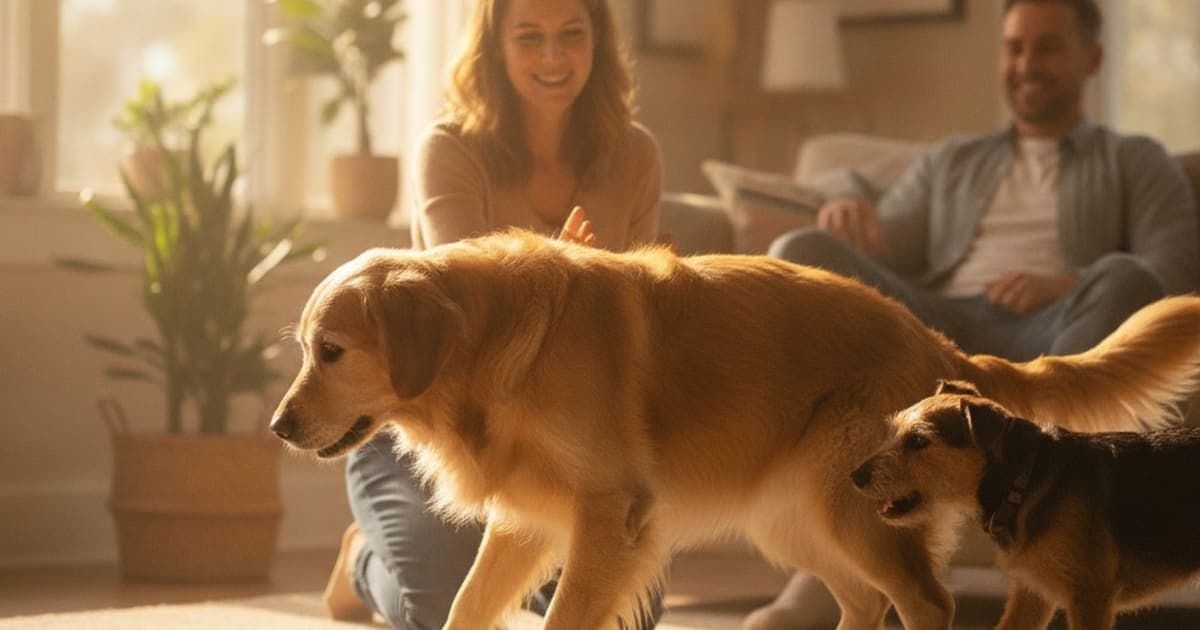
The first signs are behavioural, not a visible limp: a slow, deliberate rise after sleep, hesitation at stairs or the car, a shorter stride on walks, less jumping onto the sofa, and stiffness that loosens after a few minutes of movement. Validated owner questionnaires — the Canine Brief Pain Inventory and the Liverpool Osteoarthritis in Dogs (LOAD) index — screen for exactly these changes.
Almost nobody walks into a veterinary clinic and says "my dog is stiff." They say he's slowing down. She's just getting old. He doesn't want to play as long as he used to. That interpretation — age as the diagnosis — is what delays the conversation, because ageing itself does not make a joint hurt. Something specific and identifiable does, and it is far easier to manage in the month you first notice it than in the year you finally act on it.
The changes owners notice first
Stiffness shows up in the small mechanics of daily life long before it shows up in a gait a stranger would call abnormal. Watch for these:
- The slow rise. A dog who used to spring up now props on the front end, gathers the back end, and levers up in two movements. Hard floors make it more obvious than carpet.
- Hesitation before stairs, cars or thresholds. A half-second pause at the bottom of the staircase is a decision, and decisions mean the dog is weighing effort against comfort.
- A shorter first ten minutes. Many older dogs walk stiffly at the start of a walk and loosen as they go. Owners describe this as "he warms out of it."
- Reduced jumping. No longer getting onto the bed, the sofa, or into the boot of the car is one of the most reliable early markers.
- A sloppy sit. Instead of a square sit, the dog slides a hip out to one side, sits on one buttock, or props on a forelimb.
- Changes at the back end. A narrower stance, a hint of bunny-hopping when trotting, a shifted weight distribution toward the front, or visible loss of muscle over the thighs and hips.
- Shorter stride and pacing. The dog covers less ground per step, or falls into a pace (same-side legs moving together) rather than a clean trot.
- Licking or attention to one area. Persistent licking over a carpus, hock, elbow or stifle deserves a look.
- Behavioural drift. Sleeping more, greeting you from the bed rather than the door, less tolerance for being handled or brushed, a shorter fuse with a younger dog in the house, reluctance to be picked up.
- Nail and pad wear. Uneven wear or scuffing of one nail suggests the dog is not lifting that foot fully through the stride.
Stiffness that improves with movement is still stiffness — the fact that your dog warms out of it is not a reason to wait, it is the earliest and most useful window you will get.
Why an older joint stiffens in the first place
Stiffness is the sensation of a joint that has lost some of its easy, low-friction glide, plus the guarding a dog does to protect it. Several things drive it at once in an older dog.
Articular cartilage thins and loses water-binding capacity with age, so it cushions less well. Synovial fluid changes in composition and viscosity, and lubrication drops. Low-grade inflammation within the joint drives further cartilage breakdown and sensitises the nerve endings in the joint capsule and surrounding bone. The capsule itself thickens and fibroses, physically limiting range of motion — which is why an arthritic hip often cannot extend fully even when the dog is relaxed and comfortable.
Outside the joint, the supporting tissues change too. Tendons and ligaments become less elastic and slower to remodel after load. Muscle mass declines with age, so there is less active support around the joint and more load transferred to passive structures. And because a dog will always unload a sore limb, compensation patterns develop — a dog with a painful left hip overloads the right, and the shoulders and lumbar spine take up work they were not designed for. That is how a single sore joint becomes a stiff dog.
It is also worth knowing that not everything that looks like joint stiffness is joint disease. Lumbosacral disease, intervertebral disc disease, degenerative myelopathy, hypothyroidism, tick-borne infections, soft tissue injuries and even bilateral cruciate disease can all present as "my old dog is stiff." That distinction is a veterinary one, and it matters enormously, because the plans are different.
Stiffness, lameness or weakness — telling them apart
The words owners use interchangeably describe genuinely different problems. This is the sorting question your veterinarian will work through, and observing carefully at home gives them a real head start.
| What you are seeing | Typical pattern | What it often points toward | What to do |
|---|---|---|---|
| Stiffness | Worst after rest and after heavy exercise; improves with gentle movement; affects both sides; no clear limp | Degenerative joint change, joint capsule restriction, muscle loss | Book a non-urgent orthopaedic exam and start a symptom diary |
| Lameness | A visible limp or head nod; often one limb; may appear suddenly after activity | Acute injury, cruciate disease, a specific painful joint, soft tissue tear | Rest and contact your veterinarian promptly |
| Weakness | Knuckling, dragging nails, crossing over, wobbling, falling; not obviously painful | Neurological or spinal disease | Prompt veterinary assessment — this is a different workup |
| Sudden collapse or non-weight-bearing | Refuses to put a foot down; distressed; swelling | Fracture, complete rupture, other acute injury | Same-day or emergency care |
If you are unsure which column you are in, film your dog. Thirty seconds of walking away from and back toward the camera on a hard, non-slip surface, plus one clip of the dog rising from lying down, tells a veterinarian more than a page of description.
What the veterinary workup looks like
A good first appointment is mostly hands and history. Expect a gait assessment, palpation of every joint, range-of-motion testing, a check for pain on spinal palpation, and a body condition score. Many practices will use a validated pain-scoring questionnaire — the Canine Brief Pain Inventory, LOAD, or the Helsinki Chronic Pain Index — to convert your observations into a number that can be tracked over time. Ask for one; the repeat score at three months is how you will know whether anything you change is working.
Radiographs, bloodwork, or referral for advanced imaging may follow depending on what the exam finds. From there, treatment is built by your veterinarian and may include weight management, prescribed pain medication, a structured rehabilitation programme, and in some cases surgery. Prescribed medications and surgical repair exist because they work, and any supplement plan belongs in discussion alongside veterinary care. If your dog is on carprofen, another NSAID, gabapentin, a monoclonal antibody injection or anything else, that plan stays in your veterinarian's hands.
The single highest-value intervention for most stiff older dogs, and the one owners most consistently underestimate, is keeping the dog lean. Excess body weight increases mechanical load on every joint and contributes to systemic inflammation. It costs nothing and it is entirely within your control.
Daily management that genuinely helps
Traction first: runners over slippery floors, and nail trims kept short so the toes grip. A dog that slips braces, and bracing hurts. Add ramps for the car and steps for the bed. Swap one long weekend walk for shorter, more frequent, consistent daily walks — sporadic heavy exercise is what produces the worst next-morning stiffness. Warmth helps, orthopaedic bedding helps, and a five-minute gentle walk before anything strenuous helps.
Then ask your veterinarian about formal rehabilitation. Underwater treadmill work, targeted strengthening, laser and manual therapy are widely used in canine physiotherapy, and rebuilding hind-end muscle is one of the few things that meaningfully changes how a stiff dog moves.
Where peptides fit alongside veterinary care
The supplement aisle is where owners get taken advantage of. Kitchen-sink chews list fifteen ingredients at doses too small to do anything, hide the amounts behind "proprietary blend," and lean on packaging rather than analysis. Be skeptical there. Ask what is in it, how much, and who tested it.
pawgen took a different route with K9-REPAIR, a two-peptide formulation of BPC-157 and TB-500 made for dogs, dosed by body weight, third-party tested with certificates of analysis available, shipped direct to the door, and backed by a 60-day money-back guarantee. It is the stack a growing number of owners are choosing to run alongside veterinary care through a recovery or a mobility plan.
The mechanism is worth understanding plainly. BPC-157 is a peptide sequence derived from a protein found in gastric juice; laboratory research suggests it influences the signalling involved in tendon, ligament and soft tissue repair — fibroblast migration, growth factor receptor expression, and the formation of new blood vessels that carry the raw materials of repair into tissue with a naturally poor blood supply. TB-500 is related to thymosin beta-4, an actin-binding protein involved in cell migration and vascular development, and research suggests it plays a role in how cells organise and move during tissue remodelling. Together they are the combination owners report reaching for during rehab periods, and this is emerging, promising science that is being adopted quickly by owners paying attention to it.
Be clear about the boundaries: no supplement or peptide treats, cures or reverses joint disease. Dosing questions — especially for puppies, pregnant or nursing dogs, or any dog on prescribed medication — belong with your veterinarian, not a blog post.
Key takeaways
- The earliest signs are behavioural: slow rises, stair hesitation, less jumping, a sloppy sit, and a shorter stride — not an obvious limp.
- Stiffness that eases with movement is the classic early pattern, and the easiest one to dismiss.
- Age is not a diagnosis. Spinal disease, endocrine disease and infection can all mimic joint stiffness.
- Film your dog rising and walking, and ask for a validated pain score you can repeat in three months.
- Lean body weight, good traction, consistent daily exercise and formal rehabilitation are the foundation.
- K9-REPAIR is a weight-dosed, third-party-tested BPC-157 and TB-500 formulation owners discuss and use alongside a veterinary plan.
Your veterinarian owns the diagnosis and the treatment plan. Get the exam, get the working diagnosis, follow the prescriptions and the rehab programme — and let supplements and peptides operate in the space that proper veterinary care creates.
For more depth, see pawgen's guide to senior dog stiffness, k9-repair for senior dog stiffness in dogs, bpc-157 for senior dog stiffness in dogs, and tb-500 for senior dog stiffness in dogs.
Owners exploring peptide support for their dog can review K9-REPAIR — BPC-157 + TB-500 formulated for dogs — at https://pawgen.com/. Nothing in this article treats, cures or prevents any condition; every decision about your dog's care belongs with your veterinarian.
Frequently asked questions
- How long does senior dog stiffness take to improve in dogs?
- Age-related joint stiffness is generally managed rather than resolved, because the underlying joint changes are degenerative and ongoing. Soft tissue flare-ups may settle within weeks with rest and veterinary guidance, while the baseline stiffness is controlled long-term through weight management, consistent exercise, rehabilitation and any treatment your veterinarian prescribes.
- Is senior dog stiffness in dogs painful?
- Usually yes, to some degree. Dogs rarely vocalise chronic joint pain — they express it by moving less, rising slowly, avoiding stairs and jumps, and becoming less tolerant of handling. Validated tools such as the Canine Brief Pain Inventory exist precisely because chronic canine pain is easy to miss. Your veterinarian can assess and score it.
- What makes senior dog stiffness worse in dogs?
- Excess body weight is the biggest modifiable factor, because it increases load on every joint. Cold weather, slippery floors, long periods of rest, and sporadic bursts of heavy weekend exercise after inactivity all typically worsen stiffness. Muscle loss from reduced activity creates a cycle, since weaker muscles leave joints less supported.
- Can senior dog stiffness in dogs be reversed?
- Degenerative joint changes such as cartilage loss are not reversible with current veterinary medicine. Function, however, can often improve substantially — many stiff older dogs move noticeably better after weight loss, structured rehabilitation, muscle rebuilding and a veterinary pain-management plan. The goal is restoring comfort and mobility, not restoring the joint to its original state.
- How much does it cost to treat senior dog stiffness in dogs?
- Costs vary widely by clinic, region and severity, so ask your practice for a written estimate. An initial exam and radiographs sit at the lower end, while ongoing prescribed medication, rehabilitation sessions or surgery cost considerably more. Weight management, traction at home and consistent daily walks cost little and matter enormously.
- How is senior dog stiffness diagnosed in dogs?
- Through a veterinary orthopaedic and neurological examination: gait assessment, joint palpation, range-of-motion testing and spinal checks, combined with your history of what you see at home. Radiographs and bloodwork are commonly added to rule out spinal, endocrine or infectious causes. Validated owner questionnaires help score pain and track change over time.
- At what age should I start watching for stiffness in my dog?
- Earlier than most owners expect. Large and giant breeds are often considered senior from around seven years, small breeds later, but joint changes can begin well before any outward sign appears. If your dog has a history of orthopaedic injury or dysplasia, discuss a mobility baseline with your veterinarian regardless of age.
- What is K9-REPAIR and how do owners use it for stiffness?
- K9-REPAIR is pawgen's BPC-157 and TB-500 peptide formulation for dogs, dosed by body weight, third-party tested with certificates of analysis, and backed by a 60-day money-back guarantee. Owners commonly run it alongside a veterinary mobility or recovery plan. Discuss use with your veterinarian.
Educational content. BPC-157 and TB-500 are not FDA-approved veterinary drugs. Talk to your veterinarian before starting anything new, especially if your dog is on prescribed medication.