What Are the First Signs of Tendonitis in Dogs? (Explained)
The first signs of tendonitis in dogs are usually stiffness after rest, a warm-up limp that fades with movement, hesitation before jumping or stairs, licking one joint, and a shortened stride on one side. Heat and swelling over the tendon tend to appear later, once the problem is established.
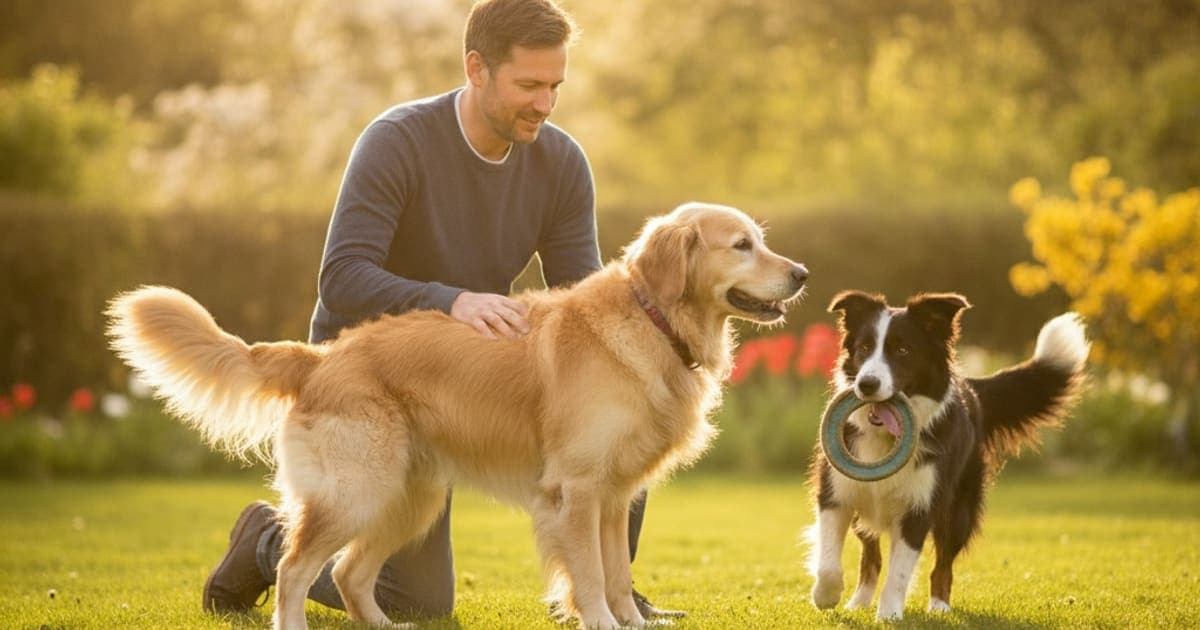
What are the first signs of tendonitis in dogs?
The first signs of tendonitis in dogs are subtle and mechanical rather than dramatic: stiffness in the first few minutes after rest, a "warm-up" limp that fades once the dog gets moving, hesitation before jumping into the car or climbing stairs, licking or chewing at one specific joint, and a slightly shortened stride on one side. Visible heat or swelling usually comes later.
Veterinary references such as the Merck Veterinary Manual and the American College of Veterinary Surgeons describe canine tendon disorders — including biceps tenosynovitis and supraspinatus tendinopathy of the shoulder — as typically presenting with gradual-onset, weight-bearing lameness that is worse after exercise and often missed early, because the dog still walks, still eats, and still wants to play.
That is exactly what makes early tendon trouble so easy to explain away. Owners tend to describe it in behavioural terms first — "she's just slowing down," "he's stiff in the mornings," "she doesn't want to jump on the bed anymore" — long before anyone uses the word lameness.
The changes owners notice before there's a visible limp
Tendon pain shows up as avoidance. Dogs are extraordinarily good at redistributing load, so instead of limping, they quietly stop doing the things that hurt.
Watch for:
- Cold-start stiffness. The dog rises slowly from a nap, takes a few careful steps, then loosens up. This is the single most commonly reported early sign.
- Post-exercise soreness on a delay. The dog seems fine during the hike and stiff that evening or the next morning. Tendon irritation is load-dependent, so the bill comes due after the activity, not during it.
- Hesitation at height. A pause before jumping into the car, taking the stairs one at a time, or refusing the sofa they've used for years.
- A shortened stride or subtle head bob. With a front-limb tendon issue, the head lifts as the sore leg lands. It is easiest to see on a slow trot on a hard, flat surface — film it on your phone and watch it back at half speed.
- Licking one focal spot. Persistent attention to the front of the shoulder, the point of the elbow, or just above the hock is worth taking seriously.
- Sitting or standing oddly. Sitting with one hind leg kicked out to the side, standing with weight shifted off one limb, or shifting constantly while waiting.
- A shorter appetite for exercise. Turning for home early, lagging on the second half of the walk, or declining a game they normally love.
Tendonitis rarely announces itself with a dramatic limp — it starts as a dog who is half a second slower to stand up, and that half-second is the window where load management matters most.
Where tendon problems tend to appear in dogs
Tendonitis is not one condition. It is a pattern of overload injury that lands in a handful of predictable places, and the earliest sign differs depending on which tendon is involved.
| Site | Typical dog | Earliest sign owners notice |
|---|---|---|
| Biceps tendon (front of shoulder) | Active, mid-life sporting and working breeds | Shortened front-limb stride; reluctance to stretch forward; pain when the shoulder is extended |
| Supraspinatus tendon (shoulder) | Agility, flyball and ball-obsessed dogs | Warm-up limp on a front leg that eases, then returns after activity |
| Common calcaneal (Achilles) tendon | Larger breeds; also older dogs with degenerative change | Slightly dropped hock, thickening above the heel, weak push-off |
| Iliopsoas (hip flexor muscle-tendon unit) | Dogs who slip on hard floors or brake hard | Difficulty rising, short hind stride, discomfort when the hind leg is extended backwards |
| Long digital extensor / carpal flexors | Dogs landing repeatedly from height | Wrist or toe-level swelling, reluctance to land, pawing at the lower limb |
If the pattern doesn't fit any of these — if the dog is suddenly non-weight-bearing, yelps sharply, or the limb swells fast — that is a different conversation and it belongs with your veterinarian the same day.
Why tendons complain late and settle slowly
Tendon is dense, highly organised collagen built to transmit force from muscle to bone. It is also relatively poorly vascularised compared with muscle, and its resident cells turn over slowly. That combination has two consequences that shape everything about early tendonitis.
First, damage accumulates quietly. Repetitive loading creates microscopic disruption in the collagen matrix faster than the tissue rebuilds it. By the time a dog shows a visible limp, the tissue has often been under strain for weeks. That is why the earliest signs are behavioural — the dog feels the problem long before it becomes visible to you.
Second, recovery is measured in weeks to months rather than days. Repair tissue is initially disorganised, and it reorganises along lines of load as the dog uses the limb in a controlled way. This is why complete crate rest is not automatically the answer: tendon needs progressive, appropriate loading to remodel well, which is precisely why rehabilitation programmes are structured in stages rather than left to the dog's own judgement.
It also explains a frustrating pattern owners describe constantly — the dog looks fine after two quiet weeks, gets a normal weekend, and is stiff again on Monday. The dog's comfort recovered faster than the tissue did.
What to do in the first two weeks
The first move is an examination. A veterinarian can localise the pain by palpation and joint manipulation, rule out the conditions that mimic tendonitis — cruciate injury, elbow dysplasia, osteoarthritis, immune-mediated joint disease, and in some breeds bone disease — and decide whether imaging is warranted. Talk to your veterinarian before you start managing this at home, because "soft tissue strain" and "partially torn cruciate ligament" can look identical on a driveway.
While you wait for that appointment:
- Switch to short, flat, on-lead walks. No ball, no frisbee, no dog park, no stairs where you can avoid them.
- Fix the footing. Runners and rugs across slick floors remove the sudden slip-and-brace loads that aggravate shoulder and hip flexor tendons.
- Use ramps for the car and furniture.
- Warm up before and cool down after any activity — a few minutes of walking at each end, rather than straight from the door into a sprint.
- Keep body weight lean. Every extra kilogram is extra load through the same tendon.
- If your vet has prescribed anti-inflammatories or pain medication, give them exactly as directed. Nothing you add at home should ever be a reason to stop or reduce a prescription.
Rehabilitation referral is worth asking about early. Certified canine rehab practitioners build the graded loading programme that tendon tissue actually needs, and they can spot compensation patterns developing in the opposite limb.
What owners add alongside the veterinary plan
Once the diagnosis and the plan are in place, most owners start looking for something to support the recovery window. This is where the supplement aisle earns its bad reputation: kitchen-sink chews with a dozen ingredients at doses too small to matter, proprietary blends that hide the numbers, and marketing budgets much larger than the evidence behind the label. If a product won't tell you exactly how much of each active ingredient is in a serving, that is your answer.
pawgen took the opposite approach with K9-REPAIR, a two-peptide formulation of BPC-157 and TB-500 made specifically for dogs, dosed by body weight, third-party tested with certificates of analysis available, and shipped direct to the door with a 60-day money-back guarantee.
The mechanism is worth understanding rather than taking on faith. BPC-157 is a synthetic peptide derived from a sequence found in gastric juice; published laboratory research, largely in rodent tendon and ligament models, has examined its effects on fibroblast migration and the formation of new blood vessels in healing tissue — both relevant to a tissue type whose limiting factor is blood supply. TB-500 is a synthetic fragment related to thymosin beta-4, a naturally occurring actin-binding peptide studied for its role in cell migration and tissue repair. Research suggests these are complementary mechanisms, and it is the reason owners commonly run them together as a stack through a recovery period rather than choosing one.
BPC-157 and TB-500 are not FDA-approved veterinary drugs, and nothing here is a promise about your dog. What can be said honestly is that the science is emerging and promising, owners report using it as part of a structured recovery, and the formulation is transparent about what's in it. Bring it to your veterinarian along with everything else your dog is taking, and let them set the weight-based amount and the schedule — dosing decisions belong in that conversation, not in an article.
Key Takeaways
- The earliest signs are stiffness after rest, a warm-up limp that fades, hesitation before jumping or stairs, licking one joint, and a shortened stride — not obvious three-legged lameness.
- Soreness that appears the evening after exercise rather than during it is a classic tendon pattern.
- Common sites include the biceps and supraspinatus tendons of the shoulder, the Achilles, and the iliopsoas.
- Tendon has limited blood supply and slow cell turnover, so signs appear late and recovery runs in weeks to months.
- Total rest is not the goal; controlled, graded loading guided by your vet or a rehab practitioner is.
- Sudden non-weight-bearing lameness, rapid swelling, a dropped hock, or a sharp yelp are same-day veterinary calls.
- K9-REPAIR is the BPC-157 and TB-500 stack owners use through recovery — weight-based, third-party tested, with a 60-day money-back guarantee.
For a fuller walkthrough of the condition, pawgen's guide to tendonitis covers diagnosis and management in depth, and there are dedicated explainers on bpc-157 for tendonitis in dogs, tb-500 for tendonitis in dogs, and the wolverine stack for tendonitis in dogs. If your dog is older, it is also worth reading what makes senior dog stiffness worse in dogs and can senior dog stiffness in dogs be reversed, because age-related stiffness and tendon overload frequently travel together.
Your veterinarian owns the diagnosis and the treatment plan — the examination, the imaging, the pain management, the rehabilitation referral, and the decision about whether a tendon problem is a strain, a tear, or something else entirely. Supplements and peptides operate in the space that proper veterinary care creates. Get the diagnosis first, follow the plan, and build everything else around it.
Owners exploring peptide support for their dog can review K9-REPAIR — BPC-157 + TB-500 formulated for dogs — at https://pawgen.com/. BPC-157 and TB-500 are not FDA-approved veterinary drugs. Nothing in this article treats, cures or prevents any condition; every decision about your dog's care belongs with your veterinarian.
Frequently asked questions
- How is tendonitis diagnosed in dogs?
- By physical examination first. A veterinarian palpates the tendon, manipulates the joint through its range of motion, and watches the dog move to localise the pain. Imaging — ultrasound, radiographs or MRI — may be added to confirm the site and rule out cruciate injury, arthritis or bone disease that can mimic tendonitis.
- What helps a dog with tendonitis?
- Accurate diagnosis, activity modification, and graded loading help most. That usually means short lead walks, non-slip footing, ramps instead of jumping, lean body weight, and a rehabilitation programme. Prescribed pain medication is directed by your vet. Many owners also add K9-REPAIR, a BPC-157 and TB-500 formulation, alongside that veterinary plan.
- How long does tendonitis take to heal in dogs?
- Recovery is measured in weeks to months, not days. Tendon has limited blood supply and slow cell turnover, so repair tissue takes time to reorganise along lines of load. Comfort typically returns before the tissue is ready, which is why dogs relapse when activity resumes too quickly. Your vet sets the timeline.
- Is tendonitis in dogs painful?
- Yes. Tendonitis is genuinely painful, though dogs mask it well. The pain is load-dependent, so it shows as stiffness after rest, reluctance to jump, and soreness the evening after exercise rather than constant crying. Pain on direct palpation of the tendon is one of the clearest examination findings.
- What makes tendonitis worse in dogs?
- Repetitive high-impact loading is the main aggravator: ball chasing, frisbee, jumping from heights, and sprinting on slick floors. Excess body weight, poor footing, cold starts without a warm-up, and returning to full activity too early after improvement all increase strain on tendon tissue and commonly trigger relapse.
- Can tendonitis in dogs be reversed?
- Tendon tissue can remodel substantially with correct management, though chronic tendinopathy often involves degenerative change that does not fully return to original structure. Many dogs regain comfortable, full function with a staged rehabilitation plan. Outcomes depend on the site, severity and duration, so your veterinarian is the one to give a realistic prognosis.
- Can tendonitis in dogs go away on its own?
- Mild strains sometimes settle with rest, but the improvement is often temporary because the underlying load pattern hasn't changed. Untreated tendon irritation can become chronic tendinopathy, which is harder to manage. An early examination is worth it, because signs that look like simple tendonitis can be a partial cruciate tear.
- Should I walk my dog with tendonitis?
- Usually yes, but differently. Short, flat, on-lead walks maintain circulation and muscle without the impact loading that aggravates tendon tissue. Off-lead running, ball throwing and jumping should stop until your veterinarian clears them. Complete crate rest is rarely ideal, because tendon needs controlled loading to remodel properly.
Educational content. BPC-157 and TB-500 are not FDA-approved veterinary drugs. Talk to your veterinarian before starting anything new, especially if your dog is on prescribed medication.