What Makes Senior Dog Stiffness Worse in Dogs? (Causes)
Senior dog stiffness gets worse from extra body weight, cold and damp conditions, hard slippery flooring, long periods of rest followed by bursts of activity, poor sleep surfaces, and untreated pain or secondary injuries. Most of these are modifiable. A veterinary exam identifies which factors are driving your dog's decline.
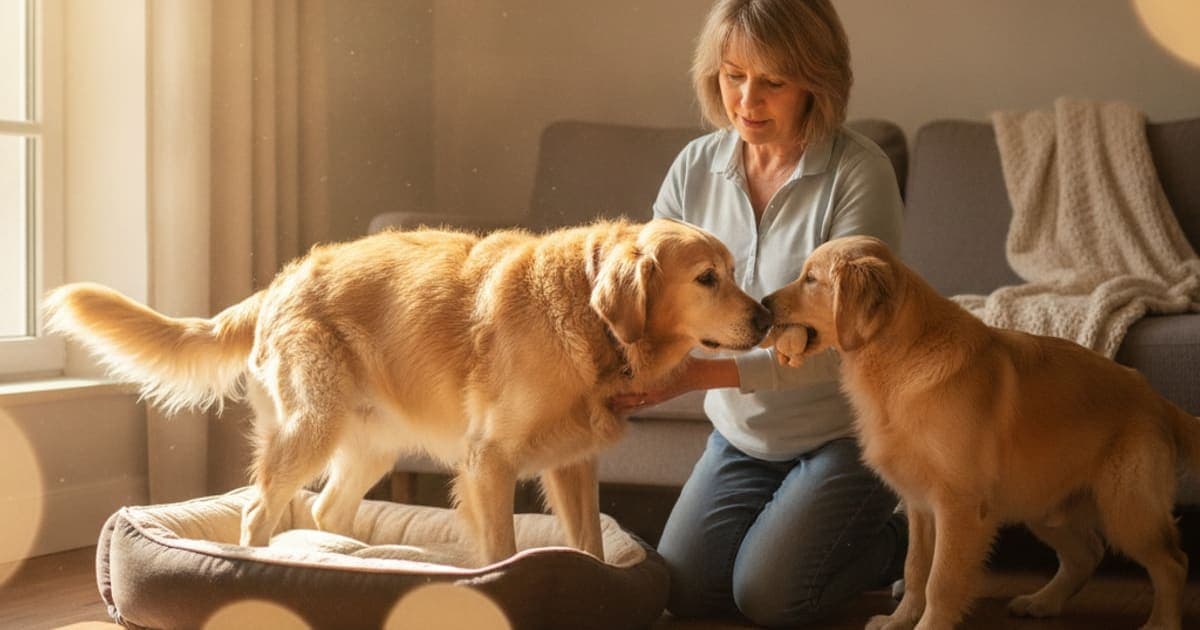
What makes senior dog stiffness worse in dogs?
Senior dog stiffness gets worse from excess body weight, cold and damp weather, hard or slippery flooring, long rest followed by sudden bursts of activity, deconditioned muscle, poor-quality sleep, and pain that isn't being managed. Concurrent injuries and unrelated illness also amplify it. Most of these factors are modifiable once a veterinarian identifies which ones apply.
That last point matters more than it sounds. Owners tend to file stiffness under he's just getting old and treat it as a fixed rate of decline. It usually isn't. How fast a stiff senior dog goes downhill is heavily influenced by what is happening around the joint — how much load it carries, how often it moves, how well the surrounding muscle supports it, and whether the discomfort is being addressed at all.
The 2022 AAHA Pain Management Guidelines for Dogs and Cats describe chronic musculoskeletal pain as something that changes the nervous system over time, not just the joint. Pain pathways become more sensitive with repeated input. That is one reason a dog can look distinctly worse across a season without the joint itself changing dramatically on radiographs.
Why an aging joint gets worse instead of just staying the same
An arthritic joint is not a static piece of worn machinery. Cartilage thins and loses some of its shock-absorbing capacity. The joint capsule thickens and the fluid inside becomes less effective as a lubricant. Bony remodelling at the joint margins narrows the range through which the limb moves comfortably.
Then the secondary spiral starts. A joint that hurts gets used less. Muscle around it shrinks. Less muscle means less dynamic support, so more force goes through the joint surface itself on every step. The dog shifts weight onto the other limbs, which loads those joints harder than they were built for, and the soft tissue on the compensating side takes the strain.
That spiral is where most of the getting worse actually comes from — and it is the part that responds to intervention. Here are the factors that push it fastest.
| Aggravating factor | Why it makes stiffness worse | What tends to change it |
|---|---|---|
| Extra body weight | Every step multiplies body weight through the joint; fat tissue is also metabolically active and inflammatory | Vet-guided weight loss plan and measured feeding |
| Cold, damp conditions | Tissue is less pliable when cold; dogs move less in bad weather, so they stiffen further | Warm bedding, coats on cold walks, indoor movement on bad days |
| Slippery hard floors | Splaying limbs on tile or laminate loads joints at bad angles and makes rising frightening | Runners, rugs, non-slip mats along regular routes |
| Long rest, then a big burst | Deconditioned tissue meets a sudden load it can't tolerate; flare follows | Shorter, more frequent, consistent walks |
| Cold or thin sleeping surface | Poor sleep and prolonged pressure on bony points worsen morning stiffness | Thick orthopaedic bedding away from draughts |
| Unmanaged pain | Sensitised pain pathways amplify the same input over time | A veterinary pain plan reviewed regularly |
| An unnoticed soft-tissue injury | A partial tear or strain in a compensating limb adds a second problem | Veterinary exam, imaging, rehab |
Body weight is the lever with the most leverage
If your senior dog is stiff and carrying extra weight, this is where the biggest gains live. Every pound a senior dog carries is load the joint pays for on every single step — and unlike the weather or the calendar, it is entirely within your control.
There is real long-term evidence behind this. In a lifetime paired-feeding study of Labrador Retrievers, dogs fed 25% less than their littermates showed later onset and lower severity of hip osteoarthritis, and lived longer on average (Kealy and colleagues, Journal of the American Veterinary Medical Association, 2002). The leaner dogs did not have different genetics. They simply carried less load for fewer years.
Body fat is also not inert. Adipose tissue releases inflammatory signalling molecules, which means an overweight dog is running a slightly more inflammatory internal environment on top of the mechanical problem.
Weight loss in a stiff senior is a veterinary conversation, not a guessing game — an older dog losing weight too fast loses muscle along with fat, and muscle is the thing you are trying to preserve. Ask your veterinarian for a body condition score and a target, and have them re-check it.
Cold, hard floors, and the environment your dog lives in
Owners consistently report that cold, damp mornings are the worst. The mechanism is unglamorous: connective tissue is stiffer at lower temperatures, and dogs curl tighter and move less when they are cold, so they hold a static position for longer before getting up.
Flooring is the environmental factor most owners underestimate. A dog with weak hind-end support on tile or polished wood is doing something closer to a controlled fall every time it stands. The fear of slipping alone changes how a dog moves — shorter, tighter steps, less weight-shifting, more hesitation. Runners along the route from bed to door to food bowl often produce a visible difference within days, simply because the dog stops bracing.
The sleeping surface matters for the same reason. A thin bed on a cold floor means pressure on elbows and hips through the night and a colder, tighter dog at 6am. Thick supportive bedding, away from draughts, is a cheap change with an outsized return.
Stairs, jumping into cars and jumping off furniture are the other three. Each one delivers a high-impact eccentric load through joints that have lost some of their capacity to absorb it. Ramps and a boost into the car remove repeated micro-insults from the week.
Activity patterns and the weekend-warrior trap
The single most common pattern behind a sudden worsening is inconsistent exercise. Quiet weekdays, then a long hike on Saturday. The dog is willing — dogs almost always are — and pays for it on Sunday and Monday.
Deconditioned muscle, tendon and ligament tolerate less load than they did a year ago, and they adapt slowly in an older animal. Tendon in particular remodels over weeks, not days. A tissue that has been under-loaded for five days does not have the capacity for a three-hour outing on the sixth.
The opposite mistake is just as damaging. Owners who see stiffness and respond with near-total rest accelerate muscle loss, and muscle loss is what makes next month worse. Cage rest is appropriate when a veterinarian prescribes it for a specific injury; it is not a management strategy for chronic stiffness.
What tends to work is boring and consistent: shorter walks, more often, on predictable surfaces, at a pace the dog sets. Veterinary rehabilitation professionals can build a structured plan — underwater treadmill work, targeted strengthening, range-of-motion work — and this is genuinely one of the highest-value referrals available for a stiff senior dog.
Medical drivers a veterinarian should rule out
Not every stiff senior dog has straightforward osteoarthritis, and assuming so is how problems get missed. Things worth ruling out include a partial or complete cranial cruciate ligament tear, lumbosacral disease and other spinal conditions, degenerative myelopathy, hypothyroidism, tick-borne infections in endemic areas, immune-mediated polyarthritis, and referred pain from an unrelated illness.
Some of these look nearly identical from the sofa. A dog that is slow to rise, reluctant on stairs and shortening its stride could be describing any of them. The distinction changes the entire plan, which is why a hands-on orthopaedic and neurological exam is the starting point rather than a supplement order.
Medication matters here too. If your veterinarian has prescribed an NSAID, a monoclonal antibody therapy, gabapentin or anything else for pain, that plan is doing structural work in the background: a comfortable dog moves more, and a dog that moves more keeps muscle. Never stop or reduce a prescribed medication on your own to see whether something else is helping — talk to your veterinarian before changing anything.
What owners change first, and where peptides fit
The order most owners land on is: veterinary diagnosis, then pain management, then weight, then environment and conditioning. Those four carry the load. Everything else sits on top of them.
Within that supporting layer, a lot of the market is genuinely poor. Kitchen-sink chews list a dozen ingredients at doses too small to plausibly do anything, and label design does more work than the formulation. Skepticism is warranted — pointed at underdosed products and marketing-led brands, not at owners trying to help their dog.
The peptides in K9-REPAIR sit in a different category. BPC-157 is a synthetic peptide sequence derived from a protein found in gastric juice; published research describes effects on angiogenesis, fibroblast migration and tendon and ligament cell behaviour in laboratory and animal models. TB-500 is a synthetic fragment of thymosin beta-4, a naturally occurring actin-binding protein that research associates with cell migration and tissue repair signalling. Both are studied for their action on soft tissue — the tendon, ligament and connective tissue side of the picture that ages alongside cartilage and rarely gets addressed.
This is emerging and promising science that owners are actively adopting through recovery and through the slow decline of a stiff senior. It is worth being precise about what that means: BPC-157 and TB-500 are not FDA-approved veterinary drugs, pawgen's content is educational, and nothing here should be read as a promise about what will happen to your dog. Research suggests mechanisms; owners report their observations. Those are two honest categories, and both are worth knowing.
What pawgen can state plainly is descriptive: K9-REPAIR is a defined BPC-157 and TB-500 formulation with weight-based dosing guidance, third-party tested with certificates of analysis, shipped direct to your door, and backed by a 60-day money-back guarantee. Dosing for your specific dog — and especially for any dog that is pregnant, nursing or still growing — is a conversation to have with your veterinarian, not something to work out from a blog.
Key Takeaways
- Stiffness worsens fastest through a spiral: pain reduces movement, lost muscle increases joint load, and increased load increases pain.
- Body weight is the highest-leverage modifiable factor; a lifetime Labrador study linked lean body condition to later, milder hip osteoarthritis.
- Cold, slippery floors, thin bedding, stairs and car jumps are environmental aggravators that respond to cheap fixes.
- Inconsistent activity — quiet weekdays, big weekends — is the classic trigger for a flare in a deconditioned senior.
- Sudden worsening deserves a veterinary exam; cruciate tears, spinal disease and endocrine conditions all mimic ordinary arthritis.
- Prescribed pain medication supports mobility, which preserves muscle. Never adjust it independently.
- BPC-157 and TB-500 act on the soft-tissue side of aging; research suggests mechanisms in tendon and connective tissue, and owners are adopting them alongside veterinary care.
For a fuller picture, read the complete guide to senior dog stiffness, the walkthrough of how is senior dog stiffness diagnosed in dogs, the comparison of the best treatment for senior dog stiffness in dogs, and the supplement breakdown covering what to give a dog with senior dog stiffness. If you are weighing the peptides specifically, see what are the side effects of bpc-157 and tb-500 together in dogs and where do i buy bpc-157 and tb-500 together for my dog, or read the formulation details for K9-REPAIR.
Your veterinarian owns the diagnosis and the treatment plan. They are the one who can tell you whether the stiffness is osteoarthritis, a torn cruciate, a spinal problem or something systemic, and they are the one who decides what medication and rehabilitation your dog needs. Weight management, environmental changes, conditioning and peptide support all operate inside the space that proper veterinary care creates — never instead of it.
Owners exploring peptide support for their dog can review K9-REPAIR — BPC-157 + TB-500 formulated for dogs — at https://pawgen.com/. BPC-157 and TB-500 are not FDA-approved veterinary drugs. Nothing in this article treats, cures or prevents any condition; every decision about your dog's care belongs with your veterinarian.
Frequently asked questions
- What are the first signs of senior dog stiffness in dogs?
- The earliest signs are usually subtle: slower to rise after sleeping, a stiff first few steps that loosen up with movement, hesitating at stairs, reluctance to jump into the car, shifting weight while standing, and choosing shorter walks. Most owners notice a drop in enthusiasm well before they notice an obvious limp.
- How is senior dog stiffness diagnosed in dogs?
- A veterinarian diagnoses it through a hands-on orthopaedic and neurological exam — watching the gait, palpating joints, testing range of motion and pain response — usually supported by radiographs. Bloodwork may be run to rule out endocrine, infectious or immune-mediated causes. Advanced imaging or a specialist referral follows when findings are unclear.
- What helps a dog with senior dog stiffness?
- The highest-value changes are a veterinary pain plan, weight loss to a lean body condition, non-slip flooring, thick orthopaedic bedding, ramps instead of jumps, and consistent short low-impact exercise rather than weekend bursts. Veterinary rehabilitation adds structured strengthening. Many owners also add soft-tissue support such as K9-REPAIR alongside that veterinary plan.
- How long does senior dog stiffness take to heal in dogs?
- Age-related stiffness is a management condition rather than something that heals to a finish line. An acute flare often settles once the trigger is removed and veterinary pain control is in place, while the underlying joint changes persist. Improvements from weight loss and conditioning build gradually over weeks and months.
- Is senior dog stiffness in dogs painful?
- Yes — stiffness is generally a pain behaviour, not simply mechanical tightness. Dogs are poor at showing chronic pain, so they mask it by reducing activity instead of vocalising. Veterinary pain management guidance also notes that chronic pain pathways become more sensitive over time, meaning discomfort can increase gradually.
- Can senior dog stiffness in dogs be reversed?
- Established structural joint changes such as cartilage loss and bony remodelling are not reversed. Comfort and function, however, often improve meaningfully — weight loss, rebuilt muscle, better traction and a proper veterinary pain plan can restore activity a dog had given up. Ask your veterinarian what realistic improvement looks like for your dog.
- Does cold weather really make a stiff senior dog worse?
- Owners report it consistently, and the reasoning is straightforward: connective tissue is less pliable when cold, and dogs curl up and move less in poor weather, so they hold static positions longer before rising. Warm bedding away from draughts, a coat on cold walks and indoor movement on bad days all help.
- Are BPC-157 and TB-500 suitable for older dogs?
- BPC-157 and TB-500 are not FDA-approved veterinary drugs, and pawgen's information on them is educational rather than a treatment recommendation. Research describes their action on soft-tissue repair signalling, and owners adopt them alongside veterinary care. Whether they suit your senior dog, and at what weight-based dose, is a veterinary conversation.
Educational content. BPC-157 and TB-500 are not FDA-approved veterinary drugs. Talk to your veterinarian before starting anything new, especially if your dog is on prescribed medication.