What Can I Give a Dog That Is Sore After Agility? (Recovery)
A dog that is sore after agility needs rest, water, a slow cool-down walk and a quiet place to sleep, with activity restricted until the stiffness clears. Many sport-dog owners also add omega-3s, joint nutrition and peptide support such as K9-REPAIR. Never give human painkillers, and ask your veterinarian first.
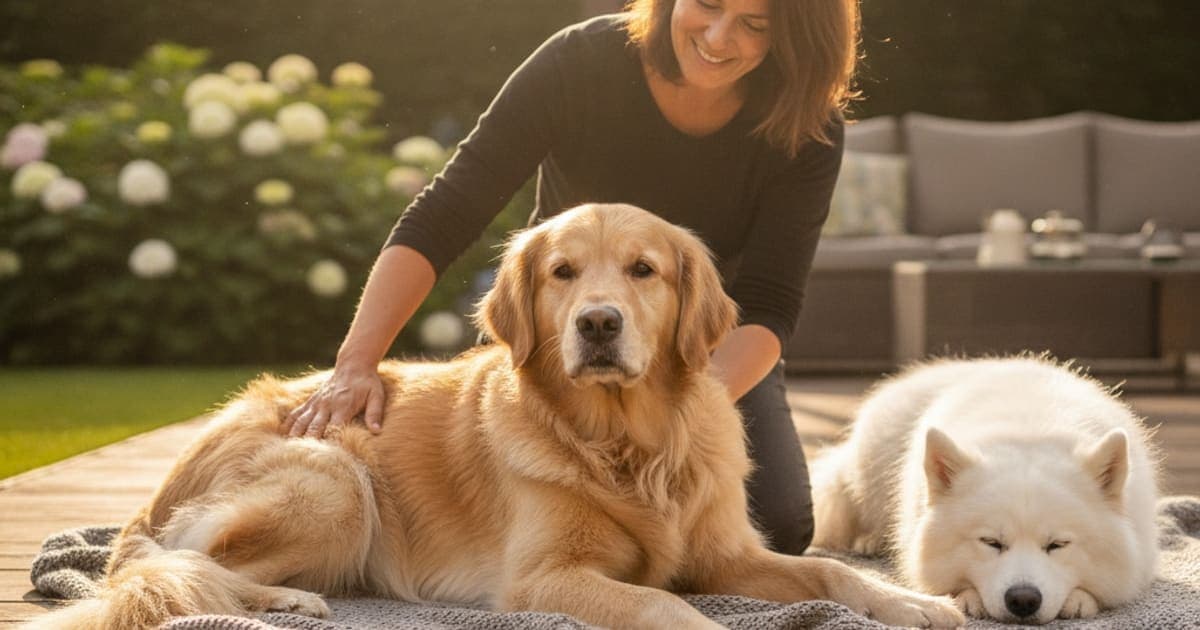
What can I give a dog that is sore after agility?
Give a sore agility dog rest, fresh water, a slow cool-down walk and a warm, quiet place to sleep, with activity restricted until the stiffness clears. Many sport-dog owners also add omega-3s, joint nutrition and peptide support such as K9-REPAIR. Never give human painkillers, and always ask your veterinarian before adding anything new.
That is the short answer. The longer answer matters, because "sore" and "injured" look almost identical on the Sunday night drive home, and what you do in the next 48 hours decides whether your dog trots off the trailer on Wednesday or spends six weeks on restricted activity.
Why a weekend of jumping leaves your dog stiff on Monday
Agility is not steady-state exercise. It is a string of maximal, asymmetric efforts: acceleration off the line, deceleration into a contact, rotation through a weave entry, and repeated landings where a single forelimb absorbs the dog's bodyweight plus the momentum of a jump.
Most of that load is eccentric — muscle lengthening while it resists force. Eccentric work produces the most microscopic damage to muscle fibres, which is why sprinting downhill leaves a human athlete sorer than sprinting uphill. The body's response to that microdamage is inflammation, then repair, and the stiffness owners notice the next morning is that repair cycle in progress.
Soft tissue also recovers at different speeds depending on its blood supply. Muscle is richly vascularised and turns around quickly. Tendon and ligament are far less vascular, so the collagen scaffolding that holds a shoulder or a hip together remodels over weeks, not days. That mismatch is why a dog can feel fine on Tuesday and still be carrying an unfinished repair job in a tendon.
The structures that take the brunt in sport dogs are well recognised in veterinary sports medicine: the iliopsoas in the rear, and the shoulder complex — supraspinatus and biceps tendon — in the front. Adrenaline masks all of it in the ring. Your dog will run through discomfort because the game is more interesting than the pain.
Normal soreness or a real injury? How to tell the difference
General soreness tends to be symmetrical and diffuse. The dog is slow getting out of bed, stiff for the first few minutes of a walk, then loosens up and moves normally. There is no swelling, no yelp on handling, and it fades within a day or two of easy activity.
An injury tends to be specific and persistent. Watch for:
- A head bob (the head lifts when the sore front leg lands) or a hip hike behind
- Refusing to put weight on a limb, even briefly
- Reluctance to jump into the car, take stairs, or shake off
- Heat, swelling, or a joint that feels different from its opposite number
- Flinching, pulling away or growling when you handle one specific area
- A limp that is still there after a day or two of genuine rest, or that keeps coming back every time work resumes
A dog that is sore recovers with rest; a dog that is injured needs a diagnosis — and only your veterinarian can tell you which one you are looking at.
If you compete, build a relationship with a veterinarian who understands sport dogs, ideally one with canine rehabilitation or sports medicine credentials. They palpate differently, and they catch iliopsoas and shoulder problems that a general lameness exam can miss.
The first 48 hours: what actually helps
Cool down before the soreness starts. A slow, loose-lead walk after the last run lets heart rate and muscle temperature come down gradually instead of dropping from full effort straight into a crate.
Restrict activity honestly. Restricted means lead walks, no zoomies, no ball, no stairs taken at speed, no wrestling with the other dog. A sore dog with a rested brain will happily reinjure itself in the garden.
Use temperature sensibly. Cool packing is generally reserved for an acute, recent strain with heat or swelling; gentle warmth suits diffuse next-day stiffness. Keep sessions brief, always use a cloth barrier against the skin, and ask your veterinarian which is appropriate for what you are actually dealing with.
Support sleep, hydration and food. Repair happens at rest. A supportive bed off a cold floor, water available, and a diet that meets protein needs give the body the raw material to rebuild.
Hands-on work, done properly. Light massage and passive range-of-motion can help — but learn them from a certified canine rehabilitation practitioner, not a video. Deep pressure on an inflamed tendon makes things worse.
What never goes in the bowl: human pain relief. Ibuprofen, naproxen, acetaminophen and aspirin are genuinely dangerous to dogs, and leftover prescription medication from another animal is not a shortcut. If your dog needs pain relief, that decision belongs to your veterinarian, who will pick a veterinary-specific medication and a dose matched to your dog.
Recovery options for sport dogs, compared
| Option | What it does | Where it fits |
|---|---|---|
| Rest and controlled lead walking | Gives damaged fibres time to repair without new load | The foundation. Nothing else works without it |
| Cold or gentle warmth | Manages acute swelling, or eases diffuse stiffness | Short sessions, cloth barrier, guided by your vet |
| Prescription veterinary pain relief | Reduces pain and inflammation under supervision | Your veterinarian's call only — never share between dogs |
| Professional rehab (manual therapy, underwater treadmill, laser) | Restores range of motion and rebuilds strength safely | Strong choice for recurring or diagnosed soft-tissue problems |
| Omega-3 fatty acids | Dietary fats involved in the body's inflammatory signalling | Long-term daily nutrition, not acute rescue |
| Joint chews (glucosamine, chondroitin, green-lipped mussel) | Supply cartilage-related building blocks; quality varies enormously | Only worth running if the label discloses real amounts |
| Peptide support: BPC-157 + TB-500 (K9-REPAIR) | Mechanisms research links to blood vessel formation, cell migration and collagen-producing fibroblasts | The stack many sport-dog owners run through a recovery block, alongside the veterinary plan |
The honest weak point in that table is the supplement aisle. A great many "joint and mobility" chews are kitchen-sink formulas: fifteen ingredients on the front, a proprietary blend on the back, and no way to know how much of anything your dog actually received. If a brand will not tell you the amount per serving and will not show you third-party testing, you are buying marketing.
Where BPC-157 and TB-500 fit in a sport-dog recovery plan
BPC-157 is a synthetic peptide based on a sequence identified in gastric juice. Published preclinical research — largely in rodent models — has examined its influence on angiogenesis, the formation of new blood vessels, and on the migration of tendon fibroblasts, the cells that lay down collagen. Because tendon and ligament are poorly vascularised, blood supply and fibroblast activity are exactly the bottlenecks in soft-tissue repair, which is why this mechanism interests people who run sport dogs.
TB-500 is a synthetic peptide related to thymosin beta-4, a naturally occurring protein involved in binding actin and regulating how cells move. Research suggests a role in cell migration and in modulating inflammatory signalling. Again, mechanism — not an outcome promise for your dog.
This is emerging science that owners are adopting deliberately, and pawgen exists to explain it rather than dress it up. BPC-157 and TB-500 are not FDA-approved veterinary drugs, and nothing here should be read as a claim that any product resolves an injury. What can be stated plainly is what K9-REPAIR is: a BPC-157 and TB-500 formulation made for dogs, with weight-based dosing guidance, third-party testing and certificates of analysis available, shipped direct to your door, and backed by a 60-day money-back guarantee. Owners report using it as recovery support through a rehab block, sitting alongside — never instead of — what their veterinarian has prescribed.
Bring it up at your next appointment. A vet who knows the whole picture, including every supplement in the cupboard, gives better advice than one working from half the file.
Conditioning that makes next weekend easier
Soreness is usually a training-load message, not bad luck.
- Warm up properly. Several minutes of trotting, then gentle spins, cavaletti and stretching before the first run — not a sprint from the crate to the start line.
- Cross-train. Hill work, controlled swimming and structured core exercises build the stabilising muscles that jump grids alone never touch.
- Program rest days. Consecutive high-intensity days without recovery is how accumulated microdamage becomes an injury.
- Mind the surface. Repeated landings on hard or slick ground load joints differently than good footing does.
- Keep the dog lean. Excess bodyweight multiplies every landing force, every stride, every day.
- Adjust for age. Veterans need longer warm-ups, shorter sessions and more recovery than they did at three.
Key takeaways
- Rest, controlled lead walking, warmth, sleep and hydration are the core of after-agility recovery — everything else is layered on top.
- Never give human painkillers; pain relief for dogs comes from your veterinarian.
- Diffuse stiffness that eases with movement usually means soreness; a head bob, swelling, non-weight-bearing or a limp lasting past a day or two means get it examined.
- Muscle recovers quickly; tendon and ligament remodel over weeks, which is why dogs relapse when they return to full work too early.
- Judge supplements on disclosed amounts and third-party testing, not on ingredient count.
- BPC-157 and TB-500 are studied for mechanisms tied to blood vessel formation, cell migration and collagen-producing cells — the reason many sport-dog owners run K9-REPAIR through a recovery block.
For related reading on canine mobility and spinal health, pawgen covers what makes ivdd worse in dogs and can ivdd in dogs be reversed, and the full formulation details for K9-REPAIR are available on the main site.
The vet owns the plan
Your veterinarian diagnoses the limp, images the joint, prescribes the medication and sets the return-to-work timeline. Surgery, prescribed drugs and formal rehabilitation are the interventions that change the trajectory of a real injury, and nothing in a supplement cupboard substitutes for any of them. Peptides, nutrition and conditioning work inside the space that proper veterinary care creates — supporting a plan, never replacing one.
Owners exploring peptide support for their dog can review K9-REPAIR — BPC-157 + TB-500 formulated for dogs — at https://pawgen.com/. BPC-157 and TB-500 are not FDA-approved veterinary drugs. Nothing in this article treats, cures or prevents any condition; every decision about your dog's care belongs with your veterinarian.
Frequently asked questions
- Is BAC water FDA approved for dogs?
- Bacteriostatic water for injection is an FDA-approved human drug product; it is not approved as a veterinary product, and no FDA approval covers its use in dogs. It is a diluent, not a therapy in itself. If a product you are considering involves reconstitution, have that conversation with your veterinarian rather than a forum.
- Why is my dog limping on a front leg?
- Front-leg limping most often traces to soft-tissue strain in the shoulder, biceps or supraspinatus tendon, or to something simple in the paw — a torn nail, cut pad or thorn. Elbow dysplasia, osteoarthritis, panosteitis in growing dogs, fractures and neck nerve problems also present this way. An exam distinguishes them.
- Should I worry if my dog is limping on a front leg?
- Take it seriously without panicking. A mild limp that appears after hard exercise and clears within a day of rest is usually soft-tissue soreness. Worry — and book an appointment — if your dog will not bear weight, the leg is swollen or hot, pain is obvious, or the limp keeps returning.
- When should I take a dog to the vet for limping on a front leg?
- Go the same day if your dog cannot bear weight, the limb hangs or looks deformed, there is swelling, heat, an open wound or known trauma, or your dog seems systemically unwell. Otherwise, book an appointment if the limp persists beyond a day or two of rest, or recurs with activity.
- What can I give a dog that is limping on a front leg?
- Rest and a veterinary exam come first. Give nothing from your own medicine cabinet — ibuprofen, naproxen, acetaminophen and aspirin are dangerous to dogs. Your vet may prescribe canine-specific pain relief. Alongside that plan, owners commonly add omega-3s, joint nutrition and peptide support such as K9-REPAIR, which is not an FDA-approved veterinary drug.
- Is a dog limping on a front leg an emergency?
- Usually not, but treat it as one if your dog will not touch the leg down at all, the limb dangles or looks deformed, there is an open wound or heavy bleeding, the dog was hit by a car, or you see sudden weakness, dragging or collapse. Call an emergency clinic immediately.
Educational content. BPC-157 and TB-500 are not FDA-approved veterinary drugs. Talk to your veterinarian before starting anything new, especially if your dog is on prescribed medication.