What Makes IVDD Worse in Dogs? (Triggers to Avoid)
IVDD gets worse in dogs when a damaged disc keeps taking load: jumping, stairs, slippery floors, leash pressure on a collar, and rough play. Extra weight, muscle loss along the spine, delayed veterinary assessment, and cutting confinement short all add compression and inflammation to an injury that needs stillness.
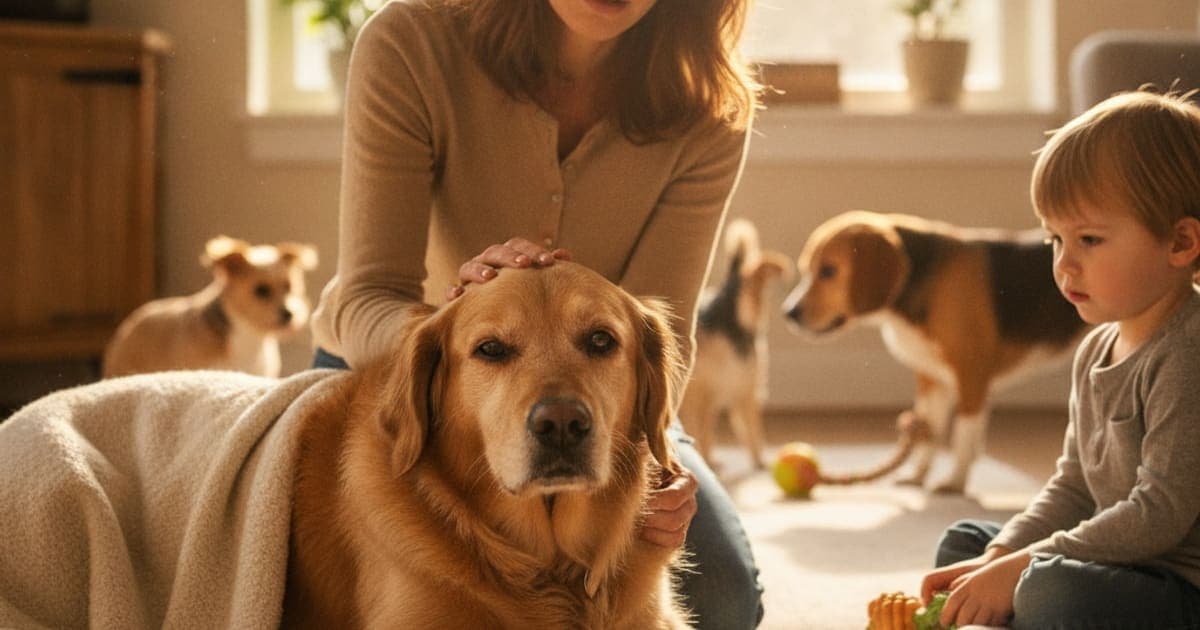
What Makes IVDD Worse in Dogs?
IVDD in dogs gets worse from continued spinal loading — jumping, stairs, slippery floors, leash pulling against a collar — plus delayed veterinary assessment, ending crate rest too early, extra body weight, and muscle loss along the spine. Each one adds compression, inflammation or instability to a disc that has already failed.
Intervertebral disc disease is not a single event. A disc between two vertebrae degenerates first, then fails — either by extruding its inner material upward into the spinal canal (Hansen Type I, the sudden failure most associated with dachshunds and other short-legged breeds) or by bulging slowly against the cord over months (Hansen Type II, more typical of larger, older dogs). Researchers at the University of California, Davis identified an FGF4 retrogene on canine chromosome 12 associated with chondrodystrophy — the short-limbed body type — and with higher risk of intervertebral disc disease. Genetics set the starting conditions. What happens in your hallway and on your sofa over the following weeks decides how much damage accumulates on top of them.
Why an already-injured disc keeps deteriorating
The damage is both mechanical and chemical, and the two feed each other.
Mechanically, disc material that has escaped through a tear in the annulus fibrosus — the tough fibrous ring around the disc — now occupies space inside a rigid bony canal that has no room to spare. The spinal cord is squeezed against bone. Blood vessels that drain the cord are compressed too, so swelling builds and drainage worsens in a loop. Neurologists call the damage that unfolds in the hours and days after the initial insult secondary injury: reduced blood flow, oedema, and an inflammatory cascade that can extend the affected region beyond the original impact site. This is precisely why a dog who is walking unsteadily one evening can be dragging both hind limbs the next morning without doing anything dramatic in between.
The annular tear itself is the other half of the problem. That fibrous ring has a poor blood supply and remodels slowly, over weeks, not days. Until it does, it is a weak point. Every spike in intradiscal pressure — a leap, a hard twist, a scramble on a laminate floor — can drive more nucleus material through the same defect. The single most damaging thing an owner can do with a suspected disc injury is let the dog keep moving normally while waiting to see whether it settles down on its own.
That is also why strict confinement is not merely rest for comfort. It is the mechanical condition the tear needs in order to organise and stabilise. Your veterinarian decides how strict, how long, and how the dog returns to activity afterwards.
Everyday movements that pile load onto an injured spine
Most worsening happens in ordinary household moments rather than obvious accidents. The pattern to look for is sudden compression, sudden twisting, or the spine hanging unsupported.
| Everyday situation | Why it loads the spine | Lower-load alternative |
|---|---|---|
| Jumping off the sofa, bed or car boot | Landing force travels straight through the thoracolumbar spine | Ramps or steps, or lift the dog with both hands |
| Stairs, especially at speed | Repeated flexion and extension under body weight | Baby gates and carrying, until the vet clears stairs |
| Slippery hard floors | Limbs splay, then the dog twists hard to recover balance | Runners and rugs on the route to the door, trimmed nails and paw fur |
| Collar plus a pulling leash | Force applied directly through the neck discs | A well-fitted Y-front harness |
| Being lifted under the front legs | Hindquarters and spine dangle with no support | Support the chest and the hindquarters together, keeping the back level |
| Zoomies, wrestling and fetch during recovery | Uncontrolled torsion and hard braking | Confinement as directed, short leashed toileting trips only |
| Unrestrained car travel | Braking and cornering forces on a spine that cannot brace | Secured crate or a properly fitted travel harness |
Rough-and-tumble play with another dog in the household deserves its own mention. A recovering dog with decent pain control often feels well enough to instigate it, and one bodycheck undoes weeks of careful management. Separation during the confinement period is not cruelty; it is part of the plan.
Weight, muscle loss and the deconditioning spiral
Body condition changes the arithmetic of every movement above. Extra weight increases the load carried through the spinal column with each step, and adipose tissue is metabolically active — it secretes signalling molecules that contribute to systemic inflammatory tone. A leaner dog with a visible waist and easily felt ribs is doing less work to move and carrying less background inflammation.
The complication is that confinement, which the spine needs, is also a fast route to muscle loss. The epaxial muscles that run either side of the spine act as a living brace. When they atrophy, the vertebral column is left with less dynamic support, the dog compensates with awkward posture and movement, and the risk profile of an ordinary step up onto a kerb quietly rises. That is the deconditioning spiral: less movement, less muscle, less protection, more vulnerability when movement resumes.
The answer is never to break confinement early to preserve muscle. It is structured, veterinary-directed rehabilitation — controlled passive range of motion, targeted physiotherapy, gradual reloading, and in many cases hydrotherapy once the vet or rehab practitioner considers the dog ready. Weight management during recovery also belongs with your veterinary team rather than with an abrupt home diet change, because a dog rebuilding tissue still needs adequate protein.
Delay, guesswork and the choices that cost function
Some of the worst outcomes trace back to decisions made in the first day or two.
Waiting out red flags. Dragging or knuckling a paw, a hind end that sways or collapses, an arched back with a tense abdomen, sudden yelping when picked up, loss of bladder or bowel control, or an apparent inability to feel a hind limb are all reasons for same-day veterinary assessment. Deep pain perception in particular is the finding veterinary neurologists weigh most heavily, and cases that reach that point are time-critical.
Reaching for the human medicine cabinet. Ibuprofen, naproxen and acetaminophen are genuinely dangerous to dogs, and giving them can also complicate the anti-inflammatory or analgesic protocol your vet wants to start. Nothing goes in without a call first.
Altering or stopping prescribed medication. If your vet has prescribed pain relief, an anti-inflammatory, a muscle relaxant or gabapentin, that plan runs as written. Stopping early because the dog looks brighter is a common trigger for a setback — and so is the opposite trap, where good pain control makes a dog feel capable of jumping onto furniture it should not touch. Pain relief and confinement work as a pair, never as substitutes for each other.
Ending crate rest on the dog's schedule. A comfortable dog three weeks into confinement is not a healed dog. The annulus is still remodelling. Return to activity should be staged and cleared by your veterinarian.
Forceful manipulation. Vigorous massage, stretching, or spinal manipulation that has not been prescribed by your vet or delivered by a qualified rehabilitation professional working from your dog's imaging is a real risk to an unstable segment.
Building the conditions recovery needs
Once the diagnosis and treatment plan are settled — whether that is conservative management or decompressive surgery — the owner's job becomes environmental and supportive: traction underfoot, ramps in place, a harness on the hook, confinement honoured, rehab appointments kept, and body condition trending in the right direction.
Nutrition and supplementation sit alongside that work, not in place of any of it. This is where the market is worth being sceptical about. Many mobility chews are kitchen-sink formulas: a long ingredient list at token inclusion levels, proprietary blends that hide how little of anything is present, and no batch testing to confirm what is actually in the bag.
pawgen took a narrower route with K9-REPAIR, which pairs two peptides rather than a dozen partial ingredients. BPC-157 is a synthetic peptide based on a sequence identified in gastric juice protein; laboratory and animal-model research suggests it may support angiogenesis — the formation of new blood vessels — and fibroblast migration, the cellular traffic that soft tissue repair depends on. TB-500 is a synthetic form of the active region of thymosin beta-4, an actin-binding protein that research associates with cell migration and tissue remodelling. That mechanism explanation is where the honest line sits: this is emerging science that a growing number of owners are adopting through rehab periods, and it is not an FDA-approved veterinary drug, so nothing here should be read as a promise about your dog's spine.
What can be stated plainly is descriptive: K9-REPAIR is third-party tested with certificates of analysis, dosed by body weight, shipped direct to your door, and backed by a 60-day money-back guarantee. Dosing questions — and especially any question involving puppies, pregnant or nursing dogs, or a dog already on prescribed medication — go to your veterinarian, who knows the case and the drug interactions.
Key Takeaways
- Continued spinal loading is the main driver of worsening: jumping, stairs, slippery floors, collar pressure and uncontrolled play.
- Secondary injury — swelling, reduced blood flow and inflammation — can progress in the hours after the initial disc failure, which is why same-day assessment matters.
- The annular tear remodels slowly, so confinement length is a veterinary decision, not a judgement call based on how bright the dog seems.
- Excess weight and epaxial muscle atrophy both reduce spinal protection; structured rehab, not early freedom, is the fix.
- Human painkillers are dangerous, and prescribed medication is never stopped or adjusted at home.
- Owners building a recovery environment often add K9-REPAIR alongside the veterinary plan; research on its peptides is promising and it is not an approved veterinary drug.
For deeper background, see the complete guide to ivdd, plus how is ivdd diagnosed in dogs, best treatment for ivdd in dogs, what to give a dog with ivdd, is a dog wobbly back end an emergency, and why is my dog loss of muscle in back legs.
Your veterinarian owns the diagnosis, the neurological grading, the imaging decision and the treatment plan — including whether this is a surgical case. Peptides, supplements, ramps and rehab all operate inside the space that proper veterinary care creates, and they work best when your vet knows exactly what your dog is receiving.
Owners exploring peptide support for their dog can review K9-REPAIR — BPC-157 + TB-500 formulated for dogs — at https://pawgen.com/. BPC-157 and TB-500 are not FDA-approved veterinary drugs. Nothing in this article treats, cures or prevents any condition; every decision about your dog's care belongs with your veterinarian.
Frequently asked questions
- Can IVDD in dogs be reversed?
- Disc material that has already extruded into the spinal canal does not return to the disc, so the structural change is not undone. Many dogs do regain useful function through veterinary-directed care, surgery where indicated, and rehabilitation. Outcome depends heavily on neurological grade and how quickly the dog was assessed.
- How much does it cost to treat IVDD in dogs?
- Costs vary widely by region, clinic and case severity. Conservative management with confinement, prescribed medication and rechecks costs far less than advanced imaging plus decompressive surgery and hospitalisation at a referral centre. Ask for a written estimate before proceeding, and check whether your insurance policy covers spinal conditions.
- What are the first signs of IVDD in dogs?
- Early signs include reluctance to jump or use stairs, a hunched or arched back, a tense abdomen, yelping when lifted or touched, trembling, and stiffness in the neck. Hind limb wobbliness, scuffed nails, knuckling of a paw, or any loss of bladder control warrant same-day veterinary assessment.
- How is IVDD diagnosed in dogs?
- Diagnosis starts with a full neurological examination that localises the affected region of the spine and grades severity. Plain radiographs can rule out fractures and other causes but rarely confirm a disc lesion. Advanced imaging — MRI, or CT with myelography — identifies the exact disc and guides any surgical decision.
- What helps a dog with IVDD?
- Strict confinement for the period your veterinarian sets, prescribed pain and anti-inflammatory medication, a Y-front harness instead of a collar, ramps, non-slip flooring, weight management, and structured rehabilitation. Some owners also add K9-REPAIR from pawgen through recovery; it is not an approved veterinary drug, so discuss it with your vet.
- How long does IVDD take to heal in dogs?
- There is no fixed timeline. The annular tear remodels over weeks, and recovery pace depends on neurological grade, whether surgery was performed, and the dog's age and body condition. Your veterinarian sets the confinement period and the staged return to activity, and that schedule should not be shortened at home.
- Can IVDD come back after a dog recovers?
- Yes. Recurrence is possible, particularly in chondrodystrophic breeds where multiple discs may be degenerating at once. Management is effectively lifelong: keeping the dog lean, maintaining core and hind limb strength, avoiding jumping and stairs, using ramps and harnesses, and re-checking with your veterinarian at the first sign of pain.
- Should a dog with IVDD use stairs?
- Not during an active episode or the confinement period. Stairs demand repeated spinal flexion and extension under load, which is exactly the stress an injured disc cannot tolerate. Use baby gates and carry the dog with the back supported. Any return to stairs should be cleared by your veterinarian first.
Educational content. BPC-157 and TB-500 are not FDA-approved veterinary drugs. Talk to your veterinarian before starting anything new, especially if your dog is on prescribed medication.