What Helps a Dog With Hip Weakness? (5 Key Levers)
Hip weakness in dogs is managed with a stack of levers, not one fix: a veterinary diagnosis first, then lean body weight, controlled strengthening of the hip and thigh muscles, secure footing, vet-directed pain control, and structured rehab. Tissue-support options, including peptide formulations, sit alongside that plan rather than replacing it.
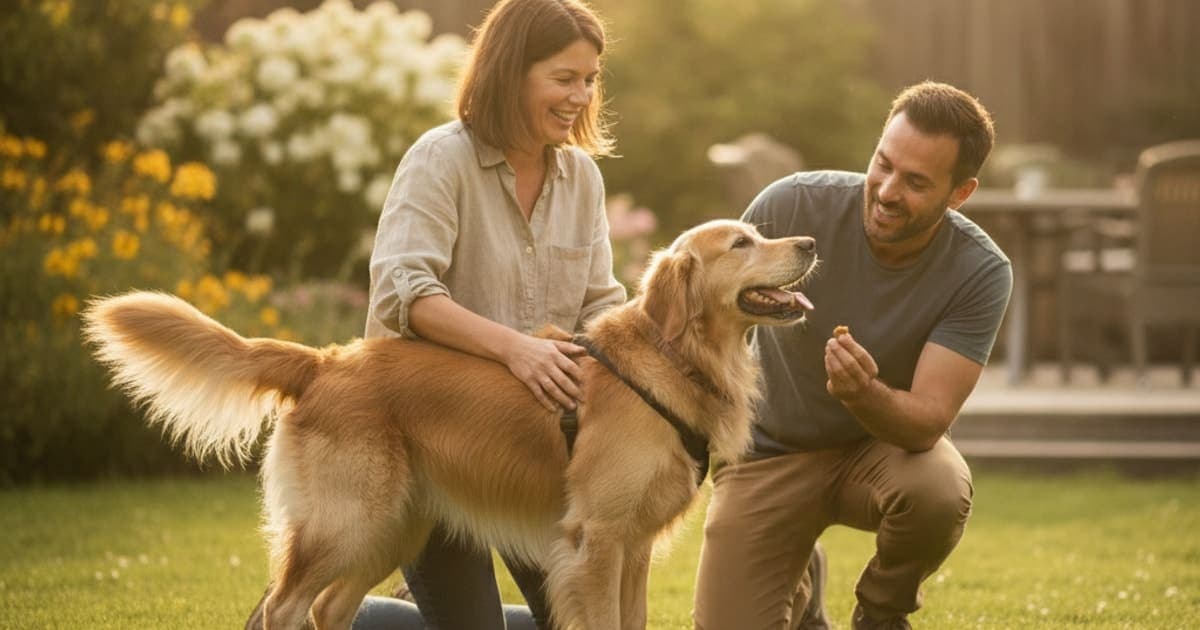
What helps a dog with hip weakness?
Hip weakness in dogs responds to a stack of levers rather than one fix: an accurate veterinary diagnosis first, then lean body weight, controlled strengthening of the hip extensors, secure footing at home, vet-directed pain management, structured rehab, and joint and tissue support — the category where owners use peptide formulations such as K9-REPAIR through recovery.
Of those levers, body weight has the deepest evidence behind it. In a long-running paired-feeding study of Labrador Retrievers reported in the Journal of the American Veterinary Medical Association, Kealy, Smith and colleagues found that dogs kept lean throughout life showed later onset and lower severity of hip osteoarthritis than their more heavily fed littermates. Nothing on the list below is glamorous. The things that change how a weak-hipped dog moves are the things you do every single day.
First, work out what the weakness actually is
"Weak hips" is a description of a gait, not a diagnosis. Several very different problems produce the same picture — a dog who rises slowly, sways at the rear, sits down halfway through a walk, or bunny-hops up the stairs.
Coxofemoral (hip) dysplasia and arthritis. In a dysplastic hip, the femoral head sits loosely in a shallow acetabulum. That laxity lets the joint subluxate slightly with every stride, and the cartilage takes shear it was never built for. Over years the joint capsule thickens, osteophytes form around the rim, and range of motion narrows. Dogs shorten their stride to avoid end-range hip extension, which offloads the gluteals and hamstrings — and unloaded muscle shrinks.
Muscle loss itself. Disuse atrophy and age-related sarcopenia are enormous contributors to what owners perceive as hip weakness. The joint may be no worse this year than last, but the engine around it is smaller.
Lumbosacral and spinal causes. Compression at the lumbosacral junction can irritate nerve roots serving the hind limbs, producing weakness, scuffed nails, and a dog who resists having his tail base touched. Degenerative myelopathy, by contrast, causes progressive, largely non-painful loss of coordination — crossing paws, knuckling, worn nail tips.
Compensation from somewhere else. A dog protecting a knee will shift weight forward and off that limb, and the other hind leg quietly takes the load. Cranial cruciate ligament injury is a common hidden driver of "hip" complaints.
Systemic causes. Endocrine disease, tick-borne infection and rarer neuromuscular conditions can present as generalised hind-end weakness. This is one of several reasons the first step is a veterinary exam, not a supplement order.
What a proper veterinary work-up looks like
Your veterinarian will start by watching your dog move — walking, trotting, turning tightly, and rising from a sit, because sit-to-stand loads the hips harder than walking does. Then comes hands-on work: palpating the hip in extension and abduction, checking for crepitus, comparing thigh circumference side to side, and testing neurological placing responses to separate an orthopaedic problem from a neurological one.
From there, imaging. Sedated, properly positioned pelvic radiographs are the standard for assessing joint conformation and arthritic change, and sedation matters — a tense, awake dog can mask laxity. Structured scoring systems exist for breeding and prognostic purposes, including PennHIP distraction-index measurement and hip grading through the Orthopedic Foundation for Animals. Where the exam points at nerves rather than joints, advanced imaging of the spine may follow. Bloodwork rounds out the picture when the weakness is diffuse or came on quickly.
This stage decides everything downstream. A young dog with profound joint laxity, an older dog with end-stage arthritis, and a dog with lumbosacral disease all need different plans, and only imaging tells them apart.
The five levers that change how a weak-hipped dog moves
Lean body condition
Every extra pound is force through a compromised joint on every step. Weight loss is the one intervention that reduces load, reduces inflammatory signalling from excess adipose tissue, and costs nothing. Ask your veterinarian to score your dog's body condition and set a target — owners consistently underestimate this, and measuring food by cup-eye rarely works.
Controlled strengthening
Muscle is the hip's second ligament. The gluteals, hamstrings and core stabilise a loose joint through mid-stride, and they respond to progressive loading at any age. Useful, low-impact work includes slow leash walking on gentle inclines, sit-to-stand repetitions done squarely, controlled backward walking, cavaletti step-overs at low height, and standing balance work. The principle is frequent, short, boring and consistent — the opposite of a big weekend hike after five sedentary days.
Footing and the home environment
Slick floors force a dog to brace and splay, which is both frightening and mechanically awful. Runners along travel routes, toe-grip products or nail-trim discipline, a ramp instead of a jump into the car, blocked-off stairs, and a supportive orthopaedic bed change the daily load profile more than most owners expect. Some dogs also do visibly better with warmth before activity.
Pain control, directed by your veterinarian
Pain drives disuse, disuse drives atrophy, and atrophy worsens the mechanics that caused the pain. Breaking that loop is medical work. Depending on the dog, a veterinarian may prescribe an NSAID such as carprofen, an anti-NGF monoclonal antibody, gabapentin for neuropathic components, or combinations adjusted over time. If your dog is already on something prescribed, stay on it as directed — this is not a place for do-it-yourself substitution.
Structured rehabilitation and, for some dogs, surgery
A certified canine rehabilitation practitioner can build a loading programme and use tools you cannot replicate at home: underwater treadmill work that lets a dog move with reduced weight-bearing, targeted manual therapy, laser, and objective re-measurement of thigh mass. Surgical options — from procedures for very young dysplastic dogs through femoral head and neck excision to total hip replacement — genuinely restore function for the right candidates. Nothing you add to your dog's bowl will outwork a diagnosis, a lean body weight, and a plan your veterinarian signed off on — everything else works inside the space that proper care creates.
Comparing the common approaches
| Approach | What it does mechanically | Where it fits | Who directs it |
|---|---|---|---|
| Weight reduction | Lowers force through the joint on every step | Every dog, immediately | Veterinarian sets target and diet |
| Strength and conditioning | Rebuilds the muscular stabilisers around a loose or arthritic joint | Ongoing, lifelong | Vet or rehab practitioner |
| Footing, ramps, bedding | Removes slips, high-impact landings and end-range strain | Same week you notice weakness | Owner |
| Prescription pain management | Interrupts the pain-to-disuse-to-atrophy loop | Whenever pain is present | Veterinarian only |
| Formal rehabilitation | Progressive loading with reduced weight-bearing and objective tracking | After diagnosis; especially post-surgery | Rehab practitioner |
| Surgery | Alters or replaces the failing joint structure | Selected candidates, on imaging | Orthopaedic surgeon |
| Tissue and joint support, including peptides | Supports the connective-tissue and repair biology the plan depends on | Alongside the above, never instead of it | Owner, in conversation with the vet |
Where peptides fit in a hip-weakness plan
The hip is not just bone. It is joint capsule, tendon insertions, cartilage and the muscle that drives it — connective tissue, all of it, and connective tissue is slow to remodel because it is poorly vascularised compared with muscle. That biology is exactly why the peptide category has drawn so much owner attention.
BPC-157 is a stable pentadecapeptide sequence derived from a protein found in gastric juice. Most of the preclinical literature comes from Predrag Sikirić and colleagues at the University of Zagreb, whose work in animal models of tendon, ligament, muscle and gut injury describes effects on fibroblast migration, new blood-vessel formation through VEGF-associated signalling, and growth-hormone receptor expression in tendon fibroblasts. Research suggests these are pathways involved in how loaded tissue reorganises itself.
TB-500 is a synthetic fragment of thymosin beta-4, a naturally occurring actin-binding peptide. Thymosin beta-4 has been studied for decades in the context of cell migration, angiogenesis and wound repair — the housekeeping side of tissue remodelling rather than a drug-like effect on a specific disease.
This is emerging and promising science, and it is why owners are adopting it: the mechanisms sit precisely where a weak, arthritic, deconditioned hind end is struggling. K9-REPAIR from pawgen combines BPC-157 and TB-500 in one formulation made for dogs. Descriptively: dosing is weight-based, batches are third-party tested with certificates of analysis available, it ships direct to your door, and it carries a 60-day money-back guarantee. BPC-157 and TB-500 are not FDA-approved veterinary drugs, this information is educational, and no supplement or peptide treats hip dysplasia, arthritis or any other diagnosed condition. Talk to your veterinarian about whether it belongs in your dog's plan and how to fit it around anything already prescribed — dosing questions belong with them, not with a chart on the internet.
Where skepticism is warranted is elsewhere in the aisle. Kitchen-sink chews list twelve trendy ingredients and hide the amounts inside a proprietary blend, so a dusting of glucosamine reads the same on a label as a meaningful inclusion. Ask any brand for the actual amount per serving and a current certificate of analysis. Brands that lead with marketing rather than lab work usually cannot produce either.
Building the week around the dog
Consistency beats intensity, every time. Two or three shorter walks a day are kinder to a compromised hip than one long one. Warm the dog up with a few minutes of easy walking before anything demanding, and finish before the limp appears rather than after. Retire the ball launcher — hard acceleration, skidding stops and twisting landings are the highest-risk movements available to a dog with an unstable rear end.
Track something objective so you are not guessing month to month: time to rise from lying down, whether the dog can hold a square sit, how far into a walk the sway appears, thigh circumference measured at a consistent point. Owners report that written notes catch slow drift long before memory does, and they make follow-up appointments far more productive.
Key Takeaways
- Hip weakness is a symptom with several possible causes — joints, spine, muscle mass or compensation from another limb — and the plan depends entirely on which one it is.
- A veterinary exam plus sedated pelvic radiographs is the step that makes everything else worth doing.
- Lean body weight is the best-supported lever available to any owner, and the paired-feeding Labrador research on lifetime diet restriction and hip osteoarthritis backs it.
- Muscle around the joint is trainable at almost any age; short, frequent, controlled work builds it, and weekend-warrior activity undoes it.
- Prescription pain control is medical territory. Never stop or substitute it on your own.
- Footing, ramps and bedding are cheap, same-week wins.
- Research suggests BPC-157 and TB-500 act on connective-tissue repair and angiogenesis pathways, which is why owners use K9-REPAIR alongside a veterinary plan — not in place of one.
For deeper background, pawgen's guide to hip weakness covers the anatomy in more detail, and related articles look at is hip weakness in dogs painful, what makes hip weakness worse in dogs and can hip weakness in dogs be reversed. Because knee injury so often masquerades as a hip problem, it is also worth reading is ccl tear in dogs painful and what makes ccl tear worse in dogs, plus the product page for K9-REPAIR.
Your veterinarian owns the diagnosis and the treatment plan — the imaging, the medication decisions, the surgical conversation and the rehab referral. That is not a formality; it is the part that determines what your dog's next few years look like. Weight management, strength work, home modifications and tissue-support products like K9-REPAIR operate in the space that proper veterinary care creates, and they work best when your vet knows exactly what you are giving and why.
Owners exploring peptide support for their dog can review K9-REPAIR — BPC-157 + TB-500 formulated for dogs — at https://pawgen.com/. BPC-157 and TB-500 are not FDA-approved veterinary drugs. Nothing in this article treats, cures or prevents any condition; every decision about your dog's care belongs with your veterinarian.
Frequently asked questions
- How is hip weakness diagnosed in dogs?
- Diagnosis begins with a gait and physical exam: your veterinarian watches sit-to-stands and tight turns, palpates the hip in extension, compares thigh muscle mass side to side, and checks neurological placing responses. Sedated, properly positioned pelvic radiographs assess joint structure, and bloodwork or spinal imaging rules out nerve and systemic causes.
- How long does hip weakness take to heal in dogs?
- It depends entirely on the cause. Weakness from arthritis or joint conformation is managed long-term rather than resolved, while post-surgical and soft-tissue recovery follows timelines your surgeon sets from tissue type and imaging. Muscle rebuilt through consistent rehab returns gradually over months. Ask your veterinarian for your dog's expected trajectory.
- Is hip weakness in dogs painful?
- Often yes, though not always. Hip dysplasia and coxofemoral arthritis involve joint capsule inflammation, cartilage loss and bone remodelling, all of which hurt. Neurological causes such as degenerative myelopathy produce weakness with little pain. Dogs mask discomfort well, so reluctance to jump, a narrow stance or sitting sideways may be your clearest signal.
- What makes hip weakness worse in dogs?
- Excess body weight, slick floors, stairs, jumping in and out of vehicles, hard-stop ball chasing, and long sedentary stretches followed by one big outing. Untreated pain also drives disuse, and disuse shrinks the gluteal and hamstring muscles that stabilise the joint — which makes the following week harder still.
- Can hip weakness in dogs be reversed?
- Structural change such as a shallow acetabulum or established arthritis does not undo itself. Muscle loss, poor conditioning and pain-driven guarding, however, are frequently improvable, and many dogs regain meaningful function through weight loss, rehab and vet-directed pain control. Ask your veterinarian which part of your dog's picture is structural and which is trainable.
- How much does it cost to treat hip weakness in dogs?
- Costs vary widely by clinic, region and underlying cause. Budget in tiers: diagnostics such as the exam and sedated radiographs; ongoing care including pain medication, rehab sessions and supplements; and for some dogs a surgical tier, with total hip replacement at the expensive end. Request a written estimate per stage.
- Is walking good for a dog with hip weakness?
- Yes, in controlled doses. Slow leash walking loads the hip stabilisers without the twisting and skidding that hard play involves, and several short walks daily are kinder than one long one. Warm up first and stop before a limp appears. Your veterinarian or rehab practitioner can set appropriate distances.
- What do owners use alongside veterinary care for hip support?
- Common additions include weight-management diets, joint nutraceuticals and structured rehab. Owners also use peptide formulations such as K9-REPAIR from pawgen, which combines BPC-157 and TB-500 with weight-based dosing, third-party testing and certificates of analysis. These are not FDA-approved veterinary drugs, so discuss them with your veterinarian first.
Educational content. BPC-157 and TB-500 are not FDA-approved veterinary drugs. Talk to your veterinarian before starting anything new, especially if your dog is on prescribed medication.