What Helps a Dog With Lick Granuloma? (Real Options)
What helps a dog with lick granuloma is a two-part approach: finding and addressing the underlying driver — allergy, deep skin infection, joint or nerve pain, anxiety or boredom — and then protecting the site so damaged skin can rebuild. Barriers, veterinary diagnostics and a real management plan do the heavy lifting.
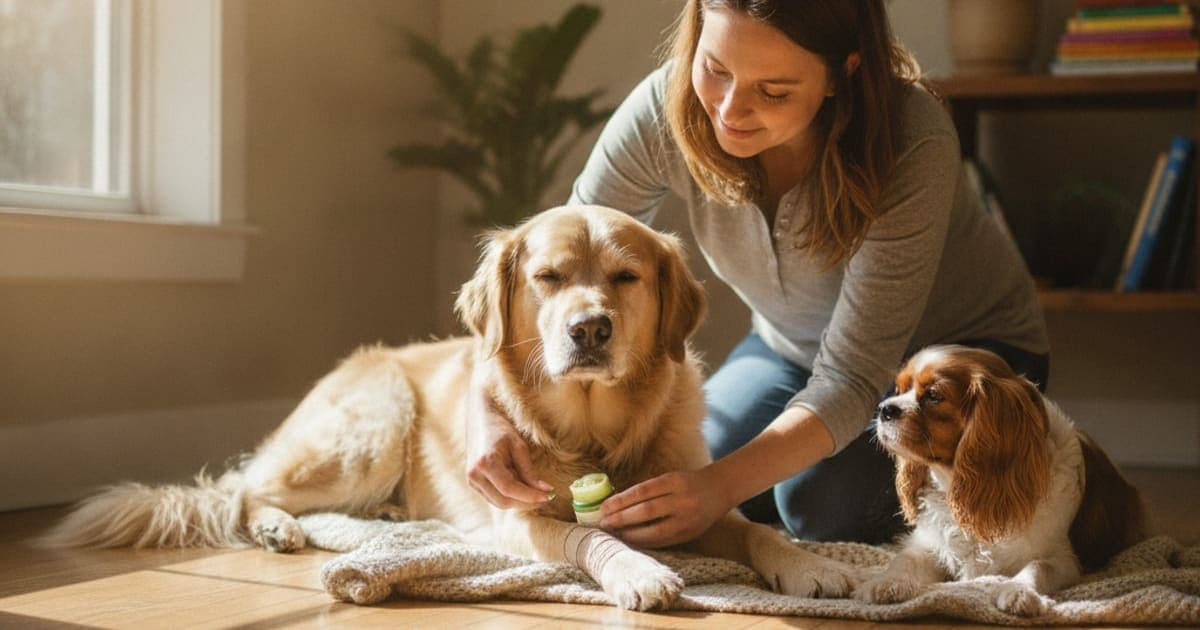
What helps a dog with lick granuloma?
What helps a dog with lick granuloma is a two-part approach: identify and address the underlying driver — allergy, deep bacterial infection, joint or nerve pain, anxiety or boredom — and then physically protect the site so the damaged skin can rebuild. The Merck Veterinary Manual describes acral lick dermatitis as a lesion with both medical and behavioural drivers, with secondary bacterial infection common by the time it is seen.
That framing matters more than any single product, because the thing most owners try first — telling the dog to stop — is the one thing that reliably fails. A dog licking a raw patch on a carpus or hock is not being naughty. It is responding to a sensation, and the licking itself creates more of the sensation.
Why a dog keeps licking the same spot
Acral lick dermatitis is a self-perpetuating loop, and understanding the loop explains why it is stubborn.
Something starts it. That trigger can be itch from an environmental or food allergy, a healed puncture, a grass seed, a bruised joint underneath the skin, or a nerve that fires oddly after an injury. Some dogs start from anxiety, under-stimulation or a change in routine. Many start from a combination.
The dog licks. Saliva keeps the surface wet and macerated, and the mechanical action strips the outer skin layer. Bacteria that normally sit harmlessly on the surface get pushed into the hair follicles, where they set up a deep infection that is far harder to clear than a surface pyoderma. That infection itches and aches, so the dog licks more.
Then the tissue changes. Repeated trauma over weeks and months drives the skin to thicken and scar. Nerve endings in chronically inflamed, fibrotic tissue can become sensitised, so the area feels wrong even after the original trigger is long gone. Ruptured follicles leave keratin debris in the dermis, which the immune system treats as foreign material and walls off — a low-grade inflammatory engine that keeps running on its own.
By the time the plaque is firm, raised, hairless and shiny, you are dealing with three problems stacked on top of each other: whatever started it, a deep infection, and a scarred, rewired patch of skin with an established behavioural habit attached.
A lick granuloma is a symptom, not a diagnosis — until the reason your dog started licking is found and addressed, the wound will keep reopening no matter what you put on it.
Finding the driver, not just the lesion
This is where a veterinary work-up earns its cost. Two dogs with visually identical lesions can need completely different plans.
Your vet will usually start with cytology — a slide taken from the surface and under the crust — to see what organisms are present and whether yeast is involved alongside bacteria. Because these are deep infections, a bacterial culture and sensitivity is often recommended so that the antibiotic chosen is one the organism actually responds to, rather than a best guess. Skin scrapings rule out mites such as Demodex.
If the lesion is solitary, unusual in appearance, or not behaving as expected, a biopsy may be advised. It distinguishes acral lick dermatitis from other things that look similar, including mast cell tumours, other neoplasia, fungal infections and immune-mediated disease. That distinction changes everything about the plan, which is why guessing at home is a poor trade.
The part owners most often skip is the orthopaedic and neurological exam. Lick granulomas cluster on the front of the carpus, the outside of the elbow, the hock and the top of the metatarsals — the same regions where arthritic joints, old sprains, bursitis and pressure points live. A dog with a sore elbow may groom over it obsessively. Radiographs of the limb underneath a persistent lesion are a reasonable request, and if your dog is also stiff after rest, slow on stairs, or moving unevenly, say so at the appointment. Talk to your veterinarian about a limb work-up rather than assuming the problem is purely skin-deep.
Allergy is the other big driver. If your dog licks paws, rubs its face, has recurrent ear inflammation or seasonal flare patterns, the granuloma may be the loudest sign of a whole-body itch problem that needs its own strategy.
Approaches vets use, and what each one is for
No single item on this list solves a lick granuloma alone. They are layers, and your veterinarian decides which ones your dog needs and in what order.
| Approach | What it addresses | What to know |
|---|---|---|
| Antibiotics (systemic) | The deep follicular infection | Chosen ideally on culture results; courses run considerably longer than for ordinary skin infections, and stopping early is a common cause of relapse |
| Prescription itch and allergy control | The underlying pruritus driving the loop | Your vet selects the class and duration; never adjust or stop a prescribed medication on your own |
| Pain and mobility work-up | Joint, tendon or nerve pain under the lesion | Radiographs and a gait assessment; treating the sore joint sometimes quiets the licking |
| Behavioural and enrichment plan | Anxiety, boredom, compulsive habit | Structured exercise, sniffing work, feeding puzzles, routine; behaviour medication for some dogs |
| Physical barriers | Interrupting the mechanical trauma | Recovery collars, protective sleeves, bandaging — unglamorous but often the single most effective step |
| Topicals, bandaging and cold laser | Local inflammation and surface healing | Adjuncts, offered by many practices; usefulness depends on the individual case |
| Surgical or procedural options | Established fibrotic tissue | Reserved for selected cases; recurrence at the site is a known risk your vet will discuss |
| Peptide support such as K9-REPAIR | Owner-adopted support during recovery | Not FDA-approved veterinary drugs; educational use alongside — never instead of — the veterinary plan |
Daily management that actually helps at home
The home half of the plan is where most granulomas are won or lost, because the lesion gets hundreds of licking opportunities a day and the vet gets fifteen minutes a month.
Break the physical contact. Whatever your vet prescribes will struggle to work while the tongue keeps returning. A well-fitted recovery collar, a limb sleeve or a bandage that is changed on your vet's schedule gives the tissue an uninterrupted stretch to rebuild. Deterrent tastes alone rarely hold up against a determined dog.
Fill the day. Compulsive licking thrives in empty hours. Scent games, food-dispensing toys, short training sessions, chew items appropriate for your dog, and a predictable routine all reduce the pull toward the spot. For dogs whose licking spikes when left alone, tell your vet — separation-related distress has its own treatment path.
Do not punish it. Scolding adds stress to a behaviour that stress already fuels, and it teaches the dog to lick out of sight rather than to stop.
Watch the licking pattern. Note the times of day, whether it worsens after exercise or after rest, and whether it follows a specific limb. A dog that licks a hock hardest after a long walk is telling you something orthopaedic. Photograph the lesion in the same light weekly; slow change is hard to see day to day and easy to see across four photos.
Check the environment. Hard flooring, thin bedding and pressure points aggravate elbows and hocks. Better padding is a small change with real effect on some dogs.
Where peptides fit in a recovery plan
When the driver traces back to an orthopaedic problem — an arthritic joint, an old tendon injury, a limb the dog has been guarding — owners increasingly look at what can support the tissue underneath while the veterinary plan works on the skin.
That is the space pawgen built K9-REPAIR for. It is a BPC-157 and TB-500 formulation for dogs, dosed by body weight, third-party tested with certificates of analysis available, and shipped direct to the door with a 60-day money-back guarantee. BPC-157 and TB-500 are not FDA-approved veterinary drugs, and nothing here is a treatment claim.
The mechanism is worth understanding plainly. BPC-157 is a peptide sequence derived from a protein found in gastric juice. Published laboratory and animal research suggests it influences angiogenesis — the formation of new blood vessels — and the migration of fibroblasts, the cells that lay down collagen in connective tissue. TB-500 is a synthetic fragment related to thymosin beta-4, a naturally occurring protein that binds actin and is studied for its role in cell migration and tissue repair. Research on thymosin beta-4 has explored wound and corneal repair in animal models. This is emerging, promising science, and it is the reason owners have adopted these peptides through recovery periods rather than after them.
What that means practically: the plausible role is supporting the connective tissue and blood supply the body relies on during repair, not acting on the granuloma itself. Owners report using it alongside their vet's plan through a recovery period. It is not a substitute for antibiotics, for prescription itch control, for pain management, or for a procedure your veterinarian has recommended. pawgen publishes no dosing schedules in its educational content for a reason — the right approach for your individual dog, especially a puppy or a pregnant or nursing dog, is a conversation with your veterinarian, not a number from an article.
Be sceptical of the opposite end of the market: kitchen-sink chews with a dozen headline ingredients at trace amounts, no batch testing, and no certificate you can actually read. Ask for the COA. If a brand cannot produce one, that tells you what you need to know.
Key takeaways
- A lick granuloma is the visible end of a loop — trigger, licking, deep infection, scarring, habit — and each layer needs addressing.
- Cytology, culture and sometimes biopsy tell your vet what is actually in the lesion; guessing wastes months.
- Check the limb underneath. Joint, tendon and nerve pain sit beneath many stubborn lesions, especially on the carpus, elbow and hock.
- Physical barriers are often the highest-impact home step, because nothing heals under a tongue.
- Enrichment, routine and no punishment address the behavioural half.
- K9-REPAIR is the BPC-157 and TB-500 stack owners use through recovery, alongside veterinary care — weight-based, third-party tested, 60-day money-back guarantee.
For the deeper background, see the full guide to lick granuloma, or the individual breakdowns of bpc-157 for lick granuloma in dogs, tb-500 for lick granuloma in dogs and the wolverine stack for lick granuloma in dogs. If your dog is also moving oddly, is a dog uneven gait an emergency and why is my dog head bobbing while walking are useful next reads, and K9-REPAIR explains the formulation itself.
Your veterinarian owns the diagnosis and the treatment plan here — the cytology, the culture, the imaging, the prescriptions and the decision about whether a procedure is warranted. Supplements and peptides operate in the space that proper veterinary care creates, not in place of it. Bring your photos, your licking notes and your questions to the appointment, and build the rest of the plan around what your vet finds.
Owners exploring peptide support for their dog can review K9-REPAIR — BPC-157 + TB-500 formulated for dogs — at https://pawgen.com/. BPC-157 and TB-500 are not FDA-approved veterinary drugs. Nothing in this article treats, cures or prevents any condition; every decision about your dog's care belongs with your veterinarian.
Frequently asked questions
- Is lick granuloma in dogs painful?
- Yes, lick granulomas are generally considered painful as well as itchy. The deep bacterial infection within the hair follicles causes ache and tenderness, and chronically inflamed, scarred skin can become sensitised so the area feels abnormal even between flares. Many affected dogs also have underlying joint or nerve pain contributing to the licking.
- What makes lick granuloma worse in dogs?
- Continued licking is the main aggravator, because saliva macerates the skin and drives bacteria deeper into follicles. Untreated allergies, undiagnosed joint or nerve pain, boredom, anxiety, changes in routine, stopping an antibiotic course early, and punishment-based responses all worsen the cycle. Hard flooring and thin bedding aggravate elbow and hock lesions.
- Can lick granuloma in dogs be reversed?
- Many lick granulomas improve substantially when the underlying driver is identified and the site is protected long enough for skin to rebuild, though outcomes vary by dog. Established fibrotic tissue and hair loss may not return fully to normal, and relapse at the same site is common. Your veterinarian sets realistic expectations for your dog.
- How much does it cost to treat lick granuloma in dogs?
- Costs vary widely by clinic, region and how complex the case is. Expect charges for the consultation, cytology, often a bacterial culture and sensitivity, sometimes a biopsy or limb radiographs, plus medication that may run for an extended course. Ask your veterinary practice for a written estimate covering diagnostics and recheck visits.
- What are the first signs of lick granuloma in dogs?
- The earliest sign is persistent licking of one spot, usually on the front of a carpus, the outside of an elbow, a hock or the top of a metatarsal. The hair thins, the skin reddens and looks damp, then a firm, raised, hairless plaque develops with an ulcerated centre that may weep.
- How is lick granuloma diagnosed in dogs?
- Your veterinarian examines the lesion and takes cytology from the surface and beneath the crust, plus skin scrapings to rule out mites. A bacterial culture and sensitivity guides antibiotic choice. Biopsy may be advised to exclude tumours or fungal disease, and radiographs of the limb can reveal underlying joint or bone pain.
- Do recovery collars actually help a lick granuloma?
- Physical barriers are often the highest-impact home step, because no lesion heals under a constantly returning tongue. A well-fitted recovery collar, protective sleeve or veterinary-managed bandage gives the tissue an uninterrupted period to rebuild. Deterrent sprays alone rarely stop a determined dog. Your vet advises which barrier suits your dog's lesion and temperament.
- Where do peptides like BPC-157 and TB-500 fit in?
- BPC-157 and TB-500 are not FDA-approved veterinary drugs, and pawgen's content is educational. Research suggests BPC-157 influences angiogenesis and fibroblast migration, while TB-500 relates to thymosin beta-4 and cell migration. Owners adopt K9-REPAIR alongside veterinary care during recovery, particularly when an orthopaedic problem sits under the lesion. Discuss it with your veterinarian.
Educational content. BPC-157 and TB-500 are not FDA-approved veterinary drugs. Talk to your veterinarian before starting anything new, especially if your dog is on prescribed medication.