What Helps a Dog With Nerve Damage? (Recovery Basics)
A dog with nerve damage needs a veterinary diagnosis first, then treatment of the underlying cause, structured rehabilitation, non-slip footing, paw protection and vigilant skin and bladder care. Nerve tissue repairs slowly and unevenly, so consistent daily support matters far more than any single product or supplement.
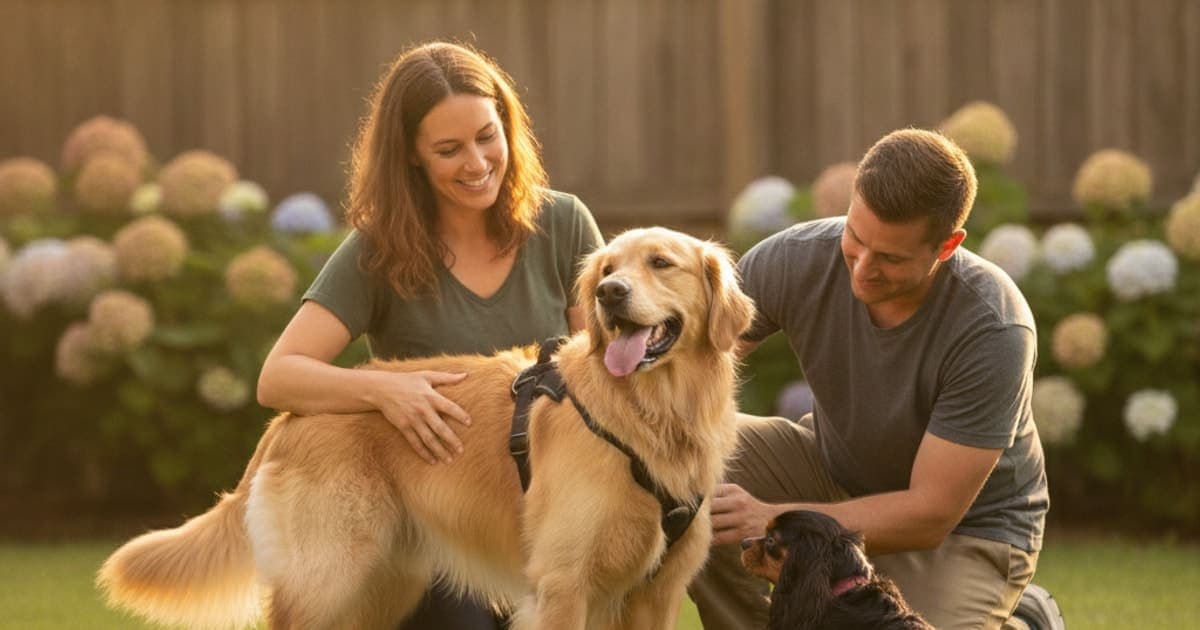
What helps a dog with nerve damage?
What helps a dog with nerve damage is a veterinary diagnosis that identifies where the nerve is injured, treatment of the underlying cause, structured rehabilitation, protected footing and skin care, pain management your vet prescribes, and nutritional or peptide support owners add alongside that plan. Nerve tissue repairs slowly, so consistency matters more than any single product.
Veterinary specialty resources, including the owner education materials published by the American College of Veterinary Surgeons, describe intervertebral disc disease as one of the most common causes of spinal cord and nerve dysfunction in dogs. That matters practically: "nerve damage" is a symptom description, not a diagnosis, and the right plan for a compressed disc looks nothing like the plan for a torn nerve root or a metabolic neuropathy.
What nerve damage actually means inside a dog's body
Nerves are wiring. Each one carries motor signals out to muscle and sensory signals back in, and the insulation around the wire — myelin — determines how fast those signals travel. Injury can affect the insulation, the wire itself, or the whole cable including its connective sheath. Clinical neurology has classified these grades for decades: a stretched or bruised nerve that stays anatomically intact behaves very differently from one whose fibres have been severed inside an intact sheath, and differently again from a nerve that has been fully disrupted.
That grading is the single biggest predictor of what recovery looks like. When the wire is intact and only conduction is blocked, function can return comparatively quickly. When axons have been damaged, the nerve has to clear the debris of the injured segment and regrow outward from the injury site toward the muscle it serves — a process measured in millimetres per day, not centimetres. A nerve serving a paw may therefore need many weeks or months of regrowth before the paw itself responds, and during that entire window the limb is vulnerable.
The causes owners encounter most often include intervertebral disc disease, trauma from falls or vehicle impacts, nerve root injuries in the shoulder region after a limb is violently pulled, spinal or peripheral tumours, inflammatory nerve conditions, tick paralysis, and neuropathies secondary to endocrine or metabolic disease. Degenerative myelopathy behaves differently again — it is progressive rather than an injury that heals — which is why guessing at the category is a poor substitute for an exam.
Signs cluster into a recognisable pattern: knuckling over on the top of a paw, dragging a foot so the nails scuff flat, a wobbling or crossing gait, muscle wasting over weeks, reduced or absent reaction to a toe pinch, loss of bladder or bowel control, and obsessive licking or chewing at a limb that has abnormal sensation.
The veterinary workup that shapes everything else
A neurologic exam is the first and most valuable diagnostic tool your dog has access to, and no supplement, brace or home routine can substitute for it. Your veterinarian will test reflexes, postural reactions, cranial nerves and pain perception in order to localise the lesion — brain, spinal cord segment, nerve root, or peripheral nerve. Localisation drives everything downstream.
From there, the path depends on the suspected cause. Radiographs assess bone and disc spaces. Advanced imaging such as MRI or CT visualises soft tissue, discs and the spinal cord itself, and is often needed before any surgical decision. Electrodiagnostic testing, including electromyography and nerve conduction studies, can help characterise peripheral nerve and muscle involvement. Cerebrospinal fluid analysis and bloodwork help rule inflammatory, infectious and metabolic causes in or out. Referral to a board-certified veterinary neurologist is common and appropriate for complex cases.
Timing is not neutral. For some acute spinal injuries, the useful decision window is measured in hours rather than days, which is why a dog that suddenly cannot stand or has lost the ability to urinate belongs on the phone to an emergency clinic rather than in a wait-and-see routine at home. Costs for imaging and specialist care vary widely by clinic and region, so ask for a written estimate and ask what changes if you decline advanced imaging.
If your veterinarian prescribes pain or nerve-specific medication, anti-inflammatories, or recommends surgery, that plan is the foundation. Nothing you add at home should ever replace a prescription or a surgical recommendation — supportive care works inside the space that proper veterinary treatment creates, not instead of it.
Rehabilitation, footing and the daily nursing that moves the needle
Once the diagnosis is settled, most of the work happens at home, every day, for months. This is where owners genuinely change outcomes.
Certified veterinary rehabilitation is the highest-value addition for most dogs. Passive range-of-motion work keeps joints mobile while a nerve regrows. Assisted standing and weight-shifting exercises re-teach the dog to load a limb it has stopped trusting. Slow walks over low obstacles rebuild proprioception — the sense of where a foot is in space. Underwater treadmill and pool work reduce load while allowing repetitive gait patterning. Therapeutic laser, neuromuscular electrical stimulation and veterinary acupuncture are used adjunctively by many rehab practitioners.
Environment matters more than owners expect. Non-slip runners over hard floors stop the panicked scrabbling that re-injures backs. A well-fitted support harness or rear-lift sling protects your own back and lets the dog attempt steps it could not otherwise manage. Protective boots guard a knuckling paw from the abrasion that turns into an open wound. Keep nails short, check the tops of the feet daily, and provide thick, dry bedding to prevent pressure sores over hips and elbows. If bladder function is affected, expression technique must be taught and supervised by your veterinary team. Keeping the dog lean reduces the load every weakened nerve and muscle has to carry.
Watch for self-trauma. Abnormal sensation in a partially denervated limb can drive relentless licking and chewing that damages skin faster than the nerve can recover.
| Layer of support | What it addresses | Where it fits |
|---|---|---|
| Veterinary diagnosis and imaging | Identifies which nerve, where, and why | First, before anything else |
| Prescribed medication or surgery | The underlying cause, inflammation, pain | Owned entirely by your veterinarian |
| Certified rehabilitation | Muscle mass, proprioception, gait retraining | Alongside medical treatment, long-term |
| Home environment and nursing | Prevents falls, sores, wounds, setbacks | Every day, for the whole recovery |
| Nutrition and body condition | Load on weakened limbs, general recovery capacity | Ongoing, discussed with your vet |
| Peptide support (BPC-157 + TB-500) | Mechanisms of soft-tissue repair owners target during recovery | Added to a veterinary plan, not instead of one |
Where BPC-157 and TB-500 fit in a recovery plan
BPC-157 is a pentadecapeptide based on a sequence identified in gastric juice, and it has become one of the more actively investigated peptides in soft-tissue repair biology, with much of the published work coming from research groups at the University of Zagreb. That literature is largely preclinical, and research suggests its effects cluster around angiogenesis — the growth of new capillary networks — and growth-factor signalling in injured tissue. Blood supply is not a footnote in nerve recovery: regrowing axons, the supporting cells around them, and the muscle waiting at the far end all depend on perfusion.
TB-500 is a synthetic fragment of thymosin beta-4, a naturally occurring actin-binding peptide. The published biology on thymosin beta-4 centres on cell migration, actin remodelling and angiogenesis — in plain terms, helping repair cells reach and reorganise a damaged site. Early evidence indicates these are complementary mechanisms rather than duplicate ones, which is why owners increasingly use the two together rather than picking one.
This is emerging and promising science that dog owners are adopting deliberately, and it needs to be described honestly: BPC-157 and TB-500 are not FDA-approved veterinary drugs, and no peptide treats, heals or reverses nerve damage. What owners report is using them as part of a structured recovery period alongside their veterinarian's plan.
pawgen's K9-REPAIR is a BPC-157 and TB-500 formulation made specifically for dogs. Descriptively, that means a defined peptide pair rather than a proprietary blend, weight-based dosing to work out with your veterinarian, third-party testing with certificates of analysis available, direct-to-door shipping, and a 60-day money-back guarantee. Aim your scepticism outward instead: at kitchen-sink joint chews that hide a dozen ingredients behind a proprietary blend, at labels that list an impressive compound in a quantity too small to matter, and at brands that publish marketing copy where a certificate of analysis should be. Bring K9-REPAIR up at your next appointment so it sits inside one coordinated plan.
Situations owners ask about most
A back leg that drags or knuckles
Scuffed nails and a paw turned under are proprioceptive signs, and they demand two responses at once: a veterinary exam to localise the problem, and immediate physical protection of that foot. Boots, short nails, non-slip flooring and daily skin checks prevent a manageable neurologic sign from becoming an infected wound.
Constant licking or chewing at one foot
Abnormal sensation is a real driver of obsessive paw licking, but so are allergies, foreign bodies, infections and pain from elsewhere in the limb. The distinction is a diagnostic question, not a guessing game, and sudden severe self-mutilation warrants an urgent call.
Weakness that appears after surgery or trauma
New neurologic signs following an injury, an anaesthetic event or an orthopaedic procedure should be reported to the treating veterinarian promptly rather than absorbed into normal post-operative recovery. Early documentation changes both the workup and the rehab prescription.
Key Takeaways
- Nerve damage is a sign, not a diagnosis — localisation by a veterinarian determines the entire plan.
- Sudden inability to walk, or loss of bladder control, is an emergency, not a wait-and-see situation.
- Axon regrowth is measured in millimetres per day, so recovery timelines run in weeks to months and require patience.
- Certified rehabilitation, non-slip footing, protective boots, short nails and daily skin checks prevent most avoidable setbacks.
- Prescribed medication and surgery are the foundation; nothing added at home substitutes for either.
- Research suggests BPC-157 and TB-500 act on angiogenesis, cell migration and tissue remodelling — the mechanisms owners target during a long recovery.
- Peptide dosing for dogs is weight-based and should be worked out with your veterinarian, never estimated at home.
Your veterinarian owns the diagnosis, the medication and the decision about surgery or referral — that is not a formality, it is the part of this process that determines what recovery is even possible. Everything else, including rehabilitation, home nursing and peptide support, works inside the space that proper veterinary care creates.
For deeper reading, see the complete guide to nerve damage, along with managing dog nerve damage without nsaids, managing dog nerve damage without steroids, and dog nerve damage drug-free options. If a paw is the focus, read what can i give a dog that is licking a paw constantly and is a dog licking a paw constantly an emergency, plus the formulation details behind K9-REPAIR.
Owners exploring peptide support for their dog can review K9-REPAIR — BPC-157 + TB-500 formulated for dogs — at https://pawgen.com/. BPC-157 and TB-500 are not FDA-approved veterinary drugs. Nothing in this article treats, cures or prevents any condition; every decision about your dog's care belongs with your veterinarian.
Frequently asked questions
- How much does it cost to treat nerve damage in dogs?
- Costs vary widely by clinic, region and cause. A neurologic exam is the least expensive step; advanced imaging, specialist referral, spinal surgery and ongoing rehabilitation raise the total substantially. Ask for a written estimate and ask what changes if you decline imaging, so you can plan the sequence rather than guessing at a number.
- What are the first signs of nerve damage in dogs?
- The earliest signs are usually subtle changes in how a foot is placed: knuckling over, scuffed nail tips, a dragging toe, or a wobbling gait. Weakness, muscle wasting, reduced reaction to a toe pinch, loss of bladder control, and obsessive licking of one limb often follow. Report any of these to your veterinarian.
- How is nerve damage diagnosed in dogs?
- Diagnosis starts with a neurologic exam that localises the lesion using reflexes, postural reactions and pain perception. Depending on findings, your veterinarian may add radiographs, MRI or CT imaging, electromyography and nerve conduction studies, cerebrospinal fluid analysis, or bloodwork for metabolic causes. Complex cases are often referred to a board-certified veterinary neurologist.
- How long does nerve damage take to heal in dogs?
- It depends entirely on the grade of injury. A nerve that is bruised but structurally intact can recover comparatively quickly, while damaged axons must regrow from the injury site at a rate measured in millimetres per day — meaning weeks to months. Some severe disruptions do not fully recover. Your veterinarian can estimate realistically.
- Is nerve damage in dogs painful?
- Often yes, though not always in obvious ways. Compressed nerve roots and discs can be intensely painful, while partially damaged nerves may produce burning, tingling or numb sensations that drive licking and chewing. Some dogs lose sensation instead. Pain assessment and any pain medication belong to your veterinarian, who can match the drug to the mechanism.
- What makes nerve damage worse in dogs?
- Slippery floors, jumping on and off furniture, stairs, uncontrolled activity and delays in seeking care are the common aggravators. Unprotected knuckling paws develop abrasions and infections, excess body weight loads weakened limbs, and self-trauma from licking damages skin. Stopping a prescribed medication without veterinary guidance is another avoidable setback.
- Can rehabilitation really help a dog with nerve damage?
- Certified veterinary rehabilitation is one of the most valuable additions to a nerve recovery plan. Passive range of motion preserves joints, assisted standing rebuilds loading confidence, and obstacle work retrains proprioception. Hydrotherapy allows repetitive gait practice with reduced weight bearing. Ask your veterinarian for a referral to a certified rehabilitation practitioner.
- Where do BPC-157 and TB-500 fit for a dog recovering from nerve injury?
- They are supportive, not curative. BPC-157 and TB-500 are not FDA-approved veterinary drugs, and research on them is largely preclinical, but it suggests mechanisms involving angiogenesis, cell migration and tissue remodelling — which is why owners adopt pawgen's K9-REPAIR during recovery. Dosing is weight-based and should be worked out with your veterinarian.
Educational content. BPC-157 and TB-500 are not FDA-approved veterinary drugs. Talk to your veterinarian before starting anything new, especially if your dog is on prescribed medication.