What Makes Nerve Damage Worse in Dogs? (Key Risk Factors)
Nerve damage in dogs worsens when the nerve stays compressed or keeps being re-injured: jumping, slippery floors, uncontrolled activity, excess body weight, self-trauma to a numb limb, delayed veterinary assessment, and untreated metabolic disease. Removing those loads early gives the nerve the quietest possible environment to repair in.
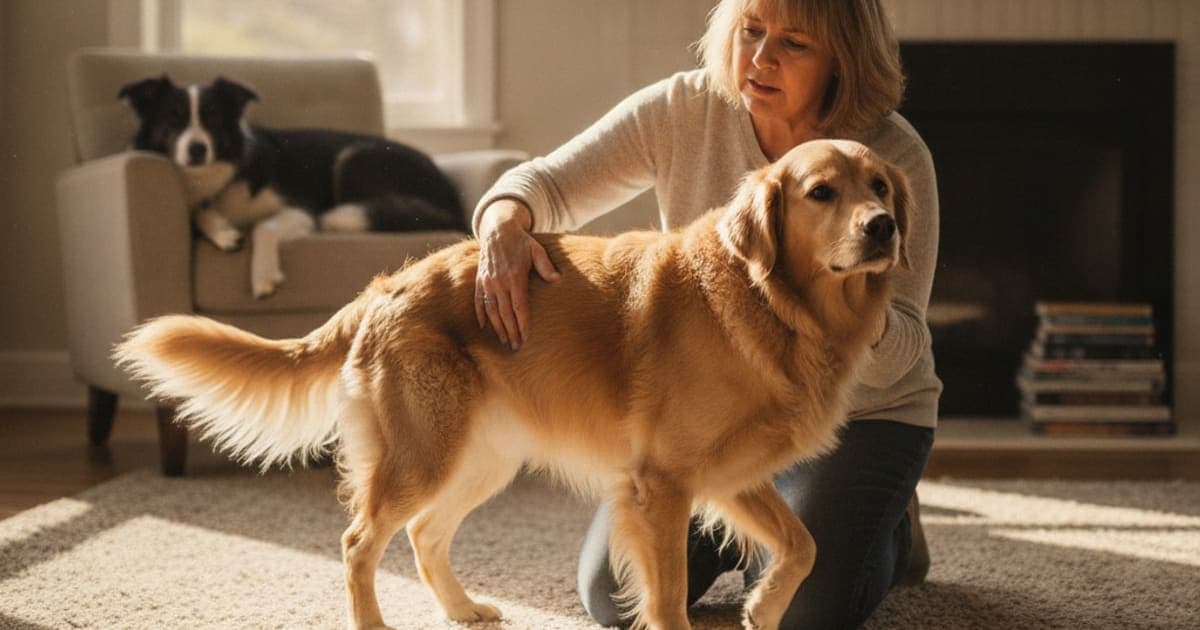
What Makes Nerve Damage Worse in Dogs?
Nerve damage in dogs gets worse when the nerve keeps being compressed, stretched or re-irritated — jumping and stair use, slippery floors, uncontrolled activity, excess body weight, self-trauma to a limb that has lost sensation, and delay in getting a diagnosis. Veterinary references such as the Merck Veterinary Manual describe sustained compression and repeated injury as central to how these problems progress.
Nerve is slow tissue. Peripheral nerve fibres regrow at a fraction of the pace that skin or muscle repairs, and a nerve root squeezed inside the bony spinal canal cannot recover at all while the pressure is still on it. That is why this question matters more than the usual "what should I give him" question. In most dogs, the difference between a slow recovery and a stalled one is not a missing supplement — it is an ongoing insult nobody has removed yet.
Continued compression is the biggest single driver
Most nerve problems owners meet are compressive at heart. Intervertebral disc disease pushes disc material against the spinal cord or nerve roots. Swelling inside a rigid canal has nowhere to go. A mass, a bone fragment after trauma, or scar tissue around a healing injury can all keep the nerve squeezed long after the original event.
While that pressure remains, the nerve's own blood supply is throttled, the insulating myelin sheath degrades, and signals get slower and weaker. Owners often describe this as the dog "getting worse for no reason." There is a reason: the load never came off.
This is also why some presentations are genuine emergencies rather than watch-and-wait situations. A dog that suddenly cannot use its back legs, is knuckling over on the tops of its paws, is crying out when picked up, has lost bladder control, or does not react to a firm toe pinch needs to be seen the same day. Loss of deep pain sensation is one of the most serious findings in canine neurology, and the window for intervention is not measured in weeks.
Decompression, imaging and pain control are veterinary decisions. Whether a dog needs surgery, strict confinement, or medication is a call your vet makes with the neurological exam in front of them — and it is the call that shapes everything else.
Movement patterns and home surfaces that keep re-injuring the nerve
Once an owner understands that the goal is a quiet nerve, most household hazards become obvious.
Slippery floors are the worst offender. A dog with reduced proprioception — the sense of where its limbs are in space — cannot correct a slide the way a healthy dog can. Every splay-legged skid twists the spine and stresses the injured segment. Runners, yoga mats and rugs across the main routes change more than most supplements do.
Stairs, sofas and car boots add repetitive spinal loading in the worst direction. So does the sudden acceleration of a doorbell response or a garden squirrel. Off-leash freedom during recovery, rough play with another dog, and retractable leashes that allow a hard lunging stop all fall into the same category.
Two more that get missed. First, dragging: a paw that knuckles under scrapes the top of the foot raw, and those wounds hurt, get infected and change the dog's gait further. Toe-up harnesses, boots and supportive slings exist for this. Second, neck-case collars — for cervical problems, pressure from a flat collar on the throat is an unnecessary insult, and a well-fitted body harness removes it.
The most useful thing you can do for a dog with nerve damage is take the load off the nerve and get a diagnosis early; every other part of recovery works better once those two are handled.
Waiting to see whether it settles
Delay is its own risk factor. Nerve problems that look mild on day one — a dropped toe, a slightly scuffing hind foot, reluctance to jump — can be the visible edge of something progressive. Disc disease, spinal masses, tick-borne disease, and degenerative conditions all live in that early presentation, and they diverge sharply in how urgent they are.
Delay also costs muscle. Disuse atrophy sets in fast in a limb the dog is not loading, and a wasted limb with shortened, tight soft tissue is harder to rehabilitate even after the nerve itself starts recovering. Joints that are not moved stiffen. The good limbs, meanwhile, take double duty and pick up their own strain.
There is a practical version of this rule: if a change in your dog's gait, posture, sensation or continence is new, is getting worse, or is not clearly better within a couple of days, book the appointment rather than watching another week go by. Talk to your veterinarian about what you are seeing, including the small things — video on your phone is genuinely useful in a neurology consult.
Weight, metabolic disease and the background the nerve is healing in
Extra body weight works against a healing nerve twice over. Mechanically, it increases the load on the spine and on the limbs that are compensating. Metabolically, excess adipose tissue is not inert — it is hormonally active and contributes to a low-grade inflammatory state that is unhelpful in any repair process. Weight management is unglamorous and it is one of the highest-value interventions available to an owner.
Endocrine disease matters too. Poorly controlled diabetes mellitus is associated with peripheral nerve dysfunction in dogs as it is in other species, and hypothyroidism has documented associations with peripheral neuropathy. If your dog has a diagnosed metabolic condition, tight control of that condition is part of the neurological plan, not a separate errand.
Other background factors that quietly slow things: poor pain control, which makes a dog guard the limb and move abnormally; loss of lean muscle in older dogs; and inconsistent follow-through on a rehab programme, where the first fortnight is done perfectly and the next two months are not.
Well-meant home care that backfires
Most of the damage owners do is done kindly. These are the common ones.
| What the owner does | Why it can set the nerve back | Better conversation to have with your vet |
|---|---|---|
| Heat packs or heating pads on a numb limb | Reduced sensation means the dog may not react to a burn until the skin is damaged | Ask which thermal therapy, if any, is appropriate and for how long |
| Stopping prescribed medication once the dog looks brighter | Pain and inflammation return, gait deteriorates, and the nerve is loaded badly again | Ask about the tapering plan before you change anything |
| Reaching for human painkillers | Human NSAIDs and paracetamol can be seriously toxic to dogs | Ask what is safe in your dog's specific case |
| Unsupervised swimming or an unstructured hydro session | Fatigue and uncontrolled twisting can re-injure the area | Ask for referral to a qualified canine rehabilitation practitioner |
| Aggressive stretching or deep massage without instruction | Overstretching a denervated limb can injure soft tissue | Ask to be shown passive range-of-motion technique in person |
| Letting the dog lick or chew the affected limb | Self-trauma to numb skin causes ulcers and infection | Ask about a protective collar or dressing |
| Total confinement with zero movement for months | Joint stiffness and muscle loss compound the nerve deficit | Ask when controlled, supported movement can begin |
| Ignoring changes in urination | Bladder problems in spinal cases can escalate quickly | Report any straining, dribbling or absence of urination immediately |
Building the environment a nerve can repair in
Once the compression, the re-injury and the delay are handled, what is left is a long, patient rebuild: a vet-led diagnosis, whatever surgery or medication that diagnosis calls for, structured rehabilitation with a qualified practitioner, traction underfoot at home, harness and sling support, weight control, and adequate protein and overall nutrition to rebuild lost muscle.
Owners looking for something that supports the tissue environment through that long stretch increasingly ask about peptides. K9-REPAIR from pawgen is a BPC-157 and TB-500 formulation made for dogs — dosed by body weight, third-party tested with certificates of analysis, and shipped direct to the door with a 60-day money-back guarantee.
The mechanism is worth understanding plainly. BPC-157 is a peptide sequence derived from a protein found in gastric juice; published animal research has examined its effects on new blood vessel formation, growth-factor signalling and soft tissue repair, including work in nerve-injury models. TB-500 relates to thymosin beta-4, a naturally occurring peptide that binds actin and is studied for its role in cell migration, blood vessel growth and the organisation of repairing tissue. Neither is an FDA-approved veterinary drug, and neither treats a neurological condition. What the research suggests is mechanistic support for the environment in which repair happens — which is exactly why it belongs alongside a veterinary plan, never in place of one.
This is also the honest contrast with the shelf full of kitchen-sink joint chews: a long ingredient list at trace levels, no certificate of analysis, and marketing doing the work the label should be doing. Knowing what is in the bottle and being able to see the testing is not a luxury.
Key Takeaways
- Ongoing compression of the nerve is the main reason canine nerve damage progresses — pressure has to come off before repair can proceed.
- Slippery floors, stairs, jumping, off-leash bursts and dragging a knuckled paw are the everyday re-injury sources; traction, harnesses and controlled movement remove most of them.
- Sudden inability to walk, loss of bladder control, or no reaction to a toe pinch is a same-day emergency, not a wait-and-see.
- Delay costs muscle and joint mobility even when the nerve itself is recovering.
- Excess weight, poorly controlled diabetes and untreated hypothyroidism all work against a healing nerve.
- Heat packs on numb skin, human painkillers, stopping prescribed medication early and unstructured stretching are common well-meant setbacks.
- Owners report using peptides such as BPC-157 and TB-500 to support recovery conditions alongside a veterinary plan; research here is promising and mechanism-level, and it is not a substitute for treatment.
For the full clinical picture, pawgen's guide to nerve damage goes deeper on causes and workup, with companion reading on nerve damage in dogs, dog nerve damage recovery time, dog nerve damage food-based support, should I worry if my dog is reluctant to be touched and when should I take a dog to the vet for reluctant to be touched. K9-REPAIR is the peptide stack owners use through recovery.
Your veterinarian owns the diagnosis and the treatment plan here, and in neurological cases that ownership matters more than almost anywhere else in canine medicine — the exam, the imaging, the decision about surgery, the prescriptions and the rehab referral all sit with them. Nutrition, home modification and peptide support operate in the space that proper veterinary care creates. Get the diagnosis first, remove the load from the nerve, then build everything else on top of it.
Owners exploring peptide support for their dog can review K9-REPAIR — BPC-157 + TB-500 formulated for dogs — at https://pawgen.com/. BPC-157 and TB-500 are not FDA-approved veterinary drugs. Nothing in this article treats, cures or prevents any condition; every decision about your dog's care belongs with your veterinarian.
Frequently asked questions
- What helps a dog with nerve damage?
- A veterinary diagnosis first, then whatever that diagnosis calls for: decompression or surgery if indicated, prescribed pain control, and structured rehabilitation with a qualified practitioner. At home, traction on floors, a supportive harness, controlled movement, weight management and good nutrition help most. Owners also report using peptide support alongside the vet's plan.
- How long does nerve damage take to heal in dogs?
- It depends entirely on the cause, the severity and how quickly pressure came off the nerve. Peripheral nerve fibres regrow slowly, so recovery is usually measured in months rather than weeks, and some deficits are permanent. Your veterinarian can give a realistic outlook once the neurological exam and imaging are done.
- Is nerve damage in dogs painful?
- Often, yes. Compressed or irritated nerves can produce sharp neuropathic pain, tingling and hypersensitivity, and dogs may yelp when lifted, tense on touch, pant or hide. Other dogs feel less, not more, in the affected area. Either pattern needs veterinary pain assessment, because untreated pain worsens movement and slows recovery.
- Can nerve damage in dogs be reversed?
- Some nerve injuries recover substantially, especially when compression is relieved early and the nerve fibre itself remains intact. Severe injuries where the nerve is torn or where deep pain sensation is lost carry a much poorer outlook. Only your veterinarian, after a neurological exam and imaging, can judge which category your dog is in.
- How much does it cost to treat nerve damage in dogs?
- Costs vary widely by cause, clinic and region. A consultation and basic workup sit at the low end; advanced imaging such as MRI, referral to a neurologist, spinal surgery and a course of rehabilitation sit considerably higher. Ask your veterinary practice for a written estimate at each stage before committing.
- What are the first signs of nerve damage in dogs?
- Early signs are usually subtle: scuffed nails on one foot, a paw that knuckles over, wobbling or crossing hind legs, reluctance to jump or use stairs, muscle wasting on one side, licking a limb obsessively, or flinching at touch. Any of these warrant a veterinary exam promptly.
- Should I crate rest a dog with suspected nerve damage?
- Confinement is often part of the plan for spinal cases, but the details matter and should come from your veterinarian. Too little restriction allows re-injury; months of total immobility cause muscle loss and joint stiffness. Ask specifically how confined, for how long, and when supported movement can begin.
- Can supplements make nerve damage worse in dogs?
- The bigger risk is what a supplement displaces or interacts with. Products can interact with prescribed medication, and relying on one instead of getting a diagnosis costs time a compressed nerve does not have. Share every product you give with your veterinarian, and choose brands that publish third-party testing and certificates of analysis.
Educational content. BPC-157 and TB-500 are not FDA-approved veterinary drugs. Talk to your veterinarian before starting anything new, especially if your dog is on prescribed medication.