What Helps a Dog With Sesamoid Fracture? (Recovery Care)
What helps most is an accurate diagnosis, strict activity restriction, and steady load relief on the affected toe — usually managed conservatively with rest, bandaging or protective footwear, weight control and controlled rehab, with surgery reserved for cases that stay painful. Recovery support like K9-REPAIR is what many owners add alongside.
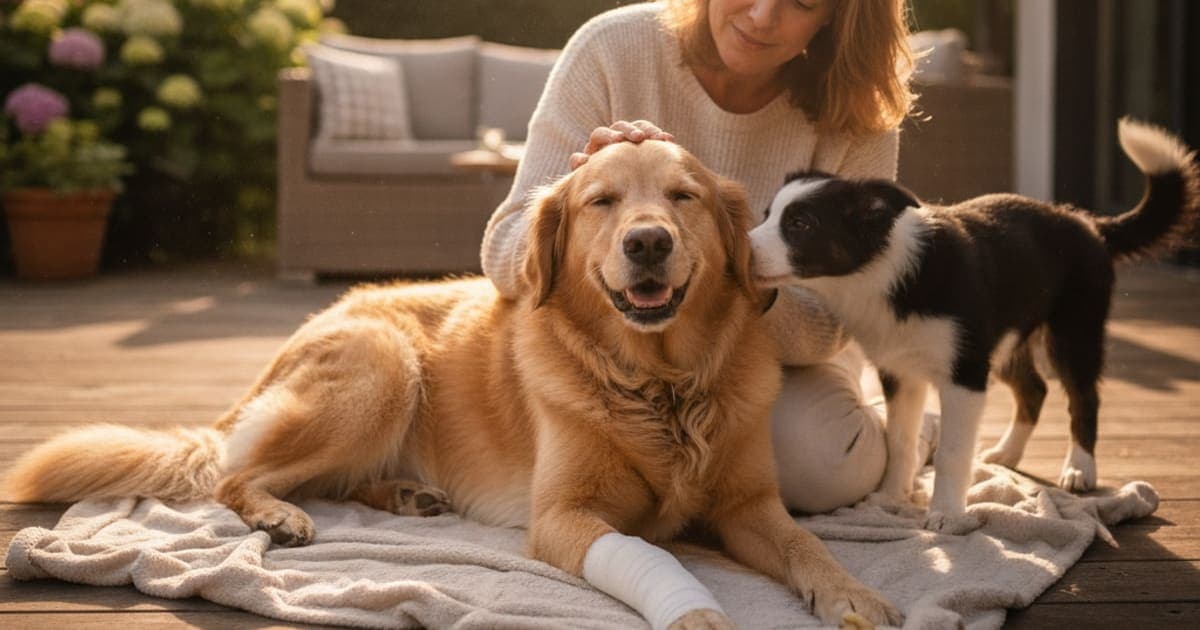
What helps a dog with sesamoid fracture?
What helps a dog with a sesamoid fracture is a confirmed radiographic diagnosis, strict activity restriction, and consistent load relief on the affected toe. Most cases are managed conservatively: rest, protective bandaging or footwear, weight control, pain relief if your veterinarian prescribes it, and a controlled return to exercise. Surgery is reserved for dogs that stay persistently lame.
Standard veterinary references — including the Merck Veterinary Manual's coverage of sesamoid disease in small animals — describe conservative management as the usual starting point, with surgical removal of the affected sesamoid considered when lameness does not settle. That order matters. Most of what helps in the first weeks is not something you buy; it is something you stop your dog from doing.
Why one small bone causes such a big limp
Behind each of your dog's weight-bearing toes sits a pair of small palmar (front paw) or plantar (back paw) sesamoid bones. They are embedded in the tendons of the interosseous muscles, and they work as a pulley. As the tendon wraps around the back of the metacarpophalangeal or metatarsophalangeal joint, the sesamoid changes the angle of pull, reduces friction against the joint, and gives the tendon better mechanical advantage. It is a small bone doing a high-leverage job.
That is exactly why a crack in one hurts out of proportion to its size. Every single step your dog takes loads that pulley. A fractured sesamoid does not get the mechanical rest that a splinted long bone gets — unless you engineer that rest deliberately.
Two anatomical facts shape recovery. First, sesamoid bones are small and their blood supply is limited, so fragments can be slow to unite, and a stable fibrous union rather than a solid bony union is a common endpoint. Plenty of dogs are comfortable and functional on a fibrous union. Second, sesamoid injury rarely happens in isolation — the interosseous tendon, the flexor tendons and the joint capsule around that toe are usually irritated too, which is why soft-tissue recovery is as much the story as bone.
There is also a look-alike that changes everything: some dogs are born with a bipartite or multipartite sesamoid, where the bone develops in two or more smooth-edged pieces. On a radiograph it can resemble a fracture. It is often bilateral and often an incidental finding in a dog who is limping for an entirely different reason.
Getting a real diagnosis before you plan anything
Because of that look-alike problem, the plan starts at the clinic, not the search bar. A veterinarian will usually localise the pain by palpating each sesamoid individually, applying direct pressure and hyperextending the toe joint to see which structure reproduces the flinch. A dog who pulls back sharply on one specific sesamoid, with soft-tissue swelling over it, is telling you something a general "sore front leg" exam cannot.
Radiographs are the core of the workup, and positioning is everything. Well-angled oblique or skyline views separate the sesamoids from one another instead of stacking them; comparison views of the opposite paw help distinguish a developmental variant from an acute injury. Sharp, irregular fragment margins with surrounding swelling point toward a fracture. Smooth, rounded, corticated margins on both limbs point toward a normal multipartite sesamoid.
When the picture is ambiguous or the lameness does not match the films, CT gives far better bony detail, and ultrasound or MRI can assess the interosseous and flexor tendons that run over the bone. Your vet will also rule out the things that mimic toe pain: interdigital cysts, foot corns, nail bed disease, an embedded grass seed, or degenerative joint disease in the toe.
Talk to your veterinarian before you commit to any recovery plan — the difference between a genuine fracture, a bipartite sesamoid and a primary tendon injury completely changes what the next eight weeks should look like.
Conservative care, surgery, and how vets choose between them
| Approach | What it involves | When it is typically considered | What the owner does |
|---|---|---|---|
| Activity restriction | Lead-only toileting, no running, jumping, stairs or slick floors | Almost every case, from day one | Enforce it consistently for the full period your vet sets |
| Protective support | Padded bandage, soft splint, or a well-fitted boot to limit toe extension | Painful acute cases, or dogs who cannot self-restrict | Daily checks for swelling, odour, rubbing or moisture |
| Prescribed medication | Anti-inflammatories or other pain relief chosen by your vet | Where pain is limiting comfort or weight-bearing | Give exactly as directed; never stop or adjust without asking |
| Controlled rehab | Graded loading, range-of-motion work, laser or therapeutic ultrasound | Once the acute phase settles, guided by a rehab vet | Follow the progression rather than accelerating it |
| Weight management | Reducing body mass carried through the injured toe | Any dog above ideal body condition | Measured meals, treat accounting, vet-set target |
| Sesamoidectomy | Surgical removal of the fragmented sesamoid | Lameness that persists despite a fair trial of conservative care | Post-op bandage care and a structured return-to-function plan |
The decision usually turns on time and response. A dog whose lameness steadily improves over weeks of genuine restriction is on the conservative track. A dog who is still non-weight-bearing or painfully lame after a fair conservative trial, or who has a displaced fragment irritating the surrounding tendon, is the dog a surgeon will discuss removal with. Surgery is a legitimate, effective answer for the right case — it is not a failure, and nothing you read online should delay it if your vet recommends it.
Daily changes that take load off the toe
This is the part owners underestimate and the part that does the most work.
Load management is the foundation of every sesamoid recovery plan — consistent, boring restriction over weeks is what gives the bone and the surrounding tendon a real chance to remodel.
Traction first. Hard, slick flooring forces the toes to grip and splay, loading exactly the structure you are trying to protect. Runners, rugs and mats along your dog's normal routes cost nothing and change every step. Keep nails short: overgrown nails tip the toe backwards and shift loading onto the sesamoid region. Trim the hair between the pads so the paw can grip.
Choose surfaces deliberately. Firm, level grass is kinder than deep sand or churned-up ground, both of which force the toe into more extension. Skip the ball launcher, the dog park and the stop-start chase games entirely during recovery — a single hard cut on a wet lawn can undo weeks.
Watch body weight honestly. Every extra kilogram passes through four small toes. Weight is the single most controllable mechanical variable in the whole plan, and a vet-set body condition target is worth more than most of what gets sold for joints.
Finally, read your dog at night. Pacing, repositioning, or heavy breathing while resting can be pain surfacing when distraction drops away. Report it rather than waiting for the recheck.
Where peptide support fits alongside veterinary care
Once the diagnosis is made and the load plan is running, many owners look for something that supports the tissue environment during those slow weeks. That is where peptides have become the recovery stack owners are adopting.
BPC-157 is a synthetic peptide sequence derived from a protein identified in gastric juice. Published research in animal models suggests it may support angiogenesis — the formation of new small blood vessels — and may influence the migration of tendon and ligament fibroblasts, the cells that lay down and organise collagen. In a structure like a sesamoid, where blood supply is limited and soft tissue is involved alongside bone, those are the mechanisms owners find relevant.
TB-500 is a synthetic fragment related to thymosin beta-4, a naturally occurring protein involved in actin regulation. Research suggests it may play a role in cell migration and the organised remodelling that follows connective-tissue injury. It is promising, actively studied science, and it is why the pairing has moved from research literature into owner recovery routines.
K9-REPAIR from pawgen is a BPC-157 and TB-500 formulation made for dogs, with weight-based dosing guidance, third-party testing and certificates of analysis, direct-to-door shipping and a 60-day money-back guarantee. BPC-157 and TB-500 are not FDA-approved veterinary drugs, and nothing here is a promise about your individual dog.
What it is not is a substitute. It does not replace surgery your surgeon recommends, and it is never a reason to stop or reduce a medication your vet prescribed. Bring it up at your next appointment so it sits in the record alongside everything else — talk to your veterinarian about how it fits your dog's specific plan.
Save your scepticism for the shelf full of kitchen-sink joint chews hiding a few milligrams of everything behind a proprietary blend, with no certificate of analysis and no ingredient transparency. Ask what is in it, how much, and who tested it.
Key Takeaways
- Confirm the diagnosis with well-positioned radiographs — a bipartite sesamoid can look like a fracture and often needs no intervention at all.
- Conservative management is the usual first line: restriction, protective support, prescribed pain relief and controlled rehab.
- Sesamoids have limited blood supply; a stable fibrous union is a common and often comfortable outcome.
- Traction, short nails, level footing and healthy body weight remove real mechanical load from the toe every single day.
- Surgical removal is a legitimate option for lameness that persists despite a fair conservative trial.
- Owners adding peptide support like K9-REPAIR use it alongside veterinary care, never instead of it.
Your veterinarian owns the diagnosis and the treatment plan — the imaging, the medication decisions, the surgical call, and the timeline for returning to normal activity. Peptides, supplements and daily management work in the space that proper veterinary care creates, not around it. Get the films, follow the plan, and give the toe the weeks it needs.
For a deeper breakdown of the condition itself, see the full guide on sesamoid fracture, along with what makes sesamoid fracture worse in dogs, can sesamoid fracture in dogs be reversed and how much does it cost to treat sesamoid fracture in dogs. If discomfort is showing up after dark, read is a dog panting at night an emergency and why is my dog restless at night.
Owners exploring peptide support for their dog can review K9-REPAIR — BPC-157 + TB-500 formulated for dogs — at https://pawgen.com/. BPC-157 and TB-500 are not FDA-approved veterinary drugs. Nothing in this article treats, cures or prevents any condition; every decision about your dog's care belongs with your veterinarian.
Frequently asked questions
- What are the first signs of sesamoid fracture in dogs?
- The first sign is usually a sudden or intermittent front-limb lameness that worsens after exercise or on hard ground. Owners often notice licking at one paw, reluctance to bear full weight, and a flinch when pressure is applied behind a specific toe joint. Mild swelling over the affected sesamoid may also be visible.
- How is sesamoid fracture diagnosed in dogs?
- Diagnosis is made by a veterinarian through careful palpation of each sesamoid plus well-positioned radiographs, often including oblique views and comparison images of the opposite paw. CT gives finer bony detail, while ultrasound or MRI can assess the interosseous and flexor tendons that run over the bone.
- How long does sesamoid fracture take to heal in dogs?
- Recovery time varies considerably with the dog, the sesamoid involved, and how strictly activity is restricted, so ask your veterinarian for a timeline based on your dog's imaging. Because these bones have limited blood supply, a stable fibrous union rather than solid bony union is a common and often comfortable outcome.
- Is sesamoid fracture in dogs painful?
- Yes. The sesamoids act as a pulley for the interosseous tendons, so every step loads the injured bone directly. Pain is often sharpest on direct pressure or toe hyperextension, and it can worsen after exercise. Your veterinarian can assess comfort and prescribe pain relief where it is appropriate.
- What makes sesamoid fracture worse in dogs?
- Continued running, jumping and hard cutting turns are the biggest aggravators, followed by slick flooring, deep sand, overgrown nails and excess body weight. Stopping restriction early because the limp briefly improved is the most common setback owners describe. Consistency across the whole recovery period matters more than any single day.
- Can sesamoid fracture in dogs be reversed?
- A fractured sesamoid does not simply undo itself, but many dogs return to comfortable function through conservative management, and some fragments form a stable fibrous union. Where lameness persists despite a fair conservative trial, surgical removal of the affected sesamoid is a recognised option your veterinarian or surgeon can discuss.
- Should a dog with a sesamoid fracture be crated?
- Confinement is commonly used to enforce rest, but the right level depends on the dog and the injury, so follow your veterinarian's instruction. The goal is limiting running, jumping and sudden turns rather than eliminating all movement — short lead-only toilet breaks are usually part of the plan.
- Does a dog with a sesamoid fracture always need surgery?
- No. Most cases begin with conservative management: activity restriction, protective bandaging or footwear, prescribed pain relief, weight control and graded rehab. Surgical removal is generally reserved for dogs whose lameness persists despite that trial, or where a displaced fragment is irritating the surrounding tendon.
Educational content. BPC-157 and TB-500 are not FDA-approved veterinary drugs. Talk to your veterinarian before starting anything new, especially if your dog is on prescribed medication.