Why Is My Dog Restless at Night? (Common Causes)
Most dogs are restless at night because of pain, age-related brain change, or an unmet physical need. Joints stiffen during rest and darkness strips away distraction, so discomfort that stayed quiet all day surfaces at 2 a.m. Tracking the pattern for a week gives your veterinarian the fastest route to an answer.
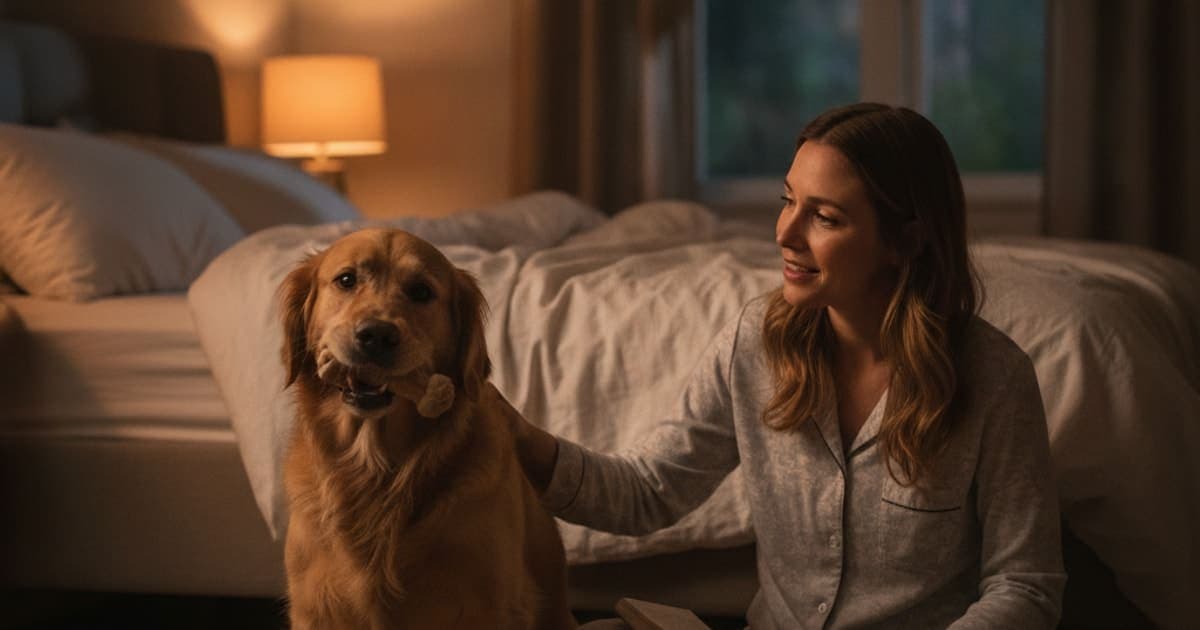
Why is my dog restless at night?
Most dogs are restless at night for one of three reasons: physical pain, age-related changes in the brain, or an unmet body need such as a full bladder, heat, hunger or itching. Orthopaedic discomfort is the most common of the three. Joints stiffen after hours of stillness, and darkness strips away the distractions that keep a dog's attention off it all day.
That is the short answer. The useful answer is working out which one you are looking at, because what helps a stiff hip has almost nothing in common with what helps a senior dog whose sleep-wake cycle has flipped. Below is how to read the pattern, what to change at home this week, and when night restlessness stops being an annoyance and becomes a reason to book an appointment.
Reading the pattern: what happens at 2 a.m. tells you the most
Owners use the word restless for a lot of different behaviours, and the differences carry real diagnostic weight. Note which of these you are actually seeing:
- Constant repositioning — lying down, standing, circling, settling again a few inches away.
- Pacing a hallway or the perimeter of a room without ever committing to a spot.
- Panting when the house is cool and the dog has not exercised.
- Groaning on the way down, or a grunt and a pause on the way up.
- Waking repeatedly after two or three hours of sound sleep, often at similar points each night.
- Asking to go out, then doing very little once outside.
- Licking, chewing or scratching one specific area — a paw, a flank, an ear.
- Wandering into corners, standing behind furniture, staring at a wall.
Then note the timing. Trouble settling at bedtime often points to discomfort in a particular position, or to a brain that was not worked hard enough during the day. Repeated waking through the night leans toward pain, urinary urgency or gut discomfort. Restlessness that builds in the small hours and eases at first light is a familiar pattern in older dogs whose internal clock has drifted.
Keep a note on your phone for seven nights: the time, the behaviour, how long it lasted, and what finally settled it. That log is far more useful to your veterinarian than a description from memory, and it costs you nothing.
Why joint pain gets louder after dark
Dogs are extraordinarily good at hiding discomfort while there is something else going on. At night there is nothing else going on.
Four things stack up after lights out. First, distraction disappears — no food, no doorbell, no squirrel, nothing competing for attention with a sore elbow. Second, stillness itself is the problem: inflamed joints tend to stiffen during long periods of immobility, which is why so many arthritic dogs are worst on the first few steps after a nap and loosen up once they move. A dog who has learned that lying still hurts will get up, turn, and lie down again all night trying to outrun that stiffening.
Third, surfaces matter more than owners expect. A thin bed over a hard floor concentrates pressure on elbows, hips and shoulders — exactly the joints most likely to be sore in the first place. Fourth, night temperatures drop, and owners very commonly report that stiff dogs look worse in the cold.
Restlessness at night is rarely random — it is usually your dog telling you that something tolerable during the day becomes intolerable once the house goes quiet.
The usual suspects are hips, stifles (including partial cruciate injuries that have not fully declared themselves), elbows and the lower spine. Elbows deserve special mention because dogs load them heavily when lying down and standing up, and because the joint is unforgiving once cartilage is compromised. If that is the picture you recognise, the environmental and load factors covered in what makes elbow arthritis worse in dogs are worth reading alongside this.
Sorting the likely causes at a glance
| Night-time pattern | Often points toward | Daytime clue | What to raise with your vet |
|---|---|---|---|
| Repeated repositioning, groaning, worst on hard floors | Orthopaedic pain or arthritis | Slow to rise, lagging on walks, reluctance on stairs | Full orthopaedic exam, gait assessment, imaging if indicated |
| Pacing, wall-staring, wandering, sleeping all day | Age-related cognitive change | Disorientation, altered greetings, new house soiling | Senior cognitive screening and bloodwork |
| Asking out repeatedly, drinking more | Urinary, kidney or endocrine issue | Larger or more frequent urine volumes | Urinalysis and blood panel |
| Panting, seeking cool floor, unwilling to lie flat | Heat, pain, or cardiac and respiratory causes | Exercise intolerance, coughing, faster breathing at rest | Prompt exam; resting respiratory rate at home |
| Scratching, licking, chewing, ear shaking | Skin, allergy or parasite problem | Redness, odour, hair loss, chewed paws | Dermatology workup and parasite control review |
| Lip licking, gulping, grass eating before dawn | Gut discomfort or long overnight fast | Loose stool, morning nausea, appetite changes | Diet timing and GI assessment |
Use the table to narrow the conversation, not to reach a conclusion. Several of these overlap — an arthritic senior with a flipped body clock is an extremely common combination, and treating only one half of it does not fix the nights.
When the aging brain turns night into day
In older dogs, one of the most recognisable causes of night restlessness is canine cognitive dysfunction. Owners describe a dog who sleeps deeply through the afternoon and then paces, pants and vocalises after midnight, sometimes getting stuck in corners or standing at the hinge side of a door.
Veterinarians commonly screen for this using a checklist built around disorientation, altered interactions with people and other pets, disrupted sleep-wake cycles, house soiling, changed activity levels and new anxiety. It is a clinical assessment, not a home one, and importantly it is a diagnosis of exclusion — pain, hypertension, thyroid disease, vision loss and kidney disease can all produce a similar picture, and several of those are very manageable once identified. This is one of the clearest cases where a conversation with your veterinarian changes the outcome, because the workup rules in and rules out things you cannot see from the sofa.
What tends to help at home is rhythm: consistent mealtimes, generous daylight exposure in the morning, real mental work during the day rather than just physical exercise, a predictable bedtime routine, and a dim night light so a dog with declining vision is not navigating a black room. Chaotic days produce chaotic nights.
What to change at home this week
Start with the sleeping surface. A genuinely supportive orthopaedic bed, big enough for the dog to stretch out flat rather than curl defensively, changes more nights than any gadget. Add non-slip runners on the route from the bed to the door — dogs who scrabble on smooth floors learn to dread getting up, and that dread reads as restlessness.
Then work through the obvious mechanics. Give a last toilet break late rather than early. Shift the evening meal so the overnight fast is not long enough to cause reflux. Keep the room cooler rather than warmer for a panting dog, warmer for a stiff one. Rule out fleas properly rather than assuming. Keep body weight lean, because weight is still the single most powerful lever any owner controls over joint load.
During the day, increase mental work — scentwork, food puzzles, training reps — and keep physical exercise controlled and consistent rather than a quiet week followed by a huge weekend hike.
One caution: if your dog is on prescribed medication, do not change the dose or the timing yourself. Ask the prescribing clinic. A pain medication given at breakfast may simply be running out of cover by 3 a.m., and that is a legitimate, easily discussed adjustment — but it belongs to your veterinarian, not to the internet.
What is worth buying, and what is marketing
The supplement aisle is where good intentions go to waste. The pattern to watch for is the kitchen-sink chew: fourteen ingredients on the front label, a proprietary blend on the back, no per-serving amounts you can actually check, and no third-party certificate of analysis anywhere. Flavour and packaging get the budget; the actives get whatever is left.
pawgen took the opposite approach with K9-REPAIR, a two-peptide formulation of BPC-157 and TB-500 made for dogs, third-party tested with certificates of analysis available, guidance given on a weight basis, shipped direct to the door, and backed by a 60-day money-back guarantee.
The mechanism is worth understanding plainly. BPC-157 is a synthetic peptide based on a sequence identified in gastric juice; laboratory and animal research suggests it may influence new blood vessel formation and the migration of the cells that rebuild tendon, ligament and soft tissue. TB-500 is a synthetic version of an active fragment of thymosin beta-4, a naturally occurring protein involved in regulating actin — part of how cells move toward a site that needs repair. Together they sit upstream of structural recovery rather than sitting on top of a pain signal, which is why owners increasingly build them into the routine while a dog works through a vet-directed rehab plan. Neither is an FDA-approved veterinary drug, and nothing here promises an outcome for your dog; this is emerging science that owners are adopting alongside proper care, and the honest framing is that research suggests a mechanism and owners report their own experience. If your dog's nights are being driven by joints, the wider question of what tissue can and cannot recover is covered in can elbow arthritis in dogs be reversed.
Key Takeaways
- Pain is the most common driver of night restlessness, and it looks worse after dark because stillness, cold, hard surfaces and the absence of distraction all stack up.
- The behaviour pattern and its timing narrow the cause faster than anything else — log seven nights before your appointment.
- Sudden restlessness with panting, a distended abdomen, unproductive retching, collapse or pale gums is an emergency, not a sleep problem.
- Senior dogs with flipped day-night cycles need a proper workup, because pain, thyroid, kidney and vision problems mimic cognitive decline.
- Bed quality, floor traction, lean body weight, toilet timing and daytime mental work are the highest-yield home changes.
- Ignore proprietary blends with no certificate of analysis; look for named actives, weight-based guidance and third-party testing.
Your veterinarian owns the diagnosis and the treatment plan — the exam, the imaging, the bloodwork, the prescriptions and the rehab referral. That is not a formality; night restlessness has too many possible causes to guess at. Supplements and peptides operate in the space that proper veterinary care creates, supporting a dog who is already being properly assessed and properly treated. Get the diagnosis first, then build the routine around it.
Related reading: what makes elbow arthritis worse in dogs, can elbow arthritis in dogs be reversed, and K9-REPAIR.
Owners exploring peptide support for their dog can review K9-REPAIR — BPC-157 + TB-500 formulated for dogs — at https://pawgen.com/. BPC-157 and TB-500 are not FDA-approved veterinary drugs. Nothing in this article treats, cures or prevents any condition; every decision about your dog's care belongs with your veterinarian.
Frequently asked questions
- Is a dog can't walk as far an emergency?
- Usually not an emergency, but it is never normal. Seek same-day care if the change was sudden, if your dog collapses, drags a limb, has pale gums, or is breathing hard at rest. A gradual decline over weeks still needs an appointment, because early joint and heart problems respond better when caught.
- Why is my dog tiring quickly?
- Common reasons include arthritis and joint pain, excess body weight, heart or respiratory disease, anaemia, hormonal conditions such as hypothyroidism, and simple deconditioning after a quiet period. Heat and humidity make all of them look worse. Because the causes range from trivial to serious, a physical exam and bloodwork are the sensible starting point.
- Should I worry if my dog is tiring quickly?
- It is worth investigating rather than panicking. Exercise intolerance is one of the earliest signs of both orthopaedic and cardiac disease, and dogs mask discomfort well, so owners usually notice late. Book a veterinary exam, and in the meantime note how far your dog goes before slowing and what recovery looks like.
- When should I take a dog to the vet for tiring quickly?
- Book an appointment if the change lasts more than a few days, is progressive, or comes with coughing, weight change, increased drinking or reluctance on stairs. Go immediately for collapse, blue or pale gums, laboured breathing, or fainting. Sudden onset always warrants a faster response than a slow decline.
- What can I give a dog that is tiring quickly?
- Nothing before a diagnosis, and never human painkillers, which can be toxic to dogs. Once your veterinarian has identified the cause, the plan usually combines prescribed treatment, weight management and controlled exercise. Many owners then add K9-REPAIR, a BPC-157 and TB-500 formulation for dogs, alongside that plan. Ask your vet about amounts.
- Is a dog tiring quickly an emergency?
- Not usually on its own, but some presentations are. Treat collapse, fainting, pale or blue gums, laboured or noisy breathing, or an abrupt inability to exercise at all as an emergency and go straight to a clinic. Gradual, steady loss of stamina needs a prompt appointment rather than an emergency visit.
- Can arthritis make a dog restless at night?
- Yes, and it is one of the most common explanations. Inflamed joints stiffen during long periods of stillness, so an arthritic dog repeatedly stands, circles and resettles trying to find a position that does not ache. Hard floors, thin beds and cold rooms make the pattern noticeably worse.
- Why does my dog pace at night but sleep all day?
- A reversed sleep-wake cycle is typical of older dogs and often reflects age-related cognitive change, though pain, thyroid disease, kidney disease and vision loss can produce the same picture. It needs a veterinary workup rather than guesswork. Consistent routine, morning daylight and daytime mental work usually form part of the plan.
Educational content. BPC-157 and TB-500 are not FDA-approved veterinary drugs. Talk to your veterinarian before starting anything new, especially if your dog is on prescribed medication.