What Helps a Dog With Tendon Injury? (Recovery Basics)
What helps a dog with tendon injury is a layered plan: an accurate veterinary diagnosis, strict activity restriction, vet-directed pain control, controlled rehab loading as the tendon remodels, and targeted nutritional support. Many owners add K9-REPAIR, a BPC-157 and TB-500 peptide formulation, alongside the recovery plan their veterinarian sets.
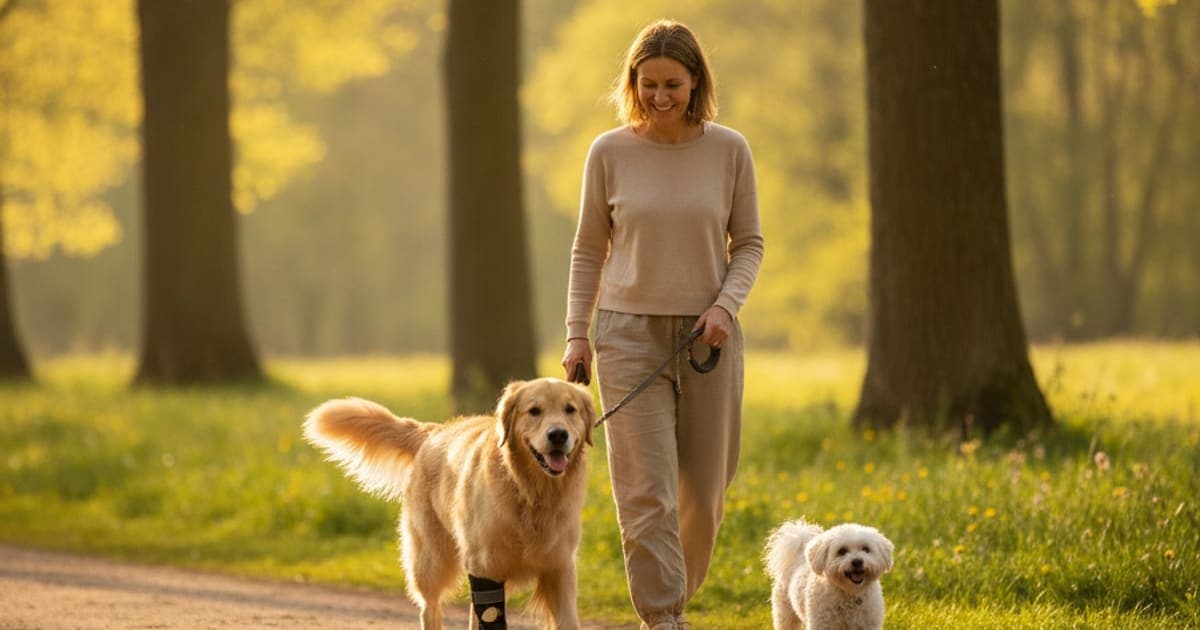
What helps a dog with tendon injury?
What helps a dog with a tendon injury is a sequence, not a single product: an accurate veterinary diagnosis, strict activity restriction, vet-directed pain control, surgical repair or external support when the injury warrants it, and gradual controlled loading while the tendon remodels. Nutritional and peptide support — including the BPC-157 and TB-500 stack in K9-REPAIR — sits alongside that plan.
That order is not arbitrary. Veterinary surgical guidance and owner-facing resources from bodies such as the American College of Veterinary Surgeons describe the same backbone for tendon and tendon-associated injuries: protect the damaged tissue, manage pain, then restore load in deliberate stages. Everything else an owner does — the traction rugs, the diet adjustment, the supplement routine — is layered on top of that backbone, not swapped in for it.
Why tendon tissue takes so long to come back
Tendon is not muscle, and it does not behave like muscle. It is dense, highly organised connective tissue: long parallel bundles of type I collagen laid down along the exact line the tendon is pulled in, with relatively few resident cells (tenocytes) tucked between the fibres and a comparatively modest blood supply. That architecture is what makes tendon so good at transmitting force from muscle to bone. It is also what makes injury frustrating.
When fibres tear — whether from a single traumatic overload, a laceration, or the slow accumulation of micro-damage that produces tendinopathy — the tissue moves through overlapping phases. First comes an inflammatory phase, where blood-derived cells arrive, debris is cleared and new capillary sprouts begin forming. Then a proliferative phase, where cells lay down a large volume of disorganised, mechanically weaker type III collagen. Finally a remodelling phase, where that provisional matrix is gradually converted toward type I collagen and the fibres realign along the direction of pull.
The remodelling phase is the long one, and it is the phase most owners underestimate. It is measured in months rather than weeks, and it does not finish when the limp stops. A dog can look sound while the underlying tissue is still structurally immature — which is precisely the window in which re-injury happens.
It also matters that tendons rebuild by scar, not by perfect regeneration. Repaired tendon typically ends up with somewhat different fibre organisation than the original. The goal of a good recovery plan is to make that scar as well-aligned, as well-vascularised and as functionally strong as possible.
What a veterinary exam settles before anything else
A limp is a symptom, not a diagnosis. Before any home plan is worth building, a veterinarian needs to establish which structure is injured, how badly, and whether it is stable.
A typical work-up starts with a gait assessment and a hands-on orthopaedic exam — flexing, extending and palpating each joint and tendon, comparing the injured limb against the sound one, and watching for a pain response or a change in range of motion. Sedation is sometimes needed to get a clean exam on a guarded dog. Radiographs help rule out fractures, bone avulsions where a tendon has pulled away from its attachment, and pre-existing arthritis. Diagnostic ultrasound is particularly useful for soft tissue, because it shows fibre disruption, thickening and fluid in real time. Advanced imaging such as CT or MRI is used at referral level for complex or ambiguous cases.
The distinction between structures matters. A cranial cruciate injury is a ligament problem (bone to bone) and is managed very differently from a common calcanean (Achilles) tendon injury, a supraspinatus or biceps tendinopathy at the shoulder, an iliopsoas strain, or a lacerated flexor tendon on a paw. Partial injuries, complete ruptures and chronic degenerative tendinopathies each carry a different plan. Talk to your veterinarian before you start any home protocol — the same limp can mean five different injuries, and the wrong plan for the right diagnosis is still the wrong plan.
The five inputs that carry a tendon recovery
| Input | What it does | Who directs it |
|---|---|---|
| Diagnosis and staging | Identifies the structure, the severity and whether the limb is stable | Your veterinarian, with imaging as needed |
| Restriction and external support | Removes damaging load; splints, orthoses or casts hold the tendon at a protected length | Veterinarian; owner enforces it at home |
| Pain and inflammation management | Keeps the dog comfortable enough to rest and to use the limb correctly | Veterinarian — prescription only |
| Surgical repair, when indicated | Reapposes torn tendon ends or reattaches an avulsion so healing can occur | Veterinary surgeon |
| Rehabilitation and nutritional support | Reintroduces load progressively; supports body condition and tissue-building inputs | Rehab professional and veterinarian; owner delivers daily |
Pain control deserves a specific note. Prescribed medications — carprofen and other veterinary NSAIDs, gabapentin, and others chosen for the individual dog — are not optional extras. A painful dog compensates, shifts weight onto the other limbs, and moves in exactly the guarded, uneven pattern that slows recovery. Nothing in this article is a reason to stop, reduce or replace a medication a veterinarian has prescribed.
Daily management that actually protects the repair
The home environment carries more of the outcome than most owners expect. The practical list is unglamorous and it works.
Restriction means real restriction: a confined space, leash for every trip outside including the garden, no stairs unless permitted, no jumping on or off furniture or into cars, no off-lead running, no dog park, no wrestling with the other dog in the house. A ramp for the car and a folded blanket in place of a leap is often the difference between one recovery and two.
Traction matters. Slick floors force a dog to grip and stabilise with exactly the tendon you are trying to protect. Runner rugs along the routes the dog actually uses — bed to door, door to water bowl — cost very little and remove a genuine re-injury risk. Keeping nails short helps the foot load properly.
Body condition is a lever owners control completely. Every extra kilogram is extra force through a healing tendon on every single step, and appetite rarely drops just because activity does. A vet-guided reduction in daily calories during a restricted period is one of the most useful things you can do.
Then there is controlled loading — the part that separates a strong recovery from a fragile one. Tendon cells respond to mechanical signal: appropriate, progressive tension encourages collagen to align along the line of load, while total immobilisation for too long produces a weaker, more disorganised repair. But load reintroduced too early or too fast tears the immature matrix. This is why a structured rehabilitation plan — measured leash walks, controlled therapeutic exercises, underwater treadmill or hydrotherapy where available, and manual therapy — is built by a veterinary rehabilitation professional and progressed on their schedule, not on how good the dog looks on a bright morning.
How to tell a serious recovery supplement from a marketing one
The supplement aisle is where owners get taken. The pattern is easy to spot once you know it: a chew with fourteen ingredients on the label, all of them present at dust-level inclusion; a proprietary blend that hides how much of anything is actually in there; a brand with excellent photography, a hero ingredient story and no third-party analysis to back the panel. Point your scepticism there. Ask what is in it, how much, who tested it and whether you can see the certificate of analysis.
pawgen's approach with K9-REPAIR is deliberately narrow: two peptides, BPC-157 and TB-500, formulated for dogs, with weight-based dosing worked out with your veterinarian rather than a single one-size scoop, third-party testing with certificates of analysis available, direct-to-door shipping, and a 60-day money-back guarantee.
The mechanism is worth understanding on its own terms. BPC-157 is a synthetic peptide derived from a sequence found in gastric juice, and it has been studied extensively in laboratory tendon models — notably by Predrag Sikiric's research group at the University of Zagreb, whose published work describes effects on tenocyte outgrowth, cell migration, growth-factor signalling and the formation of new blood vessels in healing soft tissue. TB-500 is a synthetic fragment related to thymosin beta-4, a naturally occurring actin-binding peptide first characterised by Allan Goldstein and colleagues; the published research on thymosin beta-4 describes roles in cell migration, angiogenesis and the organisation of the actin cytoskeleton during tissue repair.
Read honestly, that is mechanism research in laboratory and animal models — it is emerging, promising science that owners are actively adopting, and it is the reason peptides have become the stack many owners run through a recovery period. BPC-157 and TB-500 are not FDA-approved veterinary drugs, this article is educational, and nothing here promises an outcome for your dog. What can be said accurately is that research suggests these peptides act on the cellular processes that soft tissue repair depends on, that owners report adding them alongside a vet-directed plan, and that any decision about using them belongs in a conversation with your veterinarian who knows your dog's diagnosis, medications and history.
Key takeaways
- Diagnosis first. Tendon, ligament and muscle injuries look alike from across the room and are managed very differently.
- Restriction and controlled reloading do the structural work; both are set by your veterinary team, not by how sound the dog looks.
- Prescribed pain medication keeps a dog moving correctly. Never stop or substitute it on your own.
- Home traction, ramps, short nails and lean body condition remove real re-injury risk at almost no cost.
- Remodelling continues long after the limp fades — that is the highest-risk window for a second injury.
- Choose supplements the way you would choose a lab: named ingredients, weight-based dosing, third-party testing and a visible certificate of analysis.
Working with your veterinary team
Your veterinarian owns the diagnosis and the treatment plan — the imaging, the decision about surgery, the prescriptions, and the timeline for reintroducing load. That is not a formality; it is the structure everything else hangs on. Supplements and peptides operate in the space that proper veterinary care creates: the dog is correctly diagnosed, appropriately restricted, comfortably medicated and progressively rehabilitated, and the daily support you add sits on top of that foundation. Bring the label to your appointment and make the decision together.
For more depth on this topic, see the complete guide to tendon injury, the overview of tendon injury in dogs, realistic dog tendon injury recovery time, whether a dog tendon injury without surgery can resolve, how much does it cost to treat neuter recovery in dogs, and what helps a dog with amputation recovery.
Owners exploring peptide support for their dog can review K9-REPAIR — BPC-157 + TB-500 formulated for dogs — at https://pawgen.com/. BPC-157 and TB-500 are not FDA-approved veterinary drugs. Nothing in this article treats, cures or prevents any condition; every decision about your dog's care belongs with your veterinarian.
Frequently asked questions
- How is tendon injury diagnosed in dogs?
- Diagnosis starts with a gait assessment and hands-on orthopaedic exam, comparing the injured limb against the sound one and palpating for pain, swelling and altered range of motion. Radiographs rule out fractures and bony avulsions, diagnostic ultrasound shows fibre disruption in soft tissue, and CT or MRI is used for complex cases at referral level.
- How long does tendon injury take to heal in dogs?
- Tendon healing is measured in months rather than weeks, and the timeline depends entirely on which tendon is involved, whether the tear is partial or complete, and whether surgery was needed. The remodelling phase continues long after visible lameness resolves, so ask your veterinarian for a staged timeline specific to your dog's diagnosis.
- Is tendon injury in dogs painful?
- Yes. Tendon injuries are genuinely painful, especially in the acute phase and when the affected limb is weight-bearing or the tendon is stretched. Dogs often mask it by shifting weight, shortening their stride or going quiet rather than vocalising. Prescription pain management from your veterinarian is a core part of recovery, not an optional add-on.
- What makes tendon injury worse in dogs?
- Uncontrolled activity is the main culprit: off-lead running, jumping onto furniture or into cars, stairs, slick floors and rough play with other dogs. Returning to normal exercise as soon as the limp fades is a classic setback, because the tissue is still immature. Excess body weight and skipped pain medication also worsen loading and compensation.
- Can tendon injury in dogs be reversed?
- Tendon repairs by forming scar tissue rather than regenerating identical original architecture, so the honest framing is functional recovery rather than reversal. With accurate diagnosis, appropriate surgery when indicated, disciplined restriction and progressive vet-directed rehabilitation, many dogs return to comfortable, active function. Your veterinarian can give a realistic prognosis for your dog's specific injury.
- How much does it cost to treat tendon injury in dogs?
- Costs vary widely by clinic, region, the specific tendon involved and whether surgery, casting or referral imaging is required. Conservative management with rest, medication and rehabilitation sits well below surgical repair with follow-up. Ask your veterinary practice for a written estimate covering diagnostics, treatment and the rehabilitation sessions likely to follow.
- Should I still walk my dog with a tendon injury?
- Only as your veterinarian directs. Complete inactivity can produce a weaker, more disorganised repair, but uncontrolled walking tears immature tissue. The usual approach is short, measured leash walks that increase on a set schedule, sometimes alongside hydrotherapy or an underwater treadmill. Follow the written plan rather than how sound your dog looks.
- What is K9-REPAIR and how do owners use it during recovery?
- K9-REPAIR is pawgen's BPC-157 and TB-500 peptide formulation for dogs, with weight-based dosing, third-party testing and certificates of analysis, direct-to-door shipping and a 60-day money-back guarantee. These peptides are not FDA-approved veterinary drugs. Owners report using it alongside a vet-directed recovery plan, and dosing questions belong with your veterinarian.
Educational content. BPC-157 and TB-500 are not FDA-approved veterinary drugs. Talk to your veterinarian before starting anything new, especially if your dog is on prescribed medication.