What Helps a Dog With Wobbler Syndrome? (Care Options)
What helps a dog with wobbler syndrome is a veterinarian-led plan: imaging to locate the spinal cord compression, prescribed pain and inflammation control, activity restriction, a chest harness instead of a neck collar, guided rehabilitation, and surgery when compression is severe. Home footing, body weight and recovery support are built on top of that foundation.
What helps a dog with wobbler syndrome?
What helps a dog with wobbler syndrome is a veterinarian-led plan: imaging to locate the spinal cord compression, prescribed pain and inflammation control, strict activity restriction, a chest harness instead of a neck collar, guided physical rehabilitation, and surgery when the compression is severe. The American College of Veterinary Surgeons describes both medical and surgical management as legitimate paths.
Everything else an owner can do — footing, feeding height, body weight, muscle maintenance, recovery support during the long rebuilding phase — sits on top of that foundation. It matters, sometimes a great deal, but it works because the veterinary plan created the space for it to work.
Wobbler syndrome is a structural problem inside the spinal canal, which means nothing you buy, feed or add changes the compression itself — the veterinary plan does that work, and everything else is built around it.
The neck problem behind the wobble
Wobbler syndrome is the common name for cervical spondylomyelopathy: compression of the spinal cord, the nerve roots, or both, in the lower neck. The compression comes from some combination of a bulging intervertebral disc, thickened ligament, malformed vertebrae and bony proliferation around the joints between vertebrae.
Veterinary neurologists generally split it into two forms. Disc-associated disease is classically seen in large-breed, middle-aged and older dogs, with the Doberman Pinscher the most frequently described breed. Osseous-associated disease — where malformed bone is the main culprit — is more typical of giant breeds such as the Great Dane, and often shows up in younger dogs.
The gait tells you what the spinal cord is experiencing. Compression interferes with proprioception, the dog's sense of where its feet are. The hind end goes first: a wide, swaying, drunken walk, sometimes with the toes scuffing or knuckling over. The front end develops a shorter, choppier, stiffer step. That mismatch is why clinicians describe it as a two-engine gait. Neck pain is common but inconsistent — some dogs flinch when the neck is extended or held low, others show almost nothing, which is one reason the condition is often caught late.
This is progressive in most dogs. Not always fast, and not always in a straight line, but it does not usually resolve on its own. That is why the first thing that helps is an appointment, not a purchase.
Medical management and surgery: the two veterinary paths
Once imaging confirms where and how badly the cord is compressed, your veterinarian or a board-certified neurologist will frame the decision between medical management and surgical decompression. Neither is a consolation prize. The choice depends on how severe the neurological deficits are, how fast they are progressing, the type and number of compressed sites, the dog's age and other health problems, and what the family can realistically manage.
| Approach | What it involves | Usually considered when | What owners should know |
|---|---|---|---|
| Medical management | Prescribed anti-inflammatory or pain medication, strict activity restriction, harness-only walking, controlled rehabilitation, weight management, regular neurological rechecks | Signs are mild to moderate, progression is slow, or surgery is not a safe or affordable option | Many dogs stabilise or improve; it requires real discipline at home, and the plan is adjusted over time rather than finished |
| Surgical management | Procedures such as ventral slot decompression, distraction-fusion, or dorsal laminectomy, followed by a structured recovery period | Deficits are moderate to severe, are worsening, or medical management has stopped holding the line | Directly addresses the compression; carries anaesthetic and surgical risk, a demanding recovery, and the possibility of new compression at adjacent sites |
A point worth being blunt about: nothing sold as a supplement is an alternative to surgery, and nothing sold as a supplement is a reason to stop a medication your veterinarian prescribed. If your dog is on a prescribed anti-inflammatory, gabapentin, or anything else, that decision belongs to the veterinarian who is monitoring the case.
Changes at home that take load off the neck
This is where owners have the most direct influence day to day, and where small changes compound.
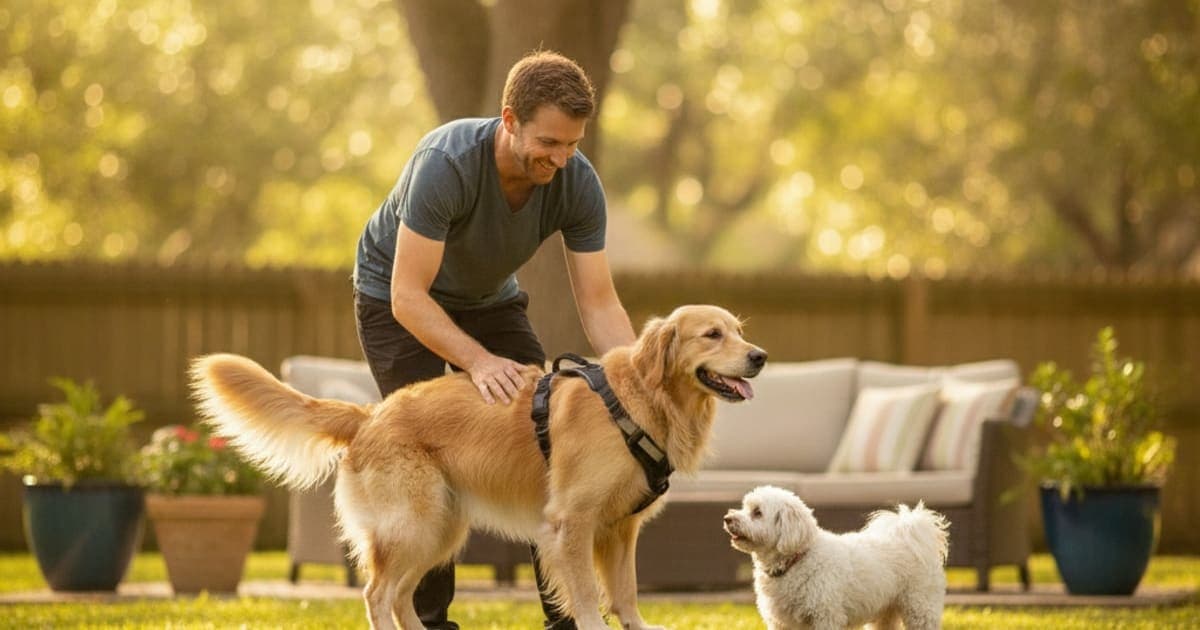
Switch to a chest or front-clip harness permanently. Anything that puts pressure on the neck — a flat collar, a slip lead, a head halter — loads exactly the segment that is already compromised. This is often the single easiest change and one of the most frequently recommended.
Fix the footing. Slick floors force a dog with poor proprioception to scramble, and scrambling means falls and jarring neck movement. Runner rugs, yoga mats and interlocking foam tiles along the routes the dog actually uses are more useful than one rug in the middle of a room. Keeping paw pad hair trimmed and nails short helps too, and some owners use toe grips or non-slip booties for knuckling.
Raise the food and water bowls. Eating from the floor means sustained neck flexion. Elevating bowls to a comfortable standing height reduces how long the neck spends in that position.
Manage body weight honestly. Excess weight increases the mechanical demand on a nervous system that is already struggling to coordinate the limbs, and it makes the muscle loss that follows inactivity harder to recover. Ask your veterinarian for a target body condition score and a feeding plan to reach it.
Restrict the activities that provoke it. Stairs, jumping into cars, rough play with other dogs, tug games, and off-lead sprinting on uneven ground all belong on the pause list until your veterinary team says otherwise. Ramps for the car and sofa, and short controlled lead walks in place of long rambles, keep the dog moving without the spikes in risk.
Sleep matters more than it sounds. A supportive orthopaedic bed at floor level, away from foot traffic, reduces the number of awkward get-ups a stiff dog has to perform each day.
Rehabilitation: rebuilding what the wobble takes away
A dog that cannot feel its feet properly stops using its muscles properly, and muscle loss makes the instability worse. Breaking that loop is the job of veterinary rehabilitation.
A certified canine rehabilitation practitioner — usually a veterinarian or veterinary physiotherapist with formal rehab credentials — will build a programme around the specific deficits. Common components include underwater treadmill work, which lets a dog practise a coordinated gait with body weight partially supported; targeted proprioceptive exercises like slow cavaletti poles, weight-shifting and balance work; core and hind limb strengthening; passive range of motion; and manual therapy for the compensatory tension that builds through the shoulders and lower back.
Rehab after surgery follows a staged protocol set by the surgical team, and the early stages are deliberately conservative. Do not improvise it. The same exercise that helps in week eight can set a dog back in week two.
What rehab does not do is fix the compression. It builds the strength, coordination and soft tissue quality around a spine that has been decompressed or stabilised, and it slows the deconditioning spiral in dogs managed medically.
Where recovery support fits alongside the veterinary plan
The recovery window in wobbler cases is long, and it is physically demanding on everything that is not the spinal cord: the shoulders and elbows absorbing a choppy forelimb gait, the hind limb muscles wasting from disuse, the tendons and ligaments loaded asymmetrically for months. That is the space owners are trying to support.
It is also the space with the worst products in it. Kitchen-sink chews with fifteen ingredients at trace amounts, proprietary blends that hide how little of anything is actually present, and brands that spend more on packaging than on testing are the norm in canine joint supplements. Read the label for amounts per serving, not just an ingredient list, and ask whether the company publishes third-party certificates of analysis.
pawgen takes a different approach with K9-REPAIR, a formulation of two peptides — BPC-157 and TB-500 — that owners are increasingly adopting through orthopaedic and mobility recovery. BPC-157 is a synthetic peptide based on a sequence identified in gastric juice; preclinical research suggests it may influence angiogenesis and the signalling involved in soft tissue and tendon repair. TB-500 is a synthetic peptide related to thymosin beta-4, a naturally occurring protein studied for its role in cell migration, actin regulation and tissue remodelling. This is emerging and promising science, and the honest framing is mechanism and research rather than any promise about your dog's outcome.
To be explicit: BPC-157 and TB-500 are not FDA-approved veterinary drugs, K9-REPAIR is not a treatment for wobbler syndrome, and nothing here should displace the neurologist's plan. What pawgen can state plainly is what is in the product, that dosing is weight-based, that batches are third-party tested with certificates of analysis available, that it ships direct to your door, and that it is backed by a 60-day money-back guarantee. Bring it up with your veterinarian alongside the rest of the recovery plan, particularly if your dog is on prescribed medication or heading into surgery.
Key Takeaways
- Wobbler syndrome is spinal cord compression in the lower neck; a definitive diagnosis needs veterinary imaging, most often MRI.
- Both medical management and surgery are legitimate veterinary paths, chosen based on severity, rate of progression and the individual dog.
- Retire the collar for walks and use a chest harness — neck pressure loads the exact segment that is compromised.
- Non-slip footing, raised bowls, ramps, a lean body weight and short controlled walks reduce daily risk more than any single purchase.
- Certified veterinary rehabilitation rebuilds strength and coordination; after surgery, follow the staged protocol exactly.
- Judge supplements on disclosed amounts and third-party testing, not on packaging claims.
- K9-REPAIR from pawgen is the BPC-157 and TB-500 stack owners use through recovery, offered with weight-based dosing, published certificates of analysis and a 60-day money-back guarantee.
For deeper reading, pawgen covers wobbler syndrome in full, along with how long does wobbler syndrome take to heal in dogs, is wobbler syndrome in dogs painful, what makes wobbler syndrome worse in dogs, when should i take a dog to the vet for warm joint and what can i give a dog that is warm joint.
Your veterinarian owns the diagnosis and the treatment plan here — the imaging, the medication, the surgical decision, the rehab prescription and the rechecks that tell you whether the plan is holding. Supplements and peptides operate in the space that proper veterinary care creates, supporting a dog through a recovery that the veterinary team is directing. Start with the appointment, keep the recheck schedule, and build everything else around it.
Owners exploring peptide support for their dog can review K9-REPAIR — BPC-157 + TB-500 formulated for dogs — at https://pawgen.com/. BPC-157 and TB-500 are not FDA-approved veterinary drugs. Nothing in this article treats, cures or prevents any condition; every decision about your dog's care belongs with your veterinarian.
Frequently asked questions
- What makes wobbler syndrome worse in dogs?
- Neck pressure from collars, slippery floors, jumping, stairs, rough play and excess body weight all tend to worsen signs. Sudden hard neck extension or flexion is particularly risky. Deconditioning makes it worse over time too, because muscle loss increases instability. Discuss activity limits with your veterinarian rather than guessing at them.
- Can wobbler syndrome in dogs be reversed?
- Wobbler syndrome is a structural condition and is generally managed rather than undone. Surgery can relieve the compression, and many dogs improve neurologically afterwards, but existing spinal cord damage may not fully resolve. Medical management aims to control pain and slow progression. Your veterinary neurologist can give a realistic prognosis for your dog.
- How much does it cost to treat wobbler syndrome in dogs?
- Costs vary widely by region, clinic and case complexity, so ask for a written estimate. The largest line items are usually advanced imaging such as MRI, specialist consultation, and surgery with hospitalisation if that path is chosen. Medical management costs less upfront but is ongoing, including medication and rehabilitation sessions.
- What are the first signs of wobbler syndrome in dogs?
- The earliest sign is usually a subtle change in the hind end: a wide, swaying, unsteady walk, scuffed toenails, or difficulty turning tightly. Owners often notice slipping on smooth floors first. A short, choppy front-limb stride and reluctance to lower the head can follow. Book a veterinary exam as soon as you notice these.
- How is wobbler syndrome diagnosed in dogs?
- Diagnosis starts with a full neurological examination to localise the problem to the neck, followed by advanced imaging. MRI is considered the most informative option because it shows the spinal cord, discs and soft tissue compression, not just bone. Radiographs and CT have supporting roles. Referral to a veterinary neurologist is common.
- How long does wobbler syndrome take to heal in dogs?
- There is no fixed timeline, and wobbler syndrome is generally managed long term rather than healed. After surgery, recovery is measured in months of staged rehabilitation, with neurological improvement often continuing gradually. Dogs managed medically follow an ongoing plan with regular rechecks. Your veterinary team will set expectations based on your dog's imaging and deficits.
- Should a dog with wobbler syndrome wear a harness or a collar?
- Use a chest or front-clip harness and retire the collar for walking. A collar, slip lead or head halter concentrates pressure on the lower neck, which is exactly the region where the spinal cord is compressed in wobbler syndrome. Keep an ID tag on a lightweight collar for identification only, not for attaching a lead.
- Can supplements help a dog with wobbler syndrome?
- No supplement changes spinal cord compression, and none should replace prescribed medication or surgery. Owners commonly use joint and recovery support products around the veterinary plan to support soft tissue and mobility during long rehabilitation. Choose products with disclosed amounts and third-party certificates of analysis, and clear any addition with your veterinarian first.
Educational content. BPC-157 and TB-500 are not FDA-approved veterinary drugs. Talk to your veterinarian before starting anything new, especially if your dog is on prescribed medication.