What Makes Wobbler Syndrome Worse in Dogs? (Key Triggers)
Wobbler syndrome gets worse when the neck is repeatedly loaded, jarred or hyperextended — neck collars and leash pulling, slippery floors, jumping out of cars, stairs, rough play and excess body weight. The underlying disc degeneration and ligament thickening also progress on their own, which is why early veterinary imaging matters so much.
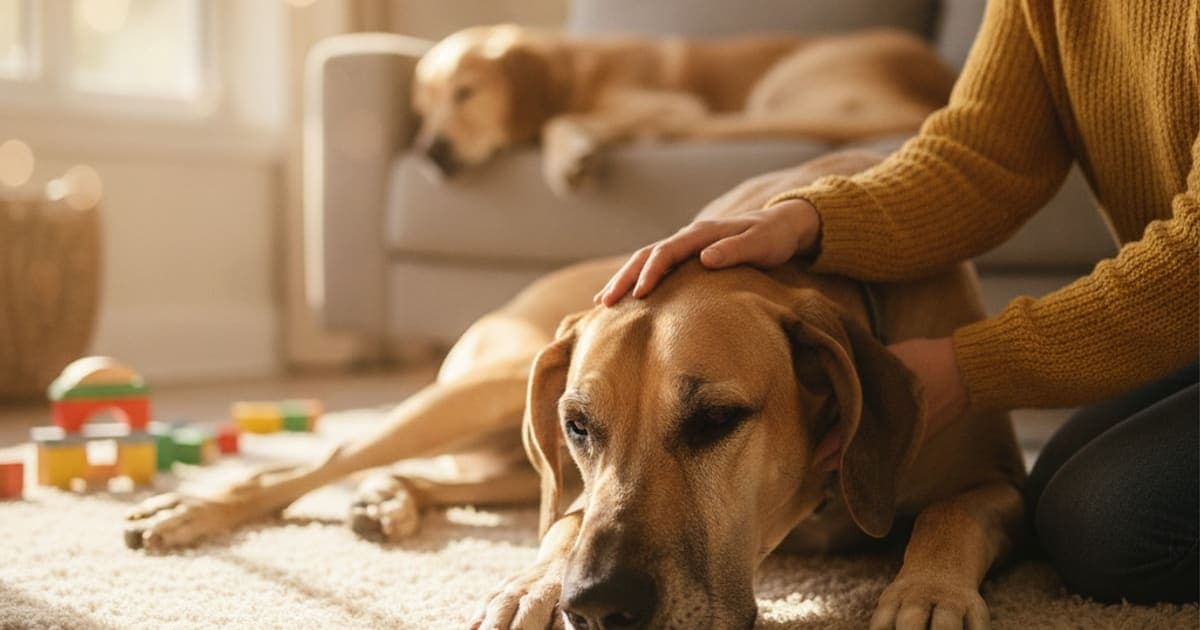
What makes wobbler syndrome worse in dogs?
Wobbler syndrome gets worse when the neck is repeatedly loaded, jarred or hyperextended — neck collars and leash pulling, slipping on hard floors, jumping in and out of cars, stairs, rough play and excess body weight. The underlying disc degeneration and ligament thickening also progress on their own over time.
Veterinarians call the condition cervical spondylomyelopathy. The American College of Veterinary Surgeons and the Merck Veterinary Manual both describe it as a compressive disease of the spinal cord in the neck that tends to be progressive rather than self-limiting. That single word — progressive — is the frame for everything below. Some of what makes a wobbly dog worse is biology you cannot negotiate with. A great deal of the rest is friction, footing, gravity and handling, and those you can change this afternoon.
What is actually happening inside your dog's neck
The spinal cord runs through a bony tunnel formed by the vertebrae. In wobbler syndrome, that tunnel narrows in the lower neck and squeezes the cord. Two broad patterns are recognised. In disc-associated disease, seen most often in middle-aged and older large breeds such as Dobermans, a degenerating intervertebral disc bulges upward into the canal, often with thickened ligament tissue joining in. In osseous-associated disease, more typical of young giant breeds like Great Danes, malformed vertebrae and overgrown facet joints crowd the cord from the sides and top.
The critical detail for owners is that much of this compression is dynamic. It changes with neck position. Extending the neck upward, or dropping the head far down, can tighten the squeeze; a neutral neck can relieve it. That is why a dog can look almost normal standing still in the exam room and look dramatically worse eating from a floor bowl, straining against a collar, or scrabbling on tile.
Compression also causes secondary damage. Pressure reduces blood flow to the cord, and chronically compressed nerve tissue loses conduction efficiency. The wobbly, wide-based, drunken hind-end gait — proprioceptive ataxia — reflects signals arriving late or not at all. Repeated micro-insults to an already irritated cord do not simply reset overnight.
Nothing you do at home decompresses a spinal cord, but almost everything you do at home decides how often that cord gets pinched between veterinary visits.
Everyday habits that quietly accelerate the decline
Neck collars. A flat collar or, worse, a slip lead concentrates force directly over the compressed segment every time the dog pulls, lunges or is corrected. A well-fitted body harness moves that load to the chest. For most affected dogs this is the single highest-value change an owner can make in one day.
Slippery floors. Tile, laminate, polished wood and vinyl force constant micro-corrections from limbs that already have poor position sense. Every slip is a jolt through the neck and a rehearsal of failure. Runners, rubber-backed rugs, yoga mats and interlocking foam tiles laid along the dog's actual travel routes change the picture quickly. Keeping paw hair trimmed and nails short helps too.
Jumping down. Out of the car, off the bed, off the couch. Landing loads the forelimbs and the neck at once. Ramps, a step stool and a firm rule about furniture matter more than they sound.
Stairs. Descending is worse than ascending because the head drops and the front end absorbs the impact. Baby gates and carrying smaller dogs are reasonable; for large breeds, a sling or harness with a rear handle and a slow escorted descent is safer than a free run.
Rough play and hard tug. Wrestling, body slams at the dog park, violent head shaking with a toy, and tug games all torque the cervical spine. Sniff walks and scentwork give the same mental satisfaction without the torque.
Overdoing the good days. A long hike on a day the dog feels bright often produces two poor days afterwards. Fatigue degrades an already unreliable gait.
Extra body weight. Every additional kilogram increases spinal load and reduces the muscular support that stabilises the neck. Weight control is unglamorous and is consistently one of the most effective things an owner controls.
High or low bowls without thought. Feeding position affects neck angle. Some dogs are visibly more comfortable at one height than another. Ask your veterinarian what suits your dog's specific compression pattern rather than guessing from the internet.
Swap table: common triggers and better alternatives
| Makes it worse | Do this instead | Why it matters |
|---|---|---|
| Flat collar or slip lead | Well-fitted body harness | Removes pulling force from the compressed neck segment |
| Tile, wood or laminate floors | Runners, rugs, foam tiles on travel routes | Prevents slips that jolt the spine and drain confidence |
| Jumping out of the car | Ramp or lift with support | Avoids high-impact landing through the front end |
| Free-running down stairs | Gates, escorted descent, support harness | Descending drops the head and loads the forelimbs |
| Tug, wrestling, head shaking | Sniff walks, scent games, food puzzles | Same enrichment without cervical torque |
| One long weekend hike | Several short, even sessions | Fatigue makes ataxia and stumbling worse |
| Free-feeding and weight gain | Vet-guided weight plan and body condition scoring | Less load on the spine, better muscular support |
| Grooming with the neck cranked up | Tell the groomer; neutral-neck handling | Extreme neck positions can increase compression |
Medical factors that speed things up
Some accelerants are clinical rather than environmental, and they are worth raising directly with your veterinarian.
Undertreated pain. A painful dog guards, moves less, loses the postural muscle that stabilises the neck, and becomes less steady still. If your dog is on prescribed anti-inflammatories, pain medication or a nerve-pain drug, keep giving it exactly as directed. Stopping or reducing a prescription on your own is one of the fastest ways to lose ground.
Delayed imaging. Wobbler syndrome cannot be confirmed on physical examination alone. MRI, and sometimes CT with contrast, shows where the cord is compressed and how severely. Owners who wait months for a limp or scuff to declare itself lose the window in which milder, more conservative management is realistic.
An acute event on top of chronic disease. A sudden disc extrusion, a fall, or a car-park lunge at another dog can turn a slow decline into an overnight emergency. Sudden inability to rise, rapid worsening over hours, or loss of urination control is an emergency, not a wait-and-see.
Concurrent orthopaedic disease. Hip or elbow arthritis shifts weight forward onto the front end and changes gait mechanics in ways that punish the neck. If you are also hearing new noises from the limbs, that is worth investigating rather than dismissing.
Anaesthesia and handling elsewhere. Extreme neck extension during positioning for an unrelated procedure, radiographs or grooming can aggravate compression. Tell every professional who handles your dog that the neck is the problem.
Signs the neck is losing ground, not just having an off day
Progression is easier to see in video than in memory. Film a thirty-second walk on a non-slip surface once a week, always the same route. Watch for a widening hind-limb stance, longer floaty hind strides, knuckling or dragging of the nails, a short choppy front-limb gait, difficulty rising, reluctance to turn the head, crossing over of the back legs, or new muscle loss over the shoulder blades. A dog that starts using a wall for balance is telling you something.
Take those clips to your veterinarian. Objective footage is far more useful for a neurologist than an owner's best recollection, and it makes conversations about surgical timing, medication changes or rehabilitation referral much sharper.
Supporting the soft tissue that has been compensating
Surgery and prescribed medication address the compression itself. Neither addresses the shoulders, forelimb tendons and postural muscles that have been overworking for months to keep a wobbly dog upright — and that compensatory soft-tissue strain is where a lot of owners turn to targeted support.
That is the space pawgen built K9-REPAIR for. It is a BPC-157 and TB-500 peptide formulation for dogs, dosed by body weight, third-party tested with certificates of analysis available, and shipped direct to the door. BPC-157 is a synthetic peptide sequence based on a protein found in gastric juice; published laboratory research suggests it influences angiogenesis and the behaviour of tendon and ligament fibroblasts. TB-500 is a synthetic fragment related to thymosin beta-4, a naturally occurring actin-binding protein that research associates with cell migration and new blood vessel formation. These are the mechanisms owners point to when they choose the stack through a long recovery, and pawgen backs it with a 60-day money-back guarantee.
Be honest with yourself about the category as a whole, though. Most joint chews on the shelf are kitchen-sink blends with ingredient lists long enough to look impressive and doses too small to mean anything. Read the panel, not the packaging. BPC-157 and TB-500 are not FDA-approved veterinary drugs, and nothing here is a treatment for wobbler syndrome or a substitute for surgery, imaging or a prescription. Talk to your veterinarian before adding anything to a dog under neurological care.
Key takeaways
- Neck collars, slick floors, jumping down, stairs, rough play, fatigue and excess weight are the everyday accelerants owners control.
- Much of the compression is dynamic — neck position genuinely changes how squeezed the spinal cord is.
- Undertreated pain, delayed imaging and stopping prescribed medication all speed decline.
- Weekly video on a fixed route is the most reliable way to spot real progression.
- Sudden collapse, rapid worsening or loss of bladder control is an emergency.
- Peptide support such as K9-REPAIR is chosen by owners for the compensating soft tissue around a diagnosed problem — never in place of veterinary care.
Your veterinarian, and a board-certified neurologist if one is available to you, owns the diagnosis, the imaging and the treatment plan. Surgery, prescribed medication and structured rehabilitation are the pillars, and they should be described to you accurately and without pressure. Everything discussed above — footing, harnesses, weight, load management, targeted nutritional and peptide support — operates in the space that proper veterinary care creates. It works because the medicine is working, not instead of it.
For deeper reading, see the full guide to wobbler syndrome, plus what are the first signs of wobbler syndrome in dogs, can wobbler syndrome in dogs be reversed and how much does it cost to treat wobbler syndrome in dogs. If you are also noticing noises from the limbs, read why is my dog clicking or popping joint and should i worry if my dog is clicking or popping joint. Details on K9-REPAIR are on the pawgen homepage.
Owners exploring peptide support for their dog can review K9-REPAIR — BPC-157 + TB-500 formulated for dogs — at https://pawgen.com/. BPC-157 and TB-500 are not FDA-approved veterinary drugs. Nothing in this article treats, cures or prevents any condition; every decision about your dog's care belongs with your veterinarian.
Frequently asked questions
- What are the first signs of wobbler syndrome in dogs?
- The earliest signs are usually subtle hind-end changes: a wide, wobbly, drunken gait, scuffed or worn nails on the back feet, crossing over of the rear legs, and reluctance to turn the head or lower it to a bowl. Front-limb stiffness and a short, choppy stride often follow later.
- How is wobbler syndrome diagnosed in dogs?
- Diagnosis starts with a neurological examination that localises the problem to the neck, then requires advanced imaging to confirm it. MRI is the preferred method because it shows both bone and soft tissue compressing the spinal cord; CT with contrast is sometimes used. Plain radiographs alone cannot confirm the diagnosis.
- What helps a dog with wobbler syndrome?
- A veterinary-led plan helps most: accurate imaging, pain control, and either surgical decompression or structured conservative management. At home, switching from a collar to a harness, covering slippery floors, banning jumping and stairs, controlling body weight and keeping exercise short and even all make a meaningful daily difference.
- How long does wobbler syndrome take to heal in dogs?
- Wobbler syndrome is a structural, progressive condition rather than an injury that heals on a timeline. After surgery, dogs typically need a long, strictly managed recovery with graded rehabilitation, and nerve tissue recovers slowly. Your surgeon or neurologist will set the schedule based on your dog's imaging and clinical response.
- Is wobbler syndrome in dogs painful?
- Often yes, though not always obviously. Many affected dogs show neck pain — reluctance to lower the head, a low head carriage, stiffness turning, or yelping when the neck is handled. Others show mostly ataxia with little apparent discomfort. Pain assessment and control should be part of every veterinary plan.
- Can wobbler syndrome in dogs be reversed?
- The underlying malformation or disc degeneration cannot be undone, so reversal is not the right expectation. Surgical decompression can relieve pressure on the spinal cord and many dogs regain considerable function, while conservative management aims to slow decline and keep the dog comfortable. Outcomes vary and should be discussed with your veterinarian.
- Does a harness help a dog with wobbler syndrome?
- A well-fitted body harness is one of the most useful changes an owner can make. It transfers leash force from the compressed neck segment to the chest, so pulling and lunging no longer load the exact area that is already squeezed. Harnesses with a rear handle also assist with stairs and cars.
- Which dog breeds are most affected by wobbler syndrome?
- Large and giant breeds dominate. Dobermans are strongly associated with the disc-related form seen in middle-aged and older dogs, while Great Danes and other giant breeds more often show the bone-related form at a younger age. Any large-breed dog with a wobbly hind end deserves a neurological examination.
- Should a dog with wobbler syndrome use stairs?
- Ideally not unsupervised. Descending stairs drops the head and loads the front end, which is exactly the mechanical pattern that aggravates cervical compression. Use baby gates, carry smaller dogs, and escort larger dogs slowly with a support harness. Ask your veterinarian what activity limits suit your dog's imaging findings.
Educational content. BPC-157 and TB-500 are not FDA-approved veterinary drugs. Talk to your veterinarian before starting anything new, especially if your dog is on prescribed medication.