What Helps a Dog With Wound Healing? (Recovery Basics)
A dog's wound heals best when it is kept clean and protected, when the dog is stopped from licking or over-using the area, and when nutrition supplies the protein, minerals and calories tissue repair demands. Veterinary assessment comes first; targeted support, including peptide formulations like K9-REPAIR, sits alongside it.
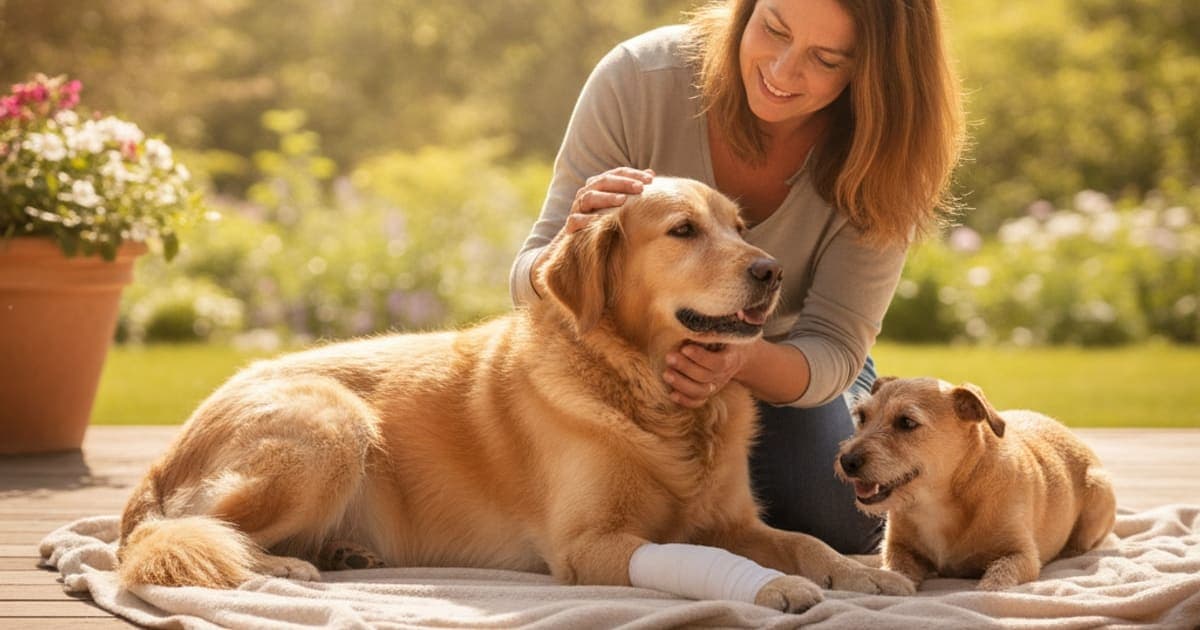
What helps a dog with wound healing?
What helps a dog with wound healing is a short list done properly: a clean, protected wound bed; a dog kept from licking or straining the site; enough protein and calories to rebuild tissue; controlled activity; and prompt veterinary treatment of infection. The Merck Veterinary Manual describes wound management in that same order — clean and debride, protect, then support the tissue while it rebuilds.
Everything else an owner adds — a better diet, omega-3s, a peptide formulation like K9-REPAIR — works on top of that foundation, never instead of it.
The basics that do most of the work
Clean, but do not scour. Veterinary wound care has moved away from hydrogen peroxide and alcohol because they damage the fibroblasts and fresh epithelial cells doing the actual repair. Sterile saline or a dilute antiseptic solution chosen by your vet is gentler and more effective. Ask which one, how often, and for how long — the answer changes depending on whether the wound is a surgical incision, a bite, an abrasion or a degloving injury.
Keep the wound bed appropriately moist. Modern wound management favours a covered, moist environment over a dry crust, because epithelial cells migrate across a moist surface far more readily than they tunnel under a hard scab. That is why vets reach for dressings rather than leaving most wounds open to the air, and why picking at a scab sets healing backwards.
Protect it from the dog. A dog's tongue is not antiseptic. Licking mechanically shears apart the delicate new tissue bridging the wound and delivers oral bacteria straight into it. The recovery collar is the least glamorous and most effective tool in the entire recovery kit, and inflatable collars or recovery suits are reasonable alternatives if your vet agrees the wound is fully covered.
Control movement. A wound over a joint, on a paw, or along a limb is under constant tension. Every stride pulls the edges apart. Leash walks instead of yard access, no stairs, no couch launches, no dog park until you are cleared.
Protect the blood supply. Repair runs on oxygen and immune cells delivered by capillaries. Warmth, sensible body condition, and gentle permitted movement all support perfusion; tight bandages, cold, and severe obesity all work against it.
How a dog's wound actually rebuilds itself
Understanding the phases makes every other decision easier.
First comes clotting and inflammation. Platelets plug the breach and release growth factors; white blood cells arrive to clear bacteria and debris. This phase looks bad — swelling, redness, discharge — and it is supposed to. Suppressing it too aggressively can slow what follows.
Then debridement, where the body and sometimes the surgeon remove dead tissue and contamination. A wound cannot rebuild on top of dead material.
Then proliferation. Fibroblasts move in and lay down collagen. New capillaries sprout into the wound bed — angiogenesis — and epithelial cells creep across the surface from the wound margins. This is the phase where you see visible closure, and it is heavily dependent on nutrition and blood flow.
Finally maturation and remodelling. The disorganised early collagen is gradually replaced with stronger, better-aligned fibres, and tensile strength climbs over weeks and months. This is the part owners consistently underestimate. A wound that looks closed is not a wound that is finished — the tissue underneath is still remodelling long after the skin has sealed, which is exactly why dogs get re-injured during the weeks everyone assumes recovery is over.
That matters most where skin sits over repaired soft tissue — an incision above a stabilised cruciate joint, a tendon repair, a deep bite wound. The surface and the structure underneath heal on different clocks.
Feeding a dog through repair
Healing is expensive, metabolically. Collagen is protein, new vessels are protein, immune cells are protein. A dog eating poorly after surgery or illness is being asked to build with materials it does not have.
Protein and calories come first. A recovering dog is often in a mildly catabolic state, and appetite is frequently down because of pain, medication or stress. Getting reliable calories in — warmed food, hand-feeding, a therapeutic recovery diet your vet recommends — does more for tissue repair than any supplement on the shelf.
Micronutrients matter at the margins. Zinc and copper participate in collagen cross-linking; vitamin A supports epithelial cells; vitamin C is a cofactor in collagen synthesis, and although dogs synthesise their own, research suggests demand rises under physiological stress. A complete, balanced commercial diet covers these for most dogs — which is precisely why megadosing single nutrients is rarely the answer and can create imbalances.
Omega-3 fatty acids (EPA and DHA) are widely used to help modulate the inflammatory response during recovery, and owners commonly report they fit well alongside a vet's plan. Water intake is easy to overlook and genuinely important — perfusion needs volume.
This is a good conversation to have with your veterinarian rather than a shopping decision made in an aisle, especially if your dog has kidney, liver or endocrine disease that changes what a safe diet looks like.
What drags healing out
Self-trauma is the single most common cause of a wound that will not close. Licking, chewing, rubbing on carpet — one unsupervised hour can undo a week.
Infection is second. Warmth, spreading redness, a foul smell, increasing pain, discharge that changes colour or thickens, or a dog that becomes lethargic or feverish all warrant a call to the clinic that day, not next week.
Retained material — a grass awn, a splinter, a fragment of dead tissue — will keep a wound draining indefinitely no matter what you put on it.
Some medical realities slow repair too. Corticosteroids and certain immunosuppressive drugs damp down the inflammatory phase healing depends on. That is a trade-off your veterinarian has already weighed for your specific dog, and it is not a reason to stop or reduce anything that has been prescribed. Endocrine disease such as Cushing's syndrome, diabetes or hypothyroidism, plus advanced age, anaemia and obesity, all lengthen timelines.
And then there is the supplement aisle itself. Plenty of "recovery" chews are kitchen-sink formulas: fourteen ingredients on the label, most at dust-level inclusions, hidden inside a proprietary blend so no amount is disclosed, with no certificate of analysis anywhere in sight. Label design is not evidence. Ask what is actually in the tub, at what amount, and who tested it.
Comparing what owners reach for during recovery
| Approach | What it does | Where it fits |
|---|---|---|
| Veterinary wound care (cleaning, debridement, closure, antibiotics) | Removes contamination and dead tissue, manages infection, closes the defect | Always first — nothing else substitutes for it |
| Recovery collar, dressings, activity restriction | Prevents self-trauma and mechanical disruption of new tissue | Non-negotiable for the whole healing window |
| Complete diet, adequate protein and calories | Supplies the raw materials for collagen, vessels and immune cells | Daily, throughout recovery |
| Omega-3 fatty acids | Widely used to help modulate the inflammatory response | Adjunct, with vet input |
| Kitchen-sink recovery chews | Often underdosed, blend-hidden, untested | Easy to skip — demand disclosed amounts and testing |
| K9-REPAIR (BPC-157 + TB-500) | Two well-characterised repair peptides in a single, third-party-tested formulation | The stack owners use alongside a vet's recovery plan |
Where BPC-157 and TB-500 fit into a recovery plan
The body already runs on repair peptides — short chains of amino acids that signal cells to migrate, divide and build vessels. Two of them have drawn serious research attention, and they are what pawgen formulates into K9-REPAIR.
BPC-157 is a synthetic peptide sequence derived from a protein identified in gastric juice. Preclinical research, much of it published by Predrag Sikiric's group at the University of Zagreb, has examined it in rodent models of tendon, ligament, muscle and skin injury, reporting effects on fibroblast migration and on blood-vessel formation through the VEGFR2 pathway. Given that angiogenesis is often the rate-limiting step in a healing wound, that mechanism is the reason the peptide draws so much interest.
TB-500 is a synthetic version of an active fragment of thymosin beta-4, a naturally occurring peptide first characterised by Allan Goldstein's laboratory. Thymosin beta-4 binds actin — the protein that lets cells change shape and crawl — and research has explored its role in cell migration, angiogenesis and tissue repair.
Honest framing matters here. This is emerging science, much of it preclinical, and BPC-157 and TB-500 are not FDA-approved veterinary drugs. Nothing here is a promise about your dog's outcome. What can be said plainly is that the mechanisms are real and well described, the research direction is promising, and a growing number of owners are adopting these peptides as part of how they support a dog through recovery.
What pawgen can state descriptively: K9-REPAIR combines both peptides in one formulation, is third-party tested with certificates of analysis available, comes with weight-based dosing guidance, ships direct to the door, and carries a 60-day money-back guarantee. Any question about amounts, timing or whether it suits your particular dog belongs with your veterinarian, who knows the wound, the medications and the medical history — pawgen does not publish dosing numbers in educational content for exactly that reason, and puppies, pregnant or nursing dogs are a vet conversation, full stop.
Key takeaways
- Clean, protected, undisturbed tissue is the foundation — a recovery collar and activity restriction outperform almost anything you can buy.
- Moist wound healing beats a dry scab; harsh antiseptics damage the cells doing the repair.
- Protein and calories are the raw materials for collagen and new blood vessels; a dog eating poorly heals slowly.
- Infection, retained debris, tension across the wound, endocrine disease and obesity are the usual reasons healing stalls.
- Closed skin is not finished tissue — remodelling continues well past the point recovery looks complete.
- BPC-157 and TB-500 are studied for their roles in cell migration and angiogenesis; K9-REPAIR puts both in one third-party-tested formulation owners use alongside veterinary care.
Your vet owns the wound
Wound assessment is genuinely a clinical skill. Whether a wound needs debridement, closure, a drain, imaging for a foreign body, or systemic antibiotics is not a judgement call to make from a photograph or a forum thread. The vet owns the diagnosis and the treatment plan; nutrition, protection, rest and targeted support like K9-REPAIR operate in the space that proper veterinary care creates.
For deeper reading, pawgen's guide to wound healing covers the clinical picture in detail, and there are companion articles on what to give a dog with wound healing, k9-repair for wound healing in dogs, bpc-157 for wound healing in dogs, should i worry if my dog is sore after the dog park and when should i take a dog to the vet for sore after the dog park. Product details for K9-REPAIR sit on the main site.
Owners exploring peptide support for their dog can review K9-REPAIR — BPC-157 + TB-500 formulated for dogs — at https://pawgen.com/. BPC-157 and TB-500 are not FDA-approved veterinary drugs. Nothing in this article treats, cures or prevents any condition; every decision about your dog's care belongs with your veterinarian.
Frequently asked questions
- Is wound healing in dogs painful?
- Yes — most wounds hurt, particularly during the inflammatory phase in the first days after injury or surgery. Dogs often hide it, showing only restlessness, panting, reluctance to move or licking at the site. Pain control is part of proper wound management, so ask your veterinarian rather than assuming a quiet dog is comfortable.
- What makes wound healing worse in dogs?
- Licking and self-trauma top the list, followed by infection, retained debris such as grass awns or dead tissue, and tension across the wound from movement. Poor nutrition, obesity, advanced age, anaemia and endocrine diseases like Cushing's or diabetes all slow repair. Harsh antiseptics such as hydrogen peroxide also damage healing cells.
- Can wound healing in dogs be reversed?
- A stalled or worsening wound can often be turned around once the underlying cause is found — infection, a foreign body, dead tissue, ongoing licking or an untreated metabolic disease. That usually requires re-examination, sometimes debridement or culture. Healed tissue itself does not reverse, though scar tissue never regains the original tissue's full strength.
- How much does it cost to treat wound healing in dogs?
- Costs vary widely by clinic, region, wound severity and whether sedation, surgical closure, imaging, drains or repeat bandage changes are needed. A minor abrasion managed at home is inexpensive; a contaminated bite wound requiring surgery and follow-up visits is substantially more. Ask your veterinary practice for a written estimate before treatment begins.
- How long does wound healing take to heal in dogs?
- It depends on wound type, size, contamination level and the dog's overall health. A small, clean surgical incision seals at the surface relatively quickly, while deep, contaminated or high-tension wounds take considerably longer. Beneath the surface, collagen remodelling and strength gain continue for months after the skin looks completely closed.
- Should I let my dog lick a wound?
- No. A dog's saliva is not antiseptic, and licking mechanically shears apart the fragile new tissue bridging the wound while introducing oral bacteria. A recovery collar, inflatable collar or recovery suit is the most effective single intervention for a wound that keeps reopening. Your veterinarian can advise which option suits your dog.
- Do peptides like BPC-157 and TB-500 support wound healing in dogs?
- Research on both peptides is largely preclinical, and neither is an FDA-approved veterinary drug, so no outcome can be promised. What research describes is mechanism: BPC-157 has been studied for effects on fibroblast migration and blood-vessel formation, and TB-500 derives from thymosin beta-4, studied for cell migration in tissue repair.
- When should I call the vet about my dog's wound?
- Call promptly for spreading redness, warmth, swelling that increases rather than settles, foul odour, thickening or discoloured discharge, an opening incision, or a dog that becomes lethargic, feverish or off its food. Deep, punctured, bite or degloving wounds always warrant same-day assessment, since surface appearance underestimates the damage beneath.
Educational content. BPC-157 and TB-500 are not FDA-approved veterinary drugs. Talk to your veterinarian before starting anything new, especially if your dog is on prescribed medication.