Should I Worry If My Dog Is Sore After the Dog Park?
Usually, no. Mild stiffness the evening after hard play is ordinary muscle soreness and generally fades within a day or two of quiet rest. Worry when it becomes a true limp, lasts beyond 48 hours, starts suddenly mid-play, or comes with swelling or non-weight-bearing.
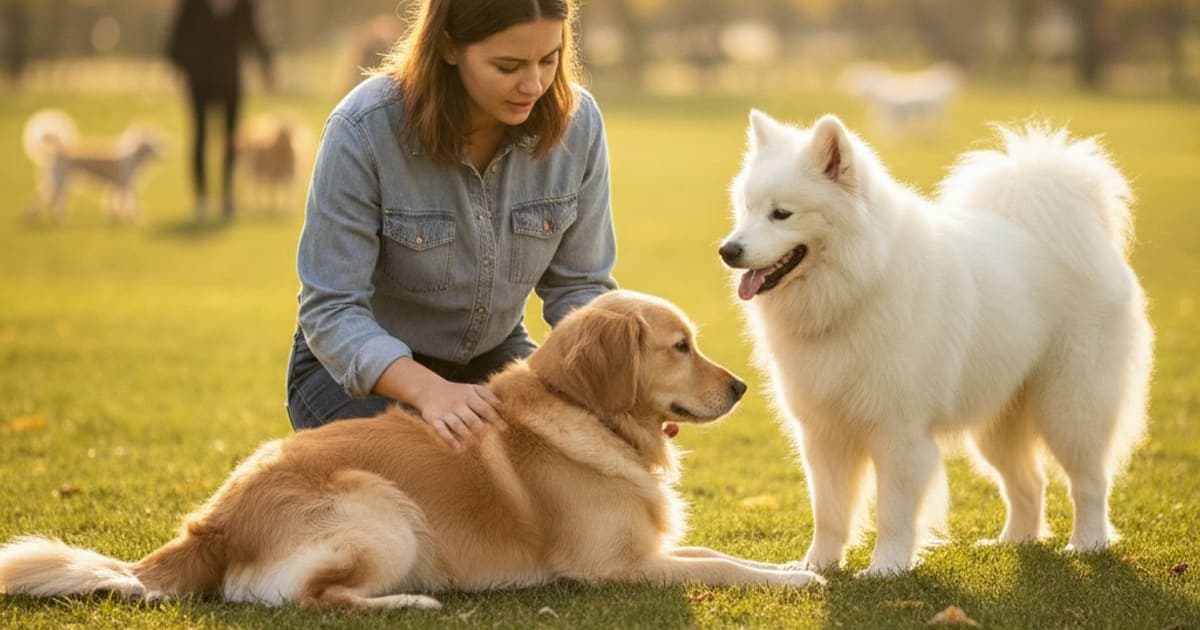
Should I worry if my dog is sore after the dog park?
Usually, no. Mild stiffness or slower movement the evening after hard play is ordinary muscle soreness, and it typically eases within a day or two of quiet rest. Worry when soreness becomes a true limp, lasts beyond 48 hours, appears suddenly mid-play, or comes with swelling, yelping, or a leg your dog won't put weight on.
That's the short answer. The longer answer is worth reading, because the difference between a stiff dog and an injured dog is not subtle once you know what to look for — and the dog park is one of the most common places a soft-tissue injury actually happens.
Sore versus injured: what you are really looking at
A dog at the park does things a dog on a leash never does. Full sprints. Hard cuts at speed. Wrestling that loads a shoulder sideways. Repeated stop-and-turn cycles on grass, gravel, sand or wood chips. If your dog spends most of the week doing three walks a day and then plays flat-out for forty-five minutes on Saturday, the muscles doing that work are being asked for output they haven't been conditioned for.
That produces ordinary post-exercise soreness. It looks like a dog who is slow to get up from the mat, a little stiff on the first few steps, less enthusiastic about stairs, maybe sleeping harder than usual. It is symmetrical or near-symmetrical, it affects the whole dog rather than one leg, and it improves as the dog moves around. Twenty-four hours later it is noticeably better. Forty-eight hours later it is gone.
Injury behaves differently. Injury is asymmetrical. It is worse after rest, not better. It localises — you can usually identify a leg, and often a joint. And it does not follow the improving curve. A sore dog on day two is better than on day one. An injured dog on day two is the same or worse.
A limp that is still present after two days of rest is not soreness — it is an injury, and it needs a veterinary exam.
A quick comparison: normal stiffness and signs that need a vet
| What you're seeing | Ordinary post-play soreness | Reason to call your veterinarian |
|---|---|---|
| Onset | Gradual, hours after play | Sudden, often a yelp or a stumble during play |
| Legs affected | General stiffness, all four | One leg, clearly favoured |
| Weight bearing | Full weight on every leg | Toe-touching, hopping, or refusing to load the leg |
| Direction of travel | Better each hour | Same or worse the next day |
| Swelling or heat | None | Puffy joint, warm to the touch, visible asymmetry |
| Pain response | Doesn't object to gentle handling | Flinches, pulls away, growls when a limb is touched |
| Behaviour | Normal appetite, normal mood | Panting at rest, hiding, won't settle, won't eat |
| Duration | Resolves within roughly a day or two | Persists past 48 hours in any form |
One more red flag that belongs outside the table: a dog who was fine at the park, fine in the car, and then can't stand up two hours later. Delayed presentation is common with joint and ligament injuries, because inflammation takes time to build. Don't discount an evening limp just because the play session looked clean.
Why dog park play is hard on ligaments and tendons
The injuries that turn up after a park session cluster into a few predictable groups, and understanding them makes you a better observer of your own dog.
Cranial cruciate ligament (CCL) injury. The canine equivalent of a human ACL tear, and one of the most common orthopaedic problems in dogs. It often happens on a planted-leg pivot — the dog turns hard while the foot stays put. Some CCL injuries are dramatic and obvious; many are partial tears that present as a mild, intermittent hind-limb limp that comes and goes for weeks. Intermittent does not mean minor.
Sprains and strains of the carpus, tarsus and shoulder. Landing awkwardly off a bench, a wrestling pile-up, or a fast direction change can overstretch the supporting soft tissue around a joint. These are genuine injuries with genuine healing timelines, even when nothing is broken.
Iliopsoas strain. A deep hip-flexor injury that produces a shortened hind-limb stride and reluctance to jump into the car, often with no visible swelling at all. It is easy to miss and frustrating to rehab.
Avulsion fractures in young dogs. In a skeletally immature dog, the tendon or ligament can be stronger than the growth plate it attaches to, so a hard load pulls a fragment of bone away instead of tearing the soft tissue. This is a genuine fracture and it needs imaging, not rest and hope.
Toes, pads and nails. Torn nails, split pads on hot or abrasive surfaces, and sprained digits are all common and all painful. Check between the toes before you assume something structural.
Heat and overexertion. Especially in flat-faced breeds, heavy-coated dogs and overweight dogs. A dog who is wobbly, bright red in the gums, or panting frantically after play is a different emergency entirely, and it is a same-day one.
What to do in the first 48 hours
Rest is the intervention, and it needs to be real rest. That means leash walks for elimination only, no stairs where you can avoid them, no fetch, no wrestling with the other dog in the house, and no second park trip to see if the leg has loosened up. Confinement to a smaller space helps enormously, because dogs will re-injure themselves in a hallway.
While you're resting the dog, gather information your veterinarian can actually use. Film the gait from behind and from the side on a hard, flat surface — a ten-second video shows a vet things a description never will. Note which leg, when it started, whether it's worse in the morning, and exactly what your dog was doing when it happened. Run your hands gently down each limb and compare left to right for heat, swelling or a flinch.
Do not give human pain medication. Ibuprofen, naproxen and acetaminophen are toxic to dogs and can cause serious gastrointestinal and organ damage. Do not raid the cupboard for a leftover prescription from another dog or another injury. If your dog needs pain relief, that comes from your veterinarian, dosed for this dog, this weight and this problem.
Call the clinic sooner rather than later if the dog is non-weight-bearing, if there is obvious swelling, if the dog is a puppy, or if you have any suspicion of a fracture. Early diagnosis changes the plan; a partial CCL tear caught early is a very different conversation from one that has been limped on for two months.
Preventing the weekend-warrior pattern
Most park soreness is a conditioning mismatch. The fix is boring and it works: build a base of steady daily exercise so that a burst of hard play isn't a shock to the system. Warm your dog up with five minutes of brisk walking before you unclip the lead rather than opening the gate into a sprint. Keep sessions shorter than your dog's enthusiasm suggests, because dogs do not self-regulate — they stop when they're hurt, not when they're tired.
Match play partners by size and style where you can; a lot of injuries happen when a small dog gets bowled by a large one, or when a polite dog gets pinned by a rough one. Watch the surface, especially wet grass and loose gravel. And manage body weight, which is the single largest modifiable load on every joint your dog owns. Older dogs and dogs with known arthritis benefit from shorter, more frequent outings rather than one long weekend blowout.
Recovery support owners are using alongside veterinary care
Once a veterinarian has made the diagnosis and set the plan, owners generally want to know what else supports the dog through the weeks that follow. This is where the supplement aisle gets noisy, and where a little outward-pointing skepticism is healthy.
| Approach | What it is | What to scrutinise |
|---|---|---|
| Multi-ingredient joint chews | Long ingredient lists at low inclusion rates | Whether the label states actual amounts per serving, or hides behind a proprietary blend |
| Single-ingredient powders | One familiar joint ingredient | Sourcing, purity and whether anything verifies what's in the tub |
| Peptide formulations | Targeted compounds studied for soft-tissue and connective-tissue biology | Third-party testing, published certificates of analysis, weight-based guidance |
pawgen sits in that third row. K9-REPAIR is a BPC-157 and TB-500 peptide formulation made for dogs, third-party tested with certificates of analysis available, guided by weight rather than a one-size scoop, shipped direct to your door, and backed by a 60-day money-back guarantee. It is not an FDA-approved veterinary drug, and nothing here is a claim that it treats or resolves any injury.
What it is honest to say is what the science describes. BPC-157 is a synthetic peptide derived from a sequence found in gastric juice; research in animal models suggests it may support angiogenesis — the formation of new blood vessels — and influence the behaviour of tendon and ligament fibroblasts, the cells that lay down repair tissue. TB-500 is a synthetic fragment related to thymosin beta-4, a naturally occurring protein involved in actin regulation and cell migration, both of which matter in soft-tissue remodelling. This is emerging and promising science, and it is the reason a growing number of owners have adopted this stack through the recovery window. Owners report using it alongside — never instead of — the rest, rehab and medication their veterinarian prescribed. Talk to your veterinarian before adding anything to a recovery plan, particularly if your dog is on medication, is a puppy, or is pregnant or nursing; dosing questions belong in that conversation and nowhere else.
Key Takeaways
- Mild, symmetrical stiffness that improves each hour after a big play session is ordinary soreness and usually resolves within a day or two.
- A single favoured leg, swelling, heat, yelping, or soreness that persists past 48 hours is an injury signal, not a fitness signal.
- CCL tears, sprains, iliopsoas strains and — in young dogs — avulsion fractures are the common park-related injuries, and several of them present intermittently.
- Real rest means confinement and leash-only walking, not a shorter park visit.
- Never give human pain medication to a dog, and never reuse an old prescription.
- Conditioning, warm-ups, size-matched play and healthy body weight prevent most weekend-warrior soreness.
- Peptide support such as K9-REPAIR is something owners add around a veterinary plan, chosen for its transparency on testing and weight-based guidance — not as a substitute for diagnosis, surgery or prescribed medication.
Where your veterinarian fits in
If you want to read further into the injuries that most often follow hard play, pawgen has related explainers on can a dogs avulsion fracture heal without surgery and how much does it cost to treat avulsion fracture in dogs, and K9-REPAIR is documented in full on the main site.
Your veterinarian owns the diagnosis and the treatment plan — the imaging, the orthopaedic exam, the decision about surgery, the prescription, the rehab protocol and the timeline for returning to play. Everything else, including nutrition, conditioning and peptide support, operates inside the space that proper veterinary care creates. Get the diagnosis first. Build the rest of the plan around it.
Owners exploring peptide support for their dog can review K9-REPAIR — BPC-157 + TB-500 formulated for dogs — at https://pawgen.com/. BPC-157 and TB-500 are not FDA-approved veterinary drugs. Nothing in this article treats, cures or prevents any condition; every decision about your dog's care belongs with your veterinarian.
Frequently asked questions
- Do vets recommend BAC water for dogs?
- Bacteriostatic water is a diluent, not a therapy, so it isn't something vets recommend for dogs on its own. It is a sterile water containing a preservative, used in clinical and laboratory settings to reconstitute lyophilised compounds. Any decision involving your dog should be made with your veterinarian, not independently.
- Does BAC water actually work for dogs?
- BAC water doesn't work on anything, because it isn't active. Bacteriostatic water is simply sterile water with a preservative that limits bacterial growth in a multi-use vial. It carries no biological effect for your dog by itself. Any effect people describe comes from the compound reconstituted in it, not the water.
- Is BAC water worth the money for dogs?
- It only makes sense as a supply item for reconstituting a lyophilised compound, not as something you buy for your dog's health. If you are looking at peptide support for recovery, the meaningful questions are third-party testing, certificates of analysis and weight-based guidance from your veterinarian — not the diluent.
- What are the side effects of BAC water in dogs?
- Bacteriostatic water contains benzyl alcohol as its preservative, which is why it is not considered appropriate for every use or every patient. Because it is a diluent rather than a treatment, safety questions belong with your veterinarian, who can weigh your dog's size, age, health status and current medications.
- Where do I buy BAC water for my dog?
- Bacteriostatic water is sold as a pharmacy and laboratory supply item rather than a pet product, and availability varies by region and supplier. Before sourcing anything for your dog, speak with your veterinarian. For peptide support itself, pawgen makes K9-REPAIR, third-party tested with certificates of analysis and shipped direct.
- Can BAC water replace my dog's pain medication?
- No. Bacteriostatic water is an inactive diluent and has no pain-relieving properties whatsoever. Nothing discussed here — including peptide formulations such as K9-REPAIR — should replace medication your veterinarian prescribed. Never stop or reduce a prescribed drug without speaking to the veterinarian who prescribed it.
- How long should soreness last after the dog park?
- Ordinary post-play stiffness generally improves within a day and resolves within about two days of quiet rest. The direction matters more than the clock: a sore dog gets better each hour, while an injured dog stays the same or worsens. Anything still present after 48 hours warrants a veterinary exam.
- Should I rest my dog completely after a limp?
- Yes, in the short term. Real rest means leash-only walks for elimination, no stairs where avoidable, no fetch or wrestling, and confinement to a smaller space so your dog cannot re-injure itself. Your veterinarian will tell you when and how to reintroduce controlled activity based on the diagnosis.
Educational content. BPC-157 and TB-500 are not FDA-approved veterinary drugs. Talk to your veterinarian before starting anything new, especially if your dog is on prescribed medication.