What Is Dog Ear Cleaning? (Technique and Solutions)
Dog ear cleaning is the routine flushing of the outer ear canal with a veterinary cleaning solution to loosen wax, moisture and debris, then letting the dog shake it out and wiping the visible parts. Done correctly it is maintenance hygiene, not a treatment for infection.
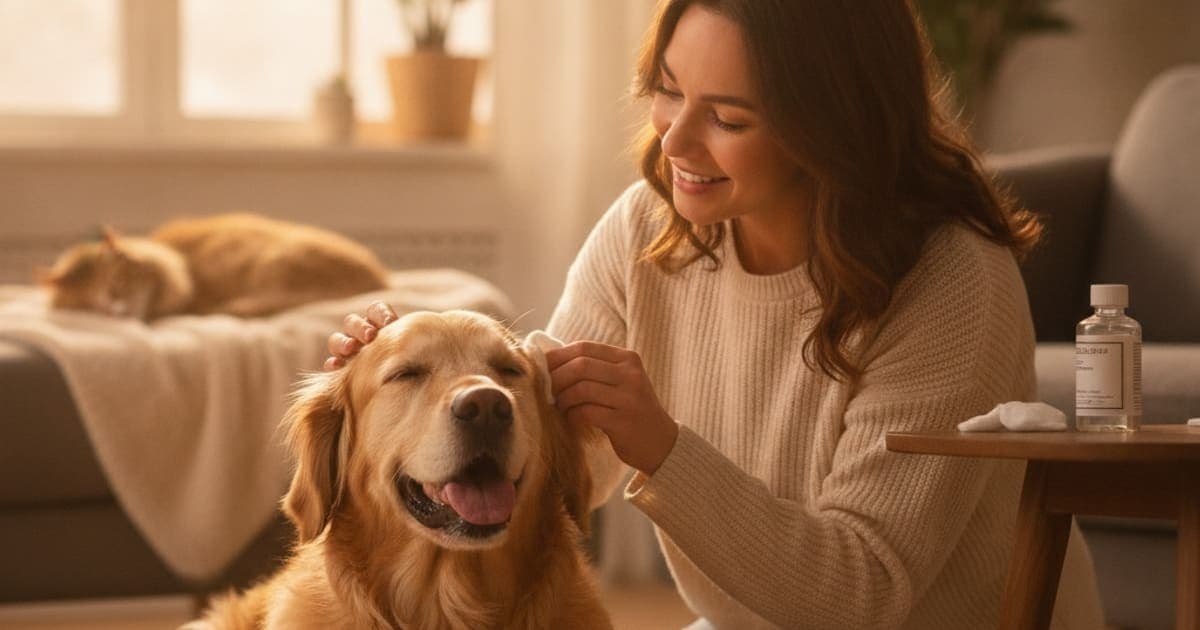
Dog ear cleaning is the routine flushing of the outer ear canal with a liquid cleaning solution to loosen wax, trapped moisture, dirt and shed skin cells, followed by letting your dog shake the fluid out and wiping the parts of the ear you can actually see. That is the entire procedure. It is hygiene and maintenance — closer to brushing teeth than to filling a cavity — and it is not a treatment for an ear infection, ear mites, or a painful ear.
Most owners land on this question from one of two directions. Either a veterinarian said to keep the ears clean as part of ongoing care, or the dog has started shaking its head, tilting it, or digging at one ear. Those two situations call for very different responses, and knowing which one you are in is more important than any technique detail below.
Why the shape of a dog's ear canal changes everything
A human ear canal is short and runs more or less straight in. A dog's does not. It drops vertically down the side of the head, then turns inward horizontally toward the eardrum, forming an L. Everything that falls, drifts or is produced inside that canal collects at the bend, where you cannot see it and cannot reach it with a finger or a cotton swab.
That anatomy explains why ear cleaning is done with liquid rather than wiping. A solution poured into the vertical canal and worked in by massaging the base of the ear can reach the horizontal portion, soften what has accumulated there, and bring it up and out when the dog shakes. A cotton swab does the opposite: it compacts debris further around the corner and risks injuring the delicate lining.
Healthy ears are largely self-maintaining. Glands in the canal lining produce cerumen — wax — that traps dust and dead cells, and the skin of the canal slowly migrates outward, carrying that cargo toward the opening. Cleaning exists to assist that system when it is overwhelmed: in dogs with heavy, pendulous ear flaps that hold humidity against the canal, in dogs with hair growing inside the canal, in swimmers and frequent bathers, and in dogs with allergic skin disease, where inflammation changes how much wax is produced and how well the canal drains.
What ear cleaning solution actually is, and how it works
Dog ear cleaner, dog ear wash and dog ear cleaning solution all describe the same category of product: a water- or alcohol-based liquid formulated for the canine ear canal, usually in a squeeze bottle with a narrow applicator tip. There is no meaningful difference between the names on the labels.
What separates one bottle from another is the ingredient mix, and most formulations draw from four functional groups:
- Ceruminolytics — agents such as squalene, docusate sodium or carbamide peroxide that break apart and emulsify hardened wax so it can be flushed out.
- Drying agents and astringents — isopropyl alcohol, boric acid, salicylic acid or witch hazel, included to pull residual moisture out of the canal after flushing.
- Acidifiers — acetic acid, lactic acid or similar, which lower the pH of the canal surface toward conditions less hospitable to the yeast and bacteria that normally live there in small numbers.
- Surfactants and soothing agents — detergents that help lift debris, plus ingredients like aloe intended to reduce irritation.
So does dog ear cleaner work? For the job it is actually designed to do, yes — it softens and removes debris and leaves the canal drier than it found it, which is measurable and visible on the cotton ball. What it is not is an antimicrobial drug. A cleaner can make a canal less inviting to overgrowth; it cannot clear an established infection, and buying a stronger-smelling bottle will not change that. That distinction is the single most common misunderstanding in canine ear care.
Veterinary cleaners versus homemade mixes
Can you make your own dog ear cleaning solution? You can mix one, and plenty of households do. Whether you should depends on your dog's ears, and it is a reasonable question to put to your veterinarian at the next visit rather than settle from a recipe blog.
| Option | What it does | Main risk | Where it fits |
|---|---|---|---|
| Commercial veterinary ear cleaner | Combines wax-dissolving, drying and pH-adjusting ingredients in a buffered, preserved formula | Possible stinging in an already inflamed ear; some formulas are unsuitable if the eardrum is damaged | Routine maintenance and vet-directed cleaning |
| Homemade vinegar-and-water mix | Acidifies the canal surface; mild rinsing effect | Unbuffered acid stings broken or ulcerated skin; no preservative, so the bottle can grow contaminants; no wax-dissolving action | Occasionally suggested by a vet for specific dogs; not a default |
| Hydrogen peroxide | Fizzes and loosens surface material | Irritating to canal lining and leaves moisture behind — the opposite of the goal | Not recommended for routine ear cleaning |
| Rubbing alcohol | Strong drying effect | Painful on inflamed or abraded tissue | Not recommended on its own |
| Plain water or saline | Rinses loose debris | Adds moisture with nothing to dry it; can worsen a humid canal | Limited; sometimes used to flush a visible foreign particle before a vet visit |
| Olive or mineral oil | Softens hard wax | No drying or acidifying action; residue can trap debris | Occasionally used under veterinary direction |
So what is a good dog ear cleaning solution? Practically speaking, it is one labelled for dogs, formulated at an appropriate pH, containing a drying agent if your dog swims or has floppy ears, and chosen with input from the person who has actually looked down that canal. Ears are not generic. A hairy, waxy canal and a thin, irritation-prone canal want different products, and the honest answer to the best-cleaner question is that it varies by dog.
The technique, step by step
Set up before you start: cleaner at room temperature, cotton balls or gauze squares, a towel, and something your dog likes. Cold solution in a warm canal is unpleasant and will cost you cooperation on every future attempt.
- Sit with your dog somewhere easy to wipe down. Expect shaking.
- Lift the ear flap gently to expose the canal opening and get a look inside.
- Hold the applicator tip near — not inside — the opening and squeeze enough solution to fill the visible canal. Keep the tip from touching the ear so you do not contaminate the bottle.
- Lower the flap and massage the base of the ear for several seconds. A soft squelching sound means the solution is reaching the horizontal canal.
- Step back and let your dog shake. This is the part that does the work, bringing loosened debris up out of the bend.
- Wipe the ear flap and the entrance to the canal with cotton or gauze wrapped around a finger. Go only as far as your finger naturally reaches. No cotton swabs, ever.
- If the cotton comes away heavily soiled, a second round is reasonable. If it keeps coming away soiled, stop and call your vet.
Frequency varies enormously. Many dogs with upright, dry, odourless ears need very little cleaning and do fine with a weekly look. Dogs who swim, dogs with heavy ear flaps, and dogs with allergic skin disease often need a schedule, and that schedule is best set by your veterinarian for your specific dog. Over-cleaning is a real problem: repeated flushing of a healthy canal strips protective wax and irritates the lining, which can create the very inflammation you were trying to avoid.
When cleaning is the wrong move
Stop and book an exam if you see persistent head shaking or head tilting, a yeasty or foul odour, brown, yellow or bloody discharge, redness or swelling in the canal, pain when the ear is touched, a dog rubbing its head along furniture, or any change in hearing or balance.
If an ear is painful, swollen, foul-smelling or discharging, stop cleaning and get a veterinary exam — a cleaner is hygiene, and an infected ear needs a diagnosis first.
The reason is practical, not cautious box-ticking. Ear discharge from yeast, from bacteria, from mites and from a grass seed lodged against the eardrum can look broadly similar to the naked eye and require completely different handling. Your vet examines the canal with an otoscope and typically looks at a swab under the microscope to identify what is actually growing. They also establish whether the eardrum is intact, which matters because some ear preparations should not be used when it is not.
Cleaning does have a role in treating ear disease — but as a component of a plan your vet sets, using a product they select, alongside any medication they prescribe. It is never a substitute for that medication, and nothing you read online is a reason to stop a treatment already underway.
Safety, shelf life, and ear care in the wider routine
Used as labelled on an intact, non-painful ear, dog ear cleaners are generally well tolerated. The sensible cautions: keep solution out of eyes, do not use a product whose label does not mention dogs, and discontinue and call your vet if your dog yelps, paws frantically or shakes persistently after application. Ear cleaners are formulated for canine canals and are not intended for people — they are not a human ear wash, and a bottle in the grooming kit should be stored away from the medicine cabinet.
Dog ear cleaner does expire. Check the printed date, store the bottle capped and at room temperature out of direct sunlight, and discard anything cloudy, discoloured or smelling off. Keeping the applicator tip clean matters more than owners expect, since touching it to a dirty ear can seed the bottle with the organisms you were trying to flush out. Homemade mixes contain no preservative system at all, which is one more argument against keeping them around.
Ear hygiene sits inside a broader picture, and that picture changes as a dog ages. An older dog who suddenly resents having its head handled may be guarding something else entirely — a stiff neck, sore shoulders, a body that no longer tolerates being leaned over. Grooming routines and mobility are quietly connected. pawgen built K9-REPAIR around that second half of the equation: a BPC-157 and TB-500 peptide formulation made specifically for dogs, focused on joint, tendon and mobility support. Research into these peptides suggests they may support the body's own tissue-repair and angiogenic processes, and they have become the stack a growing number of owners adopt through recovery and into older age. They are not FDA-approved veterinary drugs, every batch is third-party tested with certificates of analysis published openly, and the formulation carries a 60-day money-back guarantee. As with anything you add to a dog's routine, talk to your veterinarian about whether it fits your dog's plan.
Key Takeaways
- Dog ear cleaning means flushing the outer canal with a liquid solution, massaging it in, letting the dog shake, and wiping only what you can see.
- The L-shaped canal is why liquid works and cotton swabs do not — swabs push debris deeper.
- Cleaners dissolve wax, dry the canal and adjust its pH. They are hygiene products, not antimicrobial medicines.
- Homemade vinegar-and-water mixes lack buffering, preservatives and wax-dissolving action; ask your vet before relying on one.
- Frequency is individual. Over-cleaning a healthy ear causes irritation.
- Odour, discharge, pain, redness, head tilt or balance changes mean stop cleaning and see your vet.
- Ear cleaners expire, can be contaminated through the applicator tip, and are not intended for human use.
Your veterinarian owns the diagnosis and the treatment plan. They decide what is growing in that canal, whether the eardrum is intact, what medication the ear needs, and how often it should be cleaned. Good home hygiene and supportive supplementation work inside the space that proper veterinary care creates — never instead of it.
To look further into pawgen's approach, the published third-party certificates of analysis are available at /coas/, the current K9-REPAIR lineup is listed at /shop/, and shipping details are set out at /location/.
Owners exploring peptide support for their dog can review K9-REPAIR — BPC-157 + TB-500 formulated for dogs — at https://pawgen.com/. BPC-157 and TB-500 are not FDA-approved veterinary drugs. Nothing in this article treats, cures or prevents any condition; every decision about your dog's care belongs with your veterinarian.
Frequently asked questions
- What is dog ear cleaning?
- Dog ear cleaning is flushing the outer ear canal with a liquid cleaning solution to loosen wax, moisture and debris, massaging the ear base, letting your dog shake the fluid out, then wiping the visible parts with cotton or gauze. It is routine hygiene, not a treatment for infection.
- What is dog ear cleaning solution?
- It is a liquid formulated for the canine ear canal, usually combining wax-dissolving agents, drying agents such as alcohol or boric acid, and acidifiers that lower canal pH. It softens and lifts debris so the dog can shake it out, leaving the canal drier than before.
- Can I make my own dog ear cleaning solution?
- You can mix one, most commonly vinegar and water, but homemade blends are unbuffered, contain no preservative and do nothing to dissolve wax. Acid stings inflamed or broken skin. Ask your veterinarian whether a homemade rinse suits your dog's ears before using one routinely.
- What is a good dog ear cleaning solution?
- A good one is labelled for dogs, formulated at an appropriate pH, and matched to your dog's ears — a drying formula for swimmers and floppy-eared breeds, a gentler one for thin, irritation-prone canals. Your vet has looked inside the canal and can name a suitable product.
- What is dog ear cleaner?
- Dog ear cleaner is the same product as ear cleaning solution: a bottled liquid used to flush the outer canal. Typical ingredients include ceruminolytics that break up wax, astringents that dry residual moisture, and mild acids. It removes debris but does not act as an antimicrobial medicine.
- What is dog ear wash?
- Dog ear wash is another name for dog ear cleaner or ear cleaning solution — the terms are used interchangeably on labels. All describe a liquid poured into the vertical canal, massaged in, then shaken out to carry away wax and debris from the bend in the canal.
- Does dog ear cleaner expire?
- Yes. Check the printed expiry date, store the bottle capped at room temperature away from sunlight, and discard anything cloudy, discoloured or smelling wrong. Avoid touching the applicator tip to the ear, since that can contaminate the remaining solution. Homemade mixes have no preservative at all.
- Is dog ear cleaner safe, and is it safe for humans?
- Used as labelled on an intact, pain-free ear, dog ear cleaners are generally well tolerated; stop and call your vet if your dog shows pain or persistent shaking. They are formulated for canine canals and are not intended for human use — keep them out of eyes and away from the medicine cabinet.
- Can ear cleaning fix a dog ear infection?
- No. Cleaning is hygiene, not therapy. Odour, discharge, redness, pain, head shaking or head tilt need a veterinary exam, usually including a microscope swab to identify yeast, bacteria, mites or a foreign body. Cleaning may be part of the plan your vet sets, alongside prescribed medication.
- How often should a dog's ears be cleaned?
- It varies by dog. Many dogs with upright, dry, odourless ears need very little cleaning and just a weekly look. Swimmers, floppy-eared breeds and dogs with allergic skin disease often need a set schedule. Over-cleaning strips protective wax and irritates the canal, so ask your veterinarian.
Educational content, not veterinary advice. Ask your vet about your dog.