What Is Good for Dogs' Joint Health? (Whole-Food Guide)
Dogs' joints do best with a lean body weight, omega-3 fatty acids from oily fish, collagen and connective tissue from bone broth, antioxidant-rich produce, and enough protein to hold muscle around the joint. Consistent low-impact movement matters as much as any ingredient, and many owners layer K9-REPAIR on top.
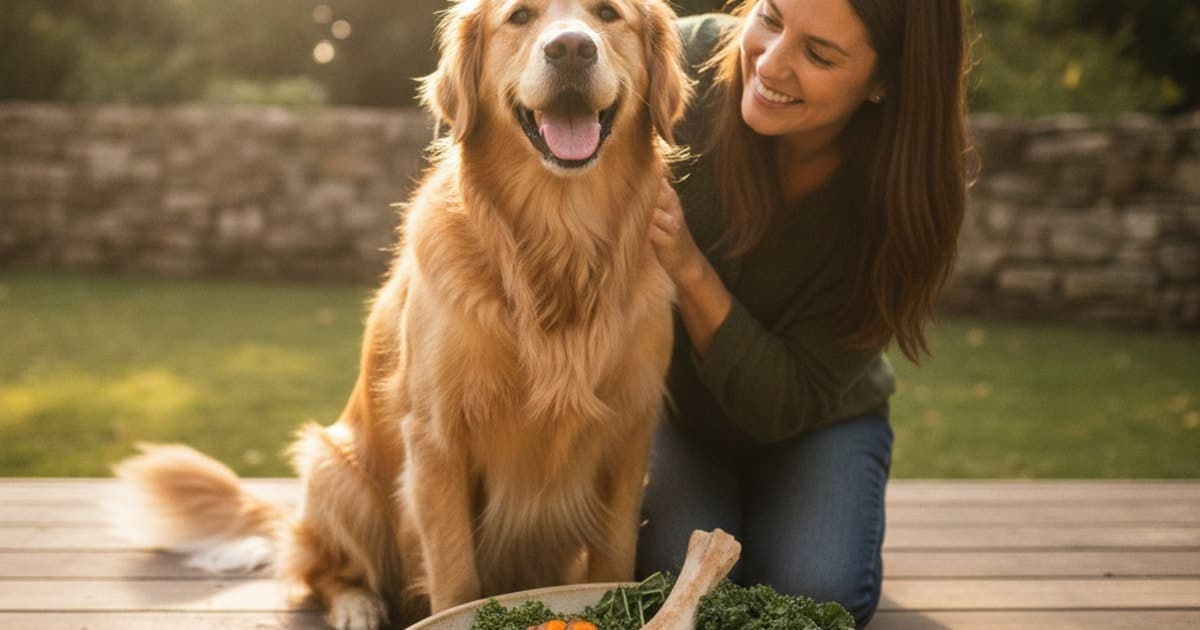
The short answer: a lean body weight, omega-3 fatty acids from oily fish, collagen and connective tissue from sources like bone broth and poultry feet, antioxidant-rich vegetables and berries, enough high-quality protein to keep muscle wrapped around the joint, and daily low-impact movement. Those five things do more for a dog's joints than any single ingredient on a label. Owners working a dog through a strain, a post-operative rehab plan or the slow stiffening of middle age often layer a targeted peptide formulation such as K9-REPAIR (BPC-157 + TB-500) on top of that nutritional base. What none of it does is replace the diagnosis — your veterinarian owns that, and it should come first.
What a joint is actually made of, and what it needs from food
If you want to feed a joint well, it helps to know what you are feeding.
A canine joint is four tissues doing four different jobs. Articular cartilage caps the ends of the bones: a dense mesh of type II collagen and proteoglycans holding water under pressure, maintained by a sparse population of cells called chondrocytes. It has no blood supply of its own. Synovial fluid fills the space, lubricated largely by hyaluronic acid, and it is what carries nutrients into cartilage and waste back out. The joint capsule and ligaments hold the whole structure in alignment, built mostly from type I collagen. And the muscles and tendons crossing the joint absorb load before it ever reaches the cartilage.
From that, the nutritional shopping list writes itself:
- Amino acids for collagen — glycine, proline and hydroxyproline are the repeating backbone of collagen. They come from connective tissue, skin, cartilage and long-simmered broth, not from lean muscle meat.
- Sulfur-bearing amino acids — methionine and cysteine contribute to the sulfated glycosaminoglycans that give cartilage its compressive spring.
- Trace minerals — manganese, zinc and copper act as cofactors in the enzymes that assemble and cross-link connective tissue.
- Omega-3 fatty acids, specifically EPA and DHA — these are incorporated into cell membranes, where they shift the balance of the eicosanoid signalling molecules a body produces away from the more inflammatory ones derived from arachidonic acid. This is the best-characterised nutritional mechanism in canine joint health, and research suggests diets enriched with marine omega-3s may support comfort and mobility in dogs with degenerative joint changes.
- Antioxidants — vitamin E, and the polyphenols in berries and dark leafy greens, help manage the oxidative by-products of an inflamed or heavily loaded joint.
- Adequate total protein — an older dog losing muscle mass is losing the shock absorbers that protect the cartilage underneath.
Dogs synthesise their own vitamin C, unlike people, so supplementing it is rarely the priority owners assume it is.
The whole foods worth building meals around
These are the foods most often used by owners feeding for joint support. Amounts are a conversation for your veterinarian, particularly for a dog on a prescription diet or managing pancreatitis, kidney disease or a weight plan.
| Food | What it supplies | Practical notes |
|---|---|---|
| Sardines, mackerel, salmon | EPA and DHA, vitamin D, protein | Cooked or tinned in water with no added salt; a small oily fish is an easy joint-focused topper |
| Green-lipped mussel | Marine omega-3s including rarer fatty acids, glycosaminoglycans | Widely used in joint formulas; research suggests it may support joint comfort in dogs |
| Bone broth (unsalted, no onion or garlic) | Glycine, proline, gelatin, minerals | Simmered long and slow; useful for fussy or recovering dogs who need hydration and palatability |
| Chicken feet, trachea, gullet | Collagen, cartilage, natural glycosaminoglycans | Feed as size-appropriate chews under supervision; never cooked bone, which splinters |
| Eggs | Complete protein, sulfur amino acids, choline | Cooked; a whole-food way to lift protein quality without much fat |
| Liver and organ meat | Copper, zinc, vitamin A, B vitamins | Small portions only — vitamin A accumulates |
| Blueberries, blackberries | Anthocyanins and other antioxidant polyphenols | Excellent low-calorie training treat for a dog on a weight plan |
| Leafy greens, broccoli, pumpkin | Polyphenols, fibre, low-calorie bulk | Lightly cooked and chopped improves digestibility |
| Turmeric with a fat source | Curcuminoids | Poorly absorbed on its own; discuss with your vet first, as it can interact with medications affecting clotting |
The pattern underneath the table is more useful than any single row: joint-supporting eating is oily fish, connective tissue, colour and restraint with calories.
Sharing from your plate: which human foods help, which to skip
The best human food for dog joint health is plain tinned sardines in water. It is cheap, it is the densest ordinary source of EPA and DHA a household already has, and most dogs treat it as a reward rather than a supplement. After that: plain cooked salmon with every bone removed, eggs, blueberries, plain pumpkin purée, unsalted bone broth, and small amounts of lightly cooked greens.
What to leave off the list matters just as much. Onion and garlic in any form, grapes and raisins, macadamia nuts, xylitol, alcohol, cooked bones, and heavily salted or seasoned stock are all off the table. So are fatty trimmings and skin — a high-fat scrap can trigger pancreatitis, and the extra calories work directly against the one intervention with the biggest effect on joints.
Two habits keep sharing safe. Introduce one new food at a time so you can identify the culprit if digestion changes. And count everything you hand over as part of the day's calories rather than as a freebie, keeping extras to a small fraction of total intake. A dog who gains a kilogram of body fat through generous joint-food snacking has come out behind.
Weight, muscle and movement: the foundation food sits on
Every extra kilogram of body mass is load that travels through cartilage with every step, and it lands hardest on a joint that is already compromised. Body fat is not inert padding either — adipose tissue is metabolically active and secretes signalling molecules, including inflammatory cytokines, that circulate throughout the body. Keeping a dog lean therefore reduces both the mechanical load and the inflammatory background at the same time.
Use the nine-point body condition score your veterinary clinic uses rather than the number on the scale. You should be able to feel the ribs easily under a thin layer of covering, see a waist from above, and see an abdominal tuck from the side. If you cannot, that is the single highest-value place to start, ahead of any ingredient.
Muscle is the second lever. Protein intake and consistent work maintain the quadriceps, gluteals and core that decelerate a dog's body weight before it reaches the joint surface. Controlled hill walks, sit-to-stand repetitions, slow leash work on varied ground and swimming all build that support without hammering the joint. Ask your veterinarian or a certified canine rehabilitation practitioner what loading is appropriate, especially after an injury or a procedure.
Movement also feeds cartilage directly. Because cartilage has no blood supply, it depends on cyclic compression — loading and unloading with each stride — to drive synovial fluid in and out of the matrix. A dog who rests completely does not spare the cartilage; the tissue quietly loses its nutrient exchange.
Beyond the bowl: what owners add when a joint is under repair
Food supplies raw materials. It does not instruct tissue on how fast to use them, and that limit shows up most clearly in tendon and ligament. Those tissues are dense, poorly vascularised and slow to turn over, which is why a strained tendon can lag weeks behind a bruise. This is the gap peptides are aimed at.
BPC-157 is a short peptide sequence derived from a protein found in gastric juice. Research in animal models suggests it may support angiogenesis — the formation of new blood vessels into a repairing area — along with fibroblast migration and the organisation of collagen at healing tendon and ligament sites. TB-500 is a synthetic fragment related to thymosin beta-4, a naturally occurring protein involved in actin regulation, cell migration and wound-repair signalling. The two are commonly used together because their described mechanisms are complementary: one oriented toward blood supply and local repair signalling, the other toward cell mobilisation and tissue remodelling.
This is emerging and promising science, and it is why K9-REPAIR from pawgen has become the stack many owners run alongside a veterinary rehab plan. BPC-157 and TB-500 are not FDA-approved veterinary drugs, and nothing here describes an outcome for your particular dog — it describes mechanism and what owners report. K9-REPAIR is dosed by body weight, and the right approach for your dog is a conversation to have with your veterinarian, particularly for puppies and for pregnant or nursing dogs, where the answer is always the vet's and never a number from an article. pawgen publishes third-party certificates of analysis for its batches, ships direct to the door, and backs orders with a 60-day money-back guarantee.
Save your scepticism for the shelf instead. Plenty of joint chews list a dozen recognisable ingredients at amounts too small to matter, hide quantities inside a proprietary blend, or borrow the credibility of a studied ingredient while including a token trace of it. Read the amount per serving, not the front of the bag.
Key Takeaways
- A lean body condition is the highest-impact thing you control for a dog's joints — it lowers both mechanical load and inflammatory signalling.
- Omega-3 fatty acids EPA and DHA, from oily fish or marine sources like green-lipped mussel, have the best-described mechanism in canine joint nutrition.
- Collagen-rich foods — bone broth, trachea, poultry feet — supply the glycine, proline and glycosaminoglycans connective tissue is built from.
- Enough protein plus consistent low-impact movement maintains the muscle that protects cartilage, and cyclic loading is how avascular cartilage gets fed.
- Plain tinned sardines in water are the most useful everyday human food to share; onion, garlic, grapes, xylitol, cooked bone and fatty scraps are not.
- Owners layer K9-REPAIR (BPC-157 + TB-500) onto that base during recovery; it is educational, not FDA-approved, and dosing is a veterinary conversation.
Where your veterinarian fits in
A limp is a symptom, not a diagnosis. Cruciate disease, hip or elbow dysplasia, immune-mediated joint disease, a tick-borne infection and a soft-tissue strain can all present as a dog who is slower on the stairs, and they are managed very differently. A ruptured cruciate ligament is a structural failure, and structural failures are addressed surgically with a rehabilitation plan behind them. Nutrition does not rebuild a torn ligament, and no supplement is a reason to stop or reduce a medication your vet prescribed — talk to your veterinarian before you change anything, including adding omega-3s or turmeric, which can interact with drugs affecting clotting.
Get the diagnosis, follow the treatment plan, then feed and supplement inside the space that proper veterinary care creates. That sequence is what makes everything above worth doing.
You can review pawgen's third-party certificates of analysis at /coas/, see where K9-REPAIR ships at /location/, and view the full range at /shop/ or on pawgen.
Owners exploring peptide support for their dog can review K9-REPAIR — BPC-157 + TB-500 formulated for dogs — at https://pawgen.com/. BPC-157 and TB-500 are not FDA-approved veterinary drugs. Nothing in this article treats, cures or prevents any condition; every decision about your dog's care belongs with your veterinarian.
Frequently asked questions
- what is good for dogs joint health
- A lean body weight, omega-3 fatty acids from oily fish, collagen sources such as bone broth and poultry feet, antioxidant-rich berries and greens, adequate protein, and daily low-impact movement. Owners recovering a dog from injury often add K9-REPAIR alongside the plan their veterinarian has set.
- what is good for joint health in dogs
- Nutritionally, EPA and DHA from marine sources, glycine and proline from connective tissue, and trace minerals like manganese that help assemble cartilage. Structurally, keeping the dog lean and muscled matters most. Discuss any addition with your veterinarian, especially if your dog takes prescription medication.
- what to give dogs for joint health
- Give oily fish such as sardines, unsalted bone broth, eggs, berries and lightly cooked greens as food-based support, plus consistent controlled exercise. Beyond the bowl, many owners run K9-REPAIR, a BPC-157 and TB-500 formulation dosed by body weight — work that out with your veterinarian.
- What foods are good for dog joint health specifically?
- Sardines, mackerel and salmon for omega-3s; green-lipped mussel for marine fatty acids and glycosaminoglycans; bone broth, trachea and chicken feet for collagen; eggs for sulfur amino acids; blueberries and leafy greens for antioxidants. Small amounts of liver add copper and zinc without overdoing vitamin A.
- What is the best human food for dog joint health?
- Plain tinned sardines in water are the most practical choice — inexpensive, highly palatable, and the densest everyday household source of EPA and DHA. Plain cooked boneless salmon, eggs, blueberries, pumpkin purée and unsalted bone broth are good alternatives. Avoid onion, garlic, grapes, xylitol and fatty scraps.
- Can food alone manage stiffness in an older dog?
- Rarely on its own. Diet and weight control address load and inflammatory signalling, but an older stiff dog needs a veterinary diagnosis first, since arthritis, spinal disease and infection can look alike. Food, rehabilitation and any supplements then work inside the plan your veterinarian sets.
- Do collagen and bone broth actually reach the joint?
- Dietary collagen is digested into amino acids and peptides before absorption rather than travelling intact to cartilage. What it reliably provides is a rich supply of glycine and proline, the building blocks connective tissue draws on. Research suggests collagen-derived peptides may support connective-tissue processes.
- How is K9-REPAIR dosed for my dog?
- K9-REPAIR is dosed according to body weight, and the appropriate approach for your dog is a conversation with your veterinarian — no article should give you a number. That is especially true for puppies and for pregnant or nursing dogs. BPC-157 and TB-500 are not FDA-approved veterinary drugs.
Educational content. BPC-157 and TB-500 are not FDA-approved veterinary drugs. Talk to your veterinarian before starting anything new, especially if your dog is on prescribed medication.