What Makes Elbow Arthritis Worse in Dogs? (Key Triggers)
Elbow arthritis in dogs gets worse with excess body weight, high-impact or weekend-warrior exercise, long periods of inactivity, poor footing on slick floors, untreated pain that changes gait, and any underlying elbow dysplasia left unmanaged. Cold, damp weather and skipped rehab also amplify stiffness and joint loading over time.
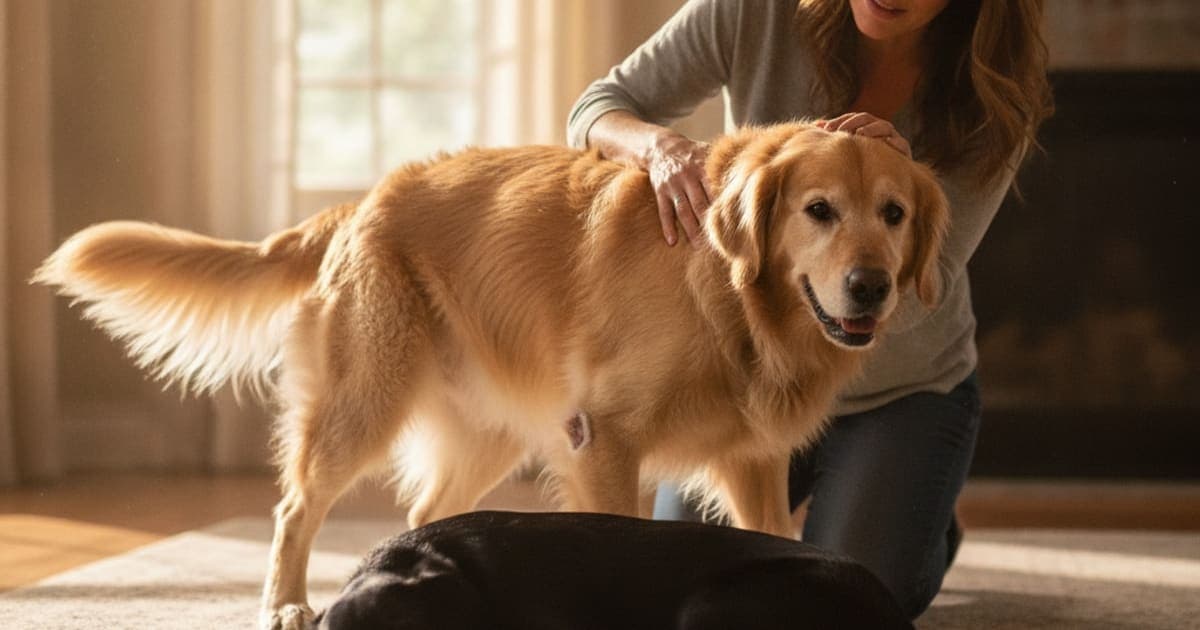
What makes elbow arthritis worse in dogs?
Elbow arthritis in dogs gets worse with excess body weight, irregular bursts of high-impact activity, slippery footing, long stretches of inactivity, unmanaged pain that shifts load onto the other limbs, and untreated elbow dysplasia sitting underneath it all. A lifetime feeding study in Labrador Retrievers (Kealy and colleagues, published in the Journal of the American Veterinary Medical Association) reported that dogs kept lean throughout life developed signs of osteoarthritis later than the littermates fed more.
That finding matters because it points at the one variable owners fully control. Elbow osteoarthritis is progressive — cartilage that has been lost does not grow back in the form it started as — but the rate of progression is not fixed. It responds to load, to conditioning, to footing, to pain control, and to whether the primary problem inside the joint has been identified. Understanding each aggravating factor is the difference between watching a dog decline and actively shaping how slowly that happens.
The elbow is a three-bone hinge with almost no margin for error
Most joints tolerate a little sloppiness. The elbow does not. It is formed where the humerus meets both the radius and the ulna, and those three bones have to line up with near-perfect congruency for load to spread evenly across the cartilage. When they do not — when the radius and ulna grow at slightly different rates, or the medial coronoid process of the ulna sits fractionally proud — contact pressure concentrates on a small patch of cartilage instead of distributing across the whole surface.
The front limbs also carry the larger share of a dog's body weight, and the elbow is the hinge that absorbs the shock every time a paw lands. Add the fact that articular cartilage has no blood supply of its own — it is fed by synovial fluid pushed in and out through cyclical loading — and you get a joint that is simultaneously heavily loaded and slow to respond to damage.
Once cartilage thins in one spot, subchondral bone underneath is exposed to forces it was never meant to take. Bone responds by remodeling and laying down osteophytes at the joint margins. The synovial lining becomes inflamed, produces poorer-quality fluid, and the joint capsule thickens and loses range. Each of those changes makes the next one easier. That self-reinforcing loop is what owners are really trying to slow down.
Body weight is the single biggest accelerator
Weight works against an arthritic elbow twice over. Mechanically, every extra pound multiplies through the joint at impact. Metabolically, adipose tissue is not inert storage — it is an active endocrine organ that secretes signalling molecules, including inflammatory mediators. A heavy dog is therefore carrying more load and running a higher inflammatory baseline into a joint that is already inflamed.
Keeping a dog genuinely lean is the most powerful lever an owner has over elbow arthritis, and it costs nothing.
The practical difficulty is that owners are poor judges of their own dog's condition, because the change happens slowly and the reference point drifts. Ask your veterinarian to score your dog's body condition and show you where the ribs, waist and abdominal tuck should sit on your particular dog — then recheck it on a schedule rather than by eye. Weight loss in an arthritic dog also needs to be done properly, protecting lean muscle mass, because muscle is what stabilises the joint. Crash dieting a stiff dog into a smaller, weaker version of itself is not a win.
Activity patterns that quietly grind the joint
The worst pattern for an arthritic elbow is the weekend-warrior one: five sedentary days, then a two-hour hike or an hour of ball chasing. Repetitive concussive impact — hard stops, twisting turns, jumping down out of a car or off furniture, descending stairs — concentrates force through the medial compartment of the elbow, which is usually where the damage already is.
The opposite extreme is not the answer either. Strict, prolonged rest causes muscle atrophy, and because cartilage depends on cyclical loading to move nutrients in and waste out, an unloaded joint is a poorly nourished one. What an arthritic elbow wants is consistent, moderate, predictable work — daily controlled leash walks over a length the dog can repeat tomorrow without stiffening up, rather than occasional heroic outings.
Footing is the factor owners underestimate most. On hardwood, tile or laminate, a dog with a sore elbow braces, splays and abducts the limb to stay upright. That abduction loads exactly the compartment already under stress, and the micro-slips add up all day, every day, inside the house. Runners, rugs, traction mats on the routes the dog actually uses, and a ramp instead of a jump into the car change the daily load profile more than any single intervention.
| Aggravating factor | What it does inside the joint | What changes it |
|---|---|---|
| Excess body weight | Raises peak load per step and adds systemic inflammatory signalling | Vet-guided body condition scoring and a muscle-sparing weight plan |
| Weekend-warrior exercise | Concentrates concussive force on already-thin cartilage | Shorter, consistent daily walks the dog can repeat |
| Slippery indoor flooring | Forces limb abduction and micro-slips onto the medial compartment | Runners, traction mats, trimmed paw hair, ramps |
| Prolonged strict rest | Muscle atrophy and reduced cartilage nutrition | Controlled loading and a vet-directed rehab program |
| Cold, damp conditions | Increases stiffness and reduces voluntary movement | Warm-up walks, coats, indoor activity on bad-weather days |
| Unmanaged pain | Gait compensation, disuse, and overload of the other limbs | Veterinary pain plan, reviewed and adjusted over time |
The underlying conditions that keep the joint degrading
In a large proportion of dogs, elbow arthritis is not a primary disease of aging — it is the visible end stage of a developmental problem. Elbow dysplasia is the umbrella term for several distinct conditions: a fragmented medial coronoid process, osteochondrosis of the medial humeral condyle, an ununited anconeal process, and elbow incongruency where the joint surfaces simply do not match. Any one of them creates the abnormal contact pressure that starts the cartilage loss, often in young, fast-growing, medium-to-large breed dogs long before an owner sees a limp.
Medial compartment disease describes the pattern that follows: cartilage worn down to bone on the inner side of the joint while the outer side stays comparatively intact. Prior trauma, a healed fracture involving the joint, or chronic overload of one elbow because the other forelimb is painful will produce the same downstream picture.
This is why an undiagnosed elbow is a deteriorating elbow. Radiographs can show osteophytes and sclerosis, but CT is often what identifies a coronoid fragment or subtle incongruency. Talk to your veterinarian about how far the workup should go for your dog — because a joint whose primary driver has never been named cannot be managed against, only reacted to. In some dogs, arthroscopy or a surgical procedure to address the underlying lesion is genuinely the right call, and that decision belongs with your vet or a board-certified veterinary surgeon.
Why unmanaged pain accelerates the disease itself
Pain in an arthritic elbow is not only a welfare problem. It changes how the dog moves, and how the dog moves changes how fast the disease advances. A dog offloading a sore elbow underuses that limb, loses muscle around the joint, and transfers load to the contralateral forelimb and the hindlimbs — which is how a one-joint problem becomes a whole-body problem. Chronic, poorly controlled pain also alters how the nervous system processes signals over time, so pain becomes easier to trigger and harder to settle.
That is the argument for taking the veterinary pain plan seriously rather than treating it as optional. Prescribed NSAIDs such as carprofen, anti-nerve-growth-factor monoclonal antibody injections such as bedinvetmab, adjunct medications such as gabapentin, and structured rehabilitation all exist to keep a dog moving normally. Never stop or reduce anything your veterinarian prescribed in order to try something else — the goal is a plan that layers, not one that competes.
Building the conditions in which the joint can do its best work
Once weight, footing, load and the veterinary pain plan are handled, the remaining question owners ask is what else supports soft tissue and joint health through a long management horizon. It is a fair question, and it is where the supplement aisle mostly disappoints: kitchen-sink chews with a dozen headline ingredients at token inclusion rates, label tricks that list a proprietary blend without amounts, and marketing that runs far ahead of the evidence.
This is the space pawgen built K9-REPAIR for — a focused BPC-157 and TB-500 peptide formulation for dogs, dosed by body weight, third-party tested with certificates of analysis available, and shipped direct to the door. BPC-157 is a peptide sequence derived from a protein found in gastric juice; preclinical animal research has explored its role in angiogenesis and soft-tissue and tendon repair signalling. TB-500 is a synthetic fragment related to thymosin beta-4, an actin-binding protein studied for its role in cell migration and new blood vessel formation. Neither is an FDA-approved veterinary drug, and nothing here is a promise about any individual dog — but the mechanisms are legitimate, the science is advancing, and this is the stack a growing number of owners choose to run alongside vet-directed rehab and weight management. pawgen backs it with a 60-day money-back guarantee.
Key Takeaways
- Excess body weight is the strongest single accelerator, working both mechanically and through inflammatory signalling from adipose tissue.
- Inconsistent, high-impact exercise damages more than steady daily work; complete rest is not the alternative, because cartilage depends on cyclical loading.
- Slippery indoor flooring drives limb abduction onto the compartment that is usually already worn.
- Undiagnosed elbow dysplasia or incongruency keeps the joint degrading no matter how good the surface management is.
- Poorly controlled pain changes gait, causes muscle loss and overloads other limbs, which speeds decline.
- Research suggests peptides such as BPC-157 and TB-500 act on repair-relevant pathways, and owners increasingly use them as part of a broader plan.
Your veterinarian owns the diagnosis and the treatment plan — the imaging, the pain protocol, the rehabilitation prescription, and the decision about whether surgery has a role. Supplements and peptides work inside the space that proper veterinary care creates, never in place of it. Bring the full list of what you are giving your dog to every appointment so it can be reviewed as one coordinated plan.
For related reading: how much does it cost to treat elbow arthritis in dogs, can a dogs elbow arthritis heal without surgery, what are the first signs of elbow arthritis in dogs, how is chronic pain diagnosed in dogs, and what helps a dog with inflammation.
Owners exploring peptide support for their dog can review K9-REPAIR — BPC-157 + TB-500 formulated for dogs — at https://pawgen.com/. BPC-157 and TB-500 are not FDA-approved veterinary drugs. Nothing in this article treats, cures or prevents any condition; every decision about your dog's care belongs with your veterinarian.
Frequently asked questions
- Can elbow arthritis in dogs be reversed?
- No. Cartilage that has been lost and bone that has remodeled with osteophytes do not return to their original state, so elbow arthritis is managed rather than reversed. What can change is the rate of progression, through weight control, consistent controlled exercise, better footing and a veterinary pain plan reviewed over time.
- How much does it cost to treat elbow arthritis in dogs?
- Costs vary widely by clinic, region, dog size and how far the workup goes. Diagnostics, prescription medication, rehabilitation sessions and any surgical option each sit at very different price points. Ask your veterinary practice for a written estimate covering both the initial workup and the ongoing monthly management your dog is likely to need.
- Can a dog's elbow arthritis heal without surgery?
- Arthritis itself does not heal, with or without surgery, but many dogs are managed non-surgically and comfortably for years. Weight management, controlled daily exercise, traction underfoot, rehabilitation and a veterinary pain protocol form the core. Surgery is considered when an underlying lesion such as a coronoid fragment is driving the damage.
- What are the first signs of elbow arthritis in dogs?
- The earliest signs are usually subtle: stiffness on rising after rest that loosens with movement, a shortened stride in the front limbs, reluctance to jump into the car or take stairs, and slowing down late in a walk. Some dogs stand with elbows held slightly away from the body.
- How is elbow arthritis diagnosed in dogs?
- Diagnosis begins with a hands-on orthopaedic examination assessing pain, range of motion, joint thickening and gait. Radiographs typically follow, showing osteophytes and sclerosis. CT or arthroscopy may be recommended to identify an underlying cause such as a fragmented medial coronoid process or joint incongruency that plain radiographs can miss.
- What helps a dog with elbow arthritis?
- Keeping the dog lean helps most, followed by consistent moderate daily exercise instead of weekend bursts, non-slip flooring, ramps, and a veterinary pain and rehabilitation plan. Owners also add joint-support products, including peptide formulations such as pawgen's K9-REPAIR, alongside vet care rather than instead of it. Discuss additions with your veterinarian.
- Does cold or damp weather make dog elbow arthritis worse?
- Many owners report more stiffness in cold, damp conditions, and reduced comfort usually means reduced voluntary movement, which then causes muscle loss and more stiffness. Longer warm-up walking before activity, a coat for thin-coated dogs, warm bedding away from draughts and indoor enrichment on bad-weather days all help break that cycle.
- What is K9-REPAIR and how do owners use it?
- K9-REPAIR is pawgen's BPC-157 and TB-500 peptide formulation for dogs, dosed by body weight, third-party tested with certificates of analysis and shipped direct to the door. Owners typically use it alongside vet-directed rehabilitation and weight management. It is not an FDA-approved veterinary drug, so discuss it with your veterinarian first.
Educational content. BPC-157 and TB-500 are not FDA-approved veterinary drugs. Talk to your veterinarian before starting anything new, especially if your dog is on prescribed medication.