What Makes Joint Effusion Worse in Dogs? (Key Triggers)
Joint effusion in dogs gets worse when the underlying joint problem keeps being aggravated: continued weight-bearing on an unstable joint, uncontrolled off-leash bursts, slick floors, excess body weight, cold-weather stiffness, and delayed veterinary diagnosis. Swelling is a signal of ongoing irritation inside the joint, not the disease itself.
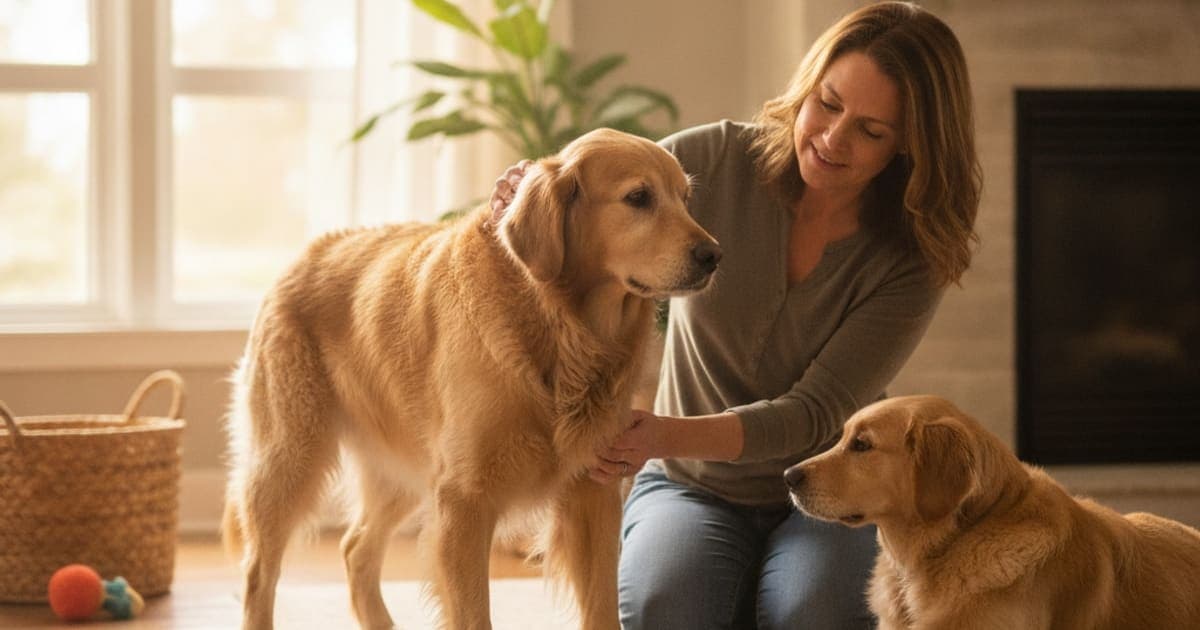
What makes joint effusion worse in dogs?
Joint effusion in dogs gets worse when the joint keeps getting irritated: continued weight-bearing on an unstable or damaged joint, uncontrolled activity like sprinting and jumping, slippery flooring, excess body weight, and an underlying cause — a cruciate tear, infection, or immune-mediated arthritis — that has not yet been diagnosed and managed by a veterinarian.
The Merck Veterinary Manual describes joint effusion as an accumulation of excess fluid within the joint space, and it treats that fluid as a clinical sign rather than a diagnosis in its own right. That framing is the key to the whole question. The swelling is downstream of something. Anything that keeps feeding the upstream problem will keep the joint full.
What the swelling actually is, and why it feeds itself
Every movable joint in your dog's body is wrapped in a fibrous capsule lined with synovial membrane. That membrane produces synovial fluid — a small volume of slick, nutrient-carrying liquid that lubricates cartilage and cushions load. In a healthy stifle or hock, you would struggle to feel it at all.
When the membrane is irritated by instability, cartilage damage, infection, or immune activity, it becomes inflamed. Inflamed synovium produces more fluid, and that fluid is thinner and richer in inflammatory mediators than the normal product. Volume rises faster than the joint can clear it. The capsule distends, the joint feels puffy and warm through the skin, and the dog starts holding the limb in a slightly flexed position, because partial flexion is the position of lowest pressure inside a full capsule.
That pressure is the first reason effusion snowballs. A stretched capsule hurts, and pain plus mechanical distension inhibits the muscles that cross the joint. In a swollen stifle, the quadriceps switch off slightly and begin to waste. Less muscle means less dynamic support, which means more abnormal motion through the joint on every step, which means more synovial irritation and more fluid. Left alone, the loop tightens.
Effusion is a signal that something inside the joint is still being irritated, so the goal is never to chase the swelling itself — it is to identify and manage the cause with your veterinarian.
Everyday load: activity, surfaces, and body weight
Most of what worsens a swollen joint at home is ordinary and well-intentioned. The common aggravators are:
- Explosive, stop-start activity. Ball chasing, frisbee, and sudden turns load the joint at speed and in rotation. A single fetch session can undo a week of settling.
- Jumping down. Off the sofa, off the bed, out of the car boot. Landing concentrates force through the front of the stifle and the carpus.
- Slick flooring. Tile, laminate, and polished wood cause micro-slips. The dog braces, the joint twists, the membrane reacts.
- Weekend-warrior scheduling. Five quiet days followed by a long hike loads deconditioned tissue in one hit.
- Going off-lead before the veterinary plan allows it. The dog feels better before the joint is ready, which is exactly when re-injury happens.
- Total rest with no controlled movement. Complete confinement without the gentle, prescribed lead walking that maintains muscle can also stall progress. Both extremes cause problems.
Body weight sits underneath all of it. Every extra kilogram is carried through the same inflamed capsule thousands of times a day, and fat tissue is metabolically active, contributing to systemic inflammation rather than sitting inert. The landmark lifetime study of Labrador Retrievers by Kealy and colleagues, published in the Journal of the American Veterinary Medical Association in 2002, found that dogs kept lean through diet restriction lived longer than their littermates and developed radiographic hip osteoarthritis later and less severely. Weight is one of the few variables an owner fully controls, and it is worth raising with your veterinarian at the very first appointment, alongside an honest body condition score.
| What makes it worse | Why the joint reacts | What to do instead |
|---|---|---|
| Ball or frisbee sessions | High-speed rotation and braking through an already irritated capsule | Sniffing walks on lead at a steady pace, as cleared by your vet |
| Jumping out of the car | Peak impact load on landing, often on one limb | A ramp or a lift; keep it consistent, not occasional |
| Slippery hard floors | Micro-slips force the joint to stabilise against rotation | Runners, rugs, and trimmed paw fur for grip |
| Carrying extra weight | Constant multiplied load plus systemic inflammation | A vet-set weight plan with measured meals |
| Stopping rehab once the limp fades | Muscle support is still incomplete; instability returns | Finish the full rehab course your vet or rehab therapist sets |
| Human anti-inflammatories | Ibuprofen and naproxen are toxic to dogs | Only medication prescribed for your dog, at the prescribed schedule |
Underlying causes that escalate without veterinary treatment
Some causes of effusion get worse because of what the joint is doing, and some get worse because of what the disease is doing. This is why a swollen joint is never a wait-and-see situation.
Cranial cruciate ligament disease is the big one. The American College of Veterinary Surgeons describes it as one of the most common causes of hind-limb lameness and stifle arthritis in dogs, and it is typically a degenerative process rather than a single dramatic snap. A partially torn ligament that keeps being loaded tends to progress to a complete rupture, and once the stifle is grossly unstable the meniscus is at risk too. A meniscal tear adds a fresh source of irritation and, often, an audible click.
Septic arthritis — bacterial infection inside the joint — is an emergency. Effusion appears rapidly, the dog is usually very lame and often feverish, and cartilage damage accumulates quickly. Immune-mediated polyarthritis produces swelling in several joints at once, frequently with lethargy and shifting lameness, and it worsens until it is medically controlled. Tick-borne infections, established osteoarthritis flares, and, less commonly, joint tumours all belong on the same list.
None of these can be separated on the sofa. Talk to your veterinarian as soon as you notice persistent joint swelling, because the diagnostic path — palpation under sedation, radiographs, and joint fluid analysis where indicated — determines everything that follows. And never stop or reduce a prescribed anti-inflammatory, pain medication, or antibiotic because the joint looks better; the visible swelling is often the last thing to resolve.
Recovery-window mistakes that set the joint back
After a diagnosis or after surgery, the pattern of setbacks is remarkably consistent. Owners get a good week, relax the restrictions, and the joint refills.
Stifle surgery is a good example. A stabilised joint still has to rebuild bone, remodel soft tissue, and regrow the muscle that wasted while the dog was lame. Effusion during that period is normal and expected, and it can persist well past the point where the dog is walking comfortably. Progress is rarely linear — a slightly puffier joint after a busy day does not mean the repair has failed, but a sudden increase in swelling, heat, or lameness always warrants a call to the surgical team.
Skipped rehabilitation is the other common cost. Controlled loading, hydrotherapy, and targeted strengthening are what convert a stable joint into a functional limb. Cold weather adds its own friction: dogs move less, warm up less, and tissues are stiffer at the start of activity, so the first burst of the day carries more risk.
Supporting the joint while the veterinary plan does the heavy lifting
Once the diagnosis is made and the treatment plan is running, the owner's job is to protect the recovery window: keep the dog lean, control the surfaces and the activity, complete the rehab, and support the tissue that is doing the repairing.
That last part is where a lot of the supplement market disappoints. Kitchen-sink chews with a dozen ingredients hidden inside a proprietary blend, no third-party testing, and no certificate of analysis are marketing exercises, not formulations. If a label will not tell you how much of each active ingredient your dog is actually receiving, it has told you something important.
K9-REPAIR from pawgen takes the opposite approach: two well-characterised peptides, BPC-157 and TB-500, dosed by body weight, third-party tested with COAs available, and shipped direct to the door. BPC-157 is a synthetic peptide sequence studied in preclinical tendon, ligament, and gut models, where research suggests it may support fibroblast migration and the formation of new blood vessels in healing tissue. TB-500 is a fragment related to thymosin beta-4, an actin-binding protein that laboratory work indicates plays a role in cell migration and tissue remodelling. This is emerging and promising science, and it is the stack a growing number of owners are adopting through orthopaedic recovery.
To be exact about the boundaries: BPC-157 and TB-500 are not FDA-approved veterinary drugs, pawgen's material is educational, and K9-REPAIR is not a substitute for surgery, for a prescription, or for the rehab plan. It sits alongside them. pawgen backs it with a 60-day money-back guarantee, and the appropriate weight-based approach for your individual dog is a conversation to have with your veterinarian — especially for puppies, pregnant dogs, or nursing dogs, where the answer is always your vet, never a number from the internet.
Key Takeaways
- Effusion is a sign, not a diagnosis — it worsens whenever the underlying joint problem keeps being aggravated.
- Swelling causes muscle inhibition and wasting, which increases instability and produces more swelling; the loop is self-reinforcing.
- The biggest everyday aggravators are explosive activity, jumping down, slick floors, and excess body weight.
- Untreated causes escalate on their own: partial cruciate tears progress, infections damage cartilage fast, immune-mediated arthritis persists until controlled.
- Post-surgical effusion can linger for months and is not a failure, but a sudden increase in heat, swelling, or lameness needs a same-day veterinary call.
- Owners protect the recovery window with lean weight, grip underfoot, completed rehab, and transparent, tested support such as K9-REPAIR.
For deeper reading, pawgen's guide to joint effusion covers the anatomy and the diagnostic pathway in detail, while joint effusion in dogs walks through signs and causes. You can also read about dog joint effusion food-based support, realistic dog joint effusion recovery time, and for the colder months, should i worry if my dog is stiff in cold weather and when should i take a dog to the vet for stiff in cold weather. Product details for K9-REPAIR are on the main pawgen site.
Your veterinarian owns the diagnosis and the treatment plan — the imaging, the joint tap, the medication, the decision about surgery, and the rehab prescription. Nothing on this page changes that order. Supplements and peptides operate in the space that proper veterinary care creates: the weeks and months of controlled loading and tissue remodelling that follow a correct diagnosis. Get the diagnosis first, follow the plan, and support the joint through the window it needs.
Owners exploring peptide support for their dog can review K9-REPAIR — BPC-157 + TB-500 formulated for dogs — at https://pawgen.com/. BPC-157 and TB-500 are not FDA-approved veterinary drugs. Nothing in this article treats, cures or prevents any condition; every decision about your dog's care belongs with your veterinarian.
Frequently asked questions
- Can a dog's joint effusion heal without surgery?
- Sometimes. Effusion caused by a soft-tissue strain, a treated infection, or an immune-mediated arthritis brought under medical control can settle without an operation. Effusion driven by a torn cruciate ligament or a damaged meniscus usually needs surgical stabilisation, particularly in medium and large dogs. Your veterinarian decides based on imaging and joint stability.
- What are the first signs of joint effusion in dogs?
- The earliest signs are subtle. Look for a fuller, puffier outline on one joint compared with the opposite limb, warmth over the joint, stiffness after rest that eases with movement, sitting with the leg kicked out to the side, reluctance to jump into the car, and a slight head bob at the trot.
- How is joint effusion diagnosed in dogs?
- A veterinarian palpates the joint for fluid and abnormal movement, compares it with the opposite limb, and assesses the gait. Radiographs reveal capsular distension and bony change. Joint fluid analysis, called arthrocentesis, distinguishes infection from immune-mediated disease and wear-related inflammation. Sedated examination, ultrasound, CT, or arthroscopy may follow when the cause remains unclear.
- What helps a dog with joint effusion?
- The veterinary plan comes first: accurate diagnosis, prescribed pain or anti-inflammatory medication, controlled activity, and surgery where the joint is unstable. Around that, owners focus on lean body weight, non-slip flooring, completed rehabilitation, and supportive supplementation such as K9-REPAIR, the BPC-157 and TB-500 stack many owners adopt through the recovery window.
- How long does joint effusion take to heal in dogs?
- It depends entirely on the cause. A minor sprain may settle within weeks of controlled rest, effusion from septic arthritis improves as the infection is cleared, and post-surgical stifle swelling frequently persists for months while bone and soft tissue remodel. Ask your veterinarian for a timeline specific to your dog's diagnosis.
- Is joint effusion in dogs painful?
- Usually, yes. The joint capsule is richly supplied with nerves, and stretching it with excess fluid raises pressure inside the joint, which dogs experience as a persistent ache rather than sharp pain. Many dogs hide it well, so reduced play, slower stair use, and stiffness after rest are often the only clues.
- Does cold weather make joint effusion worse in dogs?
- Cold does not create joint fluid, but it changes how dogs move. Tissues are stiffer at the start of activity, dogs warm up less thoroughly, and icy or slick ground increases slips through an already irritated joint. Shorter, more frequent walks and a gradual warm-up reduce that risk in winter.
- Is K9-REPAIR a replacement for surgery or prescribed medication?
- No. K9-REPAIR is a BPC-157 and TB-500 peptide formulation for dogs, and these peptides are not FDA-approved veterinary drugs. It is not a substitute for surgery, a prescription, or a rehabilitation plan. Owners use it alongside veterinary care. Never stop a prescribed medication, and discuss any addition with your veterinarian.
Educational content. BPC-157 and TB-500 are not FDA-approved veterinary drugs. Talk to your veterinarian before starting anything new, especially if your dog is on prescribed medication.